
Lentil Meal Prep (6 Meals, About $1.40 a Meal, 1 Hour)
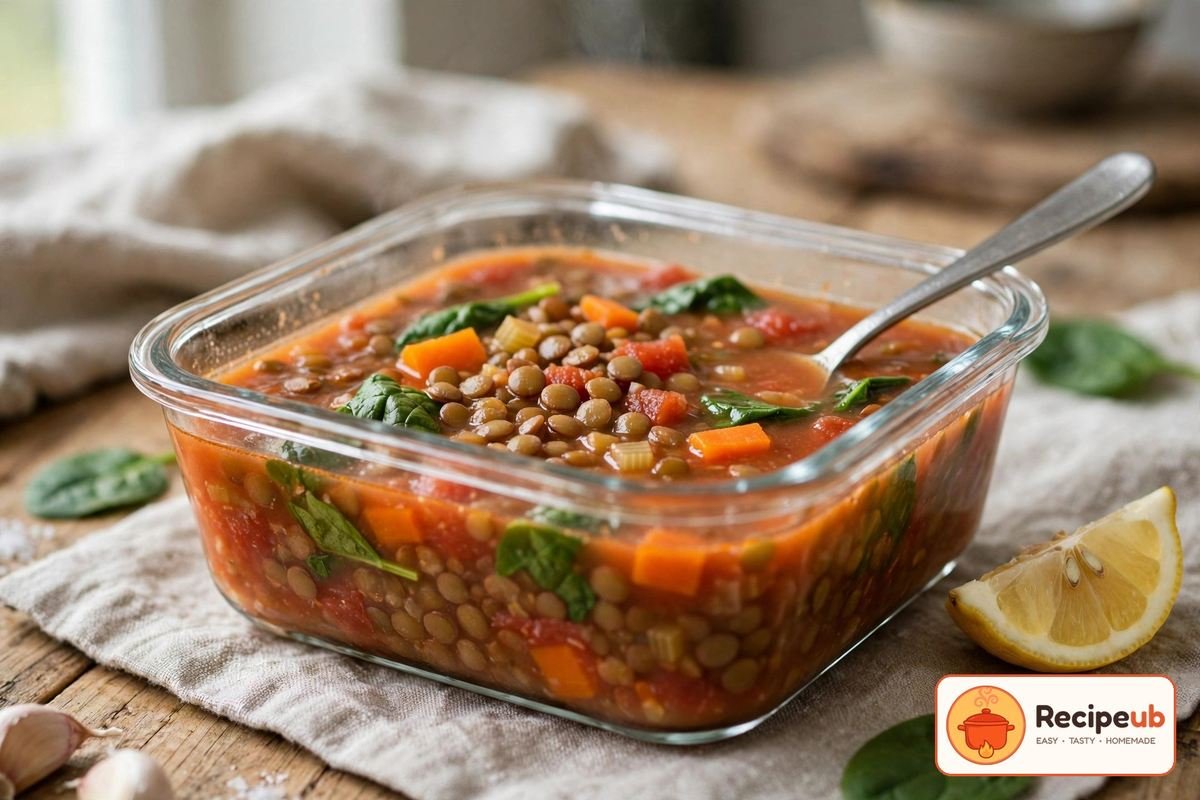
Lentil meal prep has a strange problem: the ingredient is the cheapest serious protein in the grocery store, and almost nobody will tell you what a batch of it costs, or which lentil to buy for it. Search the term and page 1 hands back a plain batch of lentils with dressing ideas, a base recipe that is a component rather than a meal, and frameworks that reach for a lentil pot as their example dish without ever printing the pot. So this post prints the pot. It is one large Dutch oven of tomato-vegetable lentil soup: 1½ pounds of dry brown lentils simmered with 1 pound of carrots, 4 celery stalks, a large onion, a 28-ounce can of diced tomatoes, cumin and smoked paprika, finished with 10 ounces of frozen spinach and a whole lemon, then portioned into 6 meals of about 2 cups each. Six meals at about 525 calories and ≈$1.40 a meal (both estimates, itemized on this page), in 1 hour — with no soaking, because lentils are the one dry legume that never asks for it. This pot is one entry in this site’s wider shelf of priced batch systems — the full shelf is gathered in my budget meal prep ideas — the complete collection of this site’s budget meal prep systems, each one a priced batch with its own chart; this post is the lentil entry, the meatless pot at the bottom of the price range — and it sits at the cheap end of that shelf on purpose.
Read page 1 for this dish closely and two objects are missing from every seat. The first is a chart: every holder explains lentil types in prose — this one holds its shape, that one breaks down, simmer somewhere between 15 and 30 minutes — and the liquid ratios and yields are scattered across three different sites, so the reader assembling the answer has to do the table’s work in their head. The second is a price: the strongest system on the page claims its bowl lands at “$1 to $2 a serving” and a week of lunches at “under $5 in ingredients,” and prints no grocery list behind either number; every other holder prints no number at all. This page prints both objects: the Lentil Chart with every common type’s yield, liquid, simmer time, texture and best use in one table, and the Priced Pot with this batch costed line by line to its per-meal figure. And it prints them around a finished, hot meal — not a plain base waiting for a dressing, and not a 185-calorie component waiting for the rest of lunch to be invented.
It also knows its nearest neighbor on this site, because this shelf already holds a dry-legume budget prep and the two are easy to confuse from the outside. This post is lentils only, eaten as a soup, with no soak and no second pot — the beans-and-rice prep elsewhere on this shelf is built on dry black beans soaked 8 to 12 hours and a separate pot of rice, served as bowls. Same shelf, same dry-legume logic — different legume, different form, different rules, and the two posts are linked where the comparison belongs, in the chart section below.
The short answer: Rinse and pick over 1½ lb of dry brown lentils — no soaking. Sauté 1 diced large onion, 1 lb of diced carrots and 4 diced celery stalks in 2 Tbsp of olive oil for 8 minutes; add 4 minced garlic cloves, 2 tsp of ground cumin, 2 tsp of smoked paprika and 1 tsp of dried thyme for 1 minute. Add the lentils, 1 (28 oz) can of diced tomatoes with their juices, 7 cups of water and 1 bay leaf; simmer, covered, 30 minutes, until the lentils are tender. Stir in 10 oz of frozen spinach to wilt, then the juice and zest of 1 lemon, and salt to taste — 2 minutes of finishing. Portion into 6 containers, about 2 cups each: refrigerate 4, freeze 2. Six meals at about 525 calories and ≈$1.40 each, in 1 hour total.
In This Recipe
The Plan at a Glance
- The lentils: 1½ lb dry brown lentils (about 3⅓ cups), rinsed and picked over — no soaking, ever; brown is the chart’s budget row, the cheapest type that still holds together in a soup
- The vegetables: 1 large yellow onion, 1 lb carrots, 4 celery stalks, 4 garlic cloves, a 28 oz can of diced tomatoes, 10 oz frozen spinach stirred in at the end
- The liquid: 7 cups water — the tomato juices and vegetables carry the pot; bouillon or salt seasons it (the water-only pot is proven on page 1, and it is one reason the batch costs what it costs)
- The seasoning: 2 tsp ground cumin, 2 tsp smoked paprika, 1 tsp dried thyme, 1 bay leaf — and the lemon, juice and zest, at the very end, because acid added early slows the lentils down (the chart’s second rule)
- Time: 20 minutes prep / 40 minutes cook (sauté 8 + simmer 30 + finish 2, stated openly) / 1 hour total
- Yield: 6 meals, about 2 cups each
- Calories: ≈525 per meal (estimate); protein ≈30 g per meal (estimate); fiber ≈15 g per meal (estimate)
- Cost: ≈$1.40 per meal (estimate) at October 2026 prices — every line a labeled shelf estimate; the BLS-verified protein comparisons are in the protein-per-dollar chart below
- Storage: refrigerate 4 meals, freeze 2 from day one — cooked food keeps 3 to 4 days (USDA), and the split is the system, not an afterthought (the Storage section below)
Why This Recipe Works
The chart replaces the guesswork, because “lentils” is five different ingredients wearing one name. The search box proves the confusion on its own: red lentil meal prep completes as its own search, because cooks keep buying the type they have heard of and discovering at the stove that it does something different from what the recipe wanted. Red lentils break down on purpose — that is their job in dals and puréed soups — and a meal prep built on them for bowls collapses into porridge by day two. Brown and green hold. Puy holds hardest and charges for it. Every holder on page 1 knows this and prints it as prose fragments scattered through their pages; the Lentil Chart below prints it as the table it always should have been — type, yield, liquid, simmer minutes, texture, best use — with this recipe’s row marked, so the swap question is answered before it is asked.
The pot is priced, because a budget claim without a list is just a mood. The lane’s strongest holder prices its bowl at “$1 to $2” with no grocery list behind the range, and its week at “under $5” with no list behind that either. This page takes the opposite approach: the Priced Pot below costs this exact batch line by line — lentils, carrots, celery, onion, the tomato can, the spinach, the lemon, the pantry shares — labels every line a shelf estimate (there is no official price series for these ingredients, and this page will not pretend there is), and divides by six. ≈$1.40 a meal is not a slogan; it is the bottom of a table the reader can check against their own store’s shelf tags.
It is a finished meal, not a base. The two systems on page 1 both sell a starting point: plain lentils to be re-dressed across the week, or a seasoned base at 185 calories a serving that still needs the rest of lunch built around it. Dressing profiles are a fine idea, but a base is not dinner, and the cook who wanted meals ends the recipe still cooking. This pot is the meal itself — protein, vegetables, tomato, greens, acid — at roughly 525 calories and 2 cups a container, eaten with a spoon straight from the reheated container. Nothing is left to invent on a weeknight, which is the entire promise of meal prep.
Water, not broth, because the pot seasons itself. The minimalist soup holder on the soup page proved the point in its own kitchen: a lentil soup built on a proper sauté, tomatoes, cumin and lemon does not need a carton of broth to taste like something. Skipping the broth is also a budget line — a carton is a dollar or two spent on flavored water the vegetables were going to make anyway — and it keeps the pot’s seasoning in the cook’s hands: bouillon or salt, added to taste at the end, costs pennies. The Priced Pot prints that choice as a line, not a shortcut.
The storage split is designed in, not patched on. Six meals eaten in series by one or two people runs past the USDA window — cooked food keeps 3 to 4 days refrigerated, whatever a recipe’s storage paragraph claims (one page-1 soup holder claims a week in the fridge; this page does not repeat that figure, here or anywhere). So the batch is portioned with the split already decided: 4 containers in the fridge, 2 in the freezer from day one, the frozen pair thawed overnight when their turn comes. The system never asks the reader to do food-safety arithmetic on day 5, because the arithmetic was done at the pot.
And if a pot is not the shape you want, the shelf says so honestly. A lentil pot is one system among several on this shelf, and it is not the beginner’s first system — that one is a protein-and-rice batch with boxes to fill. If you are new to this and want the guided version first, my meal prep on a budget for beginners — the 8-meal beginner system, chicken and rice portioned into boxes with an eat-four-freeze-four plan; this post is one pot of lentil soup, portioned after cooking teaches the habit; come back here when the habit is set and the grocery bill is the problem. Different first step, same standard: every quantity stated, every price labeled.
Which Lentils for Meal Prep? The Lentil Chart
Here is the first chart this post exists to print, and it starts with the two rules stated plainly, the way rules should be: no lentil needs soaking — rinse and pick over only — and acid slows lentils down, so lemon juice and vinegar always go in at the end. Ask which lentils to buy for meal prep and page 1 answers in prose, one type at a time, spread across three sites: one holder’s type section gives simmer times but no liquid ratios and no yields, another’s checklist gives a ratio but no chart, a third gives texture verdicts for a single soup. Here they are in one table — every figure per 1 cup of dry lentils, ranges printed as ranges because the holders’ ranges differ slightly and this chart does not pretend to a precision nobody published. This recipe uses the bold row.
| Type | Cooked yield | Liquid per cup dry | Simmer | Texture | Best meal-prep use |
|---|---|---|---|---|---|
| Brown (this recipe) | ~2½ cups | 3 cups | 25–30 min | Tender, mostly holds | Soups, pots, bowls — the budget buy |
| Green | ~2½ cups | 3 cups | 20–25 min | Holds firm | Bowls, salads |
| French Puy | ~2¼ cups | 3 cups | 25–30 min | Firmest of all | Cold salads (premium price) |
| Black beluga | ~2¼ cups | 3 cups | 20–25 min | Firm | Bowls, salads |
| Red / yellow (split) | ~2¼ cups | 2½–3 cups | 15–20 min | Breaks down on purpose | Dals, puréed soups — never bowls |
How to read the chart: the columns are the whole buying decision. Yield is why dry lentils are the budget protein they are — a cup of dry becomes about two and a half cups cooked, so this recipe’s 1½ lb (about 3⅓ cups dry) becomes the roughly 8 cups of lentils at the heart of the pot. Liquid barely moves across the table — 3 cups per cup of dry is the working ratio for every whole lentil here — which is why this soup’s 7 cups of water plus the tomato juices land where they do for 3⅓ cups of lentils. Simmer is where the types actually separate: red lentils are done in 15 to 20 minutes because they are split and huskless, while the whole types need 20 to 30. And texture is the column that decides the recipe before the recipe starts: hold-shape types (green, Puy, beluga, and brown on a good day) are the bowl and salad lentils; red and yellow are thickeners that fall apart on schedule, which is a feature in a dal and a failure in a lunch bowl. The two rules ride on the chart because they govern every row: soaking is never required for any type in the table — a rinse and a pick-over for the occasional small stone is the whole of the prep — and acid is a finishing ingredient: lemon juice or vinegar added at the start firms the lentils’ skins and stretches the simmer, which is why this recipe’s lemon waits for the last two minutes. Canned tomato is the chart’s one stated exception — it can cook in the pot, as it does here, but the cook budgets the full simmer and never shortens it.
And the chart is where this post’s boundary with the shelf’s other legume prep belongs, because the comparison is the first thing a budget cook asks. Lentils and beans are both dry legumes sold by the pound, and that is where the resemblance ends: my rice and beans meal prep — the beans-and-rice bowls, dry black beans soaked 8 to 12 hours before cooking and served over a separate pot of rice; this post is the lentil soup, no soak, no rice, eaten from the container with a spoon runs on the bean rules — soak, long cook, two components. This pot runs on the lentil rules above: no soak, one pot, thirty minutes of simmer. A cook stocking a pantry for budget prep buys both, and uses each by its own chart.
Ingredients
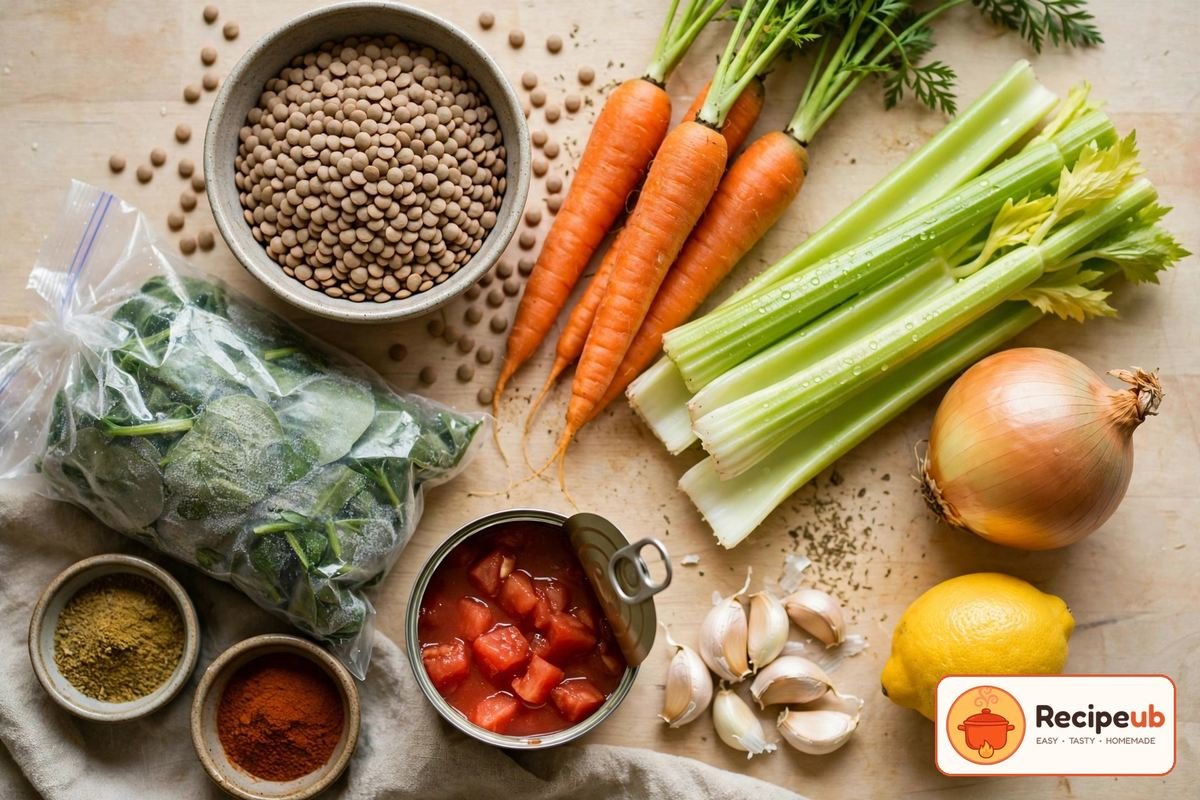
- 1½ lb dry brown lentils (about 3⅓ cups), rinsed and picked over
- 2 Tbsp olive oil
- 1 large yellow onion, diced
- 1 lb carrots, diced (about 6 medium)
- 4 celery stalks, diced
- 4 cloves garlic, minced
- 2 tsp ground cumin
- 2 tsp smoked paprika
- 1 tsp dried thyme
- 1 bay leaf
- 1 (28 oz) can diced tomatoes, with their juices
- 7 cups water
- 1 Tbsp vegetable bouillon paste (or kosher salt, to taste)
- 10 oz frozen spinach
- 1 lemon, zested and juiced
- Kosher salt and black pepper, to taste
Ingredient notes: The lentils are dry brown lentils, 1½ lb — the chart’s budget row, the cheapest type that still holds together through a 30-minute simmer and four days of reheating. Rinse them in a strainer and pick over them for the occasional small stone or shriveled lentil; that is the entire prep, and it replaces the soak a bean recipe would demand. Green lentils swap in 1:1 with the same liquid and a slightly shorter simmer (the chart’s second row); red lentils are not a silent swap — they break down by design and turn the pot thick and dal-like, which is a fine soup but a different one (FAQ below). The tomatoes are one 28 oz can, juices and all — the chart’s stated exception to the acid rule: canned tomato can cook in the pot, and its juices are part of this recipe’s liquid, counted in the method rather than added on top of it. The spinach is frozen, 10 oz, and frozen is the system choice: it goes in at the end straight from the bag, wilts in two minutes, and costs a fraction of the fresh bunches that would fill the pot raw. The lemon is one whole lemon, zest and juice, added at the very end — the acid rule is load-bearing, not garnish logic: lemon in at the start would keep the lentils firm long past the 30-minute simmer. The liquid is water, honestly — 7 cups of it, seasoned with bouillon paste or salt — because the sautéed vegetables, tomato and spices build the broth in the pot, and the Priced Pot below shows what skipping the carton saves. And the carrots are a full pound, bought loose or in the 1 lb bag — they are the pot’s sweetness and a quarter of its vegetable weight, not a garnish.
How to Make Lentil Meal Prep
- Rinse the lentils. Put the 1½ lb of dry brown lentils in a strainer, rinse under cold water, and pick over them for small stones or shriveled pieces. No soaking — set them aside and start the pot. Dice the onion, carrots and celery and mince the garlic while the pot heats.
- Sauté the vegetables. Heat the 2 Tbsp of olive oil in a large Dutch oven or stockpot over medium heat. Add the onion, carrots and celery with a pinch of salt and cook for 8 minutes, stirring now and then, until the onion is soft and the carrots are starting to sweeten at the edges. This sauté is the broth — it is where the water gets its flavor — so give it the full time.
- Bloom the spices. Add the garlic, 2 tsp of cumin, 2 tsp of smoked paprika and 1 tsp of thyme and stir for 1 minute, until the spices smell toasted. One minute is enough; spices scorch if they sit, and the pot is about to be full of liquid.
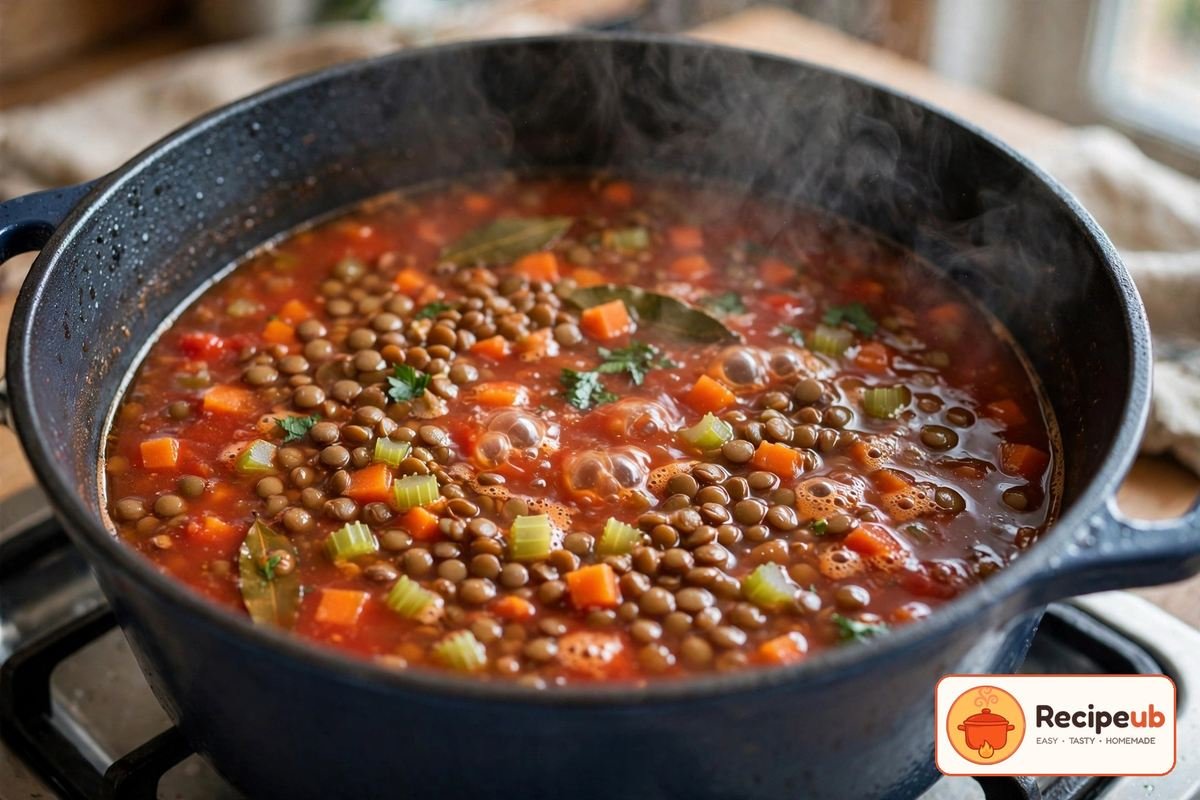
- Simmer the pot. Add the rinsed lentils, the 28 oz can of diced tomatoes with their juices, 7 cups of water and the bay leaf. Stir, bring to a boil, then lower to a steady simmer, cover, and cook for 30 minutes, stirring once or twice, until the lentils are tender and the soup has thickened around them. Stir in the bouillon paste (or salt) partway through, then taste near the end and adjust — the tomatoes and bouillon both bring salt at their own rates, so the final seasoning is a tasting decision, not a measurement.
- Finish with spinach and lemon. Stir in the 10 oz of frozen spinach and cook just until it wilts into the soup, about 2 minutes. Take the pot off the heat, fish out the bay leaf, and stir in the lemon zest and juice. Taste once more — the lemon should brighten the pot without making it sour — and add black pepper and any last salt.
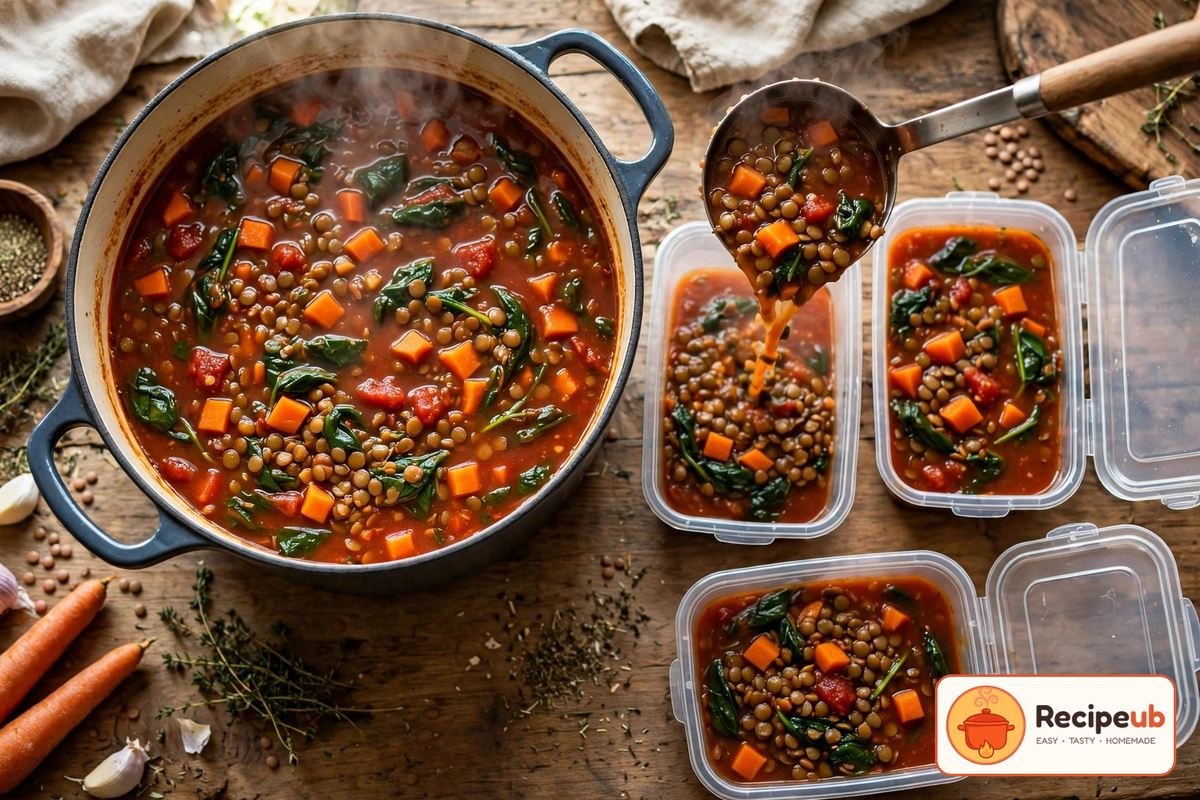
- Portion the six meals. Ladle the soup into 6 containers, about 2 cups each. Cool briefly, then refrigerate 4 containers and freeze 2, all within 2 hours of cooking. The split is the storage system (below): four meals are eaten inside the USDA 3-to-4-day window, and the frozen pair thaws overnight in the fridge when their turn comes.
Lentil Soup Meal Prep
Ingredients
Equipment
Method
- Rinse the lentils and pick over them for small stones. No soaking. Dice the onion, carrots and celery; mince the garlic.
- Heat the olive oil in a large Dutch oven over medium heat. Sauté the onion, carrots and celery with a pinch of salt for 8 minutes, until softened.
- Add the garlic, cumin, smoked paprika and thyme; stir 1 minute, until fragrant.
- Add the lentils, the diced tomatoes with their juices, 7 cups of water and the bay leaf. Bring to a boil, then simmer, covered, 30 minutes, until the lentils are tender. Stir in the bouillon paste partway through and adjust salt to taste.
- Stir in the frozen spinach and cook about 2 minutes, until wilted. Off the heat, remove the bay leaf and stir in the lemon zest and juice.
- Portion into 6 containers, about 2 cups each. Refrigerate 4 and freeze 2, within 2 hours of cooking.
Notes
What Does the Pot Cost? The Priced Pot
Here is the second chart, and it exists because the lane’s own claims do not survive a grocery list. The strongest lentil system on page 1 prices its bowl at “$1 to $2 a serving” and a week of lunches at “under $5 in ingredients” — and prints no list behind either figure, so the reader cannot check the one thing a budget recipe exists to prove. Here is this batch’s list, dated to the October 2026 evidence like the rest of this site’s shelves. Every line is a labeled shelf estimate — the Bureau of Labor Statistics publishes no average price series for lentils, carrots, celery, onions, canned tomatoes or spinach, and this page will not dress an estimate up as a verified price. The lentil line carries one outside check: it lands inside the lane’s own published range of $0.30–$0.50 per cooked cup, across the roughly 8 cooked cups this batch makes.
| Line | Amount for the batch | Price basis | Batch cost |
|---|---|---|---|
| Dry brown lentils | 1½ lb | Shelf estimate (~$1.60/lb; inside the published $0.30–$0.50 per cooked cup × ~8 cups cooked = $2.40–$4.00) | ≈$2.40 |
| Carrots | 1 lb | Shelf estimate, labeled as one | ≈$0.90 |
| Celery | 4 stalks (share of a bunch) | Shelf estimate, labeled as one | ≈$0.60 |
| Yellow onion | 1 large | Shelf estimate, labeled as one | ≈$0.80 |
| Diced tomatoes | 28 oz can | Shelf estimate, labeled as one | ≈$1.30 |
| Frozen spinach | 10 oz | Shelf estimate, labeled as one | ≈$1.25 |
| Olive oil | 2 Tbsp (pantry share) | Shelf estimate, labeled as one | ≈$0.25 |
| Lemon | 1 | Shelf estimate, labeled as one | ≈$0.60 |
| Garlic, spices, bay, bouillon | Pantry amounts | Estimate, labeled as one | ≈$0.40 |
| Batch total | 6 meals | ≈$8.50 → ≈$1.40 per meal |
How to read the table: the list is the recipe — nothing on it is bought for any other purpose, and the leftovers are pantry staples and half a celery bunch, not a second meal’s worth of perishables quietly subsidizing the math. Read the lines by weight and the system explains itself: the lentils are the biggest line and still under two-fifty, the vegetables together cost less than the spinach and tomatoes combined, and the two pantry-share lines — oil, garlic, spices, bouillon — are where a broth carton would have sat, at roughly four times the price for flavor the sauté already made. It is also a list built almost entirely from the cupboard and the freezer aisle, which is the same territory as this shelf’s other pantry-first cooking — my cheap pantry dinners — the dinner list built from what is already in the cupboard, a night’s cooking at a time; this post is the batch system, one pot portioned into six meals with the chart and the priced list — except that where those are dinners, this is a week-sized system with the storage split designed in. Eight dollars and a half, six lunches handled, and the most expensive decision in the batch is whether the spinach is on sale.
The Protein Math: What a Dollar of Lentils Buys
The priced pot says what the meals cost; this chart says what the protein costs, because on a budget shelf that is the comparison that decides what gets cooked. The math is uniform — label protein values, before cooking loss, divided by price — and the prices are the honest asymmetry this page has carried from the top: the three comparison proteins are priced from BLS October 2026 averages read directly from the BLS API, while the lentil line is the labeled shelf estimate from the table above, because no official lentil price exists.
| Protein | Math | Protein per $1 |
|---|---|---|
| Lentils (this build) | 680 g × 24.6 g/100 g ≈ 167 g ÷ $2.40 est. | ≈70 g (est.) |
| Eggs | 12 × ~6.3 g ≈ 76 g ÷ $2.320/dozen (BLS Oct 2026) | ≈33 g |
| Chicken breast | 454 g × 31 g/100 g ≈ 141 g ÷ $4.099/lb (BLS Oct 2026) | ≈34 g |
| Ground beef | 454 g × 26 g/100 g ≈ 118 g ÷ $6.755/lb (BLS Oct 2026) | ≈17 g |
How to read the chart: lentils deliver roughly double the protein per dollar of the best meat on the table — and the figure is printed as an estimate, with the BLS anchors named, because that is what it is. This chart is context, not a conversion pitch: the pot also brings about 15 grams of fiber a meal (estimate), which none of the animal rows bring at all, and it asks for no butcher counter, no sell-by date watching and no freezer Tetris with raw meat. And it is printed next to its honest counterweight on this shelf: a cook whose target is animal protein at volume, boxed ten at a time, is served by a different system — my cheap high-protein meal prep — the meat-box protein-first system, ten boxes built around chicken and eggs; this post is the meatless pot, half the price per meal, with its protein printed as a plain estimate rather than a target — and the two systems share a shelf precisely because they answer different questions. This one answers: what is the cheapest real meal a dollar-forty buys?
Emma’s Tips for the Best Lentil Meal Prep
Pick over the lentils like you mean it. The rinse takes one minute and the pick-over takes one more, and together they are the whole of lentil prep — but the pick-over is not ceremonial. Dry lentils are a field product, and a small stone or a piece of grit rides along in a bag often enough that every holder on page 1 prints the step. Spread the rinsed lentils on a light-colored plate or tray and the odd stone shows itself. Two minutes at the start is cheaper than one bad bite on day three.
Do not shorten the sauté. Eight minutes of onion, carrot and celery in olive oil is where this water-based pot gets the depth a broth carton would have faked. The vegetables should be properly soft and sweet at the edges before the spices go in — a rushed sauté leaves the finished soup tasting like lentils in water, which is the exact bowl that gives lentil soup its plain reputation. The spices then get their one minute, no more: cumin and smoked paprika bloom fast and scorch faster.
Salt in two passes, and taste like it matters. The tomatoes bring salt, the bouillon brings salt, and the lentils bring none — so a single measured dose at the start is a guess at a moving target. Season lightly when the bouillon goes in, then do the real seasoning at the end, after the lemon, with a spoon in the actual pot. Lemon changes how salty a soup tastes — acid brightens and lifts — so salting before the lemon lands means salting twice. End first, then salt.
Portion while the pot is warm, and label the freezer pair. Warm soup ladles evenly, so the 2-cup portions are honest portions instead of five generous containers and one thin one. Then the unglamorous step that makes the system work: a strip of tape and the date on the two freezer containers. Six identical containers is a fine sight on day one and a small mystery on day nine; the labeled pair is the difference between a system and a hope.
Storage and Reheating
Fridge: The four refrigerated meals keep 3 to 4 days at 40°F or below — the USDA leftover standard, refrigerated within 2 hours of cooking, in the shallow containers they were portioned into. Note the honest number, because page 1 does not always print it: one soup holder in this lane claims its lentil soup keeps a week in the fridge, and another claims plain cooked lentils keep five days. USDA guidance for cooked leftovers is 3 to 4 days, and this system is built on that figure — it is exactly why the batch is six meals and not eight, and why two of the six never see the fridge at all. Eat the refrigerated four in order and treat day 4 as the last day.
Freezer: The two frozen containers keep up to 3 months, frozen on day 0, fully cooked — lentil soup is one of the best-freezing meals on this shelf, because the lentils and vegetables come back with their texture intact and the soup needs no separating, draining or rescuing. Thaw a container overnight in the fridge when its turn comes; do not thaw on the counter. If a week ever calls for a bigger batch, the same rule scales: freeze everything past meal four on the day it is cooked, in the same labeled containers.
Reheating: One container at a time: stir in a splash of water first — lentils keep absorbing liquid as they sit, so a stored container is tighter than the soup that went into it, and the splash hands that liquid back — then heat until steaming hot throughout, 165°F, in the microwave or in a small saucepan over medium-low. Stir once halfway so the middle of the container catches up with the edges. A fresh squeeze of lemon over a reheated bowl is not required, but on day 4 it makes the meal taste cooked today, and a wedge costs almost nothing.
A note for the household of one: this is a standard six-meal batch, and it is deliberately not this shelf’s solo system. A single eater working through six meals in series is exactly the cook the freeze-two split was designed for — four inside the window, two waiting in the freezer — but a cook who wants the batch itself sized down from the start is served by the other design: my meal prep for one — the solo 4-meal system, a sheet pan batch sized to one person’s fridge window with no freezer step; this post is the standard 6-meal pot, with the freeze-two split built in scales the whole problem the other way. Same rules, two sizes — pick by the household, not by habit.
FAQs
Do lentils need to be soaked before cooking?
No — no type of lentil needs soaking, and that is the first rule on the Lentil Chart above. Lentils are small, thin-skinned and (in the case of red and yellow) split, so water reaches them fast enough in the simmer itself. The whole of the prep is a rinse and a pick-over for small stones. This is the sharpest difference between lentils and the other dry legumes: the black beans in a beans-and-rice prep need 8 to 12 hours in water before they cook at all, while this pot goes from dry bag to simmering soup in the time it takes to dice the vegetables.
Which lentils are best for meal prep — and which should I avoid for bowls?
For anything that must hold its shape — bowls, salads, containers reheated across the week — buy brown or green lentils for value, or French Puy or black beluga if the firmest texture is worth a premium price. Brown is this recipe’s row: the cheapest of the holders, tender but intact through a 30-minute simmer and four days of reheating. Avoid red and yellow lentils for bowls entirely — they are split and huskless, and they break down into a soft purée by design. That breakdown is exactly right for dals and thick puréed soups, and exactly wrong for a bowl that is supposed to still look like lentils on day three. The chart above prints every type’s texture next to its best use so the choice is made at the shelf, not discovered at the stove.
How much water do lentils need?
3 cups of liquid per 1 cup of dry lentils for the whole types — brown, green, Puy and beluga — and 2½ to 3 cups for red and yellow. That ratio is this recipe’s arithmetic: about 3⅓ cups of dry lentils against 7 cups of water plus the juices from the tomato can, which together land the pot at the chart’s working ratio. Too little liquid and the lentils stay chalky in the center no matter how long they sit at a simmer; too much and a soup still works, but a bowl-style prep comes out loose. When in doubt mid-cook, add water a quarter cup at a time — lentils forgive small additions and do not forgive being left dry.
How many cups does 1 cup of dry lentils make?
About 2½ cups cooked for brown and green lentils, and about 2¼ cups for Puy, beluga and red. That yield is the quiet engine of this whole category: dry lentils more than double in the pot, so this recipe’s 1½ lb — roughly 3⅓ cups dry — becomes about 8 cups of cooked lentils before the vegetables and tomatoes join them, which is how a two-dollar-and-forty-cent line (estimate) fills six 2-cup meals. It is also the number to use when scaling any lentil recipe written for cooked lentils down to the dry bag: divide the cooked amount by two and a half.
How long does lentil soup last in the fridge?
3 to 4 days at 40°F or below — the USDA standard for cooked leftovers, refrigerated within 2 hours of cooking. This answer is worth stating plainly because this lane’s pages do not all state it: one widely read lentil soup claims a week in the fridge, and a lentil prep hub claims five days for plain cooked lentils. This system is built on the USDA figure instead, which is why the batch is portioned 4 to the fridge and 2 to the freezer on day one — no meal in the system is ever scheduled outside the window, and nothing depends on a reader remembering to move a container on day 4.
Can I freeze lentil soup?
Yes — lentil soup freezes well for up to 3 months, and it is one of the most freezer-friendly meals on this shelf. The lentils hold their texture, the vegetables come back as they went in, and there is nothing to separate or drain. Freeze it fully cooked, in the same portioned containers, labeled with the date; thaw overnight in the fridge, then reheat with a splash of water to 165°F. One distinction worth knowing: the undercooking tip sometimes printed for frozen lentils — cook them 3 to 4 minutes shy — applies to plain lentils frozen for later bowls. A finished soup is frozen as it is, fully cooked, exactly as this recipe portions it.
How much protein is in a cup of cooked lentils?
About 18 grams per cup of cooked lentils — the most repeated number in this lane, and it checks out against standard reference values. Scaled to this recipe, a 2-cup meal carries about 30 grams of protein (estimate), because each container holds roughly a cup and a third of cooked lentils plus the vegetables’ contribution. The protein-per-dollar chart above puts the figure in its budget context: at the prices printed there, a dollar of lentils (estimate) buys roughly twice the protein of a dollar of the best-priced meat on the table. The number is printed here as what it is — a plain nutritional fact about the ingredient — and this post makes no macro promises beyond it.
Can I use red lentils instead of brown in this soup?
Yes, with the change understood before the pot starts: red lentils break down, so the soup comes out thick, smooth and dal-like rather than brothy with whole lentils in it — a good soup, and a different one. Drop the simmer to 15 to 20 minutes, keep the liquid at the same total, and expect the containers to set up firmer in the fridge; the reheating splash of water matters even more. What red lentils cannot do is pretend to be brown ones — if the meal you pictured has distinct lentils in it, the swap is a new recipe, not a substitution. The chart above prints both rows side by side for exactly this decision.
Why are my lentils still hard?
Almost always one of two causes, and both are in the chart’s rules. The first is acid in too early: lemon juice or vinegar added at the start firms the lentils’ skins and can stretch the simmer far past its printed time — acid is a finishing ingredient, always. (Canned tomato is the managed exception: it can cook in the pot, as it does here, but the full simmer is budgeted for it.) The second is an old bag: dry lentils keep for years on the shelf, but very old lentils cook slower and sometimes never fully soften. The fix in both cases is patience plus liquid — keep the pot at a gentle simmer, add water a little at a time, and give them the minutes they ask for rather than raising the heat.
Is lentil meal prep a good everyday option?
It is built like one: a 2-cup meal at about 525 calories, 30 grams of protein and 15 grams of fiber (all estimates, itemized on this page) is a substantial, ordinary lunch — the kind of meal that carries an afternoon without a snack run. Two honest qualifiers belong with that. First, the rotation rule applies to lentils as to everything else: the batch is six meals, four of them eaten inside a 3-to-4-day window, so even in a lentil week the pot is a rotation of days, not a month of identical lunches — and variety across the week is the sensible default this shelf always recommends. Second, this page makes its case on price, protein and fiber, and stops there: those are the claims the numbers on this page can carry, and they are enough.
Final Thoughts
Lentil meal prep is the rare budget topic where the ingredient was never the problem — the paperwork was. The type knowledge existed, but scattered as prose across three sites, so cooks kept buying red lentils for bowls and learning the texture lesson at the stove. The price claim existed too, but as a range with no list behind it, so the cheapest protein in the store went unpriced by the very pages recommending it. What this page adds is the two objects the lane leaves out: a chart that puts every lentil type’s yield, liquid, time and texture in one table with its two rules printed on it, and a priced pot that costs one finished batch line by line to about $1.40 a meal, every line labeled with the basis it stands on. Around those two objects sits a plain, good pot of soup — no soak, one hour, six meals, four in the fridge and two in the freezer, by the food-safety numbers as they actually read. That is the whole system, and at this price it does not need to be more.
More Easy Budget Meal Prep
If the lentil pot fits your kitchen, the rest of this shelf runs on the same rules — every quantity stated, every price labeled, every difference named. The shelf’s other soup-shaped system cooks while you are not even watching it: my slow cooker vegetable soup — the slow cooker vegetable soup, a meatless vegetable pot that simmers unattended for hours; this post is the stovetop lentil pot, 1 hour start to finish, with the legume as the protein instead of a side is the cross-category sibling for the cook who would rather load a crock in the morning than stand at a stove in the evening — same meatless budget logic, different appliance, different base. Between the two of them, the shelf covers the soup end of budget prep at both speeds: the pot you tend for an hour and portion the same day, and the pot that tends itself. One shelf, one standard — the batch is priced, the chart is printed, and dinner is handled.



Never Run Out of Dinner Ideas
One easy air fryer or slow cooker dinner in your inbox every week. No spam, ever.
You’re on the list — welcome to Recipeub!