
One Pot Jambalaya Recipe (Chicken, Sausage and Shrimp)
One pot jambalaya is the Louisiana rice pot the searcher is actually describing when the completions are read honestly: jambalaya recipe chicken and sausage, jambalaya recipe with shrimp, jambalaya rice to liquid ratio, raw or cooked shrimp for jambalaya. A named dish — not a description of its ingredients — built on the holy trinity of onion, bell pepper and celery, with three proteins in one pot and the rice cooked in the pot, not under it. This version delivers the trio whole, from scratch, with measured seasoning instead of a box mix: 12 ounces of andouille sliced into coins and browned first, 1 pound of boneless skinless chicken thighs cut in 1-inch pieces and seared in the sausage drippings, 1½ cups of long-grain white rice toasted and simmered covered in 3 cups of chicken broth with a drained 14.5-ounce can of diced tomatoes and toasted tomato paste — and 1 pound of large shrimp laid on top of the rice for the last 5 minutes of the simmer, never a minute earlier. It is a Creole jambalaya — the red one, tomatoes in — and this page says so plainly and prints the Cajun conversion for anyone who wants the brown one. Six servings at about 555 calories and ≈$3.55 a serving (both estimates, itemized on this page), in 1 hour 5 minutes, with the rice grains separate and glossy instead of bound into a paste.
Read page 1 for this dish closely and every top seat leaves something out. The head term’s number-one recipe contains no shrimp at all — a defining protein, missing from the dish’s biggest page. The “easy” seat at number four contains no chicken. The builds that do carry all three proteins run on bone-in, skin-on thighs, a shred-off-the-bone step and an oven finish, at an hour and a quarter and up — and one of the top five stirs its shrimp in before the rice, where it cooks for about twenty minutes. Underneath all of it sits the question the search box asks by name — jambalaya rice to liquid ratio — and page 1’s printed answers run from 1¼ cups of broth per cup of rice to 2⅓ cups, with the tomato counted as liquid on some pages, drained and discarded on others, and never mentioned on the rest. America’s Test Kitchen, in its own problem statement for this dish, names what that spread produces: “rubbery shrimp, dry chicken, and gummy rice bound in a thin, watery tomato base.” This page prints the three systems that prevent the three failures: the Jambalaya Rice-to-Liquid Chart with every camp’s ratio side by side, the Creole vs Cajun Chart with the liquid consequence attached, and the Protein Timing Ladder that states when each protein enters and leaves.
It also knows its nearest neighbor on this site, because the word “Cajun” already lives on this shelf attached to a different dish. This post is the rice dish — long-grain rice simmered in the pot with the trinity and three proteins, no cream anywhere. If the Cajun-spiced chicken you want is the one in a pasta pot, that is my one-pot cajun chicken pasta — the Cajun-spiced chicken pasta in a cream sauce, penne and chicken only; this post is the rice dish the jambalaya name belongs to, with sausage and shrimp and no cream. Same seasoning family, different dinner — this one is the Louisiana original, eaten with a spoon straight from the Dutch oven.
The short answer: Brown 12 oz of andouille coins in 2 Tbsp of olive oil for 4–5 minutes and set them aside. Season 1 lb of boneless skinless chicken thighs, cut in 1-inch pieces, with 1 Tbsp of Cajun seasoning and sear them in the drippings 5–6 minutes; set aside with the sausage. Cook 1 diced onion, 1 diced green bell pepper and 2 diced celery ribs in the drippings 7–8 minutes; add 4 minced garlic cloves (30 seconds) and 2 Tbsp of tomato paste (1 minute). Stir in 1½ cups of long-grain white rice and toast 1–2 minutes, then pour in 3 cups of low-sodium chicken broth with 1 drained can of diced tomatoes, 1 tsp dried thyme, 2 bay leaves and 2 tsp Worcestershire sauce; return the sausage, chicken and their juices, cover and simmer on low 20 minutes, stirring once at the halfway point. At minute 15, lay 1 lb of large raw shrimp, seasoned with 1 tsp of Cajun seasoning, on top of the rice and cover for the last 5 minutes, to opaque. Rest covered 5 minutes, fluff, and finish with 3 sliced scallions and ¼ cup of chopped parsley — six servings at about 555 calories and ≈$3.55 each, in 1 hour 5 minutes total.
In This Recipe
The Plan at a Glance
- Sausage: 12 oz andouille, cut in ½-inch coins, browned first for 4–5 minutes — it is fully cooked before it goes in; its job is rendered fat and browned edges (the Timing Ladder below)
- Chicken: 1 lb boneless skinless chicken thighs in 1-inch pieces, seasoned with 1 Tbsp Cajun seasoning, seared in the drippings, finished inside the covered simmer to 165°F
- Shrimp: 1 lb large shrimp (31/40), peeled and deveined, raw — laid on top of the rice at minute 15 for the last 5 minutes only, never stirred in early, never pre-cooked
- The rice: 1½ cups long-grain white rice, toasted 1–2 minutes in the drippings before the liquid goes in
- The liquid: 3 cups low-sodium chicken broth for 1½ cups of rice — 2 cups per cup, the convergent middle row of the Liquid Chart below, with the tomatoes drained so their water stays out of the ratio
- The style: Creole — the red build, with diced tomatoes and toasted tomato paste; the Cajun (no-tomato) conversion is printed in the Creole vs Cajun Chart below and costs no liquid
- The trinity: 1 large onion, 1 green bell pepper, 2 celery ribs, diced — 7–8 minutes in the drippings, with the garlic and paste at the end
- Time: 20 minutes prep / 45 minutes cook (browning 10 + trinity and toast 10 + covered simmer 20 with the shrimp in the last 5 + covered rest 5, stated openly) / 1 hour 5 minutes total
- Yield: 6 servings
- Calories: ≈555 per serving (estimate); protein ≈39 g per serving (estimate)
- Cost: ≈$3.55 per serving (estimate) at October 2026 prices — the shrimp is the price driver; the breast swap and the no-shrimp version are both priced in the cost section below
- Storage: fridge 3 to 4 days (best in the first 2 — the shrimp firms on reheating); leftovers always need a splash of broth — the rules are in the Storage section below
Why This Recipe Works
The trio is whole, because a jambalaya missing a protein is a different pot. Page 1 proves the point by accident: the head term’s top recipe has no shrimp, the easy seat has no chicken, and the search box completes chicken and sausage, shrimp and sausage and with shrimp on the same stems — the searcher is asking for all three in one pot, and the cluster keeps handing back two. This build prints all three, in the order the pot needs them, and the price of the third protein is stated on the card instead of hidden: the shrimp is the most expensive line in the batch, and the no-shrimp version is priced beside it for the cook who wants the budget variant (FAQ 5).
Each protein enters when its texture needs it to — that is the whole ladder. America’s Test Kitchen’s problem statement for this dish — rubbery shrimp, dry chicken, gummy rice — is really a timing statement. Sausage is already cooked, so it can brown hard at the start and simmer the full twenty minutes without loss. Chicken thighs forgive the same twenty minutes that dry out breast — which is why the twice-cooked breast on one top page lands on the failure word, and why this build cubes thighs, sears them for fond, and lets the simmer finish them to 165°F. And shrimp need five minutes in the steam, on top, at the end — the consensus of five page-1 kitchens, against the one that stirs them in early and cooks them twenty. The Protein Timing Ladder below prints all of it as one table.
It is not just chicken and rice with a Louisiana label. This shelf already holds the plain version of that pair, and the difference is the dish itself: my one-pot chicken and rice — the plain chicken-and-rice pot on this shelf, no sausage, no shrimp, no trinity and no spice system; this post is jambalaya, the named Louisiana dish built on top of that pair is chicken and rice as an ingredient pair. Jambalaya is what happens when that pair meets the holy trinity, a Cajun seasoning system, a sausage that seasons the whole pot with its drippings, a tomato decision that has a name (Creole), and a shrimp finish timed to five minutes. Same two base ingredients, different dinner — and each page says which one it is.
The tomatoes are drained, because the can is a liquid decision. A 14.5-ounce can of diced tomatoes carries roughly a cup and three-quarters of water and juice. Counted, it belongs in the ratio; uncounted, it lands on top of the ratio and the pot eats wet — the spread between page 1’s driest and wettest builds is mostly this one decision, made silently in both directions. This build drains the can and toasts the paste, so the tomato flavor is in and the tomato water is out, and the broth ratio printed on the card (2 cups per cup of rice) is the whole liquid story. The Liquid Chart below prints every other camp’s handling next to this one, with what each is doing.
One stir, because the gummy failure is technique, not arithmetic. The rice simmers covered for twenty minutes and is stirred exactly once, gently, at the halfway point. Every extra stir works the grains against each other and releases the starch that binds a pot into paste — a warning one page-1 holder prints in his own notes (“Over-stirring releases starch and makes the jambalaya gummy”). At the right ratio, a jambalaya can still be ruined by attention; the ladder and the chart assume the cook also leaves the spoon alone, and the card’s notes say so.
How Much Liquid Does Jambalaya Rice Need? The Jambalaya Rice-to-Liquid Chart
Here is the first chart this post exists to print. Ask the search box about jambalaya rice and it completes the question itself — jambalaya rice to liquid ratio — because the ratio is the thing page 1 cannot agree on. Every recipe prints exactly one number as if it were universal, and the numbers run from 1¼ cups of measured broth per cup of rice to 2⅓ cups, before the tomato is even counted — and the tomato is counted a different way on nearly every page. Here they are, side by side, each row a named page-1 card’s printed amounts, organized by the two variables that actually move the number: the rice type, and how the tomato is handled. This recipe uses the bold row.
| Rice + method | Whose card | Broth per 1 cup rice | The tomato | What the numbers are doing |
|---|---|---|---|---|
| Converted (parboiled), oven finish | Once Upon a Chef (ATK) | ≈1¼ cups (2 cups rice : 1½ cups broth + 8 oz clam juice) | 14.5 oz can, drained + paste | The low outlier with two reasons: parboiled grains are pre-steamed and drink less, and the chicken simmered 20 min in the liquid first and gave back its juices |
| Long-grain, tomato-sauce build | Mikesailab (Creole) | 1½ cups (1½ cups : 2¼ cups stock) | 14 oz tomato sauce | The floor for regular rice — the sauce IS part of the liquid, and the row only works because it is counted |
| Jasmine, covered stovetop | Tasty | 1¾ cups (1¼ cups : 2¼ cups broth) | 15 oz fire-roasted, undrained | Jasmine runs soft; their row also carries the peas — and the cluster’s broken shrimp timing (the Ladder below) |
| Long-grain, test-kitchen build | America’s Test Kitchen | ≈1⅞ cups total (1½ cups : 1 cup clam juice + 1½ cups broth + ¼ cup tomato juice) | Drained, juice measured and counted | The proof of the chart’s rule: when every liquid is measured — including the tomato juice — long-grain lands just under 1:2 |
| Long-grain, drained tomatoes | THIS RECIPE | 2 cups (1½ cups rice : 3 cups broth) | 14.5 oz can, drained + 2 Tbsp paste | The convergent middle: tomato flavor in, tomato water out — the ratio stays the ratio |
| Long-grain, NO tomato (Cajun) | Studio McGee | 2 cups (2 cups : 4 cups stock) | None | The control row: with no tomato at all, long-grain still lands at 1:2 — the swap in the next chart costs no liquid |
| Long-grain, undrained tomatoes | Allrecipes | 2 cups (1¼ cups : 2½ cups broth) | 16 oz crushed, undrained | Same 1:2 broth, plus ~1¾ cups of tomato on top — the wettest of the 1:2 builds, and the reason “same ratio” pots eat differently |
| Basmati, covered stovetop | Damn Delicious | ≈2⅓ cups (1½ cups : 3½ cups stock) | 14.5 oz petite diced, undrained + paste | The top of the range, on the rice the converted-rice holder warns needs its own ratio — with the cluster’s shortest simmer (15 min) doing the rest |
| Long-grain, wet Creole (the boundary) | Tasting Table | 2 cups broth (1½ cups : 3 cups) | 28 oz crushed + 1½ cups purée | Not a ratio failure — a different dish: ~4½ cups of tomato product makes a red jambalaya that eats like a stew. Printed as the boundary, the way the soup row bounded the orzo chart |
How to read the chart: the ratio is a rice type plus a tomato decision, not a preference. Read down the rows and the pattern explains itself — converted rice drinks least because it was pre-steamed in the husk; basmati sits at the top of the range on the cluster’s shortest simmer; and the long-grain rows cluster at 1:2 once the tomato is accounted for — drained and discarded (this recipe), measured and counted (the test kitchen), or absent entirely (the Cajun control row). The failure ends are printed because they are the ways this dish actually goes wrong: under about 1½ cups total liquid for long-grain, the rice keeps a chalky core that turns gummy as it sits; at 2⅓ cups plus an undrained can, the pot goes soupy and then mushy as the rice keeps drinking; and stirring more than once at the halfway point makes it gummy at any ratio — the one failure that is technique, not arithmetic. And at every ratio on the table, one rule holds: the rice keeps steaming after the heat is off. The 5-minute covered rest in this recipe is part of the measurement, and leftovers will always need the splash of broth in the Storage section. This site prints one other liquid chart — for a pasta, not a rice: my one pot lemon chicken orzo — the orzo liquid chart, pasta ratios by cooking method; this post is the rice chart, ratios by rice type and tomato handling is the sibling system, and the two charts never share a number because the two starches never share a rule.
Creole or Cajun Jambalaya? The Tomato Split
Here is the second chart, and it starts with this recipe’s position stated plainly: this is a Creole jambalaya — the red one, with tomatoes — and it says so on the card. The style question is the other thing the search box asks as a comparison — creole jambalaya vs cajun jambalaya completes as a full stem — and page 1 answers it in at most one sentence (the biggest trio holder’s whole treatment: “Creole, or ‘red,’ jambalaya, which contains tomatoes, and Cajun jambalaya, which typically does not”) and never charts it, and never connects it to the liquid chart above, where the tomato decision is doing ratio work. Here is the split as a system:
| Creole (“red”) | Cajun (“brown”) | |
|---|---|---|
| The tomato | Yes — diced or crushed tomatoes, usually with paste | No tomato at all |
| Where it comes from | New Orleans — the city style, with Spanish tomato influence | Rural Acadiana — the country style, built on browning |
| Color + flavor | Red; brighter, with tomato acidity cutting the sausage fat | Brown; deeper and smokier, from a darker-cooked trinity and fond |
| The liquid consequence | The can is a liquid decision: drained, it changes nothing (this recipe); undrained, it adds ~1¾ cups the ratio must absorb (the Liquid Chart above) | No tomato liquid to count — the broth ratio stands alone (the 1:2 control row in the Liquid Chart above) |
| Who holds it on page 1 | Once Upon a Chef, America’s Test Kitchen, Allrecipes, Tasting Table, Damn Delicious (all tomato builds) | Studio McGee (the only no-tomato build in the top seats) |
| The conversion | THIS RECIPE is Creole. To make it Cajun: leave out the tomatoes and paste, keep the broth at exactly 3 cups, and cook the trinity 3–4 minutes longer, to a deeper brown, before the rice goes in. Nothing else changes — same ladder, same ratio |
How to read the chart: the tomato changes three things, and only one of them is the color. It brings acidity that cuts the andouille’s fat, which is why the red build tastes brighter off the same sausage. It brings water — about a cup and three-quarters in a standard can — which is a ratio input whether the recipe admits it or not, and the reason this build drains the can and takes its tomato flavor from the drained tomatoes and the toasted paste instead. And it decides the browning workload: with no tomato to brighten the pot, the Cajun build earns its depth in the trinity pan, cooking the vegetables to a deeper brown before the rice goes in. What the tomato does not change is everything else — the trinity is identical, the three proteins are identical, the ladder below runs in the same order, and the broth stays at 3 cups in both directions, which the Cajun control row in the Liquid Chart proves: a no-tomato build from page 1 lands on the same 1:2.
When Does Each Protein Go In? The Protein Timing Ladder
Here is the third chart, and it starts with the rule stated in one sentence, the way a rule should be: the sausage renders, the chicken sears, the shrimp finishes. Three proteins with three different clocks share one pot, and the order is not a preference — it is the difference between this dish and the failure list America’s Test Kitchen printed for it (rubbery shrimp, dry chicken, gummy rice). Read page 1’s methods closely and five kitchens already run some version of this ladder, while two break it and land on the failure words. The evidence:
| Protein | When it is in the pot | Time | Why this slot |
|---|---|---|---|
| Andouille coins | First — browned, then out; back in with the rice | 4–5 min browning + the 20-min simmer | It is fully cooked already; the browning renders the fat the trinity cooks in, and the coins re-enter with the rice so they season every grain |
| Chicken thighs, cubed | Second — seared in the drippings, then out; back in with the rice | 5–6 min sear + the 20-min simmer, to 165°F | The sear builds the fond; the simmer finishes it. Thighs forgive the 20 minutes — breast in the same window is the test kitchen’s “dry chicken,” which is why the twice-cooked breast on one top page is this chart’s cautionary row |
| (The bone-in path) | The test-kitchen builds: browned whole, simmered in the liquid 20 min before the rice, finished on the rice, pulled off the bone | The longest path — their totals run 1¼ hours+ | Printed as the alternative: deeper chicken flavor, bought with bone-in handling and an oven finish this weeknight build deliberately skips |
| Shrimp | Last — laid on top of the rice at minute 15, lid on | 5 minutes in the steam, to opaque (145°F) | The cluster’s consensus (the test kitchen, Once Upon a Chef, Studio McGee, Damn Delicious) — against one top-five page’s stir-in-at-step-5 shrimp, which cooks ~20 minutes and lands on the failure word: rubbery. One more holder’s off-heat residual-heat poach (~3 min) is the ladder’s gentlest variant, printed as one |
How to read the chart: each row is a texture decision disguised as a schedule. The sausage goes first not because it needs the most cooking — it needs none, being fully cooked — but because its rendered fat is the medium everything after it cooks in, and its browned edges are flavor the simmer cannot make. (It is the same sausage-first logic as sausage’s other pot on this shelf: my one-pot sausage and potatoes — the sausage-and-potato skillet, where the coins brown first and season the pan; this post runs the same sausage over rice instead of potatoes, with two more proteins behind it.) The chicken goes second because the sear has to happen in the sausage fat while the pot is still dry enough to brown anything, and because cubed thighs are the one chicken cut that can take the full simmer afterward and come out juicy — the 20 minutes that finish them to 165°F are the same 20 minutes that would dry a breast past saving. The shrimp go last because they need the least: five minutes of steam on top of hot rice, laid there raw — never pre-cooked, which double-cooks them, and never stirred in early, which is the twenty-minute mistake. Cook the ladder in order and the pot assembles itself; break a row and the failure has a name already printed for it.

What Does the Pot Cost? The Honest Math
No page that ranks for this dish prices the trio build. Here is this build’s math, dated to the October 2026 evidence like the rest of this site’s shelves — the three protein lines are labeled shelf estimates (the Bureau of Labor Statistics publishes no retail average for boneless thighs, shrimp or andouille, and this page will not invent one), the breast comparison beside it is the verified BLS figure, and everything else is labeled a shelf estimate, printed as one:
| Line | Amount for the batch | Price basis | Batch cost |
|---|---|---|---|
| Chicken thighs, boneless skinless | 1 lb | ~$2.50/lb, labeled shelf estimate (no BLS retail thigh series exists) | ≈$2.50 |
| Andouille sausage | 12 oz (one rope) | Shelf estimate, labeled as one | ≈$4.50 |
| Large shrimp, frozen (31/40) | 1 lb | Shelf estimate, labeled as one | ≈$8.00 |
| Long-grain white rice | 1½ cups | Shelf estimate, labeled as one | ≈$0.75 |
| Diced tomatoes | 1 (14.5 oz) can | Shelf estimate, labeled as one | ≈$1.10 |
| Tomato paste | 2 Tbsp | Shelf estimate, labeled as one | ≈$0.25 |
| Trinity (onion, green bell pepper, celery) | 1 onion, 1 pepper, 2 ribs | Shelf estimate, labeled as one | ≈$1.75 |
| Chicken broth | 3 cups (one 32-oz carton) | Shelf estimate, labeled as one | ≈$1.90 |
| Olive oil, Cajun seasoning, thyme, bay leaves, Worcestershire | Pantry amounts | Estimate, labeled as one | ≈$0.60 |
| Batch total | 6 servings | ≈$21.35 → ≈$3.55 per serving |
How to read the table: the shrimp line is the pot. At ≈$8.00 it is more than a third of the batch — more than the chicken and sausage combined — which is why the “no shrimp” completion on the search stems is a budget question in disguise, and why this page prices that version instead of waving at it: drop the shrimp line and the same pot costs ≈$13.35, or ≈$2.20 per serving, as a chicken-and-sausage jambalaya (FAQ 5). The breast swap, priced: built with 1 lb of boneless breast at the verified BLS October 2026 average of $4.099/lb, the chicken line rises from ≈$2.50 to $4.10 and the pot costs ≈$3.80 per serving — about 25 cents more per bowl for the cut the Timing Ladder says dries in the simmer, so thighs win this pot on price and texture at once. Everything else is small either way: the trinity costs less than the broth carton, and the rice — the ingredient the dish is measured by — is the cheapest line on the receipt. This is the premium one-pot on this shelf, and the card says so; the premium is one ingredient, and it is priced where everyone can see it.
Ingredients
- 2 Tbsp olive oil
- 12 oz andouille sausage, cut in ½-inch coins
- 1 lb boneless, skinless chicken thighs, cut in 1-inch pieces
- 1 Tbsp Cajun seasoning, for the chicken, plus 1 tsp for the shrimp (Tony Chachere’s or Slap Ya Mama)
- 1 large yellow onion, diced
- 1 green bell pepper, diced
- 2 celery ribs, diced
- 4 cloves garlic, minced
- 2 Tbsp tomato paste
- 1½ cups long-grain white rice
- 3 cups low-sodium chicken broth
- 1 (14.5 oz) can diced tomatoes, drained
- 1 tsp dried thyme
- 2 bay leaves
- 2 tsp Worcestershire sauce
- 1 lb large shrimp (31/40), peeled and deveined
- 3 scallions, sliced
- ¼ cup chopped fresh parsley
- Hot sauce, for serving
Ingredient notes: The sausage is andouille — a fully cooked, smoked pork sausage (the biggest trio holder’s note puts it “near the kielbasa or hot dogs in the grocery store”), and its pot time is about rendering and browning, not safety; a raw fresh sausage is a different product and is not a 1:1 swap here. The chicken is boneless skinless thighs, cut in 1-inch pieces — cubed because the sear and the simmer both have to reach every piece, and thighs because they finish the 20-minute simmer juicy at 165°F where breast dries (the Timing Ladder above); the breast swap is priced in the cost section and works, with that warning attached. The rice is long-grain white — the chart’s middle row. Converted (parboiled) rice, like Ben’s Original, holds up beautifully in this dish per the holder who builds on it, but it drinks less (≈1¼ cups per cup, the chart’s first row), so it is not a silent swap; instant rice, brown rice, jasmine and basmati all run different ratios and times (the chart prints basmati’s) and are not 1:1 here either. The tomatoes are one 14.5-ounce can, drained — drained is the recipe, not a serving suggestion: the tomato flavor goes in, the tomato water stays out, and the broth ratio stays the ratio (the Liquid Chart above). The shrimp are large (31/40), raw, peeled and deveined — raw is load-bearing (FAQ 3), and frozen is the standard buy; thaw them in cold water while you prep. One current buying note, dated November 2026: the FDA is running an ongoing recall list for certain frozen shrimp lots from one Indonesian supplier (BMS Foods) over possible cesium-137 contamination — the levels detected were below the FDA’s intervention threshold and no illnesses were reported, but check your bag’s lot code against the FDA’s current recall list and buy from a current, reputable source. The seasoning is Cajun seasoning, and blends vary widely in salt — Tony Chachere’s and Slap Ya Mama, the named US brands, are both salted, so this recipe adds no extra salt until tasting; if your blend is salt-free, add ½ tsp kosher salt with the rice (the card’s notes repeat the rule). And the shortcut, printed as a variation and not the build: a frozen diced onion-pepper-celery “trinity mix” goes straight into the pot in place of the fresh three — the budget authority in this cluster uses it in her own jambalaya, and it works; the fresh dice is the build because the browning is better.

How to Make One Pot Jambalaya
- Brown the sausage. Heat the olive oil in a large Dutch oven or 12-inch deep skillet over medium-high heat. Cook the andouille coins for 4–5 minutes, until the edges color and the fat renders into the pot. Move the coins to a plate and leave every drop of fat behind — the trinity cooks in it, and it is the dish’s first seasoning.
- Sear the chicken. Season the thigh pieces with 1 Tbsp of the Cajun seasoning and sear them in the drippings for 5–6 minutes, until browned on the edges. They will not be cooked through, and they are not supposed to be — the simmer finishes them. Move them to the plate with the sausage, juices and all.
- Cook the trinity. Drop the heat to medium. Cook the onion, bell pepper and celery in the drippings for 7–8 minutes, scraping up the browned bits as they soften. Add the garlic for the last 30 seconds, then the tomato paste, and cook it 1 minute, stirring, until it darkens a shade — toasted paste is the red build’s depth.
- Toast the rice and add the liquid. Stir the dry rice into the pot and toast it 1–2 minutes, until the grains are coated and smell faintly nutty. Pour in the broth and add the drained tomatoes, thyme, bay leaves and Worcestershire sauce. Return the sausage, the chicken and every drop of their juices. This is the ratio the Liquid Chart defends: 3 cups of broth to 1½ cups of rice, with the tomato water already discarded.
- Simmer, covered. Bring the pot to a boil, drop it to low, cover, and simmer 20 minutes. Stir once, gently, at the halfway point, and no more — over-stirring releases starch and makes the jambalaya gummy at any ratio. The rice is done when it is tender with the liquid absorbed and glossy.
- Shrimp on top, last 5 minutes. At minute 15 of the simmer, season the shrimp with the remaining 1 tsp of Cajun seasoning and lay them on top of the rice in one layer. Put the lid back on for the last 5 minutes — the shrimp steam where they sit and come out opaque and just curled (145°F). Do not stir them in; the ladder’s last row is a placement, not a mix.
- Rest, fluff, finish. Take the pot off the heat and rest it, covered, 5 minutes — the rice is still steaming, and the rest is part of the recipe, not a pause in it. Fish out the bay leaves, fluff the rice with a fork, and scatter the scallions and parsley over the top. Serve straight from the pot, with hot sauce at the table — the heat is adjusted per bowl, never cooked in.
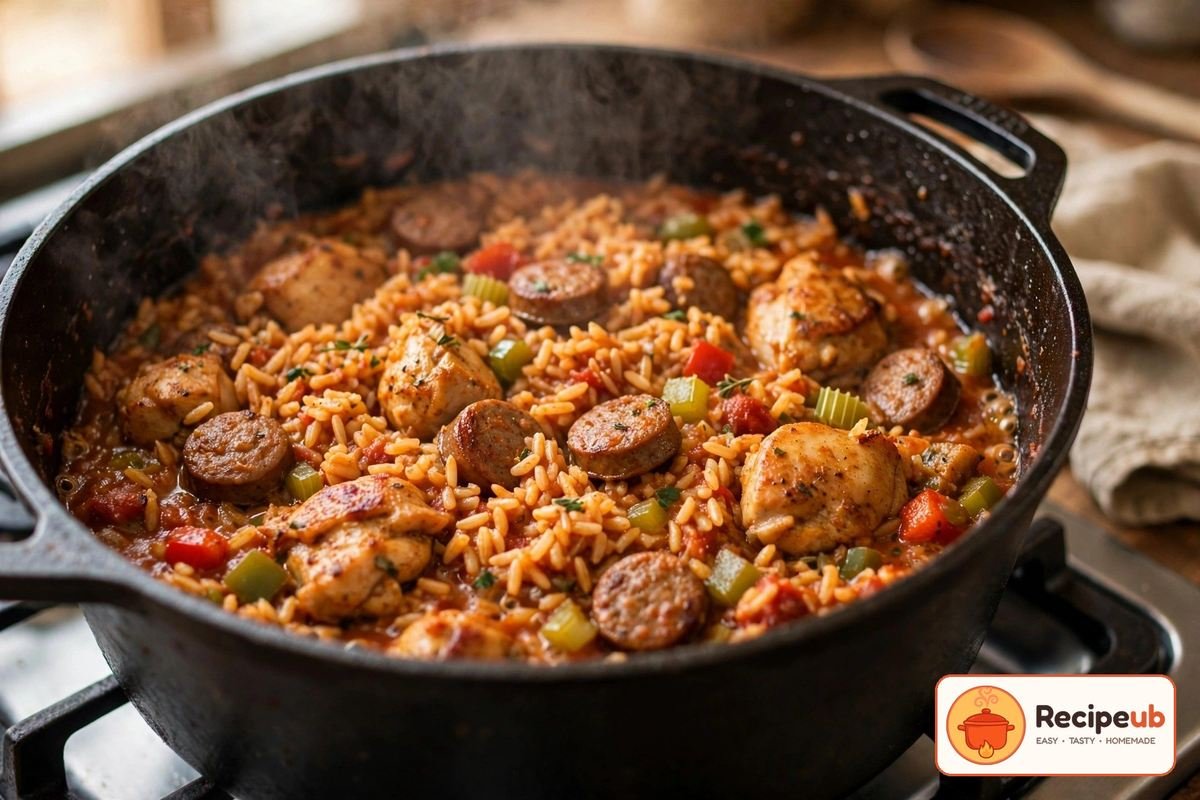

One Pot Jambalaya Recipe (Chicken, Sausage and Shrimp)
Ingredients
Equipment
Method
- Heat the olive oil in a large Dutch oven over medium-high heat. Brown the andouille coins 4–5 minutes, until the edges color and the fat renders; move to a plate.
- Season the chicken with 1 Tbsp of the Cajun seasoning and sear in the drippings 5–6 minutes, until browned (it finishes in the simmer); move to the plate with the sausage.
- Cook the onion, bell pepper and celery in the drippings 7–8 minutes. Add the garlic for 30 seconds, then the tomato paste for 1 minute. Stir in the rice and toast 1–2 minutes.
- Pour in the broth and add the drained tomatoes, thyme, bay leaves and Worcestershire. Return the sausage, chicken and their juices. Cover and simmer on low 20 minutes, stirring once gently at the halfway point.
- At minute 15, season the shrimp with the remaining 1 tsp Cajun seasoning and lay them on top of the rice; cover for the last 5 minutes, until opaque (145°F).
- Rest off the heat, covered, 5 minutes. Remove the bay leaves, fluff, and finish with the scallions and parsley. Hot sauce at the table.
Notes
- The shrimp rule: raw shrimp only, never pre-cooked — laid on top of the rice at minute 15 for the last 5 minutes in the steam. Stirred in early or cooked twice, shrimp turn rubbery; that is the failure the ladder exists to prevent.
- The stir rule: stir the rice once, gently, at the halfway point and no more. Over-stirring releases starch and makes the jambalaya gummy at any ratio.
- The salt rule: Cajun seasoning blends vary widely in salt (Tony Chachere’s and Slap Ya Mama are both salted), so this recipe adds no extra salt until tasting. If your blend is salt-free, add ½ tsp kosher salt with the rice.
- Leftovers need a splash of broth — the rice keeps absorbing liquid as it sits — and are best in the first 2 days, though safe for 3 to 4 days refrigerated; the shrimp firms up on reheating.
Emma’s Tips for the Best One Pot Jambalaya
Brown in the ladder’s order, and don’t rush the coins. The andouille’s four to five minutes are not about cooking the sausage — it arrives cooked. They are about the fat and the edges: the rendered fat is what the trinity cooks in, and the browned edges are flavor that survives the simmer. Pale coins at this step mean a pale pot at the end, and no amount of seasoning on top fixes a foundation that never browned.
Drain the can over the sink, and mean it. The single easiest way to move this pot from the chart’s middle row to its wet end is to tip the tomatoes in with their juice and keep the broth at 3 cups — suddenly the ratio is not 1:2 anymore, it is 1:2 plus a can of water, and the rice eats loose. Drain them, toast the paste for the depth, and the red color and acidity arrive without the flood. If you ever build the undrained version on purpose, the chart tells you the honest adjustment: it is a wetter dish, and it should be chosen, not stumbled into.
Judge the simmer by the grains, not the clock. Twenty minutes is the chart’s number, but stoves and lids vary, and the rice tells you where it is at the halfway stir: the grains should be swollen and just losing their chalky core, with the surface glossy rather than soupy. If the pot looks dry at halfway, your lid leaks steam — add broth two tablespoons at a time. If it looks wet, the last five minutes with the shrimp and the covered rest will take up more than you expect. The rest is not optional either way: it is where the grains finish.
Taste for salt once, at the end. Because the seasoning blend, the sausage and the broth all bring salt at different rates, the only honest salt moment is after the rest, with a spoon in the actual pot. Stir, taste, and adjust then — and remember the hot sauce at the table brings its own salt and acid with the heat, so season the pot a half-step under where you want the bowl.
Storage and Reheating
Fridge: Leftovers keep 3 to 4 days at 40°F or below — the USDA leftover standard every recipe on this site prints. Refrigerate within 2 hours, in a shallow covered container. One honest texture note, printed because it decides when to eat what: the pot is best in the first 2 days, because the shrimp firms up a little more each time it is reheated, even though the leftovers stay safe for the full window. If the week is the plan, eat the shrimp-heavy portions first. The rice will look drier and tighter cold than it did hot — that is absorption, not spoilage; the reheating splash below is the fix.
Reheating: Gently — on the stove over medium-low in a covered pan, or in the microwave at half power — with a splash of chicken broth stirred in first, until steaming hot throughout (165°F). Add the splash before the heat, not after: it is the liquid the rice drank in the fridge, handed back. Stir once halfway so the rice heats at the same pace as the proteins, and stop as soon as it is hot — every extra minute is another minute on the shrimp.
Freezer: This dish freezes well for up to 3 months — the rice, chicken and sausage hold their texture, and the shrimp softens slightly on thawing, stated rather than hidden. Freeze in portions, thaw overnight in the fridge, and reheat by the rule above with the broth splash. It is one of the better freezer pots on this shelf, which is also the Carnival-season move: a batch made in January is a Mardi Gras dinner that only needs reheating.
FAQs
What is the jambalaya rice to liquid ratio?
For long-grain white rice with the tomatoes drained, 2 cups of broth per cup of rice — this recipe’s ratio (1½ cups of rice in 3 cups of broth). The full spread is the Liquid Chart above, and it moves with the rice and the tomato handling: converted (parboiled) rice lands at ≈1¼ cups per cup in the test-kitchen oven build, a tomato-sauce build at 1½, the test kitchen’s fully measured long-grain build at ≈1⅞, and basmati at ≈2⅓ on the cluster’s shortest simmer. The variable nobody prints is the can: undrained tomatoes add roughly 1¾ cups of liquid on top of whatever ratio the card claims, which is how two recipes can both say 1:2 and eat completely differently.
What is the difference between Creole and Cajun jambalaya?
Tomatoes. Creole jambalaya — the New Orleans city style — contains them (diced or crushed, usually with paste), and eats red and brighter, with the tomato’s acidity cutting the sausage fat. Cajun jambalaya — the rural Acadiana style — has no tomato at all, and earns its brown color and deeper, smokier flavor from a darker-cooked trinity and fond. Everything else is shared: the same trinity, the same three proteins, the same ladder. This recipe is Creole; the conversion to Cajun is printed in the Creole vs Cajun Chart above — drop the tomatoes and paste, keep the broth at exactly 3 cups, and brown the trinity 3–4 minutes longer. The liquid does not change.
Do you use raw or cooked shrimp for jambalaya?
Raw. Always raw. Pre-cooked shrimp have already had their one cook, and five minutes in the steam of a covered jambalaya pot is a second one — they come out rubbery, which is the first word of the test kitchen’s failure list for this dish. Raw shrimp, peeled and deveined, laid on top of the rice for the last 5 minutes, cook through exactly once, in the steam, to opaque and 145°F. If all you have is a bag of frozen raw shrimp, that is the standard buy for this recipe — thaw it in cold water while the trinity cooks.
When do you add the shrimp to jambalaya?
In the last 5 minutes, laid on top of the rice, lid back on — minute 15 of this recipe’s 20-minute simmer. It is the consensus of the cluster’s strongest kitchens: the test-kitchen builds scatter the shrimp over the rice for the last five minutes or so, and the other trio holders land in the same window. The counterexample is printed on the Timing Ladder: one top-five page stirs its shrimp in before the rice, where it cooks about twenty minutes. The gentlest variant is one holder’s off-heat poach — shrimp stirred in after the heat is off, cooking about 3 minutes in the residual heat — which works for the same reason the ladder does: the shrimp’s total exposure stays in single digits.
Can I make jambalaya without shrimp?
Yes — chicken-and-sausage jambalaya is a real version of the dish, not a compromise, and the search stems ask for it by name (jambalaya recipe no shrimp). Skip the shrimp, keep everything else identical — the ladder simply ends at the chicken — and the pot costs ≈$2.20 per serving instead of ≈$3.55 (the math is in the cost section above; the shrimp is more than a third of the batch cost). It is worth knowing that the head term’s number-one recipe is exactly this version. What you give up is the finish — the sweet, just-cooked shrimp on top — and nothing structural: the rice, the ratio and the trinity never knew the difference.
What kind of rice is best for jambalaya?
Long-grain white rice is this recipe’s answer — it is the chart’s middle row and the cluster’s default grain. The strongest trio holder builds on converted (parboiled) rice and says why in her own notes: it “holds up beautifully — absorbs the liquid without turning mushy” — but it drinks less (≈1¼ cups per cup), so it runs its own row of the chart, not this one. Her warning list is the rest of the answer: avoid instant or quick-cooking rice, and know that brown rice, jasmine and basmati “all require different liquid ratios and cook times” — the budget authority in the cluster says the same of brown rice in her own jambalaya notes. Basmati’s row is printed on the chart (≈2⅓ cups, the top of the range); if you swap grains, swap rows with it.
Why is my jambalaya mushy or gummy?
One of the Liquid Chart’s failure ends, or the one technique failure. Mushy means too much total liquid: an undrained can counted as nothing, a basmati ratio poured over long-grain, or a wet-Creole tomato load — the rice absorbs past tender and the grains burst. Gummy is usually not the ratio at all: it is stirring. As one page-1 holder prints in his own notes, “Over-stirring releases starch and makes the jambalaya gummy. One gentle stir at the halfway point is enough.” His second warning covers the other end — rice that sticks and scorches if the heat runs too high under the covered pot. The fixes: drain the can, match the ratio to the rice, stir once, keep the simmer low — and let the covered rest finish the grains instead of extra minutes on the heat.
How do I make jambalaya less spicy?
Work the three heat dials separately, because they are separate. The blend: the cayenne lives inside the Cajun seasoning, so using half the printed amount — or a mild blend — lowers the whole pot evenly. The sausage: andouille itself ranges from gentle to fiery by brand, and a milder smoked sausage is a fair swap that keeps the ladder intact. And the hot sauce: in this build it is never cooked in — it sits at the table, so each bowl is seasoned to its own eater, which is how one pot serves a mixed table. What not to do is add dairy or sugar to cool a finished pot; the dials above prevent the problem instead of patching it.
What is the difference between jambalaya and gumbo?
Where the rice cooks. In jambalaya, the rice cooks in the pot — it is toasted, then simmered in the measured broth, absorbing the trinity, the tomato and the proteins’ juices as it goes, which is why this page is built around a rice-to-liquid ratio. Gumbo is a stew served over rice that was cooked separately — its body comes from a roux (or okra, or filé), its pot is mostly liquid, and the rice arrives at the bowl already cooked. The two dishes share the trinity, the sausage and the seasoning family, which is why the search box pairs them; but a gumbo has no ratio question to answer, and a jambalaya is nothing but. If the pot in front of you is soupy with rice mounded in the middle of the bowl, it is gumbo, whatever the title said.
How long does jambalaya keep, and can you freeze it?
3 to 4 days in the fridge at 40°F or below, refrigerated within 2 hours — the USDA leftover standard, with the honest rider that it is best in the first 2 days, because the shrimp firms up on reheating even while the leftovers remain safe. Reheat gently to 165°F with a splash of broth stirred in first; the rice has been absorbing liquid the whole time, and the splash hands it back. It freezes well for up to 3 months — thaw overnight in the fridge and reheat the same way; the shrimp’s texture softens slightly, and everything else comes back as it was. The full rules are in the Storage section above.
Final Thoughts
One pot jambalaya is not a complicated recipe, and it is an argued-about one anyway — because the argument was never about the seasoning. It is a browning, a trinity and a twenty-minute simmer. The argument is about the ratio nobody prints next to the other rices’ ratios, the tomato nobody counts as the liquid it is, the style split nobody charts, and the shrimp that goes in twenty minutes early on a top-five page. What this page adds is the paperwork the other versions leave out — a liquid chart with every camp’s number and its reason attached, a Creole vs Cajun chart with the conversion spelled out in both directions, a timing ladder that answers the test kitchen’s own failure list row by row, and a priced card that shows exactly what the third protein costs and what the pot costs without it. All three proteins, grains separate, shrimp tender, the style named on the card: that is the deal.
More Easy One-Pot Dinners
If a chart-driven pot is your kind of system, the rest of this shelf runs on the same rules — every ratio stated, every difference named. For the other spice-led one-pot on the shelf, my one-pot taco pasta — the taco-spiced one-pot pasta, where the seasoning system is built on taco spices instead of a trinity; this post is the rice pot, with the liquid measured to the grain brings the heat in a different accent, and for the other skillet classic that simmers its starch in the sauce, my skillet lasagna — the stovetop lasagna, noodles simmered in the tomato sauce in one pan; this post simmers rice in broth instead, with three proteins on a ladder is its closest structural cousin. And for the shelf’s other seafood skillet, tuna noodle skillet — the tuna and noodle skillet, the budget seafood one-pot; this post is the premium trio, with the shrimp priced and timed to five minutes proves the same one-pan system runs at the opposite end of the seafood budget. One shelf, one system — the sausage renders, the chicken sears, the shrimp finishes, and dinner is handled.



Never Run Out of Dinner Ideas
One easy air fryer or slow cooker dinner in your inbox every week. No spam, ever.
You’re on the list — welcome to Recipeub!