
Baked Oatmeal Meal Prep (6 Breakfast Squares, About 75¢ Each)
Baked oatmeal meal prep is the breakfast the search box keeps negotiating over: baked oatmeal meal prep, baked oats meal prep no banana, baked oats meal prep no protein powder, baked oatmeal with apples, baked oatmeal freezer, how long does baked oatmeal last. Read those completions together and the searcher is asking three questions at once — which oats, which flavor, and how long it really keeps — and page 1 answers all three one recipe at a time. Every holder prints exactly one flavor and asserts its oat: a peach-blueberry bake on one page, an oatmeal-cookie bake on another, a vegan cinnamon-roll bake on a third, muffin cups on a fourth, a protein-powder gym bake on a fifth. Nobody prints the comparison, nobody prints a flavor system, and nobody agrees on the storage — the same pan of baked oats is “3 to 5 days” on one page, “up to 5 days” on another, and on one prominent page it supposedly “holds up in the fridge for a week,” which the USDA’s 3-to-4-day rule for a cooked egg-and-milk dish flatly contradicts. This page is the system built to answer all three questions on one page: one base batter — 3 cups of rolled oats, 2 cups of milk, ½ cup of unsweetened applesauce, 2 eggs, brown sugar, butter, vanilla, baking powder, cinnamon and salt — with 2 diced apples folded through, baked as a slab in a 9×9-inch dish at 350°F, rested and cut into 6 squares. About 350 calories and ≈74¢ a square (both estimates, itemized on this page), in 55 minutes — and the eat order is part of the recipe: four squares in the fridge, the last two in the freezer, because a baked oatmeal is an egg dish wearing a cake’s clothes: four days in the fridge, and the rest of the pan belongs in the freezer.
The oat question is the one this post exists to settle, so it gets a chart, printed in full below: rolled oats, quick oats and steel-cut oats side by side, with the liquid each one actually needs, the bake time, and what the square eats like on day 4. The short version is that the oat is not a pantry detail — it is the difference between a square that slices clean on day 1 and reheats soft on day 4, and a pan that goes gummy by Wednesday. Rolled oats win this build for the reason the chart shows, and the five flavors the search box itself names — apple cinnamon, blueberry, banana, peanut butter banana, chocolate chip — are printed as one system on the same batter, each with its own per-square price, instead of five separate recipes scattered across five pages.
It also knows its nearest neighbor on this site, because this shelf already runs a breakfast system — the savory one. This post is the sweet slab: oats as the body of the breakfast, 2 eggs working as a binder across 6 squares, cut from one pan and eaten warm or cold. If the breakfast you want is the savory box — eggs as the protein itself, 10 of them over roasted potatoes — that is my egg meal prep breakfast boxes — the savory breakfast system, a sheet-pan egg bake with 2 eggs as the protein in every box over roasted diced potatoes; this post is the sweet breakfast system, oats as the body with 2 eggs as binder across the whole pan. That page’s own FAQ pointed readers who wanted an oatmeal breakfast to this lane — this is that post, and the fully egg-free version of the batter is printed in the FAQs below for the readers who need it. And if the breakfast you want is wrapped, hand-held and built to freeze by the dozen, that is my freezer breakfast burritos — the wrapped freezer breakfast, sausage-led eggs with hash browns inside flour tortillas, freezer-first by design; this post is the unwrapped sweet slab, cut into squares and eaten with a fork, fridge-first with two freezer squares. Three breakfasts, three systems — and each page says which one it is.
The short answer: Heat the oven to 350°F and grease a 9×9-inch dish. Whisk 2 cups of milk, ½ cup of unsweetened applesauce, 2 large eggs, ⅓ cup of brown sugar, 2 Tbsp of melted butter and 1 tsp of vanilla; stir in 3 cups of rolled oats, 1 tsp of baking powder, 1 tsp of cinnamon and ¼ tsp of salt; fold in 2 diced apples. Bake 35–40 minutes, until the center is set at 160°F. Rest 10 minutes, cut into 6 squares, and split the week: 4 squares to the fridge, 2 to the freezer — six breakfasts at about 350 calories and ≈74¢ each, in 55 minutes.
In This Recipe
The Plan at a Glance
- The batter: one base — 3 cups rolled oats, 2 cups milk, ½ cup unsweetened applesauce, 2 large eggs, ⅓ cup brown sugar, 2 Tbsp melted butter, 1 tsp vanilla, 1 tsp baking powder, 1 tsp cinnamon, ¼ tsp salt — the same batter under all five flavors (the flavor rule in the card notes)
- The fruit: 2 medium apples, diced and folded through — this build is apple cinnamon; the base carries no banana, and banana enters only as a Flavor Chart swap
- The oat: rolled (old-fashioned) — chosen from the Oat Chart below, not by habit: 1⅓ cups liquid per cup of oats, a clean slice on day 1, a soft reheat on day 4 (the oat rule in the card notes)
- The bake: a greased 9×9-inch dish at 350°F for 35–40 minutes, until the center is set at 160°F, then a 10-minute rest before slicing — the rest is inside the 45-minute cook time, stated openly
- The squares: 6 — four to the fridge for the next 4 days, squares 5 and 6 into the freezer on prep day (the freezer rule in the card notes); a frozen square thaws in the fridge overnight or reheats from frozen in short intervals
- The form: one slab, cut in squares — the same batter also bakes as 12 muffin-tin cups at 350°F for 20–25 minutes, printed as a variation in the chart notes, not a second recipe
- Time: 10 minutes prep / 45 minutes cook (bake 35–40 at 350°F + the 10-minute rest before slicing, stated openly) / 55 minutes total
- Yield: 6 breakfast squares
- Calories: ≈350 per square (estimate); protein ≈10 g per square (estimate) — no protein powder, by design
- Cost: ≈$0.74 per square (estimate) at October 2026 prices — the egg line is the BLS-verified anchor; the full line-by-line table is The Priced Pan below
- Storage: fridge 3 to 4 days for the four fresh squares; squares 5–6 frozen on prep day, good 2 to 3 months — the full eat order is in the Storage section below
Why This Recipe Works
One batter, five flavors — because the flavor is a swap, not a new recipe. Read the top seats for this dish in a row and the pattern is one flavor per page, every time: the strongest budget holder on page 1 holds two seats with two different bakes, and its other flavors — banana bread, apple cranberry, pumpkin — are separate posts again, so the searcher who wants a system has to assemble it from five pages and five slightly different batters. This build prints the thing the search box is actually asking for: one base batter, held constant, with the five flavors the autocomplete stems name themselves — apple cinnamon, blueberry, banana, peanut butter banana, chocolate chip — laid out in the Flavor Chart below as swaps on that base, each with its own per-square cost. Change the fruit, keep the batter. A system you can run from memory by the third week beats a bookmark folder of single flavors.
The oat is chosen from a chart, not from whatever is in the canister. Every holder states its oat in one prose line — “use rolled oats” — and stops, which leaves the two questions that decide the bake unanswered: how much liquid does each oat actually need, and what does the square eat like on day 4? The Oat Chart below prints all three common oats with their ratios and bake times, because the failures of this dish are oat failures: quick oats at the rolled-oat ratio go gummy by day 3, and steel-cut oats stirred into a rolled-oat batter come out chewy and underdone no matter how long the pan sits, because they were never a swap — they are a different method with a pre-soak and nearly double the liquid. Rolled oats at 1⅓ cups of liquid per cup are the meal-prep oat: tender, sliceable, and still soft after the day-4 reheat.
The storage design follows the USDA window instead of negotiating with it. Baked oatmeal is a cooked egg-and-milk dish, and cooked egg dishes keep 3 to 4 days in the fridge at 40°F or below — that is the rule, and the current page-1 holders print “3 to 5 days,” “up to 5 days,” and in one case a full week against it. A pan of 6 squares does not fit inside 4 days of breakfasts for most households, so this recipe does not pretend it does: four squares live in the fridge and get eaten inside the window; squares 5 and 6 go into the freezer on prep day, while the bake is at its freshest, where they keep well for 2 to 3 months. A baked oatmeal is an egg dish wearing a cake’s clothes: four days in the fridge, and the rest of the pan belongs in the freezer. The freezer is not the failure mode here — it is where squares 5 and 6 were always supposed to live.
No banana and no protein powder in the base — the two negotiations, answered by design. The search box argues with itself about this dish: baked oats with banana against baked oats without banana, baked oats with protein powder against baked oats meal prep no protein powder. Holders pick a side silently and the other half of the searchers bounce. This base is the plain build — no banana anywhere in the batter, no protein powder in the pantry list — and both ingredients are handled as what they are: options, printed in the Flavor Chart (banana is a full flavor row, with what it replaces) and in the FAQs (what a scoop of protein powder would actually change, honestly: about 8–10 more grams of protein per square, a drier crumb, and roughly 30¢ more per square at typical powder prices — an estimate, labeled as one). The base stays the base, and the negotiations get answers instead of silence.
The price is current, anchored, and reconciles. The lane’s famous per-serving figure — 77¢ — rests on a recipe priced in 2011, when 2 cups of oats costed 56 cents and an egg costed 23. This page re-prices the same idea at November 2026 shelf levels, line by line in The Priced Pan below: the method cuts 6 squares and the table divides by the same 6, and the one line that can be verified is verified — the 2 eggs are costed at the Bureau of Labor Statistics’ October 2026 average of $2.320 a dozen, read directly from the BLS, which puts the eggs in the whole pan at 39 cents. Egg prices have been volatile — the USDA wholesale benchmark swung sharply in late November 2026 — and the honest point is that this build barely notices: whether eggs sit at the BLS average or move with the wholesale tremor, two eggs are the cheapest line in the pan either way. It is the same pantry discipline this site runs at dinner — my cheap pantry dinners — the pantry egg fried rice dinner, eggs and rice stretched across a family’s evening meal; this post is the pantry breakfast, oats and apples baked into a week of squares — with the occasion swapped: that page spends the pantry on dinner, this one spends it on breakfast, and both print the receipt.
Which Oats Survive the Week? The Oat Chart
Here is the first chart this post exists to print. Ask the search box which oats belong in baked oatmeal and every holder answers in a single prose tip — rolled, because quick “gets mushy” and steel-cut “needs a totally different method” — and then nobody prints the numbers behind the tip. Here are the three oats side by side, organized by the facts that actually decide the bake: the liquid each cup of oats needs, the time in the oven, and what the finished square eats like on day 4, which is where a meal-prep pan is won or lost. This recipe uses the bold row.
| Oat | Liquid per 1 cup oats | Bake at 350°F | Texture in the square | Verdict |
|---|---|---|---|---|
| Rolled (old-fashioned) — this recipe | 1⅓ cups (this build: 4 cups liquid to 3 cups oats, counting the applesauce) | 35–40 min | Tender, holds a clean slice | The meal-prep oat — the only one that slices on day 1 and reheats soft on day 4 |
| Quick (instant) oats | 1⅓ cups | 30–35 min | Soft, cake-like, edges go gummy by day 3 | Works in a pinch; the week eats worse |
| Steel-cut oats | 2 cups + a 20-min pre-soak/simmer | 50–60 min | Chewy, distinct grains, never fully custardy | A different method, not a swap — the holders’ “totally different method” line, printed with its numbers |
How to read the chart: the oat decides how much liquid the batter needs and how the set behaves across a week, and the three rows are not interchangeable at any ratio. Rolled oats are flattened whole grains: they drink their 1⅓ cups of liquid evenly, set into a custard that holds a knife line, and — the meal-prep fact — they reheat soft on day 4 because the set was never fragile to begin with. Quick oats are the same grain cut finer, which is why the ratio holds but the week does not: the smaller pieces set softer on day 1 and keep softening in the fridge, so the edges of the square go gummy by day 3 — edible, and noticeably worse, which is the honest version of the holders’ one-word warning. Steel-cut oats are the chart’s cautionary row: chopped groats that need roughly double the liquid, a 20-minute pre-soak or simmer before the pan, and close to an hour in the oven — and even then the grains stay distinct and chewy inside the custard instead of melting into it. That is a fine breakfast and a different recipe; stirred raw into this batter at this ratio, they come out underdone at the center no matter how the timer is stretched. One more form note, because the search box asks it: the same batter bakes as cups — spoon it into a greased 12-cup muffin tin and bake at 350°F for 20–25 minutes, until set. The cups are the grab-and-go form of the same system; the slab is the form that slices, stacks and freezes in the neatest squares, which is why the slab is the build and the cups are the variation.

Ingredients
- 3 cups old-fashioned rolled oats
- 2 cups milk
- ½ cup unsweetened applesauce
- 2 large eggs
- ⅓ cup brown sugar
- 2 Tbsp butter, melted
- 1 tsp vanilla extract
- 1 tsp baking powder
- 1 tsp ground cinnamon
- ¼ tsp salt
- 2 medium apples, diced
Ingredient notes: The oats are old-fashioned rolled oats — the chart’s bold row, at 1⅓ cups of liquid per cup (the milk and applesauce together make this batter’s 4 cups); quick oats bake up softer and go gummy at the edges by day 3, and steel-cut oats are a different method entirely, not a swap (the Oat Chart above prints both). The eggs are 2 large eggs, and their job is binder, not protein — they set the batter into a sliceable custard across all 6 squares, which is the opposite of the egg breakfast on this site, where 10 eggs are the protein itself; at the BLS October 2026 average of $2.320 a dozen they cost 39 cents for the pan. The milk is ordinary whole milk, 2 cups — the batter’s main liquid; a dairy-free milk swaps in 1:1 and the set holds, with a slightly softer square. The applesauce is ½ cup unsweetened — it is part of the liquid count and part of the sweetness, which is why the brown sugar stays at ⅓ cup; sweetened applesauce works and the sugar can drop to ¼ cup. The apples are 2 medium, diced with the peel on — a firm, sweet-tart apple (Honeycrisp, Fuji, Gala) holds its pieces through the bake; a soft apple cooks down into the crumb, which is a texture choice, not an error. The cinnamon is 1 tsp of standard ground cinnamon. One dated buying note: the FDA’s recall of Wise Wife Ground Cinnamon, announced October 29, 2026 for potentially elevated lead levels, sits inside a broader FDA lead alert that lists specific ground-cinnamon products by brand — check the FDA’s current cinnamon alert list for the named products; a standard grocery cinnamon that does not appear on that list is what this build uses. The butter is 2 Tbsp, melted — it goes in with the wet ingredients and keeps the crumb tender through four days of reheats; coconut oil swaps in 1:1.

How to Make Baked Oatmeal Meal Prep
The method is one bowl of wet, one bowl of dry, and one pan — the order matters only at the end: the batter rests in the dish for no time at all before baking (rolled oats start drinking liquid on contact, and a batter that sits pours uneven), and the baked pan rests a full 10 minutes before the knife, because the custard finishes setting as it cools and a square cut hot slumps instead of slicing.
- Heat the oven and prep the pan and apples. Heat the oven to 350°F. Grease a 9×9-inch baking dish (butter or nonstick spray, corners included — the corners are where squares tear). Dice the 2 apples into roughly ½-inch pieces, peel on, and set them aside.
- Whisk the wet. In a large bowl, whisk the milk, applesauce, eggs, brown sugar, melted butter and vanilla until the eggs are fully broken up and the sugar is dissolved — no streaks of white or yolk should show, because an unmixed pocket of egg bakes into a rubbery streak.
- Stir the dry and combine. In a second bowl, stir the rolled oats, baking powder, cinnamon and salt together, then pour the wet over the dry and stir just until every oat is wet — about 20 strokes. Fold the diced apples through. Pour the batter into the prepared dish and spread it level; work promptly, because the oats are already drinking.
- Bake to set. Bake 35–40 minutes, until the edges are pulling slightly from the dish, the top is golden and matte, and the center is set — it should read 160°F and not jiggle like liquid when the dish is nudged. An under-set center is the soggy-square failure; the middle of the pan is the last place to set, so check there, not at the edges.
- Rest 10 minutes. Set the dish on a rack for a full 10 minutes — this rest is inside the recipe’s cook time, printed openly, and it is not optional: the custard firms as it cools, and the squares cut clean only after it.
- Slice and split the week. Cut the slab into 6 squares (one cut down the middle, two across). Lift them out with a wide spatula and let them finish cooling — the whole pan should be portioned and refrigerated or frozen within 2 hours of coming out of the oven. Pack 4 squares for the fridge and wrap squares 5 and 6 for the freezer, labeled with the date: that split is the recipe, not an afterthought (the Storage section below prints the full eat order).

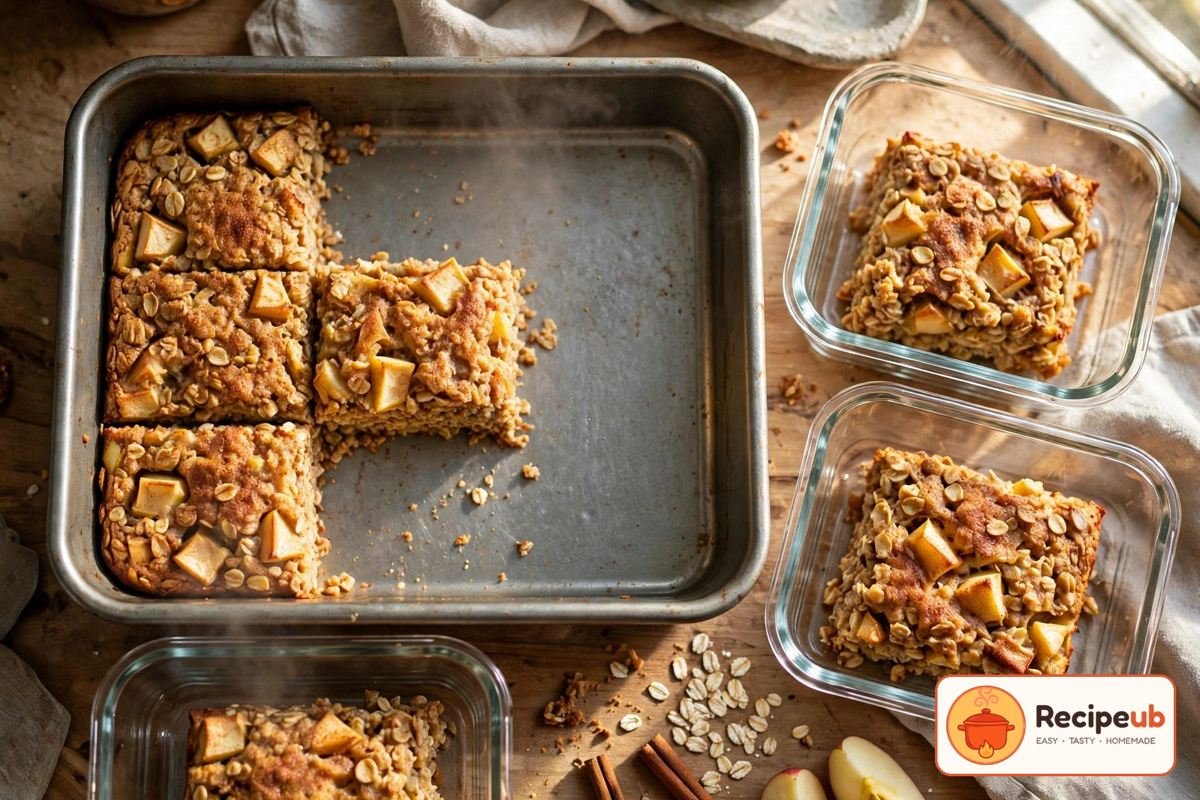
Baked Oatmeal Meal Prep (6 Breakfast Squares, About 75¢ Each)
Ingredients
Equipment
Method
- Heat the oven to 350°F. Grease a 9×9-inch baking dish. Dice the apples into ½-inch pieces.
- Whisk the milk, applesauce, eggs, brown sugar, melted butter and vanilla until fully combined.
- Stir the oats, baking powder, cinnamon and salt together; pour the wet over the dry and stir just until every oat is wet. Fold in the diced apples.
- Pour into the prepared dish, spread level, and bake 35–40 minutes, until the center is set at 160°F.
- Rest the dish 10 minutes, then cut the slab into 6 squares.
- Portion within 2 hours of baking: refrigerate 4 squares; wrap and freeze squares 5 and 6 on prep day.
Notes
One Batter, Five Flavors: The Flavor Chart
Here is the second chart this post exists to print. The five flavors below are not this page’s invention — they are the flavors the search box itself completes, one stem at a time: baked oatmeal with apples, baked oatmeal with blueberries, baked oatmeal with bananas, baked oatmeal chocolate chip. Page 1 prints each one as its own recipe with its own batter, so a cook who wants the blueberry version in week two starts over from a new page. Here they are as what they actually are: five swaps on one base batter, each row changing the fruit and the sugar and nothing else — never the oats, the liquid or the eggs, because those three are the set. This recipe uses the bold row.
| Flavor (swap on the base) | What changes | Per-square cost (est.) |
|---|---|---|
| Apple Cinnamon (this recipe) | 2 diced apples + 1 tsp cinnamon in the batter | ≈$0.74 |
| Blueberry | 1½ cups FRESH blueberries folded in; apples out, half the sugar out | ≈$0.85 |
| Banana | 2 mashed ripe bananas replace the applesauce and the apples | ≈$0.62 |
| Peanut Butter Banana | The banana row + ⅓ cup peanut butter swirled over the top before baking | ≈$0.78 |
| Chocolate Chip | Apples out, ½ cup chocolate chips folded in | ≈$0.80 |
How to read the chart: every row is the same batter wearing a different fruit, and the two columns that matter are what changes and what it costs. The blueberry row specifies fresh blueberries deliberately — frozen berries bleed purple through the whole batter and weep extra liquid into the set, so if frozen is what you have, fold them in still frozen and expect a softer, streaked square. The banana row is the sweetest of the five and the cheapest, because the bananas replace both the applesauce and the apples and carry their own sugar — ripe to the edge of brown is the right ripeness here, the lunchbox-reject bananas are the ingredient. The peanut butter swirl goes on top before baking, not through the batter: stirred in, it disappears; swirled, it bakes into a ribbon the knife finds in every square. And the chocolate chip row is the dessert-leaning one — the chips hold their shape in the hot batter only if they go in last, folded through in the final few strokes. Rotate the rows across weeks and the base never changes, which is the entire point: by the third week the batter is memorized, and the only decision left on prep day is which row.
What Does a Breakfast Square Cost? The Priced Pan
Here is the third thing this post prints that page 1 does not: the whole pan, priced line by line, at October–November 2026 prices — with the one verifiable line verified against the Bureau of Labor Statistics and every other line labeled a shelf estimate, printed as one, because this page names its sources instead of rounding a receipt it never saw. It also reconciles: the method cuts 6 squares, and the table divides by the same 6. The lane’s famous comparison figure — a 77¢ serving from the strongest holder — was priced in 2011, when the oats in it costed 56 cents for 2 cups; this table re-prices the same idea at today’s shelf levels.
| Line | Amount for the batch | Price basis | Batch cost |
|---|---|---|---|
| Rolled oats | 3 cups | Shelf estimate, labeled as one | ≈$1.05 |
| Apples | 2 medium | Shelf estimate, labeled as one | ≈$1.20 |
| Milk | 2 cups | Shelf estimate, labeled as one | ≈$0.55 |
| Large eggs, Grade A | 2 eggs | BLS October 2026 average, $2.320/dozen (verified, series APU0000708111) | $0.39 |
| Vanilla, cinnamon, baking powder, salt | Pantry amounts | Shelf estimate, labeled as one | ≈$0.45 |
| Butter | 2 Tbsp | Shelf estimate, labeled as one | ≈$0.30 |
| Unsweetened applesauce | ½ cup | Shelf estimate, labeled as one | ≈$0.30 |
| Brown sugar | ⅓ cup | Shelf estimate, labeled as one | ≈$0.20 |
| Batch total | 6 squares | ≈$4.44 → ≈$0.74 per square |
How to read the table: the oats and apples — the two ingredients the square is actually made of — are $2.25 of the $4.44 between them; everything else is garnish-priced, and the eggs, the ingredient a casual reader would expect to matter, are the verified 39 cents: two eggs as a binder is a different economy from ten eggs as a protein, which is why this breakfast undercuts the egg box on the same shelf. The dated context matters, and it is printed with its date rather than as a promise: egg prices swung hard at wholesale in late November 2026 after flock losses, and a priced page says so — but at two eggs a pan, even a doubled egg price moves this square by about 7 cents. The discipline is the same one this site runs on its other priced system, at the other end of the day: my lentil meal prep — the priced lentil soup pot, six dinners at about $1.40 a meal with the same line-by-line table; this post is the breakfast end of that discipline, six squares at about 74¢ — one shelf, two ends of the day, both receipts printed.
Emma’s Tips for the Best Baked Oatmeal Meal Prep
Dice the apples small, and keep the peel on. Half-inch pieces distribute through the batter so every square carries fruit; big chunks sink, cluster, and leave oat-only squares at the corners. The peel softens completely in the bake and disappears into the crumb — peeling is work that buys nothing here. Firm apples matter more than sweet ones: a Honeycrisp or Fuji holds its pieces, a soft apple melts into the batter and the squares lose their texture contrast.
Do not let the mixed batter sit. Rolled oats start drinking liquid the moment the wet hits the dry, and a batter that waits 15 minutes on the counter pours thick, spreads uneven, and bakes with a dense bottom. Stir, fold, pour, oven — the whole sequence should take two minutes. If the apples are not diced yet, they were supposed to be diced first: step 1 is step 1 for a reason.
Judge the set at the center, not the edges. The edges of the pan set 10 minutes before the middle does, and a pan pulled when the edges look done has a custard center that never firms — the squares slump, weep, and will not stack. Nudge the dish: the center should move like set gelatin, not like liquid, and a thermometer there should read 160°F. When in doubt, give it the extra 3 minutes; an over-baked square reheats a little dry, an under-baked one never recovers at all.
Rest the full 10 minutes before the knife. The custard is still finishing as the pan cools, and a square cut at minute 2 slumps into a scoop. At minute 10 the same pan cuts six clean squares with edges that hold through four days of containers. Wipe the knife between cuts and the tops stay tidy — a small thing, except that the tidy square is the one that reheats evenly and photographs like breakfast instead of leftovers.
Label the freezer squares before they go in. Squares 5 and 6 look exactly like squares 1 through 4, and on day 4 nobody remembers which container was meant to be frozen — except by then it is too late to freeze it at its best. A strip of tape and the date, written while the pan is still warm, is the entire system: the labeled squares are the ones that get pulled out to thaw, and the label is what makes day 5 and day 6 happen on schedule instead of by archaeology.
Storage and Reheating
Fridge — squares 1 to 4: Baked oatmeal is a cooked egg-and-milk dish, and it keeps 3 to 4 days at 40°F or below — the USDA standard, and the number this whole system is designed around. The four fresh squares are eaten inside that window, in order, across the next four mornings. Portion and refrigerate the pan promptly on prep day (cooked egg dishes never sit at room temperature past 2 hours), in containers with the lids sealed, toward the back of the fridge where the temperature holds steadiest. What this page will not print is the stretched version: the 5-day and full-week fridge claims on the current page 1 are claims about other people’s risk, and the honest window is the one on this card.
Freezer — squares 5 and 6: The last two squares go into the freezer on prep day, while the bake is at its freshest, and keep well for 2 to 3 months — wrap each square individually or freeze them in a single container with parchment between, so one square can come out at a time. Move a square to the fridge the night before its morning and it thaws by breakfast; from fully frozen, microwave it in short intervals (below). This is the design, not a workaround: a baked oatmeal is an egg dish wearing a cake’s clothes — four days in the fridge, and the rest of the pan belongs in the freezer. Prepping for a household of one instead — no second eater, no sixth anything — is the scaled-down version of the same discipline: my meal prep for one — the solo system, four meals sized for a one-person week; this post is the six-square household pan, four fresh and two frozen runs the week at the other size.
Reheating: Microwave one square for 60–90 seconds, until steaming hot throughout (165°F) — the square heats evenly because it is flat and uniform, which is the slab form’s quiet advantage over a deep bowl. A square reheats best with a teaspoon of milk drizzled over it first if it has spent 3–4 days in the fridge; the oats keep drinking as they sit, and the drizzle hands the moisture back. From frozen, thaw overnight in the fridge, or microwave at half power in 30-second intervals until hot. And the cold option is a real one, not a consolation: a baked oatmeal square eats like a soft oat bar straight from the fridge, and the apple cinnamon and chocolate chip rows are the two that eat best cold — the Storage answer and the snack answer are the same square.
FAQs
How long does baked oatmeal last in the fridge?
3 to 4 days at 40°F or below — the USDA window for a cooked egg-and-milk dish, and the only window this page prints. The holders disagree with each other by days (“3 to 5 days” on one page, “up to 5 days” on another, a full week on a third), and the disagreement itself is the tell: those are claims, and 3–4 days is the standard. This system is designed so the question never has to stretch: four squares are eaten inside the window, and squares 5 and 6 are frozen on prep day.
Can you freeze baked oatmeal?
Yes — this pan is designed for it. The baked squares freeze well for 2 to 3 months, wrapped individually or layered with parchment in one container, and two of this recipe’s six squares are frozen on prep day on purpose, while the bake is at its freshest. Thaw a square overnight in the fridge, or microwave it from frozen at half power in 30-second intervals until steaming hot. Every format of this dish freezes, in fact — the slab’s advantage is that the squares stack flat and come out one at a time.
What are the best oats for baked oatmeal — rolled, quick, or steel-cut?
Rolled (old-fashioned) oats, and it is not close for a meal-prep pan: they need 1⅓ cups of liquid per cup of oats, bake in 35–40 minutes, slice clean, and reheat soft on day 4. Quick oats at the same ratio set softer and go gummy at the edges by day 3 — usable in a pinch, worse across a week. Steel-cut oats are not a swap at all: they need about 2 cups of liquid per cup, a pre-soak or simmer, and 50–60 minutes in the oven, and the grains stay chewy inside the custard. The full comparison is the Oat Chart above.
Can I make baked oatmeal without banana?
Yes — this recipe already is. The base batter carries no banana at all: the fruit is diced apple, the liquid is milk and applesauce, and nothing in the pan needs mashing. Banana enters this system only as a deliberate swap — the banana row of the Flavor Chart, where 2 mashed ripe bananas replace the applesauce and the apples. If a banana-free breakfast is why you landed here, the base recipe as written is the answer, not a variation of it.
Can I make baked oatmeal without eggs?
Yes, with a texture cost stated honestly. Replace each egg with a flax or chia egg (1 tablespoon of ground flaxseed or chia stirred into 3 tablespoons of water, rested 10 minutes) or with an extra ¼ cup of applesauce per egg — the holders’ consensus swaps, and they work: the pan sets, the squares slice. What changes is the set itself: without egg, the custard is softer and more fragile, the squares crumble a little at the edges, and the fridge window tightens in spirit — treat the pan as a 3-day pan and freeze the rest sooner. The egg version on this card is the sturdier week; the egg-free version is a real option, not a failure.
How do you reheat baked oatmeal?
Microwave one square for 60–90 seconds, until steaming hot throughout (165°F). If the square has spent 3–4 days in the fridge, drizzle a teaspoon of milk over it first — the oats keep absorbing moisture as they sit, and the drizzle hands it back. From frozen, thaw overnight in the fridge or microwave at half power in 30-second intervals. In the oven, a square reheats at 350°F in about 10 minutes. And it does not have to be reheated at all — the next answer is the cold one.
Can I bake it in a muffin tin instead of a pan?
Yes — the same batter, spooned into a greased 12-cup muffin tin, bakes at 350°F for 20–25 minutes, until the centers are set. The cups are the grab-and-go form: portioned by the tin, quick to pack, honest freezers. What you give up is the slab’s clean stacking and its even reheating — a cup is thicker than a square, so the center runs a few seconds behind the edges in the microwave — and what you gain is a form that needs no knife. Same batter, same flavors, same eat order: the tin is a variation printed on this page, not a second recipe.
How much does one square cost to make?
≈$0.74 a square (estimate) — a batch of ≈$4.44 for 6 squares, priced line by line in The Priced Pan above. The one verified line is the eggs: 39 cents for the pan at the BLS October 2026 average of $2.320 a dozen; the oats, apples, milk and pantry lines are labeled shelf estimates. For scale, the lane’s famous 77¢ serving was priced in 2011 — this table is the same idea re-priced at today’s shelf levels, with the servings and the divisor agreeing.
Do I need protein powder in baked oats?
No — the base is built without it, on purpose. This square carries about 10 g of protein (estimate) from the oats, milk and eggs, which is a breakfast, not a gym shake, and the search box’s other half — the no protein powder stems — is asking for exactly this build. What a scoop would change, honestly: roughly 8–10 more grams of protein per square if a standard scoop is stirred into the batter, a noticeably drier, firmer crumb, and about 30¢ more per square at typical powder prices (an estimate, labeled as one). If protein is the whole goal, that is a different lane of this site; if breakfast is the goal, the base as written is the answer.
Can you eat baked oatmeal cold?
Yes — and two of the five flavors are better for it. A chilled square eats like a soft, dense oat bar: the apple cinnamon row and the chocolate chip row hold up best cold, because their flavors read clearly without heat, while the banana rows are at their best warmed, when the banana tastes baked instead of raw. Cold is also the fastest morning there is — no microwave, no wait — and the squares are portioned for it. Stored properly (3 to 4 days in the fridge, or thawed from the freezer), a cold square is a designed serving of this recipe, not a compromise.
Final Thoughts
Baked oatmeal is not a hard breakfast, and it is a fragmented one anyway — because the recipe was never the problem. It is three cups of oats, a bowl of batter and fifty-five minutes. The problem is that page 1 prints five flavors as five unrelated recipes, states its oat in one unexplained line, prices its strongest pan at 2011 shelf levels, and stores the same egg-and-milk dish for anywhere from 3 days to a full week depending on which page you land on. What this page adds is the paperwork the other versions leave out — an oat chart with the liquid ratio, the bake time and the day-4 texture for every oat in the canister; a flavor chart that turns five separate recipes into five swaps on one batter, each priced; a pan priced line by line at today’s prices with its one verifiable line verified; and an eat order that treats the USDA’s 4 days as a design constraint instead of an inconvenience. One batter, rolled oats, four mornings from the fridge and two from the freezer: that is the deal.
More Easy Budget Meal Prep
If a priced system with the charts printed is your kind of meal prep, the rest of this shelf runs on the same rules — every receipt shown, every window honest. The whole shelf is gathered in my budget meal prep ideas — the hub of every budget system on the site, dinners, solo weeks, beginner batches and both breakfasts; this post is the sweet breakfast entry, six baked oatmeal squares at about 74¢ each, and if this is your first prep of any kind, the gentler on-ramp is my meal prep on a budget for beginners — the starter system, a first week of budget prep built step by step; this post assumes the habit and spends it on a breakfast pan. One shelf, one standard — the batter mixes, the slab bakes, the last two squares freeze, and the week is handled.




Never Run Out of Dinner Ideas
One easy air fryer or slow cooker dinner in your inbox every week. No spam, ever.
You’re on the list — welcome to Recipeub!