
Slow Cooker Vegetable Soup (Easy, Fresh & Frozen — Never Mushy)
There is a specific disappointment every vegetable soup maker knows: you lift the lid after a long, patient cook and the soup underneath is a swamp. The peas are gray, the corn has gone soft and starchy, the green beans have surrendered completely, and the broth — which tasted rich at noon — has thinned into something watery and sad. Most recipes pretend this is just how slow cooker vegetable soup goes. It is not. It is one mistake, made at minute zero: the frozen vegetables went in at the start. Frozen vegetables are blanched before they are frozen — they have already been cooked once — and six hours in a slow cooker is not cooking them, it is dismantling them. This is the soup I make all January: fresh vegetables, potatoes and cannellini beans simmering all day in a fire-roasted tomato broth, and the frozen bag held back for the last 45 minutes. One rule, and nothing in the bowl is mushy.
It is the meatless member of my slow cooker soup shelf — the same all-day cooker comfort as my Slow Cooker Beef Stew, with the beef swapped for beans and a broth that never misses it. It lands at about 260 calories for a full, dinner-size bowl, with enough protein and fiber to actually be dinner, and the whole pot costs about what one takeout soup costs. I will show you the rule, the chart, and the honest numbers.
The short answer: Vegetable soup takes 6 hours on LOW or 3 hours on HIGH in the slow cooker — this recipe cooks the fresh vegetables, potatoes and beans for the full 6 hours on LOW, and the frozen corn and peas go in for the last 45 minutes only. That one rule — fresh all day, frozen last — is why nothing in the bowl turns mushy.
In This Recipe
The Plan at a Glance
- Vegetables: fresh potatoes, carrots, celery and green beans cook all day; zucchini and the frozen corn and peas go in for the last 45 minutes
- Setting and time: LOW for 6 hours (HIGH option: 3 hours)
- The Frozen Vegetable Rule: frozen vegetables are blanched before freezing — they need minutes in the hot soup, not hours
- Protein: one can of cannellini beans — about 9 g protein and 9 g fiber per bowl, no meat anywhere
- Calories: about 260 per full 2-cup serving (honest basis in the recipe card)
- Serves: 6 dinner bowls (about 2 cups each) in a 6-quart slow cooker, at about $2 a bowl
Why This Recipe Works
The Frozen Vegetable Rule is the whole fix. Every frozen-vegetable technique guide on the internet says the same thing: frozen vegetables belong in a slow cooker for the last 30 to 60 minutes, because they were blanched — briefly cooked — before freezing. And yet nearly every top recipe for this soup dumps the bag in at minute zero and lets it cook for six, seven, eight hours. The result is the gray peas and watery broth everyone complains about. This recipe makes the guide’s advice the headline: fresh vegetables cook all day, the frozen bag goes in for the last 45 minutes, straight from the freezer. That is the entire secret, and it works every single time.
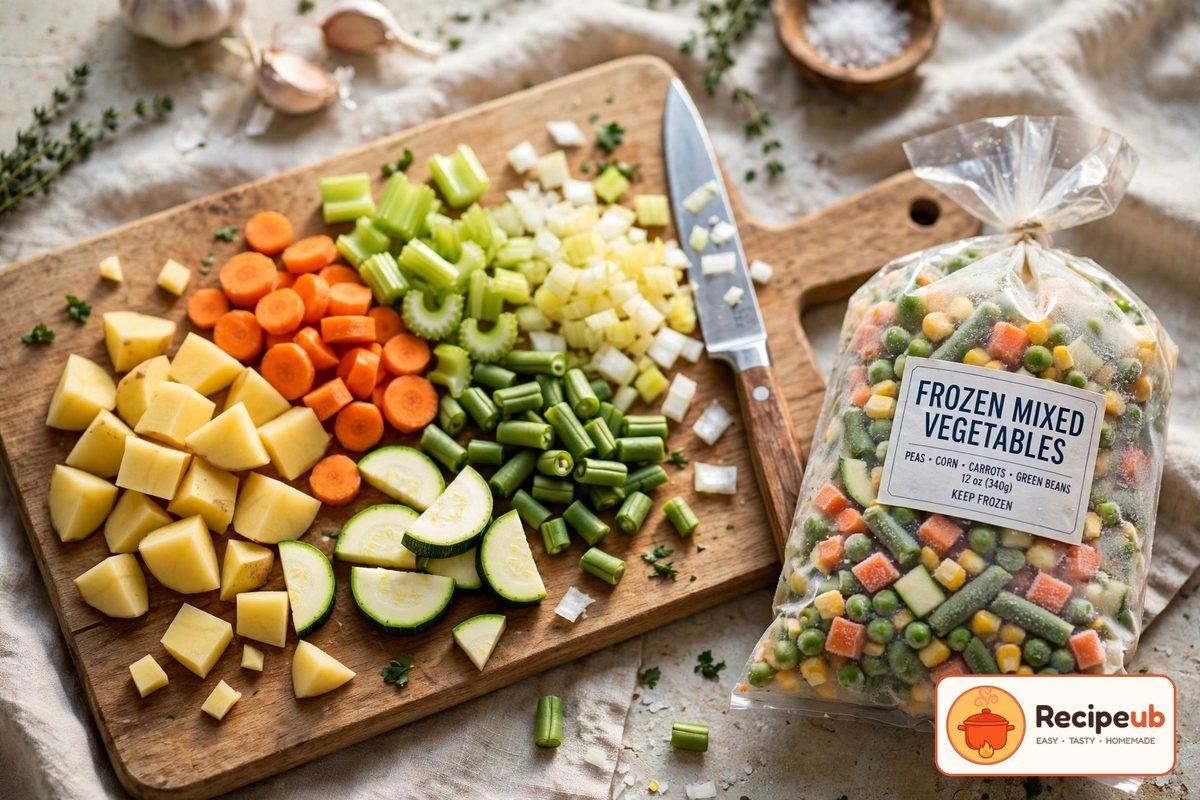
Fresh vegetables are built for the long cook. Potatoes, carrots, celery and green beans are dense, sturdy vegetables — cut at a full inch, they need every one of the six hours and finish tender but intact, sweet from the slow simmer. The recipe does not ask them to share their cook time with vegetables that were never meant to be in the pot that long. Each group gets the time it actually needs, which is the same respect I give the fresh vegetables in a stew — the difference here is that the second group comes from the freezer, not the cutting board.
Beans make it dinner, not a starter. A bowl of vegetable soup that is mostly broth and soft vegetables is a first course wearing a dinner costume. One can of cannellini beans changes the math completely: they simmer in the tomato broth all day, turn creamy at the edges, and bring the bowl to about 9 grams of protein and 9 grams of fiber. That is what makes 260 calories feel like a meal at 6 p.m. instead of a promise you break at 8.
The broth has a backbone. Fire-roasted tomatoes bring a smoky depth plain diced tomatoes do not, a spoonful of tomato paste concentrates it, and Italian seasoning does the slow, all-day melding. A squeeze of lemon at the very end — never at the start, where six hours would dull it — wakes the whole pot up. Nothing fancy, nothing missing.
How Long Does Vegetable Soup Take in the Slow Cooker?
For this recipe, the answer is 6 hours on LOW or 3 hours on HIGH — the fresh base cooks the full time, and the frozen vegetables join it for the last 45 minutes. If you have been reading other versions of this soup, you have seen everything from 4 hours to 8, and the spread is not error. It is three different soups wearing one name. Recipes built on a frozen bag from the start can call a shorter base time because nothing in them needs long. Recipes with no potatoes can stop early. And the 8-hour versions are usually compensating for big, raw potato chunks. The clock follows the potato: a 1-inch chunk of Yukon Gold needs the full 6 hours on LOW to go silky-tender all the way through, and the soup is done when a potato chunk yields to a fork with no resistance in the center. Cut the potatoes smaller — a ½-inch dice — and you can shave about an hour, but know that small dice is also how potatoes dissolve at the edges, so I keep them at an inch and keep the time.
The Frozen Vegetable Rule: Fresh All Day, Frozen Last
Here is the rule, plainly: fresh vegetables go in at the start; frozen vegetables go in for the last 45 minutes. It comes from a fact about how frozen vegetables are made that most recipes never mention. Before a pea or a corn kernel is frozen, it is blanched — plunged into boiling water or steam for a few minutes to stop the enzymes that would spoil it in the freezer. Blanching is cooking. A frozen pea has already been cooked once before it ever meets your slow cooker, which is why it needs only to heat through and mingle — 45 minutes in soup that is already hot is generous. Give it six hours instead and two things happen: the vegetable itself collapses, and it steadily leaks its water into your broth, which is exactly how a rich tomato base turns thin and gray by dinnertime.
Two corollaries ride along with the rule. First, do not thaw the frozen vegetables first. Thawed vegetables slump before they even reach the pot, and the meltwater goes in with them. Straight from the freezer, they hold their shape and their color. Second, do not add extra liquid to “make up” for anything — the late addition is precisely why this recipe’s broth stays at the measured 6 cups and finishes rich. The recipes that dump the bag in early and then warn you the soup may be watery are treating a symptom. The rule treats the cause. One honest exception: if you will be out until the moment of serving and nobody can add the bag at the 45-minute mark, the soup still works with everything in at the start — use the mixed-veg bag, cut the broth by a cup, and accept softer vegetables. But on any day when you are home for the last hour, the rule is the difference between a soup and a good soup.
Fresh or Frozen Vegetables — Which Is Better for Slow Cooker Soup?
Both, in the same pot, at different times — that is the honest answer, and this is the table I wish every vegetable soup recipe printed. It assumes this recipe’s 6-hour LOW cook. The pattern underneath it never changes: the denser and sturdier the vegetable, the earlier it can go in; the more delicate or the more pre-cooked (which is what frozen means), the later it belongs.
| Vegetable | Fresh: When It Goes In | Frozen: When It Goes In | Cost & Prep | Texture Result |
|---|---|---|---|---|
| Potatoes | At the start, 1-inch chunks, full 6 hours | Last 1½–2 hours (diced hash-brown style) | Fresh is cheaper and takes 5 minutes to cut | Fresh holds its edges; frozen diced softens and thickens the broth |
| Carrots | At the start, 1-inch pieces | Last 45–60 minutes | Fresh is the cheapest vegetable in the pot | Fresh stays sweet and firm-tender; frozen cooked all day goes soft and dull |
| Celery & onion | At the start — they are the broth’s base | Last 1 hour (frozen seasoning blend) | Fresh costs pennies | Fresh melts into the broth as flavor; the frozen blend works in a pinch |
| Green beans | At the start, cut in 1-inch pieces | Last 45 minutes | Fresh costs a little more, 5 minutes of trimming | Fresh keeps a gentle bite; frozen added late stays green and tender |
| Corn | Last 30 minutes, kernels off the cob | Last 45 minutes | Frozen wins on price all year | Both stay sweet; this recipe uses frozen |
| Peas | Last 10 minutes (fresh peas are rare and pricey) | Last 45 minutes | Frozen peas are cheaper — and usually sweeter | Frozen added late stays bright green; from the start, peas go gray |
| Zucchini | Last 45 minutes, with the frozen vegetables | Last 30 minutes (it releases more water) | Fresh is the better buy here | Fresh holds its shape; frozen zucchini goes soft fast |
| Spinach & greens | Last 5–10 minutes, stirred in to wilt | Last 20–30 minutes, squeezed dry first | Fresh wilts down to almost nothing — 2 cups is plenty | Both work; frozen greens must be squeezed or they thin the broth |
| Mixed-veg bag | — (it is a mix of the rows above) | Last 45 minutes, the whole bag | The cheapest shortcut of all | Beautiful if it goes in late; from the start, it is the mush everyone complains about |
How to read the table: this recipe is built straight down the middle of it — fresh for the all-day base, frozen for the finish — because that combination is the cheapest way to get both depth and brightness in one pot. But the table is also your permission slip for real life. All-fresh works if you add the delicate vegetables late, by their fresh column. All-frozen works if the dense ones (potato, carrot) go in at their frozen times and everything else waits for the last 45 minutes. What never works, in either column, is everything at minute zero.

What This Soup Costs in 2026 — and Why January Is Its Month
January is National Soup Month, and grocery data backs the tradition up: the classic bowl soups — the tomato, chicken noodle and vegetable family — crest in January, when everyone is eating a little more deliberately and dinner needs to come from a pot. This is the second of my two January pots, in rotation with my Slow Cooker Chicken Noodle Soup: that one for the sniffly weeks, this one for the weeks when the resolution is vegetables and the budget agrees.
And the budget really does agree. I am not going to pretend soup is free, but this pot is honestly cheap, and the reason is structural: there is no meat in it. The potatoes run about a dollar, the carrots and celery about a dollar each, the onion about 75 cents, the canned tomatoes about $1.50, the beans about a dollar, the broth about $2, the frozen corn and peas about $1.50 together, and the zucchini and green beans about $2.50 between them — roughly $12 to $13 for the whole pot, which is about $2 a bowl for six deep, dinner-size bowls. The cannellini beans do the filling work a $9 cut of beef does in a stew, for a dollar. That is the whole claim: a January dinner that costs less than the drive home from the grocery store, and tastes like you meant it.
Ingredients
- 1 Tbsp olive oil
- 1 large yellow onion, diced
- 3 cloves garlic, minced
- 3 carrots, cut into 1-inch pieces (about 2 cups)
- 3 celery stalks, cut into 1-inch pieces
- 1 lb Yukon Gold potatoes, cut into 1-inch chunks
- 2 cups fresh green beans, cut into 1-inch pieces
- 1 can (28 oz) fire-roasted diced tomatoes, undrained
- 2 Tbsp tomato paste
- 1 can (15 oz) cannellini beans, drained and rinsed
- 6 cups low-sodium vegetable broth
- 1½ tsp Italian seasoning
- 1 tsp kosher salt
- ½ tsp black pepper
- 1 bay leaf
- 1 medium zucchini, cut into half-moons
- 1 cup frozen corn
- 1 cup frozen peas
- 2 cups baby spinach (optional)
- Juice of ½ lemon, plus grated parmesan for serving (optional)
Ingredient notes: Yukon Golds are the potato — they hold their shape through six hours better than russets, and their skins are thin enough to leave on. Fire-roasted tomatoes are doing real work: in a meatless soup nothing else brings that smoky depth, so do not swap them for plain diced without knowing you are trading flavor away. Drain and rinse the cannellini beans — the canning liquid adds starch and a tinny note, and rinsing cuts the sodium noticeably, which is also why the broth is low-sodium: canned tomatoes and beans bring their own salt, and the final seasoning happens at the end, when you can judge it. The frozen corn and peas go in frozen — do not thaw them, and do not set them out on the counter while the soup cooks. Kosher salt note: if you use fine table salt, cut it to ¾ teaspoon.
How to Make Slow Cooker Vegetable Soup
- Load the fresh base. Put the olive oil, onion, garlic, carrots, celery, potatoes and green beans in the bottom of a 6-quart slow cooker.
- Add the broth builders. Pour in the fire-roasted tomatoes with all their juices. Stir in the tomato paste, the drained cannellini beans and the vegetable broth, then add the Italian seasoning, salt, black pepper and bay leaf. Give it one good stir.
- Cook low and slow. Cover and cook on LOW for 5 hours 15 minutes (or HIGH for 2 hours 15 minutes), until the potatoes are just tender when pierced with a fork. Leave the lid alone — the cooker needs its heat.
- Add the zucchini and the frozen vegetables. Stir in the zucchini half-moons, the frozen corn and the frozen peas — straight from the freezer, no thawing. This is the Frozen Vegetable Rule, happening.
- Finish the cook. Cover and cook 45 minutes more on LOW (or 30 minutes on HIGH), until the peas are bright green, the corn is hot and sweet, and the zucchini is just tender.
- Wilt, brighten, serve. Stir in the spinach, if using, and let it wilt in the hot soup, about 5 minutes. Fish out the bay leaf, stir in the lemon juice, taste for salt, and ladle into deep bowls with parmesan over the top if you like.


Slow Cooker Vegetable Soup (Easy, Fresh & Frozen — Never Mushy)
Ingredients
Equipment
Method
- Add the olive oil, onion, garlic, carrots, celery, potatoes and green beans to a 6-quart slow cooker.
- Pour in the tomatoes with their juices. Stir in the tomato paste, cannellini beans, broth, Italian seasoning, salt, pepper and bay leaf.
- Cover and cook on LOW for 5 hours 15 minutes (HIGH: 2 hours 15 minutes), until the potatoes are just tender.
- Stir in the zucchini, frozen corn and frozen peas — straight from the freezer, no thawing. Cover and cook 45 minutes more on LOW (HIGH: 30 minutes).
- Stir in the spinach and let it wilt, about 5 minutes. Remove the bay leaf, stir in the lemon juice, taste for salt, and serve with parmesan if you like.
Notes
- The Frozen Vegetable Rule: fresh vegetables cook the whole time; frozen corn and peas go in for the last 45 minutes only, straight from the freezer, no thawing. Frozen vegetables added at the start turn mushy and water down the broth — they were blanched before freezing and need minutes, not hours.
- Fresh zucchini joins the frozen vegetables for the last 45 minutes; it is too tender for the full cook. Spinach wilts in at the very end.
- No-tomato version: skip the tomatoes and paste, add 2 extra cups of broth, and finish with a splash of vinegar along with the lemon.
- Pasta: cook it separately and add it to each bowl, or stir in 1 cup of small pasta for the last 20–30 minutes on HIGH with an extra cup of broth.
Emma’s Tips for the Best Slow Cooker Vegetable Soup
Cut the potatoes at a full inch — this is the texture decision. A ½-inch dice feels tidier and cooks faster, and it is also how potatoes dissolve at the edges and cloud the broth by hour five. A 1-inch chunk of Yukon Gold survives all six hours and still eats like a potato. The same goes for the carrots: pieces, not coins.
Frozen means frozen. The single most common way this recipe gets quietly undone is the bag of peas sitting out on the counter “to take the chill off” while the soup cooks. Do not. Vegetables that go in thawed slump faster and shed their water into the broth. The bag lives in the freezer until the 45-minute mark, and then it goes in still rattling.
Rinse the beans, always. Thirty seconds under the tap washes off the starchy canning liquid that would otherwise cloud the broth and add a metallic edge, and it takes a real bite out of the sodium. The beans will give the soup all the body it needs on their own, from the inside.
Lemon goes in at the end, and it is not optional decoration. Acid dulls over a long cook — lemon juice added at hour zero is a rumor by hour six. Squeezed in after the heat, it is the brightest flavor in the pot and the thing that makes a meatless broth taste finished. If your tomatoes were particularly sweet, you may want the other half of the lemon too.
Season twice, judge once. The measured salt goes in at the start so the vegetables season as they cook, but canned tomatoes and beans vary enough from brand to brand that the final call belongs at the end, spoon in hand, after the lemon. Nine times out of ten it wants one more pinch — and occasionally, with a salty broth, none at all.
Storage and Reheating
Fridge: Cool the soup, then refrigerate in airtight containers for up to 4 days. It thickens slightly as it chills — the beans and potatoes keep giving up starch — and loosens again as it warms.
Reheating: Warm it gently on the stove over medium-low heat, stirring now and then, until steaming throughout — about 12 to 15 minutes for a family-size portion. Add a splash of broth or water if it has thickened more than you like. The microwave works for single bowls; stir halfway. One timing note for slow days: the finished soup holds on the cooker’s Warm setting for up to 4 hours, but no longer — past that, the vegetables keep softening and the bright colors you protected all day finally fade.
Freezing: This soup freezes beautifully for up to 3 months, in portion-size containers with a little headspace. One honest note, the same one I give for my Slow Cooker Ham and Potato Soup: potatoes soften a touch after freezing — still good, just softer. If you are cooking a batch for the freezer, pull it when the potatoes are just barely tender. Thaw overnight in the fridge and reheat as above; a fresh squeeze of lemon after reheating brings it right back.
FAQs
How long do you cook vegetable soup in the slow cooker?
For this recipe, 6 hours on LOW or 3 hours on HIGH — the fresh vegetables, potatoes and beans cook the full time, and the frozen corn and peas go in for the last 45 minutes. Other recipes say anywhere from 4 to 8 hours, and the spread comes from what is in the pot: soups with no potatoes finish sooner, soups built on a frozen bag from the start use different math, and big raw potato chunks push a recipe toward 8. The soup is done when a potato chunk yields to a fork with no resistance in the center.
Can I use frozen vegetables in slow cooker vegetable soup — and when do I add them?
Yes — this recipe is built on them. The rule is timing: frozen vegetables were blanched before freezing, so they are already part-cooked and need only the last 45 minutes in the hot soup. Add them straight from the freezer at the 45-minute mark and they come out bright, sweet and intact. The full fresh-versus-frozen timing table for every vegetable is in the comparison section above.
Do I need to thaw frozen vegetables before adding them to the slow cooker?
No — in fact, do not. Thawed vegetables start slumping before they reach the pot, and their meltwater goes in with them and thins the broth. Frozen vegetables added still-frozen hold their shape and color through the short finish cook. The one exception is frozen spinach or greens, which should be squeezed dry first if you are swapping them in for the fresh spinach, because they carry a lot of water.
Why is my slow cooker vegetable soup mushy or watery?
Almost always the same two causes. The frozen vegetables went in at the start: blanched vegetables cannot survive a full slow cook, and as they collapse they leak their water into the broth — mush and thin soup are the same mistake seen from two sides. Or the sturdy vegetables were cut too small, so the potatoes and carrots dissolved at the edges. Cut fresh vegetables at a full inch, keep the frozen bag for the last 45 minutes, and measure the broth as written — a slow cooker loses almost no liquid, so what you pour in is what you serve.
Can I make vegetable soup in the slow cooker without tomatoes?
Yes. Skip the canned tomatoes and the tomato paste, and add 2 extra cups of vegetable broth so the liquid level stays right. The soup will be a lighter, golden broth instead of a red one — closer to a garden minestrone without the pasta. Because you lose the tomatoes’ acidity, finish it a little more assertively: the lemon juice plus a small splash of red wine vinegar or apple cider vinegar at the end gives the bowl its brightness back.
What beans can I add to vegetable soup to make it filling?
Cannellini beans are my first choice — they go creamy at the edges and their mild flavor lets the vegetables lead. Kidney beans hold their shape best and bring a deeper, earthier bite; chickpeas stay firm and almost nutty; a drained can of lentils (or ¾ cup of dried red lentils added at the start — they dissolve and thicken the broth) works too. Any of them lands the bowl in the same place: roughly 9 grams of protein per serving, which is what turns this soup into dinner. It is the same trick the beans play in my Slow Cooker Chicken Tortilla Soup, stretched across a whole pot.
How many calories are in slow cooker vegetable soup?
In this recipe, about 260 calories for a full 2-cup dinner serving, counted honestly from the pot itself — beans, potatoes and all — with about 9 grams of protein and 9 grams of fiber. You will see versions online claiming 100 to 134 calories, and those numbers are real but they are measuring a different bowl: a 1-cup serving, or a pot stretched thin with extra broth and no beans or potato weight. A 2-cup serving of those soups lands where this one does. I would rather give you the dinner number than the flattering one.
Can you freeze slow cooker vegetable soup, and how long do leftovers keep?
Yes — it is one of the best soups on this site for the freezer. Refrigerate leftovers for up to 4 days, or freeze the soup for up to 3 months in portion-size containers with a little headspace. The beans, corn and tomatoes thaw without complaint; the potatoes soften slightly, which most of us mind less than we expected. Thaw overnight in the fridge, reheat until steaming, and add a fresh squeeze of lemon to wake it up.
Can I add pasta or noodles to slow cooker vegetable soup — and when?
Yes, with timing discipline. The cleanest way is to cook the pasta separately and add it to each bowl as you serve — pasta left sitting in soup drinks the broth and goes bloated by day two. If you want it cooked in the pot, stir in 1 cup of small pasta (ditalini, small shells, broken spaghetti) for the last 20 to 30 minutes on HIGH, with an extra cup of broth, and serve it promptly. Egg noodles go in even later — the last 15 minutes is plenty.
How much liquid does vegetable soup need in the slow cooker?
This recipe uses 6 cups of broth plus the juices from the can of tomatoes, and that is the right level for a 6-quart cooker with this much vegetable in it. A slow cooker loses almost no liquid to evaporation — the lid keeps it all — and the vegetables themselves give up some as they cook, so err on the side of less rather than more. If your soup ever finishes thinner than you like, the fix is a 15-minute simmer with the lid off at the end, not less broth at the start.
Final Thoughts
Vegetable soup never needed more ingredients or a longer cook — it needed somebody to say plainly that fresh and frozen vegetables live by different clocks, and to hold the bag back. Fresh all day, frozen last 45 minutes: that one rule turns the gray, watery pot everyone apologizes for into a bright, rich, $2-a-bowl dinner that is filling enough to mean it. Cut the potatoes at an inch, let the beans do the heavy lifting, squeeze the lemon in at the end. January is this soup’s month, but a pot that freezes this well and costs this little has a way of staying in the rotation long after the resolutions fade.
More Easy Slow Cooker Soups
If this pot earns a place in your winter rotation, the rest of the slow cooker soup shelf is built the same honest way. My Slow Cooker Lasagna Soup is the hearty opposite end of the shelf — beef, pasta and a ricotta finish, for the nights when vegetable soup’s restraint is not what anyone is asking for. The Slow Cooker Loaded Baked Potato Soup takes this soup’s humble potato and runs it in the richest direction possible, all cheese and bacon and sour cream. And the full collection lives in my 13 Slow Cooker Dinners for Busy Weeknights, where the soups, stews and dump-and-go dinners are all gathered with their exact cook times in one place — start with this pot in January, and let the shelf carry you through the rest of the winter.



Never Run Out of Dinner Ideas
One easy air fryer or slow cooker dinner in your inbox every week. No spam, ever.
You’re on the list — welcome to Recipeub!