
One Pot Chicken Alfredo Pasta (No Jar Sauce, 35 Minutes)
One pot chicken Alfredo pasta is the named Italian-American dish — fettuccine in a butter-cream-Parmesan emulsion with seared chicken sliced over the top — cooked start to finish in one pan, and it has one famous failure mode: a sauce that goes gluey, grainy or split instead of silky. This version is built to beat exactly that. The chicken — 1½ pounds, butterflied into cutlets — is seared whole, rested and sliced. The 12 ounces of fettuccine, broken in half, simmer in 3 cups of broth and 1½ cups of milk, never in cream. And the finish — 2 tablespoons of butter already in the base, ½ cup of cream and 1¼ cups of fresh-grated Parmesan — goes in off the boil, in two additions. The bowl lands at about 895 calories and about $3.00, four full servings — and the sauce coats the strands instead of clumping on them.
Read the top recipes for this dish closely and page 1 is camps that never acknowledge each other. The brand holder cooks her pasta in milk and broth and adds the cream only at the end, because cream simmered with pasta starch for the whole cook emulsifies into glue — and then buries her two best systems, the Parmesan conversion and the gluggy-sauce rescue, in footnotes. The camp opposite simmers the pasta in the full cream from minute one and never mentions the glue problem at all. One famous “one pot” entry quietly boils its pasta in a separate pot of water and builds a flour-roux sauce, which is one pot in the title only. And the jar lane — the loudest secondary demand in the searches, completing on stem after stem — is served by pages that print a 24-ounce jar and a 1,058-calorie card and never once show what is in the jar. This page prints the four systems the decisions actually need: the liquid and minutes for your pasta shape, the fix for each of the five ways this sauce fails, the jar’s own label numbers next to the homemade pot’s, and the Parmesan rule with the mechanism and the conversion attached.
It also knows its neighbors on this site, because the one-pot shelf here is deliberate. This post is the named Alfredo — fettuccine, an emulsion, seared chicken sliced over the top. Its nearest neighbor is my one pot creamy garlic chicken pasta — the garlic-led penne version, with the chicken cooked in pieces right in the sauce; this one is the fettuccine Alfredo, seared chicken sliced over a butter-cream-Parmesan emulsion: that one leads with garlic and cooks bite-size chicken in a broth-and-cream penne, and this one keeps the garlic at two background cloves and builds the sauce the Alfredo way. And where this post’s sauce is butter, cream and Parmesan with no tomato in any form, my marry me chicken pasta — the sun-dried tomato cream penne; this Alfredo keeps the tomato out and lets butter, cream and Parmesan run the sauce runs the same one-pot weeknight slot pointed at a pink tomato-cream sauce instead. Emulsion versus garlic cream versus tomato cream — each post stays in its lane.
The short answer: Butterfly 1½ lb of chicken breasts into 4 cutlets, season, and sear in 1 Tbsp olive oil for 4–5 minutes per side to 165°F; rest 5 minutes and slice. In the same pan, melt 2 Tbsp butter, cook 2 cloves of garlic for 30 seconds, and add 3 cups of low-sodium chicken broth, 1½ cups of whole milk, ¾ tsp kosher salt and 12 oz of fettuccine broken in half. Simmer 11–12 minutes, stirring, until the pasta is just shy of al dente. Off the boil, stir in ½ cup of heavy cream and 1¼ cups of fresh-grated Parmesan in two additions, lay the sliced chicken over the top — four servings at about 895 calories and $3.00 each, in 35 minutes.
In This Recipe
The Plan at a Glance
- Chicken: 1½ lb boneless skinless chicken breasts (2 large), butterflied into 4 cutlets — seared whole, rested, sliced across the grain, laid over the top
- Pasta cook: 12 oz fettuccine, broken in half, simmered in 3 cups low-sodium chicken broth + 1½ cups whole milk + ¾ tsp kosher salt — no cream in the pot during the cook
- The finish: off the boil — ½ cup heavy cream + 1¼ cups fresh-grated Parmesan (about 4½ oz) in two additions, a pinch of nutmeg if you like, black pepper, parsley
- The base: 2 Tbsp unsalted butter + 2 cloves garlic, minced — garlic is a background note here, never the lead
- Time: 10 minutes prep (butterflying and grating the Parmesan are the prep — the grating counts) / 25 minutes cook / 35 minutes total
- Yield: 4 full servings
- Calories: ~895 per serving (estimate); the charted broccoli add-in adds ~15
- Cost: about $3.00 per serving at October 2026 prices — chicken and milk lines verified, the rest labeled estimates
- Storage: fridge 3 to 4 days, reheated gently with a splash of milk and never at a boil; freeze the seared chicken, not the finished dish — the rule is in the Storage section below
Why This Recipe Works
The cream goes in at the end, because the emulsion cannot survive the cook. This is the founding insight of the best page on page 1, printed here as the recipe’s architecture instead of a tip: pasta simmered in cream from minute one spends 12 minutes emulsifying fat and starch together, and the sauce lands gluey and pasty. Pasta simmered in milk and broth releases the same starch into a leaner liquid, and the cream — added off the boil, at the end — has two minutes of gentle heat to become a sauce instead of twelve minutes of hard work to become glue. The whole recipe is arranged around that one fact.
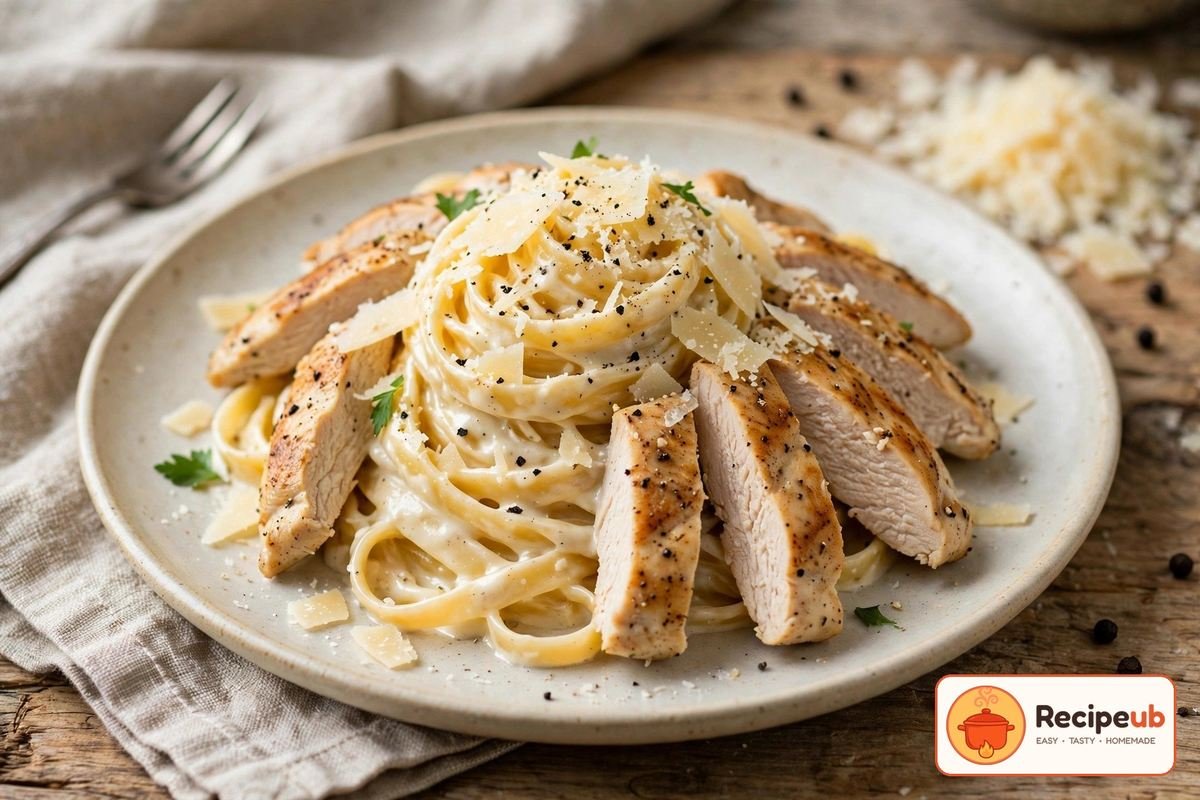
The chicken is seared whole and sliced, never cubed into the sauce. Chicken pieces cooked inside a cream sauce come out pale and slightly overcooked, with none of the browned edges a sear gives — the brand holder’s testing says so plainly, and the format is also what makes the plate look like the dish: sliced cutlets fanned over twirled fettuccine. Searing first also means the chicken rests while the pasta cooks, so its juices stay in the chicken instead of thinning the sauce.
The fettuccine is broken in half, and the chart says why. Whole strands in a standard skillet spend their first 3 minutes half out of the liquid, needing a stir every 30 seconds while they soften and sink. Halves submerge the moment they hit the pan and cook evenly from minute one. It is the format answer to the one-pot breakage problem — and the chart below prints both rows, with the wide-pan rule for cooks who refuse to break pasta on principle.
The emulsion is a sauce family this shelf already knows — with the pasta in it. A cream-and-Parmesan pan sauce is not new here: my creamy tuscan chicken — the one-pan Tuscan chicken with spinach and sun-dried tomatoes and no pasta; this one is the pasta itself, in Alfredo sauce runs one over chicken alone, as an entrée. This post is what happens when that sauce has to do the harder job — cooking 12 ounces of fettuccine in itself, and finishing as an emulsion instead of a pour-over. Same family, different engineering.
The jar gets numbers, not a sneer. “With jar sauce” completes in six of the ten autocomplete stems for this dish — the jar is the second recipe for Alfredo in America, and pretending otherwise helps nobody. So the verdict chart below prints the jar’s own label (390 mg of sodium per quarter cup, about 2,730 mg per jar, and the stabilizer list that explains why it never breaks) next to this pot’s numbers, and states honestly where the jar wins. A reader who chooses it after seeing the label has made an informed trade.
The numbers show their work. This page prints what a serving costs (about $3.00, on verified chicken and milk prices and labeled estimates for the rest) and why its calorie number is ~895 when page 1 claims everything from 491 to 1,058 for the same-named dinner: the builds and the bowls differ, and once both are stated, the spread explains itself. A number you can audit beats a number you are asked to trust.
How Much Liquid Does One-Pot Pasta Need? The Pasta Shape × Liquid Chart
Here is the first chart this post exists to print, and it starts with the split page 1 never acknowledges: there are two liquid camps for this dish. One cooks the pasta in milk and broth and finishes with cream; the other simmers the pasta in the full cream from the start. Both camps print their method as the method, and neither names the other. This chart is built on the milk-and-broth system — the one that stays silky for long strands — and every row is measured per 12 ounces of pasta in a 12-inch deep skillet. Every row ends at the same finish: just shy of al dente, the liquid reduced to a glossy coating layer — the cream and Parmesan finish it from there.
| Pasta shape | Cooking liquid per 12 oz | Simmer time | The stirring rule |
|---|---|---|---|
| Fettuccine, broken in half — the recipe | 4½ cups (3 broth + 1½ milk) | 11–12 min | Halves submerge at once; stir in the first minute, then every couple of minutes |
| Fettuccine, whole strands | 4½ cups (3 broth + 1½ milk), wide pan required | 11–13 min | Stir every 30 seconds for the first 3 minutes while the strands soften and sink — the price of unbroken strands |
| Penne | 4 cups (2½ broth + 1½ milk) | 13–14 min | Stir every couple of minutes; the tubes trap liquid, so the pot reads wetter than it is — judge by a bitten tube, not the surface |
| Rotini / fusilli | 4 cups (2½ broth + 1½ milk) | 12–13 min | Stir every couple of minutes; the spirals shed starch fastest — the sauce thickens earliest |
| Spaghetti / linguine, broken in half | 4¼ cups (2¾ broth + 1½ milk) | 10–11 min | As the fettuccine halves; thinner strands overcook fastest — start tasting at 9 |
How to read the chart: the volumes are the convergent middle of the versions that rank for this dish, normalized to 12 ounces and to this recipe’s system — which is why the chart’s 4½ cups sits below the cream-inclusive builds: cream added at the end is volume the pasta never has to absorb. The two-camp note, printed with the chart because the chart is where it belongs: the cream-from-the-start camp is forgiven by short shapes and large liquid volumes — a penne or rotini pot with plenty of cream can land fine. For long strands at family scale, milk-and-broth first is the method that stays silky, and the reason is the first row of the Sauce Fix Chart below. One more honest note, because the title of this dish promises it: at least one famous “one pot” Alfredo never cooks its pasta in the sauce at all — it boils the pasta in a separate pot of water and stirs it into a flour-roux sauce. That is a fine dinner and a different promise. Every row of this chart cooks the pasta in the sauce, for real. The charted add-in, because the searches ask for it: 2 cups of small broccoli florets go in for the last 3–4 minutes of the pasta cook and add about 15 calories per serving (estimate).
Why Did My Sauce Go Grainy? The Sauce Fix Chart
Here is the second chart. Alfredo fails five ways, and every one of them has a cause and a rescue. The fixes live on sauce-science pages that the pasta searcher never lands on, and the one recipe page founded on the glue problem still prints its rescues as asides — so here they are as one system. Every fix happens off the boil; heat is the cause of three of the five.
| What you see | The cause | The fix |
|---|---|---|
| Gluey, pasty sauce | Cream simmered with the pasta for the whole cook — fat + starch emulsifying for 12 minutes instead of 2 | Prevention is the recipe: pasta in milk + broth, cream at the end. Rescue: a splash of hot pasta liquid, tossed hard |
| Grainy, sandy sauce | Parmesan added to boiling liquid (the proteins seize into clumps) or pre-shredded cheese — its anti-caking cellulose resists melting (the Parmesan Rule below) | Off the heat; whisk in warm pasta liquid a splash at a time. Mild graininess smooths out; a badly broken batch improves but may not return to perfect — printed honestly |
| Oily pools / separated sauce | The emulsion broke — the sauce boiled after the cheese went in, squeezing the fat out | Off the heat; whisk in 1–2 Tbsp room-temperature cream and toss until it comes back together; never re-boil it |
| Thin, watery sauce | Too much liquid left, or the pasta pulled early | Simmer 1–2 minutes more (before the cheese, ideally), or stir in ¼ cup more finely grated Parmesan off the heat; remember the sauce thickens as it stands for 2 minutes off the heat |
| Bland, flat sauce | Under-salted (the Parmesan’s salt varies by wedge) or no finish | Salt after the Parmesan, never before; the pinch of nutmeg and black pepper are the classic finish; a squeeze of lemon is the modern one — printed as a note, not the base |
How to read the chart: three of the five failures are the same failure at different moments — the emulsion was asked to survive heat it cannot survive. That is why this recipe reserves a mug of the hot pasta-cooking liquid before the finish: it is the first tool for two of the five rescues, and it costs nothing but remembering. A page that prints the fixes without the arrangement is a first-aid kit; this post prints both — cream late, cheese off the boil, leftovers reheated gently, and the rescues for the nights it goes wrong anyway.
Jarred or Homemade? The Alfredo Verdict
Here is the third chart, and it answers the loudest secondary demand in the searches for this dish — with jar sauce completes on six of the ten autocomplete stems — with numbers instead of a sneer. The jar’s figures are its own published label, read in November 2026: Bertolli Alfredo, the leading US jar, at 390 mg of sodium and 90 calories per ¼ cup.
| Jarred — Bertolli Alfredo, 15 oz jar | Homemade — this recipe | |
|---|---|---|
| Sodium | 390 mg per ¼ cup → ≈2,730 mg per jar, before the pasta or its salted water | You hold the salt shaker: low-sodium broth + Parmesan’s salt + salt to taste at the end — the pot’s sodium is a decision, not a label |
| What’s in it | Water and cream first, then the stabilizer system: modified food starch, sodium phosphate, xanthan gum, enzyme-modified egg yolk — engineered so it cannot break | Butter, cream, milk, broth and actual Parmesan as the body of the sauce — it can break, which is what the Fix Chart and the Parmesan Rule are for |
| The build it makes | 24 oz jar + penne + a jar of water (the jar holder’s method) — its own card reads 1,058 kcal/serving | 12 oz fettuccine + the emulsion finish — ≈895 kcal/serving (estimate), itemized in the recipe card |
| Cost | Jar ≈$2.50–$3.50 (typical shelf range, labeled as such) — plus the same chicken and pasta the homemade pot needs | ≈$3.00 per serving all-in; the Parmesan wedge is the line the jar saves |
| Where it wins | A Tuesday with no Parmesan in the house, or a cook who wants zero emulsion risk — it reheats without breaking because there is no emulsion to break | Flavor (real cheese), sodium control, reheating taste, and the sauce is the pasta’s cooking liquid — no jar-of-water dilution |
How to read the table: the jar is not a scam and the chart does not call it one — it is a stabilized sauce product whose trade is printed on its own label. What the chart refuses is the current page-1 arrangement, in which the jar recipe never shows the jar. A reader who chooses the jar after seeing 2,730 mg has made an informed trade; a reader who never saw the number hasn’t chosen at all. One piece of dated context, printed as history and not as a warning: the ready-to-eat chicken fettuccine Alfredo meals recalled in June 2025 over Listeria — an outbreak federal investigators declared over in February 2026 — are long gone from shelves, and no recall touches this recipe’s ingredients. It is simply the documented backdrop for the homemade lane: the from-scratch pot has no supply chain.
Fresh-Grated or Pre-Shredded? The Parmesan Rule
Here is the fourth chart — one rule in three forms: grate it fresh, add it off the boil, in two additions. Every ranking page says “freshly grated” as an adjective and moves on; this chart prints it as a rule, with the mechanism and the amount conversion, because the Parmesan is not a garnish in this dish — at 4½ ounces it is a third of the sauce’s body, and its form decides the sauce’s texture.
| Form | What’s on it | In the sauce | The amount |
|---|---|---|---|
| Fresh-grated from a wedge — the recipe | Nothing | Melts fully into the emulsion; the sauce is smooth and tastes like cheese | 1¼ cups finely grated ≈ 4½ oz for this pot |
| Pre-shredded bag | Cellulose / potato-starch anti-caking (keeps the shreds separate in the bag — and separate in your sauce) | Melts in grains; the sauce can stay gritty no matter how long you stir | Use about ⅔ the volume — the brand holder’s footnote conversion (¾ cup fresh ≈ ½ cup pre-grated, because the bag’s shreds are denser and drier) — and accept the texture trade |
| Shelf-stable can (the green shaker) | Anti-caking + a much drier, finer product | Melts, but the flavor is flat and salty rather than nutty — it seasons more than it sauces | A finishing sprinkle, not a sauce base; do not build the emulsion on it |
How to read the chart: the conversion row is the part a reader with a bag of pre-shredded in the fridge actually needs, and it is the part page 1 buries in a recipe footnote. The two-additions rule works with the chart: half the Parmesan goes in first and melts into the cream, the second half follows once the sauce is already a sauce — a single dump of cold cheese into hot liquid is how the grainy row of the Fix Chart gets its customers. Grating the wedge is counted in this recipe’s prep time on purpose; it is 3 of the 10 minutes, and it is the cheapest insurance in the dish.
What Does the Pot Cost? The Honest Math
No page that ranks for this dish prints a full cost — the jar lane prints a jar, the from-scratch lane prints nothing. Here is this pot’s math, dated to the October 2026 evidence like the rest of this site’s shelves — the chicken and milk lines are verified BLS average prices, and everything else is labeled a pantry estimate, printed as one:
| Line | Amount for the batch | Price basis | Batch cost |
|---|---|---|---|
| Chicken breast | 1½ lb | $4.099/lb, BLS Oct 2026 (verified) | $6.15 |
| Whole milk | 1½ cups | $4.101/gallon, BLS Oct 2026 (verified) | ≈$0.38 |
| Fettuccine | 12 oz (of a 16 oz box) | Pantry estimate, labeled as one | ≈$1.00 |
| Parmesan wedge | 4½ oz, fresh-grated | Pantry estimate, labeled as one | ≈$2.50 |
| Heavy cream | ½ cup (of a pint) | Pantry estimate, labeled as one | ≈$0.90 |
| Butter, broth, olive oil, garlic, parsley | Pantry amounts | Estimate, labeled as one | ≈$1.10 |
| Batch total | 4 servings | ≈$12.00 → about $3.00 per serving |
How to read the table: only the chicken and milk lines are price-verified; the rest are labeled estimates, printed as estimates. The comparison the table exists for is the Verdict above: the jar version still buys the chicken and the pasta, so the honest delta between the lanes is the Parmesan wedge and the cream against the jar’s price — about a dollar a pot, not the “homemade is expensive” story either camp tells.
Ingredients
- 1½ lb boneless, skinless chicken breasts (2 large), butterflied or halved horizontally into 4 cutlets
- Kosher salt and black pepper, for the chicken
- 1 Tbsp olive oil
- 2 Tbsp unsalted butter
- 2 cloves garlic, minced
- 3 cups low-sodium chicken broth
- 1½ cups whole milk
- ¾ tsp kosher salt (for the pasta liquid)
- 12 oz fettuccine, broken in half
- ½ cup heavy cream
- 1¼ cups freshly grated Parmesan (about 4½ oz), plus more for serving
- Pinch of nutmeg (optional)
- Chopped fresh parsley, for serving
- 2 cups small broccoli florets (optional add-in — see the notes)
Ingredient notes: The Parmesan is the sauce, so buy it like it matters: a wedge you grate yourself, because the bagged shreds carry the anti-caking coating that keeps them from melting smooth — the Parmesan Rule above has the mechanism and the ⅔-volume conversion if the bag is what you have. The chicken is butterflied into cutlets so it sears fast and evenly to 165°F and slices into the fan the dish is served as; two thick whole breasts would still be raw in the middle when their surfaces are done. The pasta is fettuccine, broken in half — the halves submerge at once and cook evenly, and the Shape × Liquid Chart times the whole-strand version for a wide pan if breaking pasta is not something you do. The liquid is a split, on purpose: broth carries most of the volume so the milk does not scorch, and the milk is whole — its fat is part of the sauce’s body before the cream ever arrives. The cream is only ½ cup, a finish and not the cooking medium, which is the entire architecture of the recipe. And the garlic is 2 cloves, a background note under butter and Parmesan — the garlic-led version of a one-pot chicken pasta is a different post on this shelf, linked in the intro.

How to Make One Pot Chicken Alfredo Pasta
- Sear the chicken. Pat the cutlets dry, season both sides with kosher salt and black pepper, and heat the olive oil in a 12-inch deep skillet or Dutch oven over medium-high heat. Sear the cutlets 4–5 minutes per side, until deeply golden and the thickest part reads 165°F.
- Rest and slice. Move the chicken to a board and rest it 5 minutes — it will slice while the pasta cooks. Slice across the grain into strips just before serving, so the juices stay in the chicken instead of thinning the sauce.
- Start the base. In the same pan over medium heat, melt the butter and cook the garlic for 30 seconds, just until fragrant — no browning. The browned chicken bits left in the pan are flavor; leave them.
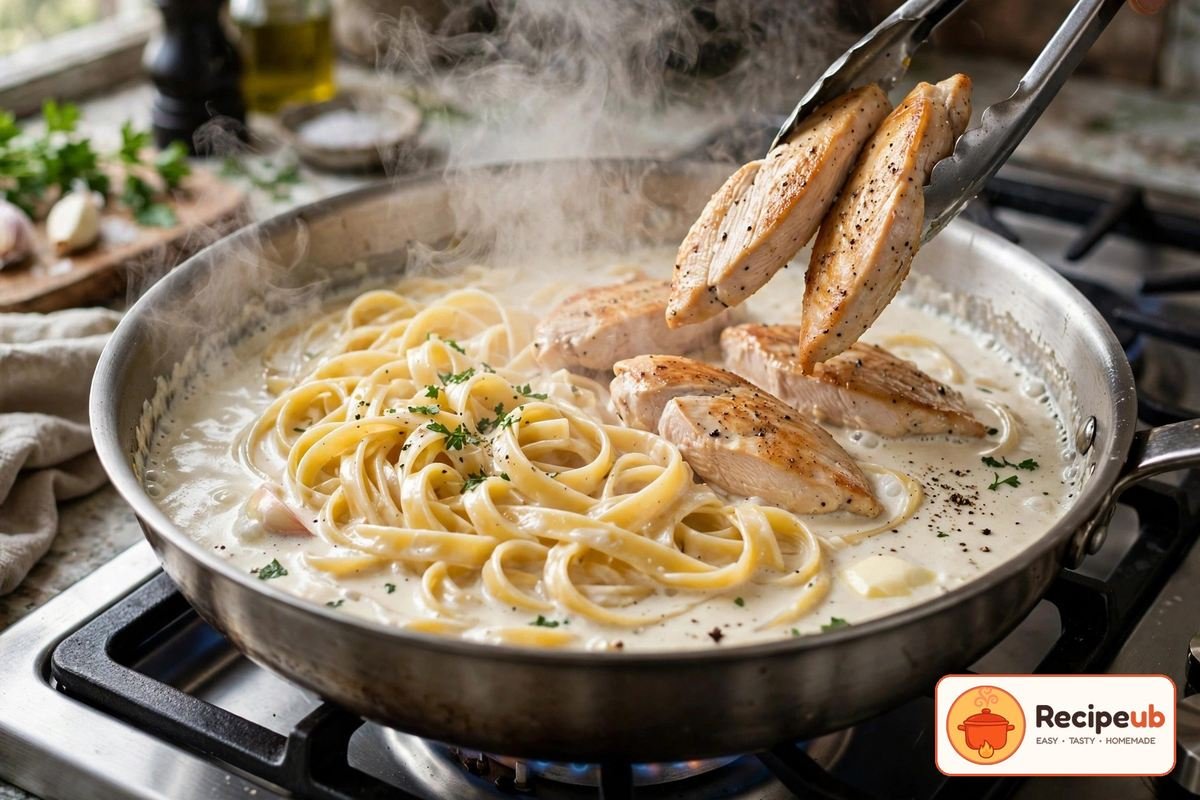
- Add the liquid and the pasta. Pour in the broth and milk, add the ¾ tsp kosher salt, and bring to a gentle simmer. Add the fettuccine halves and stir in the first minute so they submerge and separate.
- Simmer the pasta 11–12 minutes. Keep it at a steady simmer — never a hard boil — stirring every couple of minutes, until the pasta is just shy of al dente and the liquid has reduced to a glossy layer coating the pan. (Broccoli, if using, goes in for the last 3–4 minutes.) Before you finish, ladle a mug of the hot cooking liquid aside — it is the Fix Chart’s first tool.
- Finish off the boil. Take the pan off the heat (or to the lowest setting). Stir in the cream, then the Parmesan in two additions, tossing after each until the sauce turns glossy and coats every strand, 1–2 minutes. Add the nutmeg if using, black pepper, and salt now — after the Parmesan, never before. If the sauce reads thick, toss in a splash of the reserved liquid. Lay the sliced chicken over the top, shower with parsley and extra Parmesan, and serve straight from the pan.

One Pot Chicken Alfredo Pasta (No Jar Sauce, 35 Minutes)
Ingredients
Equipment
Method
- Pat the chicken cutlets dry, season with salt and pepper, and sear in the olive oil in a 12-inch deep skillet over medium-high heat, 4–5 minutes per side, to 165°F. Rest 5 minutes; slice across the grain just before serving.
- In the same pan, melt the butter over medium heat and cook the garlic for 30 seconds, until fragrant.
- Add the broth, milk and ¾ tsp salt; bring to a gentle simmer. Add the fettuccine halves, stirring in the first minute so they submerge.
- Simmer 11–12 minutes, stirring every couple of minutes, until the pasta is just shy of al dente and the liquid has reduced to a glossy layer. (Broccoli goes in for the last 3–4 minutes.) Ladle a mug of the hot cooking liquid aside.
- Off the boil, stir in the cream, then the Parmesan in two additions, tossing until glossy, 1–2 minutes. Season with nutmeg (if using), black pepper and salt to taste; loosen with a splash of the reserved liquid if needed.
- Lay the sliced chicken over the top, shower with parsley and extra Parmesan, and serve.
Emma’s Tips for the Best One Pot Chicken Alfredo Pasta
Grate the Parmesan before anything gets hot. The finish of this dish is a 2-minute window — pan off the boil, cream in, cheese in, toss, serve — and it does not pause for grating. The wedge gets grated during prep (it is counted in the 10 minutes on purpose), into a pile, next to the stove. Pre-shredded is the charted fallback at ⅔ the volume, not a plan.
Reserve the mug of pasta liquid before the finish, every time. It is the rescue for the two most common failures — gluey and grainy — and it only exists in the minute before the cream goes in. Ladling it aside takes five seconds; discovering you needed it after the pan is drained and finished takes the whole sauce. Hot, starchy, already seasoned: nothing else in the kitchen does its job.
Salt after the Parmesan, never before. Parmesan wedges vary in saltiness more than any other ingredient in this pot, and the pasta liquid is already salted. Taste the finished sauce first, then salt — a quarter teaspoon at a time. It is the whole content of the Fix Chart’s bland row, and it is free.
Slice the chicken at the last second, across the grain. The cutlets rest while the pasta simmers, and they get sliced after the sauce is glossy — not before — so the juices stay in the meat. Across the grain keeps each slice tender instead of stringy, and fanning the slices over the twirled pasta instead of stirring them in keeps the seared edges seared. The chicken is a topping here, not a mix-in; that is the dish.
Storage and Reheating
Fridge: Leftover Alfredo keeps 3 to 4 days at 40°F or below — the careful end of the range the ranking pages print, and the same standard as the rest of this site. Refrigerate within 2 hours. Two honest caveats, both from the Fix Chart’s physics: the emulsion thickens hard in the fridge, and the pasta keeps absorbing sauce overnight (the same absorption rule this site’s soup shelf runs on), so a day-2 bowl starts out looking dry and tight. That is expected, not spoiled — the reheat below is built for it.
Reheating: Gently, or not at all. Warm the leftovers over low heat with 1–2 Tbsp of milk per serving whisked in (or in the microwave at 50% power, stirring between bursts), and never let the sauce boil — boiling is what squeezes the fat out of the emulsion and leaves oily pools no whisking fully rescues. Done by the rule, leftovers come back glossy; done at a rolling boil, they come back separated, and the Fix Chart’s separated row is a rescue, not a guarantee.
Freezer: Not the finished dish. A frozen-and-thawed cream-Parmesan sauce breaks grainy and the pasta goes soft — the cluster’s honest line, and this post prints it as its rule. Freeze the seared, sliced chicken instead (up to 3 months) and cook the pasta and sauce fresh on serving day; the sauce takes 15 minutes, which is the whole point of the dish. If a finished portion is frozen anyway, thaw it overnight in the fridge and reheat by the rule above, accepting a softer bowl.
FAQs
Can you really cook the pasta in the Alfredo sauce — in one pot?
Yes — that is this recipe’s whole method, and the liquid is measured for it. The fettuccine simmers in 3 cups of broth and 1½ cups of milk (4½ cups per 12 oz, on the Shape × Liquid Chart), releases its starch into that liquid, and the cream and Parmesan finish it into the sauce off the boil. One honest note, because the title matters: at least one famous “one pot” Alfredo actually boils its pasta in a separate pot of water and stirs it into a flour-roux sauce — a fine dinner, but a different promise. Here, one pot means the pasta cooks in the sauce, start to finish.
Do you break the fettuccine in half for one-pot Alfredo?
In a standard 12-inch skillet, yes. The halves submerge the moment they hit the liquid and cook evenly for 11–12 minutes with an occasional stir. Whole strands are the wide-pan version: same liquid, 11–13 minutes, but you stir every 30 seconds for the first 3 minutes while the strands soften and sink — that stirring is the price of unbroken pasta, and the chart prints both rows so the choice is made with the cost showing. Either way, the finish is the same: just shy of al dente, because the strands keep cooking in the hot sauce.
Why did my Alfredo sauce go gluey — or grainy?
Two different failures with two different causes. Gluey is the cream’s fault: cream simmered with the pasta for the whole cook emulsifies fat and starch for 12 minutes and lands pasty — the fix is prevention (pasta in milk and broth, cream at the end) and the rescue is a splash of hot pasta liquid tossed hard. Grainy is the cheese’s moment: Parmesan added to boiling liquid seizes into clumps, and pre-shredded cheese’s anti-caking cellulose resists melting in the first place — the fix is off the heat, whisking in warm liquid a splash at a time. The full five-failure system is the Sauce Fix Chart above.
Can I use a jar of Alfredo sauce instead?
You can — it is the most-searched variation of this dish, and the Verdict above answers it with the jar’s own numbers. A 15-oz jar of Bertolli Alfredo carries 390 mg of sodium per ¼ cup — about 2,730 mg per jar — and its body comes from modified food starch and stabilizers rather than cheese, which is why it never breaks and never quite tastes like Parmesan. The jar holder’s own build (24 oz of jar sauce, penne, a jar of water) reads 1,058 kcal a serving on its own card. The jar wins on a Tuesday with no Parmesan in the house; the homemade pot wins on flavor, sodium control and cost per serving once the chicken and pasta — which both versions buy — are counted. Choose it with the label showing.
Can I make one-pot chicken Alfredo without heavy cream?
Mostly, yes — because the pasta already cooks in milk and broth. The cream in this recipe is only a ½-cup finish. Skip it and finish instead with an extra ½ cup of whole milk and 2 Tbsp of butter whisked in off the heat: the sauce lands lighter and a little less glossy, and the Parmesan carries more of the body, so grate the full amount and add it in the same two additions. What does not work is finishing with milk alone and no butter — the emulsion needs some fat at the end, or the sauce reads thin no matter how long it simmers.
Can I use penne instead of fettuccine?
Yes — it is a charted swap, not a different recipe. Per 12 ounces of penne, use 4 cups of liquid (2½ broth + 1½ milk) and simmer 13–14 minutes; the tubes trap liquid, so judge doneness by biting a tube, not by how wet the pot looks. Two honest notes: penne is the shape the rest of this shelf’s creamy chicken pastas are built on (the garlic-led one linked in the intro among them), so the fettuccine is part of what makes this post the Alfredo — and a penne pot is the one case where the cream-from-the-start camp gets away with more, because short shapes forgive what long strands don’t.
When does the Parmesan go in — and can I use the pre-shredded kind?
The Parmesan goes in off the boil, at the very end, in two additions — half melts into the cream first, the second half follows once the sauce is already a sauce. Into boiling liquid, it seizes grainy; all at once, it clumps. The pre-shredded bag works with two adjustments from the Parmesan Rule: use about ⅔ the volume (the bag’s shreds are denser and drier — ¾ cup fresh-grated ≈ ½ cup pre-grated), and accept that its anti-caking cellulose can leave the sauce faintly gritty no matter how carefully you add it. The shelf-stable can is a finishing sprinkle, not a sauce base.
How do you reheat chicken Alfredo without the sauce separating?
Low heat, added liquid, no boil. Warm the leftovers over low heat with 1–2 Tbsp of milk per serving whisked in — or in the microwave at 50% power, stirring between bursts — until it is glossy and steaming, and stop there. A boil is the one thing that breaks it: the heat squeezes the fat out of the emulsion into oily pools. If a bowl has already separated, take it off the heat and whisk in a tablespoon of room-temperature cream; it comes back together more often than not, and the honest limit is in the Fix Chart — a badly broken sauce improves, but may not return to perfect.
Can I add broccoli?
Yes — it is the add-in the searches ask for by name, and it is charted rather than improvised: 2 cups of small broccoli florets go into the pasta for the last 3–4 minutes of the simmer, which cooks them tender-crisp in the same liquid without a second pan. It adds about 15 calories per serving (estimate) and turns the pot into the chicken-broccoli Alfredo the autocomplete set keeps completing for. Cut the florets small — big florets are still crunchy when the pasta is done, and the pasta does not wait.
How many calories are in one-pot chicken Alfredo?
About 895 calories for a full serving of this build (estimate) — 1½ lb of chicken, 12 oz of fettuccine, ½ cup of cream and 1¼ cups of Parmesan across 4 servings, itemized in the recipe card so the number can be audited. The famous low number for this dish, 491, is a 7-ounce-chicken, 8-ounce-pasta build split 3 ways — a lighter dinner, honestly labeled on its own page, but a different bowl. The jar build’s own card reads 1,058, carrying 24 oz of jar sauce and two cheeses. And for this site’s own shelf: the garlic-led penne linked in the intro prints 810 at similar chicken and pasta weights with more cream and no milk — the two cards are consistent once the builds are stated, which is the only way any of these numbers mean anything.
Final Thoughts
One pot chicken Alfredo pasta is not a glamorous recipe either, and it is the Tuesday backbone anyway: the named dish a family asks for by name, at about $3.00 a serving, in 35 minutes with one pan to wash. What this page adds is the paperwork the other versions leave out — a chart that times five pasta shapes against their liquid and names the two camps page 1 pretends aren’t arguing, a fix chart for the five ways this sauce fails with the rescues measured, a jar verdict that prints the jar’s own label instead of sneering at it, and a Parmesan rule with the mechanism and the conversion the brand holder keeps in a footnote. Silky sauce, sliced chicken, honest numbers — that is the deal.
More Easy One-Pot & Skillet Dinners
If a one-pot pasta with a chart is your kind of system, the rest of this shelf runs on the same rules — every liquid measured, every number showing its work. The spiced end of the shelf starts with my one-pot cajun chicken pasta — the Cajun-spiced penne with cream cheese and fire-roasted tomatoes; this Alfredo is the unspiced original the Cajun version riffs on, and its Tex-Mex sibling is my one-pot chicken fajita pasta — the fajita-spiced penne with peppers and pepper jack; the same one-pot weeknight slot, pointed at Tex-Mex instead of Italian-American for the nights the pot should taste like a fajita pan. When the named dish should be beef instead of chicken, my one-pot taco pasta — the other named-dish one-pot on this shelf, taco-spiced beef and pasta under melted cheese runs the same one-pan promise in the taco lane, and my cheesy ground beef and rice skillet — the one-pot shelf’s rice entry, for the nights the one pot holds rice instead of pasta is what this shelf does when the starch is a grain instead of a noodle. One shelf, one system — the pot is measured before it is loaded, and dinner is handled.



Never Run Out of Dinner Ideas
One easy air fryer or slow cooker dinner in your inbox every week. No spam, ever.
You’re on the list — welcome to Recipeub!