
Meal Prep on a Budget for Beginners (8 Meals, One Hour, About $1 a Meal)
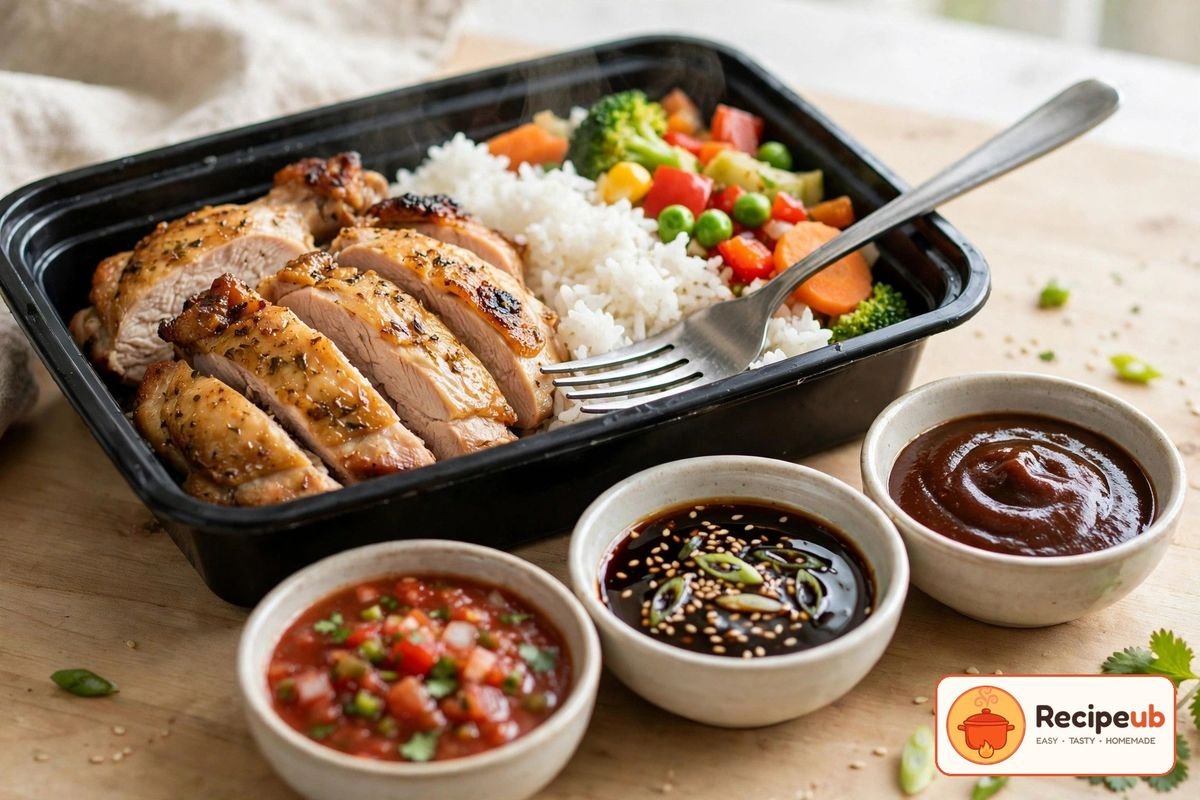
Meal prep on a budget for beginners fails, when it fails, before the oven is ever switched on — at the planning stage, where a first-timer is handed five recipes, three proteins and a four-hour Sunday, and quietly orders pizza by Wednesday. Read the searches honestly and the beginner is asking for something much smaller: how to start meal prepping for beginners, how to meal prep for the week for beginners, meal prep grocery list on a budget, one week meal prep grocery list. A short list, a first week, a way in. This page is built to be exactly that size. The whole system is three components — 2 pounds of boneless skinless chicken thighs, 2 cups of long-grain white rice, 2 pounds of frozen mixed vegetables — cooked in one 60-minute session (two sheet pans and the rice pot all running at once) and portioned into 8 boxes at about 410 calories and ≈$1.05 a meal (both estimates, itemized on this page). Four boxes are eaten fresh, four are frozen for the back half of the week, and the boxes are sauced three different ways at eating time so the same batch never tastes like the same dinner twice.
Read page 1 for this search closely and nobody hands the beginner that system. The guide at the top describes a 90-minute routine in prose — rice, sheet-pan vegetables, skillet thighs, lentils — with no amounts anywhere, so a reader can imitate it but cannot cook it. The first-week site prints price ranges instead of a list (“total first-week budget: $30–50 for about 12–14 prepared meals,” roughly $2.50–4 a meal, no source and no month attached). The one collection with a cost table — eight recipes, a weekly method, a section literally titled “Cost Comparison by Protein” — compares its proteins by prep effort and storage life and prints no prices at all, and its own FAQ answers the question “how much does a week of budget meal prep usually cost?” by telling the reader to track their own receipts for two or three weeks. The question the whole cluster is asking is printed on the strongest page in the cluster — and declined. This page answers it with a receipt: a grocery list priced line by line, every price carrying its basis and its month, and a protein-per-dollar chart that does the division the other pages leave as adjectives.
It also knows its neighbors on this site, because this shelf already holds three budget preps a beginner could land on instead, and each is a different job. This post is the first-week system — the one to cook before all the others — and it lives inside the shelf collected at budget meal prep ideas — the whole shelf of budget preps on this site; this post is the one to cook first. If the beginner stage is already behind you and the numbers you chase are macros, that is cheap high-protein meal prep — the step up once the habit sticks: 10 boxes at 37 g+ protein in a 90-minute session; this beginner system is three components in one hour, no macro targets. And if the problem is not starting but surviving the week the grocery run never happened, that is cheap pantry dinners — the other budget problem: dinners from a $25 starter pantry when there is no grocery run; this post starts from the planned shop. Three posts, three jobs — this one is the front door.
The short answer: Buy 2 lb of boneless skinless chicken thighs, 2 cups of long-grain white rice and 2 lb of frozen mixed vegetables — a batch that costs ≈$8.50 at October 2026 prices (estimate, priced line by line below). Season the thighs with 2 tsp paprika, 2 tsp garlic powder, 1 tsp kosher salt and ½ tsp black pepper and roast at 425°F for 25–30 minutes to 165°F; roast the vegetables on a second pan at the same temperature for 20–25 minutes; simmer the rice 18 minutes and rest it 10. Everything runs in parallel, so the session is one hour door to door. Portion ¾ cup rice + about 4 oz sliced chicken + about 1 cup vegetables into 8 containers — four to the fridge, four to the freezer — and sauce each box at eating time: salsa, soy-ginger, or BBQ. Eight meals at ≈410 calories and ≈$1.05 each.
In This Recipe
The Plan at a Glance
- The system: three components — one protein, one grain, one vegetable — cooked once and portioned. Components, not dishes: the variety comes from the sauce, not from cooking five recipes
- The protein: 2 lb boneless skinless chicken thighs, seasoned and roasted whole, rested and sliced — the forgiving beginner cut (the Protein-Per-Dollar Chart below shows why, in numbers)
- The grain: 2 cups long-grain white rice + 3½ cups water, simmered 18 minutes and rested 10 — about 6 cups cooked
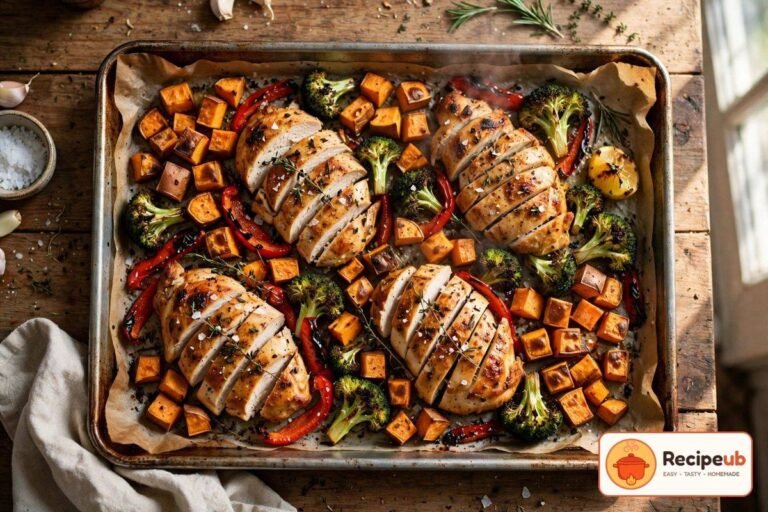
- The vegetable: 2 lb frozen mixed vegetables, oiled and salted, roasted straight from the bag — no washing, no chopping, nothing to wilt in the crisper
- The session: 15 minutes prep / 45 minutes cook, with the pans and the rice pot all running in parallel (stated openly — the hour is a real hour, not three half-hours stacked) / 1 hour total
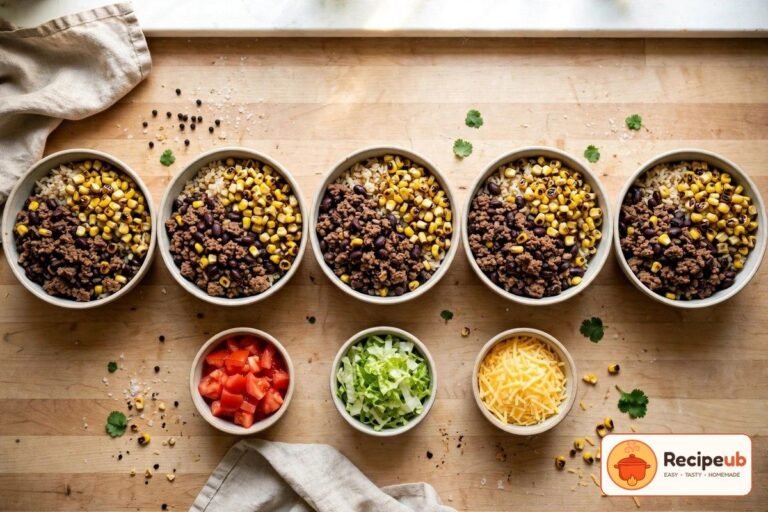
- The yield: 8 meals — ¾ cup rice + about 4 oz chicken + about 1 cup vegetables per box
- The storage rule: eat 4, freeze 4 — cooked food keeps 3 to 4 days in the fridge (USDA), so the back half of the week lives in the freezer, not in wishful thinking
- The sauces: salsa / soy-ginger (2 Tbsp soy sauce + ½ tsp ground ginger per box) / BBQ (2 Tbsp per box) — added at eating time, never in the batch
- Calories: ≈410 per meal (estimate)
- Protein: ≈26 g per meal (estimate — a fact, not a target; the macro-first prep on this site is linked in the intro)
- Cost: ≈$1.05 per meal (estimate) at October 2026 prices — the full receipt is the Grocery List below
Why This Recipe Works
Three components, because a first prep is a habit being installed, not a menu being launched. Every failed first week in the research has the same shape: too many different meals, a session that runs for hours, and a cook who never wants to do it again. Three components is the smallest system that still produces a real lunch and dinner — one protein, one grain, one vegetable — and it is deliberately the same component logic the best system-writing on page 1 describes in prose, except that here it arrives with amounts, times and a yield attached. A beginner who finishes in one hour with eight boxes has a reason to do it again next week; that repeat, not any single recipe, is what meal prep actually is.
Thighs, because the first chicken a beginner cooks should forgive them. A new cook’s thermometer habits are new too, and the two chicken cuts punish a miss in opposite directions: breast dries out the moment it passes its temperature, while thighs stay juicy well past 165°F. Thighs are also the cheaper meat on the shelf — about $2.50 a pound as a labeled shelf estimate, against boneless breast at the BLS October 2026 average of $4.099/lb — so the forgiving cut and the budget cut are the same cut. The full division is in the Protein-Per-Dollar Chart below; the short version is that thighs return ≈31 g of protein per dollar, within a rounding error of eggs, at a price per pound breast cannot match.
Frozen vegetables, because “nothing to prep and nothing to waste” is a beginner feature, not a compromise. The frozen bag needs no washing, no chopping and no race against wilting, it costs less than the same vegetables fresh out of season, and it roasts properly at 425°F — the edges catch in 20–25 minutes while the chicken cooks beside it. For a cook whose whole session budget is one hour, the twenty minutes of knife work a fresh-vegetable prep demands is not a detail; it is the difference between a system that fits the hour and one that doesn’t.
The batch is portioned plain and sauced at eating time, because boredom is a storage problem with a sauce answer. The boredom question is one of the cluster’s own FAQs, and the honest answer the strongest holder gives — change the sauce, not the base — is printed there as a sentence and built here as a system: one plain batch, three named sauces (salsa, soy-ginger, BBQ), chosen per box at the moment of eating. The chicken-and-rice base is a carrier, not a flavor commitment. It is also what separates a component system from a finished dish: my chicken meal prep bowls — one finished dish in four lunch boxes; the beginner system preps components you can sauce three ways is a complete plate, seasoned once and eaten as itself, four times. These boxes are eight starting points instead.
Eight boxes, split four and four, because the fridge rule is a rule. Cooked chicken, rice and vegetables keep 3 to 4 days at 40°F or below — the USDA line every holder on page 1 prints somewhere — and then several of those same holders quietly plan five-to-seven-day fridge weeks against it. This system takes the rule seriously enough to build the yield around it: four boxes are eaten fresh across days 1–4, and four are frozen the day they are made and thawed overnight for days 5–8. The beginner never has to make a day-six judgment call about a box that has been in the fridge since Sunday, because the system never asks them to.
How Much Does Beginner Meal Prep Cost? The Priced Grocery List
Here is the first table this post exists to print. The beginner cluster asks the cost question on every stem — meal prep on a budget grocery list, meal prep grocery list on a budget, one week meal prep grocery list — and page 1 answers it with anecdotes, with undated ranges, and in one case with a cost table whose prices were removed before publication. Here is the actual shop for this batch, priced line by line, with every price carrying its basis and its month. Where the Bureau of Labor Statistics publishes a retail average, the BLS October 2026 figure is used and labeled; where it publishes none — and it publishes no retail series for boneless thighs, rice or frozen vegetables — the line is a labeled shelf estimate, printed as one, never dressed up as a sourced price.
| Line | Amount for the batch | Price basis | Batch cost |
|---|---|---|---|
| Chicken thighs, boneless skinless | 2 lb | ~$2.50/lb, labeled shelf estimate (no BLS retail thigh series exists) | ≈$5.00 |
| Long-grain white rice | 2 cups dry (≈0.8 lb) | Shelf estimate, labeled as one | ≈$0.85 |
| Frozen mixed vegetables | 2 lb | Shelf estimate, labeled as one | ≈$2.20 |
| Oil, paprika, garlic powder, salt, pepper | Pantry amounts | Estimate, labeled as one | ≈$0.45 |
| Batch total | 8 meals | ≈$8.50 → ≈$1.05 per meal |
How to read the table: the total is a receipt, not a range — and the difference is the point. The first-week site on page 1 concludes “$30–50 for about 12–14 prepared meals,” which is a range so wide it cannot be shopped against, checked, or beaten; this table can be all three, because each line states what was assumed. Two honest footnotes keep the $1.05 clean. First, the sauces are not in the batch cost: salsa, soy sauce and BBQ sauce are buy-once jar items at roughly $2–3 a bottle (labeled estimate) that serve many batches, so they are costed as pantry, and the page says so instead of letting the per-meal number hide them. Second, the comparisons that frame the receipt are dated ones: food away from home — the takeout this batch replaces — rose another 0.5% in October 2026 on the BLS release, while this entire eight-meal batch costs less than one delivered lunch. The beginner does not need a cheaper number than $1.05; they need a number whose working is shown, and that is what a receipt is.
What Is the Cheapest Protein for Meal Prep? The Protein-Per-Dollar Chart
Here is the second table, and it answers the question the cluster keeps asking in adjectives. Page 1 will tell a beginner that eggs are cheap and lentils are inexpensive and beef is pricey; the one protein table among the holders compares five proteins by prep effort and storage life and never mentions money. Protein is what a meal is bought for, so here is the division done properly: grams of protein per dollar, on a raw basis from USDA standard reference values, with every row’s price basis labeled — BLS October 2026 averages where BLS publishes them, labeled shelf estimates where it doesn’t.
| Protein | Price basis (dated) | Protein per unit | Protein per $1 |
|---|---|---|---|
| Dried lentils | ~$1.50/lb — labeled shelf estimate | ≈113 g per lb (25 g/100 g dry) | ≈75 g (estimate) |
| Eggs, Grade A large | $2.32/dozen — BLS, Oct 2026 | ≈76 g per dozen (6.3 g/egg) | ≈33 g |
| Chicken thighs, boneless skinless | ~$2.50/lb — labeled shelf estimate (no BLS series) | ≈77 g per lb (17 g/100 g raw) | ≈31 g (estimate) |
| Boneless chicken breast | $4.099/lb — BLS, Oct 2026 | ≈104 g per lb (23 g/100 g raw) | ≈25 g |
| Canned black beans | ~$1.00 per 15-oz can — labeled shelf estimate | ≈22 g per can, drained | ≈22 g (estimate) |
| Ground beef, 80/20 | $6.755/lb — BLS, Oct 2026 | ≈79 g per lb (17.5 g/100 g raw) | ≈12 g |
How to read the chart: lentils win, and it isn’t close — and the chart prints the honest second half anyway: the beginner build above is chicken, because the first prep has to be the one a new cook will actually eat five times in a week, and the chart’s real job is to price the next swaps (an egg breakfast, a lentil week) rather than to crown its cheapest row. The eggs row is the chart’s news: eggs rose 2.1% in October to $2.32 a dozen, but they sit 33.5% below September 2025, after a 2025 spike that peaked at a $6.23 record in March — so the complete protein a generation of beginners learned to skip is cheap again, returning ≈33 g per dollar, within a rounding error of thighs. Breast’s row shows why “just buy chicken” is not advice: the same bird, the leaner cut, returns ≈25 g per dollar at its BLS average against thighs’ ≈31 — the beginner pays more per pound for less protein per dollar and a cut that dries out when overcooked. And beef’s row is the warning label: at $6.755/lb, ground beef returns the least protein per dollar of anything on the table, in a year when the USDA forecasts beef prices up another 8.7%. The chart is not telling the beginner beef is bad; it is showing them the arithmetic the rest of page 1 only gestures at.
How Do You Start Meal Prep on a Budget for Beginners? The First-Week System
Here is the system itself — the spine of the post, in the order a first Sunday actually runs. The whole design is one decision repeated three times: parallel, not sequential. The rice, the chicken and the vegetables all cook at the same time, which is how three components fit inside one hour instead of stacking into three separate cooks. The session, timed:
- Minute 0: Oven on to 425°F. Rice and water into the pot, lid on, burner on — the rice starts first because it asks for nothing after this moment.
- Minute 5: The rice is coming to a simmer; turn it to low. Season the thighs on all sides with the paprika, garlic powder, salt and pepper, and oil both sheet pans.
- Minute 10: Both pans go in — thighs on one, the frozen vegetables (oiled, salted, straight from the bag) on the other.
- Minute 18: The rice comes off the heat and rests, covered, for 10 minutes. Do not lift the lid; resting rice is finishing rice.
- Minutes 30–35: The vegetables come out (20–25 minutes in the oven, edges catching). The thighs stay in to finish.
- Minutes 35–40: The thighs come out at 165°F — 25–30 minutes in — and rest 5 minutes before slicing.
- Minutes 40–55: Slice the chicken. Portion all 8 boxes while everything is warm: ¾ cup rice, about 4 oz sliced chicken, about 1 cup vegetables.
- Minutes 55–60: Lids on. Four boxes to the fridge, four to the freezer. Done — in one hour, with the kitchen the beginner started with.
The eat-4-freeze-4 rule is the system’s storage half, and it comes straight from the fridge math in the Why This Recipe Works section: cooked food keeps 3 to 4 days at 40°F or below, so an 8-box week is four fresh boxes (days 1–4) and four frozen twins (days 5–8), each thawed overnight in the fridge before its day. The frozen boxes are not leftovers; they are the second half of the plan, portioned on purpose. One honest texture note, printed because the beginner will notice it: the roasted vegetables are the component that softens most across a freeze and thaw — which is why the order works out on its own, since the freshest-texture boxes are exactly the ones eaten first.
The 3-sauce rotation is the system’s boredom half. The boxes are portioned plain on purpose, and each box is sauced when it is eaten, not when it is packed: salsa, a spoonful straight from the jar, for the fresh, bright version; soy-ginger — 2 tablespoons of soy sauce with ½ teaspoon of ground ginger stirred in per box — for the savory version; BBQ, 2 tablespoons of bottled sauce, for the sweet-smoky version. Three sauces over one batch is three different dinners from one hour of cooking, and it is the cluster’s own boredom answer — change the sauce, not the base — made specific enough to shop for. The sauces add roughly 20–50 calories a box depending on the choice, stated here so the ≈410 on the card never pretends otherwise.
Ingredients
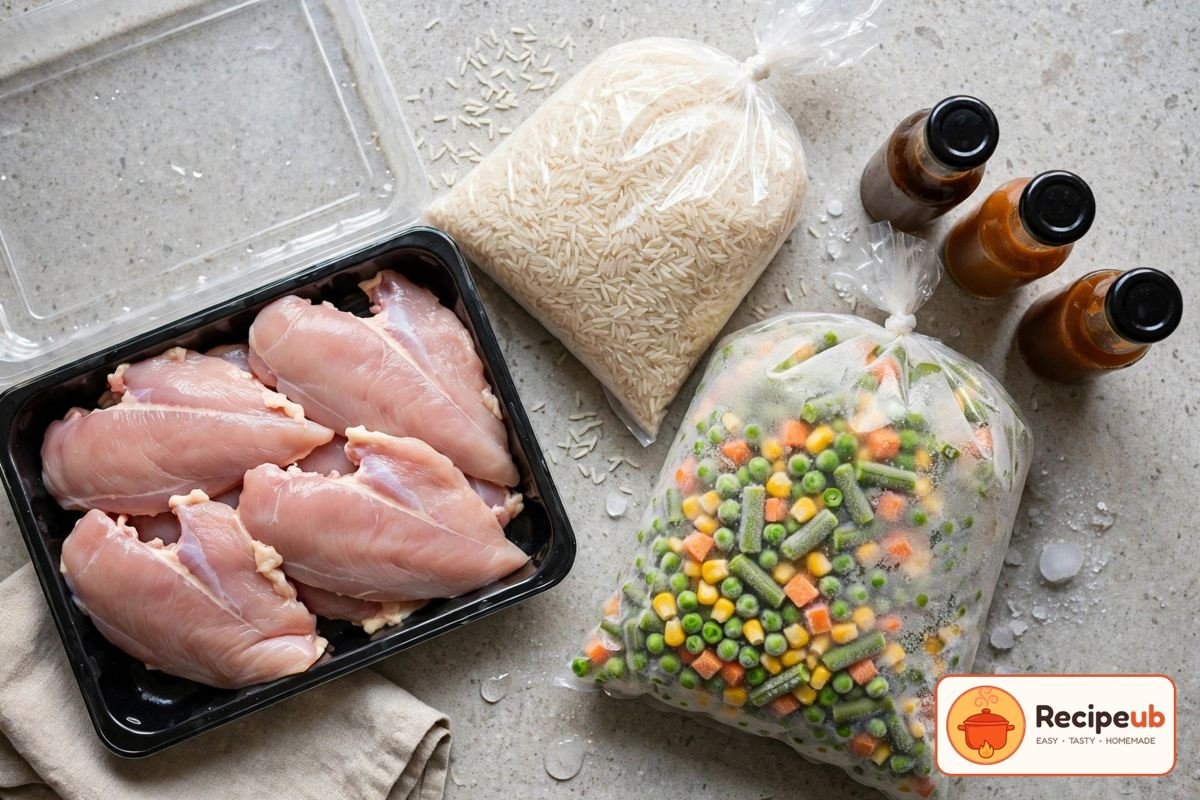
- 2 lb boneless, skinless chicken thighs
- 2 tsp paprika
- 2 tsp garlic powder
- 1 tsp kosher salt, plus ½ tsp for the vegetables
- ½ tsp black pepper
- 2 Tbsp oil, divided (1 Tbsp for the chicken pan, 1 Tbsp for the vegetables)
- 2 cups long-grain white rice
- 3½ cups water
- 2 lb frozen mixed vegetables
- For serving — the sauce rotation (buy once, use all week): salsa; soy sauce + ground ginger (2 Tbsp soy sauce + ½ tsp ground ginger per box); BBQ sauce (2 Tbsp per box)
Ingredient notes: The list is the whole shop, and its shortness is the design — four grocery lines plus pantry seasonings, exactly what the Priced Grocery List above costs out. The chicken is boneless skinless thighs, for the two reasons the Protein-Per-Dollar Chart prints: they return ≈31 g of protein per dollar at the labeled shelf estimate of ~$2.50/lb, and they stay juicy past 165°F where breast dries — the forgiving cut for a first cook. The rice is long-grain white, not brown, on purpose: it is cheaper, it cooks in 18 minutes, and a beginner’s first rice should be the one that cannot come out crunchy; brown rice is a fine week-three swap once the system is a habit. The vegetables are frozen mixed, roasted straight from the bag — no thawing, no chopping — because the bag is what makes the one-hour session honest. The seasonings are four pantry jars the beginner buys once if the cupboard is bare; after week one they are already owned, and the batch cost drops to the three food lines. And the sauces are listed as serving items, not batch ingredients, because that is the system: the batch stays plain, and the flavor decision is made per box, at eating time.
How to Make Meal Prep on a Budget for Beginners
- Start the rice and heat the oven. Set the oven to 425°F. Put the rice and the water in a pot with a lid, bring it to a boil over medium-high heat, then turn it down to low and simmer, covered, for 18 minutes. Take it off the heat and let it rest, still covered, for 10 minutes. Starting the rice first is the whole timing trick — from here on, it needs nothing from you.
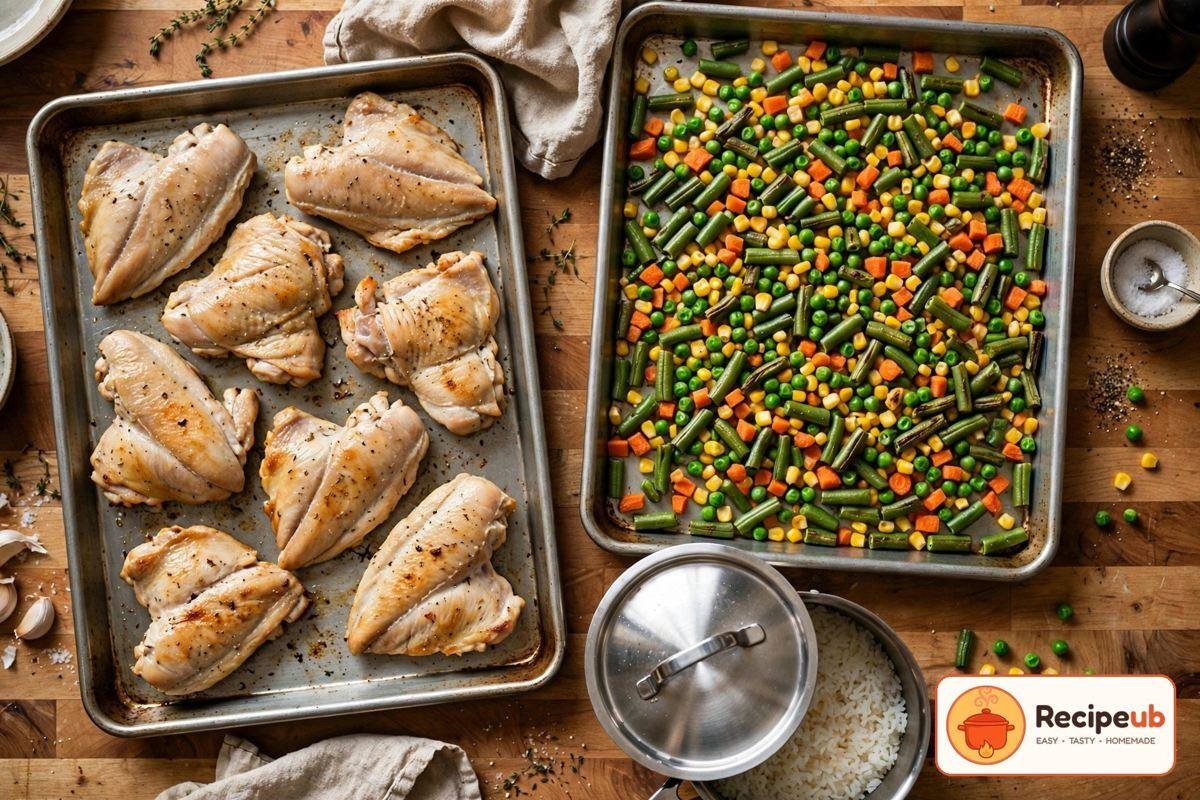
- Season the thighs. While the rice cooks, pat the thighs dry and season them on all sides with the paprika, garlic powder, 1 tsp of the kosher salt and the black pepper. Spread them on a sheet pan brushed with 1 Tbsp of the oil, in a single layer with space between the pieces — crowded chicken steams instead of roasting.
- Pan the vegetables. Toss the frozen mixed vegetables with the remaining 1 Tbsp of oil and the ½ tsp of salt and spread them on the second sheet pan in a single layer. They go in frozen; thawing them first is how roasted vegetables turn to soup.
- Roast both pans. Put both pans in the 425°F oven. Take the vegetables out at 20–25 minutes, when the edges catch and brown. Leave the thighs in for 25–30 minutes total, until the thickest piece reads 165°F on a thermometer — thighs stay juicy a little past that line, which is exactly why they are the beginner cut.
- Rest and slice the chicken. Let the thighs rest 5 minutes so the juices stay in the meat, then slice them against the grain into strips. Warm chicken portions cleaner than cold, so the boxes are built now, not later.
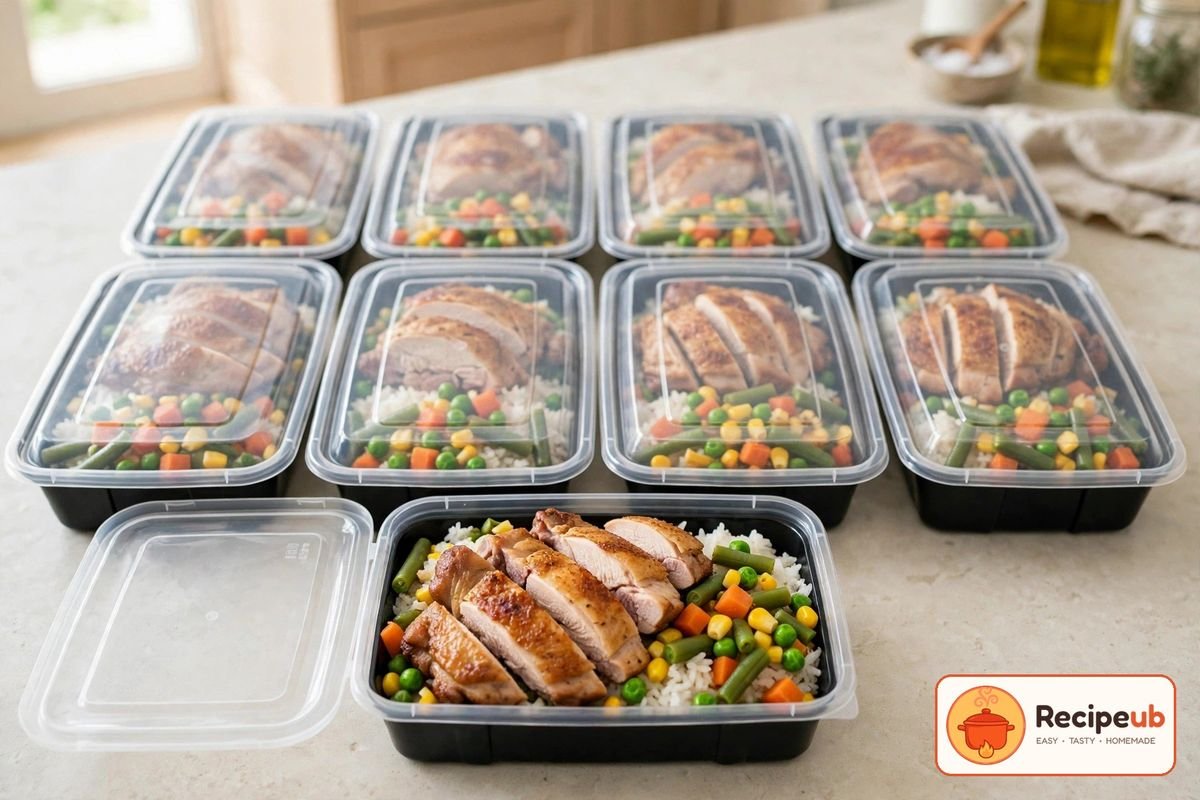
- Portion the 8 boxes. Into each of 8 containers: ¾ cup of the rested rice, about 4 oz of sliced chicken, and about 1 cup of the roasted vegetables. Lids on while everything is still warm.
- Split the week: eat 4, freeze 4. Four boxes go to the fridge for days 1–4. Four go straight to the freezer for days 5–8 — move one to the fridge the night before its day. Sauce each box when you eat it — salsa, soy-ginger or BBQ — never in the batch.
Meal Prep on a Budget for Beginners (8 Meals, One Hour, About $1 a Meal)
Ingredients
Equipment
Method
- Heat the oven to 425°F. Put the rice and water in a lidded pot, bring to a boil, then simmer on low, covered, 18 minutes; rest off the heat, covered, 10 minutes.
- Season the thighs all over with the paprika, garlic powder, 1 tsp salt and the pepper; spread on a sheet pan brushed with 1 Tbsp oil. Toss the frozen vegetables with the remaining 1 Tbsp oil and ½ tsp salt on the second pan.
- Roast both pans at 425°F: vegetables 20–25 minutes, until the edges brown; thighs 25–30 minutes, until the thickest piece reads 165°F. Rest the chicken 5 minutes and slice.
- Portion 8 containers with ¾ cup rice, about 4 oz sliced chicken and about 1 cup vegetables each. Refrigerate 4 for days 1–4 and freeze 4 for days 5–8, thawing each frozen box overnight. Sauce at eating time: salsa, soy-ginger, or BBQ.
Notes
- The receipt: the batch costs ≈$8.50 (estimate) — thighs 2 lb at ~$2.50/lb is a labeled shelf estimate (BLS publishes no retail average for boneless skinless thighs); rice ≈$0.85 and frozen mixed vegetables ≈$2.20 are labeled shelf estimates; oil and seasonings ≈$0.45. That is ≈$1.05 per meal for 8 meals. The sauces are buy-once jar items (≈$2–3 a bottle, estimate) costed as pantry, not per batch.
- The protein-per-dollar chart on the page (grams of protein per $1, October 2026): dried lentils ≈75 g (labeled shelf estimate ~$1.50/lb) / eggs ≈33 g (BLS $2.32 a dozen) / chicken thighs ≈31 g (labeled estimate) / boneless breast ≈25 g (BLS $4.099/lb) / canned black beans ≈22 g (labeled estimate) / ground beef ≈12 g (BLS $6.755/lb). This meal carries ≈26 g of protein (estimate) — printed as a fact, not a target.
- Eat 4, freeze 4: cooked chicken, rice and vegetables keep 3 to 4 days at 40°F or below (USDA), so four boxes are eaten fresh and four are frozen the day they are made (up to 3 months) and thawed overnight. The vegetables soften most across a freeze — the fresh-texture boxes are eaten first by design.
- Brown rice swap: 2 cups brown rice + 4 cups water, simmered about 40 minutes — start it first and the session still fits the hour, with the pans going in while it cooks.
Emma’s Tips for Your First Meal Prep
Prep components, not dinners. The instinct that sinks first weeks is cooking four or five different meals in one session — five recipes, five seasoning sets, four hours. Components invert it: one protein, one grain, one vegetable, cooked once, and the variety applied afterward with sauce. When the system feels too plain in week one, that plainness is the training working; a second component (a pot of beans, a tray of eggs) is a week-two addition, not a week-one requirement.
Portion while everything is warm. Warm rice levels into a container and measures honestly; cold rice clumps and lies about how much is in the box. Warm chicken slices cleaner, and portioning straight from the pans means the boxes are built in the same hour the food was cooked — which is also the food-safety habit, since the batch is lidded and refrigerated inside the 2-hour window instead of cooling on the counter while the cook rests.
Give the frozen vegetables room and heat. The one technique in the whole recipe: a single layer, a hot oven, no thawing. Frozen vegetables dumped in a heap steam in their own meltwater and come out boiled; spread out at 425°F, the water evaporates faster than it pools and the edges brown. If your oven runs small, use the pans one at a time and add 10 minutes to the session — the system survives it.
Label the freezer boxes with the day, not the date. “Day 5,” “Day 6” — a beginner’s freezer boxes get eaten in order when the box itself says which morning it moves to the fridge. It takes ten seconds with a marker on the lid tape, and it is the difference between the eat-4-freeze-4 rule running itself and the rule depending on memory by Thursday.
Storage and Reheating
Fridge: The four fresh boxes keep 3 to 4 days at 40°F or below — the USDA line, and the reason this system never plans a fifth fridge day. Refrigerate the batch within 2 hours of cooking, in the shallow containers it was portioned into. The rice firms up cold; that is expected, and the reheating splash below fixes it.
Reheating: Microwave the box until steaming hot throughout (165°F), with a splash of water sprinkled over the rice first — the cluster-wide fix for day-3 rice, and it works because the grains re-steam instead of drying at the edges. Sauce goes on after reheating, at eating time as always: salsa cold from the jar, soy-ginger stirred together in the moment, BBQ spooned over the hot chicken.
Freezer: The four frozen boxes keep up to 3 months. Thaw each one overnight in the fridge — never on the counter — and reheat by the rule above. The honest cost is texture, and it lands where the system expects it: the chicken and rice freeze and return almost exactly as they were, and the roasted vegetables come back softer. That is why the week’s order is fresh boxes first and frozen boxes second — the best-texture meals are eaten at their best, and the frozen half is still a good lunch on day 7.
FAQs
How much does meal prep cost per week for a beginner?
This batch — the beginner’s first week of lunches and dinners — costs ≈$8.50 for 8 meals, about $1.05 a meal, at October 2026 prices, with every line priced in the Grocery List above: thighs ≈$5.00, rice ≈$0.85, frozen vegetables ≈$2.20, oil and seasonings ≈$0.45, the chicken, rice and vegetable lines labeled as shelf estimates because BLS publishes no retail series for them. Compare the shape, not just the number: the first-week site on page 1 estimates “$30–50 for about 12–14 meals” with no date or source, which works out to roughly $2.50–4 a meal. A beginner who preps twice a week on this system covers the same ground for about $17 of groceries, and the receipt for it fits on an index card.
How do I start meal prepping as a complete beginner?
Start with components, not recipes: one protein, one grain, one vegetable, one hour, 8 boxes. Buy the four-line grocery list, start the rice, roast the protein and the vegetables on two pans at the same time, portion while everything is warm, and split the boxes four fresh and four frozen. That is the entire first week — no special equipment, no macro targets, no five-recipe Sunday. The second week is the same system repeated, which is the point: meal prep is a habit with a grocery list attached, and the habit forms around a session small enough to finish.
How many meals should a beginner prep at once?
Eight — not twenty-one. The classic beginner mistake is prepping every meal for the whole week in one heroic session; the guide at the top of page 1 tells on itself with a four-hour first prep that ended in a Wednesday pizza order. Eight boxes is lunch and dinner for four days, with frozen twins for the rest of the week — a win a first-timer can actually complete, sized to what the fridge rule allows. Once the one-hour session is boring, scale the batch; a system that survives is worth more than a marathon that doesn’t repeat.
What goes on a beginner meal prep grocery list?
Four lines: 2 lb boneless skinless chicken thighs, 2 cups long-grain white rice, 2 lb frozen mixed vegetables, and the pantry seasonings (paprika, garlic powder, salt, pepper, oil) — plus, bought once, the three sauces: a jar of salsa, soy sauce with ground ginger, and a bottle of BBQ sauce at roughly $2–3 each. That is the whole list, priced line by line in the Grocery List above at ≈$8.50 for the batch. If a beginner list you are reading runs to twenty items and three proteins, it is not a beginner list; it is a hobby.
How long does meal prep last in the fridge?
3 to 4 days at 40°F or below — the USDA guidance for cooked chicken, rice and vegetables, and the number this system is built around. It is why 8 boxes are not 8 fridge boxes: four are eaten inside the window and four are frozen the day they are made. Holders who plan five-to-seven-day fridge weeks are printing this same rule in their FAQs and quietly breaking it in their plans; the eat-4-freeze-4 split is what following the rule actually looks like.
Can I freeze meal prep containers?
Yes — the assembled boxes freeze for up to 3 months, and in this system half of them are supposed to. Freeze them the day they are made, thaw each box overnight in the fridge (never on the counter), and reheat to steaming. Rice freezes and reheats well; chicken returns almost unchanged; the roasted vegetables soften the most, which is why the fresh boxes are eaten first and the frozen ones second. No special containers are required — the same boxes you eat from freeze fine.
What is the cheapest protein for meal prep?
By protein per dollar, dried lentils — ≈75 g of protein per $1 at a labeled shelf estimate of ~$1.50/lb — and it isn’t close. The practical answers sit under it in the Protein-Per-Dollar Chart: eggs at ≈33 g per $1 (BLS October 2026 average, $2.32 a dozen — cheap again after the 2025 spike) are the cheapest complete protein, and chicken thighs at ≈31 g per $1 are why this build is chicken. At the other end, boneless breast returns ≈25 g per $1 at its BLS average of $4.099/lb, and ground beef ≈12 g per $1 at $6.755/lb — the chart prints all six so the swap decisions are arithmetic, not adjectives.
Do I need special containers or equipment?
No. The whole system runs on two sheet pans, a pot with a lid, and 8 containers — the beginner kit named on the recipe card. The containers can be the plain reusable kind sold for a few dollars a set (the first-week sites price them at $1–3 each); glass is nicer and heavier, plastic is cheaper and fine. What you do not need is a specialty gadget, a second appliance, or a matching set — the equipment question is real in the searches, and the honest answer is that the barrier to week one is a decision, not a purchase.
How do I keep from getting bored eating the same meal prep?
Change the sauce, not the base. The boxes are portioned plain on purpose and sauced at eating time — salsa for the fresh version, soy-ginger (2 Tbsp soy sauce + ½ tsp ground ginger) for the savory one, BBQ for the sweet-smoky one — so one batch eats like three different dinners across the week. It is the boredom answer the strongest page in the cluster gives in its own FAQ, built here as a system instead of a suggestion: the variety lives in three small bottles, not in three extra recipes cooked on Sunday.
Is it safe to eat meal prep chicken on day four?
Yes — day four is inside the rule, and the rule is the whole answer. The chicken is cooked to 165°F, the boxes are refrigerated within 2 hours of cooking, and cooked chicken keeps 3 to 4 days at 40°F or below, so a day-four box reheated to steaming is exactly what the USDA guidance describes. What this system will not do is ask about day five from the fridge: days 5–8 come out of the freezer, thawed overnight. The safety is not a property of the chicken; it is a property of the split.
Final Thoughts
Meal prep on a budget for beginners is not a cooking problem, and it was never going to be solved by more recipes. The beginner’s actual obstacles are all printed on page 1’s own pages, in the holders’ confessions: a routine with no amounts, a budget stated as a range nobody can shop against, a cost table with the prices taken out, a cost question answered by telling the reader to go and track their own receipts, and fridge plans that break the storage rule the same pages print. What this page adds is the paperwork those versions leave out — a grocery list that reads like a receipt, a protein chart that does the division, a session timed to the minute, and a yield split so the food-safety rule is obeyed by the design instead of by the reader’s optimism. One short shop, one hour, eight boxes, about a dollar a meal. That is the deal — and next week, it is the same deal again, which is precisely what makes it work.
More Easy Budget Meal Prep
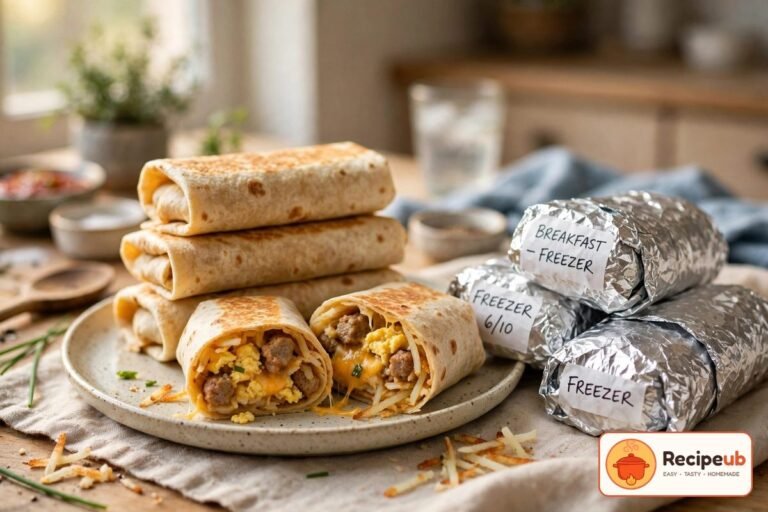
Once the first-week system runs itself, the rest of this shelf is a set of second steps, each one a single change from the batch you already know. For the same one-batch logic with the meat taken out — and the cheapest week on this shelf — my rice and beans meal prep — the meatless version of the same one-batch logic, and the cheapest week on this shelf swaps the protein line for the chart’s cheapest rows. When mornings are the meal that still gets bought, freezer breakfast burritos — the breakfast module to add in week two, once the lunch-and-dinner system runs itself adds a freezer module in the same portion-and-freeze spirit. And when you want this exact system bought even cheaper, Aldi meal prep on a budget — this same system shopped store-specific, when you want the receipt even smaller runs the component logic through one store’s prices. One system first, then the variations — the list came first, the hour stayed honest, and dinner is handled.




Never Run Out of Dinner Ideas
One easy air fryer or slow cooker dinner in your inbox every week. No spam, ever.
You’re on the list — welcome to Recipeub!