
Egg Meal Prep Breakfast Boxes (5 Hot Breakfasts, Under $1.50 a Box)
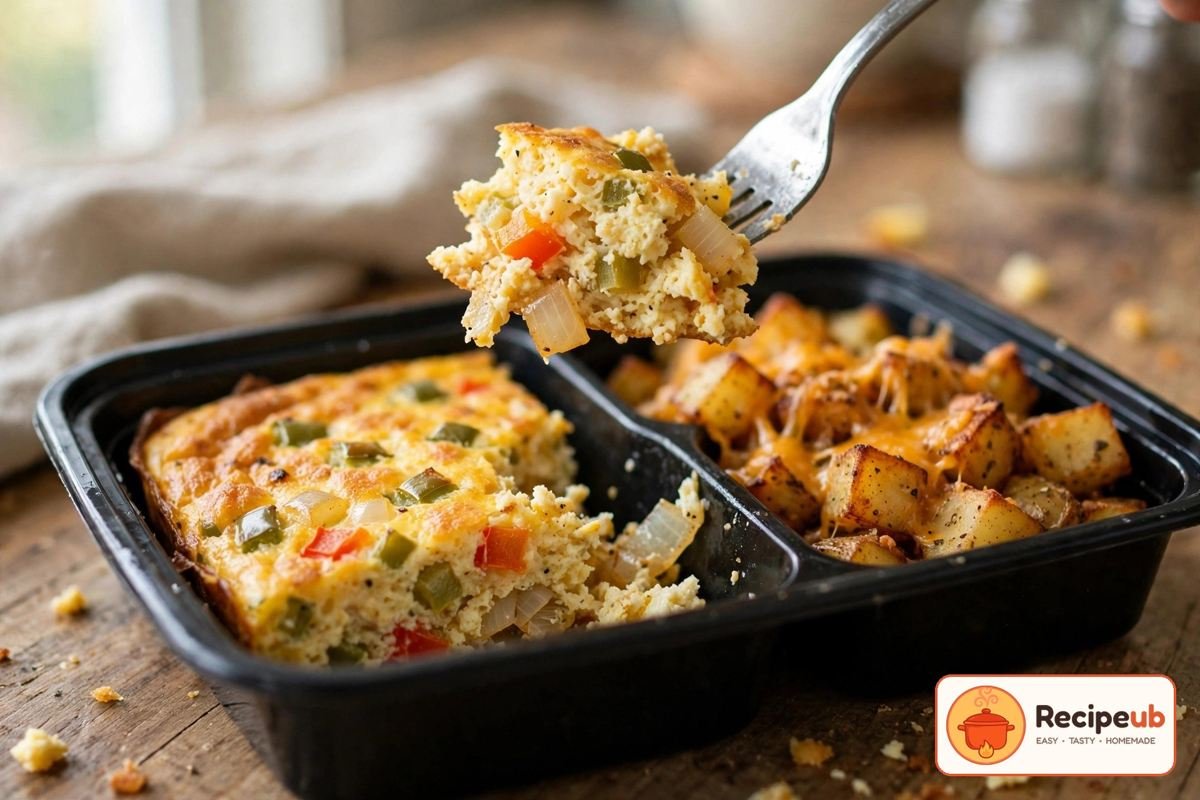
Egg meal prep is the breakfast the search box keeps asking for in pieces: egg meal prep breakfast, egg meal prep muffin tin, egg meal prep freezer, how to meal prep breakfast, what can you meal prep for breakfast. Read those completions together and the real question is not whether eggs can be prepped — it is which egg survives the box. Every page that ranks for this dish picks one format, prints it, and asserts it reheats “perfectly”: scrambled on one, muffin-tin cups on another, hard-boiled in a cold snack box on a third. Nobody prints the comparison, and nobody agrees on the storage either — the current holders claim the same cooked eggs last 5 days, 6 days, and in one case 7 to 10 days in the fridge, which the USDA’s 3-to-4-day rule for cooked egg dishes flatly contradicts. This page is the system built to answer both questions honestly: one sheet-pan egg bake — 10 large eggs whisked with ½ cup of cottage cheese and sautéed bell pepper and onion folded through, baked at 350°F until just set — portioned over roasted breakfast potatoes (2 lb of russet, ½-inch dice, 425°F) with cheddar melted over the top, into 5 boxes that eat across a work week. About 440 calories and ≈$1.48 a box (both estimates, itemized on this page), in 50 minutes — and the eat order is part of the recipe: four boxes in the fridge, the fifth in the freezer, because a work week is 5 mornings; the USDA window is 4 days. Freeze the fifth box.
The format question is the one this post exists to settle, so it gets a chart, printed in full below: scrambled eggs, muffin-tin cups, the sheet-pan bake and hard-boiled eggs, side by side, with the reheat seconds, the day-3 texture, the honest fridge window and the freezer verdict for each. The short version is that the format is not a style choice — it is the difference between a box that reheats tender on day 3 and a box that weeps into its potatoes. The bake wins this build for a reason the chart shows: it is the only hot format whose texture on day 3 is close to its texture on day 1, and the cottage cheese whisked into the eggs is the mechanism — it keeps the set soft instead of spongy, the same trick the baked-egg holders use and never explain.
It also knows its nearest neighbor on this site, because this shelf already runs an egg breakfast. This post is the open box — eggs as the only protein, roasted diced potatoes as the base layer, eaten hot with a fork, fridge-first with one freezer box. If the breakfast you want is wrapped, hand-held and built to freeze by the dozen, that is my freezer breakfast burritos — the wrapped freezer breakfast, sausage-led eggs with hash browns inside flour tortillas, freezer-first by design; this post is the open breakfast box, eggs as the only protein over roasted diced potatoes, fridge-window-first with the format chart. Same eggs, opposite system: theirs is a wrap you freeze; this is a box you eat fresh across the week, and each page says which one it is.
The short answer: Heat the oven to 425°F. Toss 2 lb of russet potatoes, cut in ½-inch dice, with 1 Tbsp of olive oil, 1 tsp smoked paprika, ½ tsp garlic powder, salt and pepper and roast 30–35 minutes. While they roast, sauté 1 diced bell pepper and 1 diced yellow onion in 1 Tbsp of olive oil for about 5 minutes; whisk 10 large eggs with ½ cup of cottage cheese and a pinch of salt, fold the vegetables through, pour into a greased sheet pan and bake at 350°F for 18–20 minutes, until just set at 160°F — the bake runs inside the potato window, on the second rack. Cut the bake into 5 portions, lay each over potatoes in its own box, scatter ¾ cup of shredded cheddar over the hot portions to melt, cool, and box: 4 boxes to the fridge, the 5th to the freezer — five hot breakfasts at about 440 calories and ≈$1.48 each, in 50 minutes.
In This Recipe
The Plan at a Glance
- The eggs: 10 large eggs whisked with ½ cup cottage cheese, sautéed bell pepper and onion folded through, baked on a sheet pan at 350°F for 18–20 minutes until just set at 160°F, cut into 5 portions — 2 eggs in every box, the full portion (the format rule in the card notes)
- The potatoes: 2 lb russet in ½-inch dice, olive oil, smoked paprika and garlic powder, roasted at 425°F for 30–35 minutes — the base layer of every box (the potato rule in the card notes)
- The cheese: ¾ cup shredded cheddar (3 oz) scattered over the hot portions as they are boxed, so it melts in place — no second bake, no broiler
- The boxes: 5 — four to the fridge for the next 4 days, the fifth into the freezer on prep day (the fifth-box rule in the card notes); the frozen box thaws in the fridge the night before day 5
- The format: sheet-pan bake — chosen from the Egg Format Chart below, not by habit: tender on day 3, freezes well, reheats in 60–90 seconds
- Time: 15 minutes prep / 35 minutes cook (potatoes roast 30–35 at 425°F; the sauté and the 18–20-minute egg bake run inside that window, stated openly) / 50 minutes total
- Yield: 5 breakfast boxes
- Calories: ≈440 per box (estimate); protein ≈23 g per box (estimate)
- Cost: ≈$1.48 per box (estimate) at October 2026 prices — the egg and potato lines are the BLS-verified anchors; the full line-by-line table is The Priced Box below
- Storage: fridge 3 to 4 days for the four fresh boxes; the fifth box frozen on prep day, good 1 to 2 months — the full eat order is in the Storage section below
Why This Recipe Works
The format is chosen from a chart, not from habit — because the format is where egg meal prep actually fails. Nobody’s egg breakfast dies on day 1. It dies on day 3, in the microwave, when the scrambled eggs come out rubbery and weeping and the potatoes underneath go soggy. Every holder on page 1 prints one format and calls it perfect; the honest answer is that the five common formats behave five different ways across a week, and the Egg Format Chart below prints all five. This build uses the sheet-pan bake because the chart’s own rows convict the alternatives: scrambled eggs are at their best on days 1–2 and suffer most in the freezer, muffin cups freeze well but eat firm and a little spongy by day 3, and hard-boiled eggs — the one format that genuinely keeps a week — are a cold breakfast, not this box. The bake is the only hot format that is tender on day 3 and freezes well, and a five-box week needs both.
Two eggs in every box — the full portion, not the stretched one. The strongest budget holder on page 1 builds its bowl on 6 eggs across 6 bowls — one and a half eggs per breakfast, once the scramble is divided honestly — and its printed per-serving price divides by 6 while its method portions the food into 4 containers, so the price and the box count never reconcile on its own page. This build does the plain arithmetic instead: 10 eggs, 5 boxes, 2 eggs in each, and the cost table below divides by the same 5 the method portions. A breakfast box whose protein is one and a half eggs is a snack wearing a meal’s title; two eggs with potatoes and cheese is a breakfast.
The storage design follows the USDA window instead of negotiating with it. Cooked egg dishes keep 3 to 4 days in the fridge at 40°F or below — that is the rule, and the current page-1 holders print 5 days, 6 days and 7-to-10 days against it. A work week is 5 mornings, and no honest fridge stretches to cover all five, so this recipe does not pretend: four boxes live in the fridge and get eaten inside the window; the fifth box goes into the freezer on prep day, while it is fresh, and thaws in the fridge the night before the fifth morning. The freezer is not a failure mode here — for a baked egg it is a good home for 1 to 2 months — it is simply where day 5 lives. A work week is 5 mornings; the USDA window is 4 days. Freeze the fifth box.
Eggs are the only protein, and right now that is also the cheap decision. There is no sausage and no bacon in this box — partly because the wrapped breakfast on this site already runs the sausage-led version, and partly because of what eggs cost at the moment: the USDA wholesale benchmark for large white eggs stood at 81.92¢/dozen on November 16, 2026, against $2.14 a year earlier, and the Bureau of Labor Statistics’ October 2026 retail average is $2.320 a dozen — the anchor this page’s cost table is built on. At that price, 2 eggs cost about 39 cents and carry the whole box; the meat versions of this breakfast cost more per box and bring the fridge window down with them. Eggs for dinner instead is a different post on this shelf — my cheap pantry dinners — the pantry egg fried rice dinner, eggs as a stir-fry ingredient over rice; this post is eggs as the breakfast system itself, baked and boxed for the week — and the difference is the occasion: that page spends 4 eggs across a family’s dinner, this one builds five mornings out of 10.
The cottage cheese is the texture mechanism, and it is printed instead of kept secret. Baked eggs go spongy for a simple reason: a plain egg set has nothing in it to stay soft, so the microwave’s second cook squeezes it. Whisking ½ cup of cottage cheese into the eggs puts small curds of dairy through the whole bake; they melt into the set as it cooks and keep the slice tender on day 3 and gentle in the reheat — the same fluffiness mechanism the baked-egg holders use with cottage cheese or Greek yogurt, stated here as the reason rather than left as a mystery ingredient. It is also nearly free: the cottage cheese line is the second-cheapest on the receipt.
Which Egg Format Survives the Box? The Egg Format Chart
Here is the chart this post exists to print. Ask the search box about egg meal prep and it completes the format stems itself — egg meal prep muffin tin, egg meal prep bake, egg meal prep freezer — because the format is the decision, and page 1 answers it one format at a time, each page certain, none of them comparing. Worse, the holders cannot agree on the storage that follows from the format: the same cooked eggs are “up to 5 days” on one page, “up to 6 days” on another, and 3–4 days on the honest minority — a three-day spread on a food-safety number. Here are the five formats side by side, organized by the facts that actually decide a meal-prep week: the reheat, the day-3 texture, the honest fridge window, and the freezer verdict. This recipe uses the bold row.
| Format | Reheat (microwave) | Day-3 texture | Honest fridge window | Freezer verdict |
|---|---|---|---|---|
| Soft scrambled eggs | 60–90 seconds, stir halfway | Rubbery, weeps liquid | Days 1–2 at their best; 3–4 days safe | Freezes, texture suffers most |
| Muffin-tin egg cups | 30–45 seconds each | Firm, a little spongy | 3–4 days | Freezes well, 1–2 months |
| Sheet-pan egg bake (this recipe) | 60–90 seconds per portion | Tender — the cottage cheese keeps it soft | 3–4 days | Freezes well, 1–2 months |
| Hard-boiled, in shell | Eaten cold (or 30 seconds to warm) | Unchanged | Up to 1 week | Do not freeze |
| Hard-boiled, peeled, in a box | Eaten cold | Rubbery whites by day 3 | 3–4 days | Do not freeze |
How to read the chart: every row is a trade, and the columns are the price tags. Scrambled eggs win the first morning and lose the week — they are the format most holders print and the one whose day-3 row reads worst, because a soft scramble has the most delicate set and the microwave’s second cook is what breaks it; the one honest trick in that row is the undercook, stopping the scramble about 30 seconds early so the reheat finishes it instead of punishing it. Muffin-tin cups are the Pinterest-native format and they are genuinely good travelers — portioned by the tin, quick to reheat, honest freezers — but the small, thick shape sets firm, and firm drifts to spongy by day 3. The sheet-pan bake spreads the same eggs thin, so the set is even, the slice reheats in the same 60–90 seconds as a scramble, and the cottage cheese through the eggs holds the texture the scramble loses; it is the only row that is tender on day 3 and freezes well, which is why a five-box week — four fresh, one frozen — has to be built on it. And the hard-boiled rows are the chart’s honest exception: in the shell, a hard-boiled egg is the one egg that really does keep a week, unchanged — but it is a cold egg, eaten cold, and the moment it is peeled and boxed its whites start the same rubbery slide as everything else. The freezer column carries its own warning: never freeze a hard-boiled egg — the whites come back rubbery and watery beyond rescue, the one flat “do not” on the chart. Read the chart as a matching exercise: the format is chosen by the week you actually have — two mornings, scramble; a freezer month, cups or the bake; a cold box, hard-boiled in the shell; a hot work week, the bake.
Ingredients
- 10 large eggs
- ½ cup cottage cheese
- 2 lb russet potatoes, cut in ½-inch dice
- 1 bell pepper, diced
- 1 medium yellow onion, diced
- ¾ cup shredded cheddar cheese (3 oz)
- 2 Tbsp olive oil, divided
- 1 tsp smoked paprika
- ½ tsp garlic powder
- Kosher salt and black pepper, to taste
Ingredient notes: The eggs are 10 large eggs — exactly 2 per box, the full portion this build is built around; buy them fresh for prep day, with a current sell-by date. One dated buying note: the FDA’s Class I recall of Midwest Poultry Services shell eggs (best-by dates July 20 to August 17, 2026) was closed as terminated in September 2026, after the outbreak was declared over on September 3, 2026 — those lots are months past their best-by dates, so a carton on the shelf today cannot be from them. The cottage cheese is ½ cup, whisked straight into the eggs — it is the texture mechanism from the Egg Format Chart, not a topping: its curds melt into the bake as it sets and keep the slices tender through the reheat; Greek yogurt swaps in 1:1 with the same effect. The potatoes are russets, 2 lb, cut in a ½-inch dice — russets because their dry, fluffy interior crisps at the edges in a way waxy potatoes do not, and ½-inch because the dice has to roast through inside the same 35-minute window the eggs bake in; larger cubes are the raw-center failure. The pepper is one bell pepper, any color — red is the sweetest, green the cheapest most weeks, and the line is priced as a labeled shelf estimate below either way. The cheddar is ¾ cup shredded (3 oz), scattered over the hot portions at boxing time so it melts in place; a Mexican blend works, Monterey Jack works, and pre-shredded bagged cheese melts a touch less smoothly than block-grated — either is fine at this amount. The spices are smoked paprika and garlic powder on the potatoes only — the eggs stay plainly seasoned with salt and pepper, because the box is reheated four mornings running and a heavily spiced egg is the one that wears out its welcome by Thursday.

How to Make Egg Meal Prep Breakfast Boxes
The method runs two pans through one oven window, and the order matters: the potatoes start first at the high heat, the vegetables sauté on the stove while they roast, and the egg bake slides in beside the potatoes for the last stretch at the lower temperature — so the 35-minute cook time is one elapsed window, stated openly, not two cooks added together. Everything is boxed while the cheddar can still melt over the hot portions, and the fifth box goes straight to the freezer the same morning it is made.
- Roast the potatoes. Heat the oven to 425°F. Toss the potato dice with 1 Tbsp of the olive oil, the smoked paprika, garlic powder, ½ tsp kosher salt and black pepper and spread them on a large rimmed sheet pan in a single layer — crowded potatoes steam instead of roasting, so use two pans rather than pile them. Roast 30–35 minutes, flipping once halfway, until the edges are crisped and browned and the centers are tender.
- Sauté the pepper and onion. While the potatoes roast, heat the remaining 1 Tbsp of olive oil in a skillet over medium heat and cook the bell pepper and onion for about 5 minutes, until softened and sweet at the edges. Take them off the heat — they fold into the eggs raw-hot, and their carryover finishes in the bake.
- Whisk the eggs. Crack the 10 eggs into a large bowl, add the cottage cheese and a pinch of salt, and whisk until the yolks and whites are fully combined and the cottage cheese is broken up through the mixture. Fold the sautéed pepper and onion through. Pour the mixture into a greased or parchment-lined sheet pan (a half sheet pan, roughly 13×18 inches) and spread it even.
- Bake the eggs inside the potato window. When the potatoes have about 18–20 minutes left, drop the oven temperature to 350°F and slide the egg pan onto the second rack. Bake 18–20 minutes, until the eggs are just set — the center should read 160°F and the surface should look matte, not glossy. The potatoes finish gently at the lower heat; they crisped at 425°F and this last stretch only completes their centers. Do not push the bake past set: an overbaked egg is tomorrow’s rubbery one, and the chart above is the reason this build stops at just-set.
- Rest and cut. Let the egg bake stand 5 minutes — it firms as it rests and cuts cleanly. Cut it into 5 equal portions (one cut across, then across again into fifths, or score it by eye against the five boxes). Lift each portion out with a wide spatula; the cottage cheese keeps the slices supple, so they move without tearing.
- Box, cheese, and split the week. Divide the roasted potatoes among 5 meal prep containers, lay an egg portion over each, and scatter the cheddar over the hot portions so it melts in place. Let the boxes cool just until the steam settles — no more than is needed — then lid them and refrigerate promptly: 4 boxes to the fridge, the 5th box straight into the freezer, labeled with the date. Cooked eggs never sit out past 2 hours, and the boxes should be cold well inside that.


Egg Meal Prep Breakfast Boxes (5 Hot Breakfasts, Under $1.50 a Box)
Ingredients
Equipment
Method
- Heat the oven to 425°F. Toss the potato dice with 1 Tbsp of the olive oil, the smoked paprika, garlic powder, ½ tsp salt and pepper; spread in a single layer on a large rimmed sheet pan and roast 30–35 minutes, flipping once, until crisped at the edges and tender.
- Meanwhile, sauté the bell pepper and onion in the remaining 1 Tbsp of olive oil for about 5 minutes, until softened.
- Whisk the eggs with the cottage cheese and a pinch of salt until fully combined; fold in the sautéed vegetables and pour into a greased or parchment-lined half sheet pan.
- With about 18–20 minutes left on the potatoes, drop the oven to 350°F and bake the eggs on the second rack for 18–20 minutes, until just set at 160°F.
- Rest the bake 5 minutes, then cut it into 5 equal portions.
- Divide the potatoes among 5 containers, top each with an egg portion, and scatter the cheddar over the hot portions to melt. Cool briefly, lid, and refrigerate 4 boxes; freeze the 5th box on prep day.
Notes
What Does a Breakfast Box Cost? The Priced Box
Here is the second thing this post prints that page 1 does not: the whole box, priced line by line, at October 2026 prices — with the two anchor lines read directly from the Bureau of Labor Statistics and every other line labeled a shelf estimate, printed as one, because this page names its sources instead of rounding a receipt it never saw. It also reconciles: the method portions 5 boxes, and the table divides by the same 5.
| Line | Amount for the batch | Price basis | Batch cost |
|---|---|---|---|
| Large eggs, Grade A | 10 eggs | BLS October 2026 average, $2.320/dozen (verified, series APU0000708111) | $1.93 |
| Russet potatoes | 2 lb | BLS October 2026 average, $0.990/lb (verified, series APU0000712112) | $1.98 |
| Cheddar cheese | ¾ cup shredded (3 oz) | Shelf estimate, labeled as one | ≈$0.95 |
| Bell pepper | 1 pepper | Shelf estimate, labeled as one | ≈$1.00 |
| Yellow onion | 1 medium | Shelf estimate, labeled as one | ≈$0.60 |
| Cottage cheese | ½ cup | Shelf estimate, labeled as one | ≈$0.55 |
| Olive oil | 2 Tbsp | Shelf estimate, labeled as one | ≈$0.30 |
| Smoked paprika, garlic powder, salt, pepper | Pantry amounts | Estimate, labeled as one | ≈$0.10 |
| Batch total | 5 boxes | ≈$7.41 → ≈$1.48 per box |
How to read the table: the eggs and potatoes — the two ingredients the box is actually made of — are the verified lines, and between them they are $3.91 of the $7.41; everything else is garnish-priced. The dated context matters, and it is printed with its date rather than as a promise: eggs are the deflation story of late 2026 — the USDA wholesale benchmark for large white eggs stood at 81.92¢/dozen on November 16, 2026, against $2.14 a year earlier, retail ads averaged around $1.25–$1.44 a dozen that week, and a November 20, 2026 Walmart sweep held store-brand dozens at $1.67 (at that shelf price, the egg line drops to $1.39 and the box to ≈$1.37). The same week’s news carried the first bird-flu stress of the new season, which is the honest footnote: eggs are the cheapest complete protein in the store right now, and a priced page dates its prices precisely because windows like this one do not stay open forever. Two comparisons, each fenced honestly. If protein per dollar is the whole goal — not breakfast, not price per box — that is a different system on this site: my cheap high-protein meal prep — the mixed-protein boxes, chicken, turkey, tuna and beans priced for protein per dollar; this post is the breakfast system, eggs only, priced per box and built around the format chart does that math across ten lunch and dinner boxes. And the only other sub-$1.50 system on the shelf runs the same priced-pot discipline at dinner: my lentil meal prep — the priced lentil soup pot, six meals at about $1.40; this post is the breakfast build, five boxes at about $1.48 — one shelf, two ends of the day, both receipts printed.
Emma’s Tips for the Best Egg Meal Prep Breakfast Boxes
Dice the potatoes small and keep them in one layer. The ½-inch dice is not fussiness — it is what lets a potato cube roast through in the same window the eggs bake in, and the single layer is what crisps it. The moment the dice pile up, the bottom layer steams in its own moisture and comes out pale and soft, and no reheat trick gives a steamed potato its edges back. Two pans, always, rather than one crowded one.
Stop the bake at just-set — glossy is underdone, matte is done. The eggs are finished when the surface loses its shine and the center reads 160°F, and every minute past that is borrowed from Thursday’s texture. The chart’s day-3 column is written in the oven on prep day: an egg baked to just-set reheats tender, and an egg baked hard reheats rubbery, and no amount of careful microwaving reverses which one you made.
Whisk the cottage cheese in properly. Break the curds up as you whisk so they distribute through the eggs instead of landing in pockets — a pocket of cottage cheese bakes into a wet spot, while curds whisked through disappear into the set and leave only the tenderness behind. Thirty extra seconds with the whisk is the whole difference.
Cheese goes on at boxing, while everything is hot. Scattering the cheddar over the portions as they land in their boxes melts it in place with heat the recipe already made — no second bake, no broiler, no extra minutes. Cheese scattered over cold portions before reheating melts unevenly and slides; cheese melted in place on prep day reheats as one layer, the way the box was designed.
Label the freezer box before it goes in. The fifth box looks exactly like the other four, and on the fourth night nobody remembers which one was meant to be frozen. A strip of tape and the date, written while the boxes are still on the counter, is the entire system — the frozen box is the one that gets pulled to the fridge to thaw, and the label is what makes day 5 happen on schedule instead of by archaeology.
Storage and Reheating
Fridge — boxes 1 to 4: Cooked egg dishes keep 3 to 4 days at 40°F or below — the USDA standard, and the number this whole system is designed around. The four fresh boxes are eaten inside that window, in order, across the next four mornings. Refrigerate the boxes promptly on prep day (cooked eggs never sit at room temperature past 2 hours, or 1 hour in a kitchen over 90°F), and keep them toward the back of the fridge where the temperature holds steadiest. What this page will not print is the stretched version: the 5-day, 6-day and 7-to-10-day fridge claims on the current page 1 are claims about other people’s risk, and the honest window is the one on this card.
Freezer — box 5: The fifth box goes into the freezer on prep day, while the bake is at its freshest, and keeps well for 1 to 2 months. Move it to the fridge the night before the fifth morning and it thaws by breakfast. This is the design, not a workaround: a work week is 5 mornings; the USDA window is 4 days. Freeze the fifth box. Cooking for a smaller household instead — one person, four meals, no fifth anything — is the scaled-down version of the same discipline: my meal prep for one — the solo system, four meals sized for a one-person week; this post is the five-box household work week, four fresh and one frozen runs the week at the other size.
Reheating: Microwave the open box for 60–90 seconds, until the egg is steaming hot throughout (165°F) — flip the egg portion or stir the potatoes at the halfway mark so the edges of the egg do not overcook while the center warms; reheating at full power without the pause is the rubbery-egg mechanism from the FAQs below. The frozen box reheats the same way once thawed; from fully frozen, defrost 3–5 minutes first, then the same 60–90 seconds. Everything in the box reheats at the same pace by design — the egg portion and the potatoes were portioned to match, so there is no cold-middle, scorched-edge split to manage.
FAQs
How long does egg meal prep last in the fridge?
3 to 4 days at 40°F or below — the USDA window for cooked egg dishes, and the only window this page prints. The holders disagree with each other by days (5 days on one page, 6 on another, 7 to 10 on a third), and the disagreement itself is the tell: those are claims, and 3–4 days is the standard. The one exception on the chart is the hard-boiled egg in its shell, which keeps up to 1 week. This system is designed so the question never has to stretch: four boxes are eaten inside the window, and the fifth is frozen.
Can you meal prep eggs for a whole week?
Not in the fridge — and yes, with the freezer doing one day of the work. Five mornings need five boxes, and cooked eggs hold 3 to 4 days refrigerated, so a fridge-only week asks the food to outlast its window. This build’s answer is the eat order: boxes 1–4 from the fridge across the first four mornings, box 5 frozen on prep day and thawed in the fridge the night before the fifth. A full work week of egg meal prep is completely doable — it is just a 4-plus-1 week, not a 5-in-the-fridge week.
What is the best egg format for meal prep?
For a hot box eaten across a week, the sheet-pan bake — it is the only format that is tender on day 3 and freezes well, which is the combination a five-box week requires (the full comparison is the Egg Format Chart above). The honest runners-up by situation: muffin-tin cups if the freezer is the main destination, hard-boiled eggs in the shell if the box is eaten cold, and scrambled eggs if the prep only has to cover a morning or two — scrambled is the best day-1 egg and the worst day-3 one, and the format most recipes print anyway.
Can you freeze breakfast meal prep boxes?
Yes — this one is designed to. The baked egg portions and the roasted potatoes freeze well for 1 to 2 months, and the fifth box in this system is frozen on prep day on purpose. Thaw it in the fridge overnight, then reheat as usual. The format decides what freezes: bakes and muffin cups freeze well, scrambled eggs freeze but lose the most texture, and hard-boiled eggs are never frozen — their whites come back rubbery and watery. Freeze the format that survives it, which is what the chart’s last column is for.
How do you reheat a breakfast meal prep box?
Microwave the open box for 60–90 seconds, until the egg is steaming hot throughout (165°F), and flip the egg portion or stir the potatoes halfway through. The halfway pause is not a nicety — it is what keeps the egg’s edges from overcooking while the center comes up to temperature, and skipping it is the rubbery-egg mechanism in the next answer. From frozen, thaw overnight in the fridge first (or defrost 3–5 minutes in the microwave), then the same 60–90 seconds. For the potatoes at their crispiest, the skillet or air fryer option is in the next-but-one answer.
Why do my meal prep eggs turn rubbery?
Two cooks, both avoidable. The first happens on prep day: eggs baked or scrambled past just-set have already squeezed their moisture out, and no reheating gives it back — stop the bake at matte and 160°F, and stop a scramble about 30 seconds early, because the reheat finishes it. The second happens at the microwave: full power, uninterrupted, cooks the edges a second time while the center warms, which is why this build reheats in 60–90 seconds with a halfway flip. The cottage cheese whisked into this bake is the built-in insurance — its curds keep the set soft through both cooks.
How much does one breakfast box cost to make?
≈$1.48 a box (estimate) — a batch of ≈$7.41 for 5 boxes, priced line by line in The Priced Box above. The two anchor lines are verified: eggs at the BLS October 2026 average of $2.320 a dozen (the 10 eggs cost $1.93) and russet potatoes at $0.990 a pound (the 2 lb cost $1.98); the cheese, pepper, onion, oil and spice lines are labeled shelf estimates. At the $1.67 store-brand dozen a November 2026 Walmart sweep was showing, the same box comes to ≈$1.37. The title’s “under $1.50 a box” is true on the verified table, not on the cheapest shelf in the country.
How many eggs go in each breakfast box?
Two. Ten eggs across five boxes, and the two-egg portion is a deliberate line in this build: the strongest budget holder on page 1 divides 6 eggs across 6 bowls — one and a half eggs per breakfast — and calls it a breakfast bowl. Two eggs with roasted potatoes and cheddar is a full hot breakfast at about 440 calories and ≈23 g of protein (estimates); one and a half is where the box starts eating like a snack. If you scale the batch, scale the ratio, not just the pan: 2 eggs per box, every box.
Do the potatoes stay crispy in the fridge?
Honestly, no — and this page would rather say so than repeat the “reheats perfectly” line. Roasted potatoes soften in the fridge as their moisture redistributes; the microwave brings them back hot and tender, not crisp. The fix is a second heat with dry air or a hot surface: 3–4 minutes in a hot skillet, or a few minutes in the air fryer, crisps the edges back close to prep day. The eggs are portioned to reheat in the microwave either way, so the practical split is: microwave mornings for speed, skillet mornings when the crisp matters.
What can I meal prep for breakfast without eggs?
The honest staple answer is overnight oats — oats, milk or yogurt and fruit, portioned into jars, eaten cold or warmed, and the one breakfast prep that asks nothing of an oven. Yogurt, granola and fruit boxes are the other cold standard. What this page will not do is point you at a hot egg-free box it does not have: every hot breakfast system on this site is egg-based, the burritos included, so for an egg-free week the jars are the real answer — and the egg chart above is here for the weeks when eggs are back on.
Final Thoughts
Egg meal prep is not a hard breakfast, and it is a badly documented one anyway — because the recipe was never the problem. It is ten eggs, a pan of potatoes and fifty minutes. The problem is that page 1 prints five different formats as if each were the only one, prices its strongest bowl with servings that do not match its own containers, and stores the same cooked eggs for anywhere from 3 days to 10 depending on which page you land on. What this page adds is the paperwork the other versions leave out — a format chart with the reheat, the day-3 texture, the honest window and the freezer verdict for every way of cooking the egg; a priced box whose servings and divisor agree; and an eat order that treats the USDA’s 4 days as a design constraint instead of an inconvenience. Two eggs a box, the bake just set, four mornings from the fridge and the fifth from the freezer: that is the deal.
More Easy Budget Meal Prep
If a priced system with the chart printed is your kind of meal prep, the rest of this shelf runs on the same rules — every receipt shown, every window honest. The whole shelf is gathered in my budget meal prep ideas — the hub of every budget system on the site, dinners, solo weeks and beginner batches; this post is the breakfast entry, five egg boxes at under $1.50 each, and if this is your first prep of any kind, the gentler on-ramp is my meal prep on a budget for beginners — the starter system, a first week of budget prep built step by step; this post assumes the habit and spends it on breakfast. One shelf, one standard — the eggs bake, the potatoes roast, the fifth box freezes, and the week is handled.


Never Run Out of Dinner Ideas
One easy air fryer or slow cooker dinner in your inbox every week. No spam, ever.
You’re on the list — welcome to Recipeub!