
Tofu Meal Prep (4 Dinner Boxes, Under $2 a Box)
Tofu meal prep is the dinner the search box describes in its own completions: tofu meal prep, tofu meal prep ideas, tofu meal prep recipes, tofu meal prep high protein, tofu meal prep lunch, tofu meal prep bowls, tofu meal prep freezer — format words, a protein question, and a freezer question, and not one price word anywhere among them. That last absence is the lane in one line. Everyone who searches this has met the same two failures. The first is texture: tofu that was crisp on Sunday is soft by Tuesday, and every holder’s page admits it in a different place — a tips line here, a storage note there, one honest test note that says the crisp lasted two days before it started to soften. The second is money: the lane calls itself budget-friendly on page after page and prices almost nothing, so the shopper who picked tofu because beef got expensive never sees the arithmetic that proves the swap was worth it. Page 1 today is a technique roundup with four flavor branches and no single carded box, two dietitian bowls with no price, a noodle jar that stores the tofu in its sauce, a baked-tofu component post with no meal built around it, and — on the budget query — a cold curried tofu salad, the one priced post in the lane, in the format this shelf just published twice. This page prints the three systems the lane leaves out: The Sauce Rule — crisped tofu is stored dry and sauced only after reheating, never before, with the sauce measured at ¾ cup, simmered, cooled and portioned into 4 cups; The Crisp Chart — every named holder’s method converted to press time, coating, vessel and a day-1 versus day-3 crust verdict, in one table; and The Priced Box — the batch priced line by line at November 2026 prices, with the rice line anchored to a verified Bureau of Labor Statistics average and the protein line priced against ground beef at its verified average, so the swap is arithmetic instead of an adjective. Four hot dinner boxes at about 560 calories and ≈$1.95 a box (both estimates, itemized on this page), in 50 minutes.
Two fences belong right here, before this looks like a repeat of anything on the shelf. The meatless box already on this site is my rice and beans meal prep — the category’s other plant protein, a dry bean soaked overnight and simmered into its cooking liquid; this post is a fresh block pressed and crisped, with the exact opposite moisture logic — there, the protein is meant to sit in liquid; here, liquid is the enemy the whole system is built against, and there is no soak and no simmer. And a confession this page is glad to print: this site has never cooked tofu. Ninety-nine posts in, there is no tofu post, no tofu ingredient lead, no tofu system anywhere on the site — this is the first plant-protein box that crisps. It is also, deliberately, a hot box: the last two boxes on this shelf were cold — a tuna box and a pasta salad box, both eaten straight from the fridge — and the rotation turns back to a dinner that is reheated, with the sauce poured over hot, the way a weeknight dinner should land.
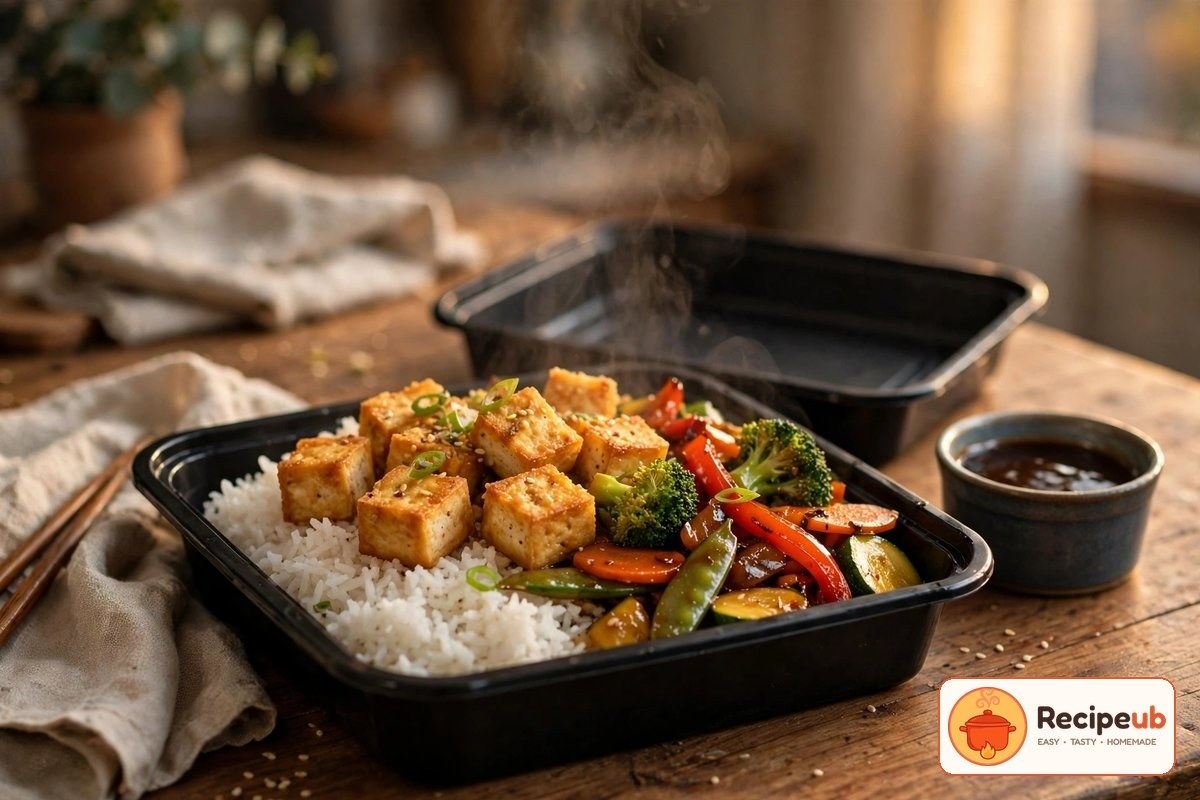
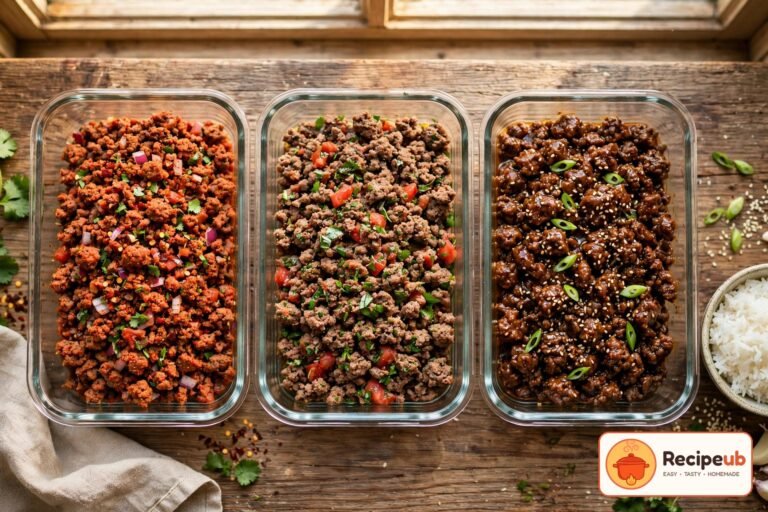
The short answer: Drain 2 (14 oz) blocks of extra-firm tofu, press them 15 minutes under a heavy skillet, cut them into ¾-inch cubes and toss them with 3 Tbsp cornstarch, ½ tsp kosher salt and ¼ tsp black pepper. Crisp them in a large skillet in 2 Tbsp neutral oil, in 2 batches, until deeply golden. Cook 1½ cups of long-grain white rice in 2¼ cups water, and stir-fry 2 lb of frozen stir-fry vegetables from frozen in the same skillet with garlic and ginger. Simmer the ¾-cup sauce (⅓ cup low-sodium soy sauce, 3 Tbsp brown sugar, 2 Tbsp rice vinegar, ⅓ cup water, 1 Tbsp cornstarch, 1 tsp toasted sesame oil, 2 grated garlic cloves) for 1 to 2 minutes until glossy, cool it, and portion it into 4 small sauce cups. Build each box with rice on the bottom, vegetables beside it, tofu on top — never buried — and the sauce cup on the side. Reheat the box first, pour the sauce over after: four hot dinners at about 560 calories and ≈$1.95 each, in 50 minutes, eaten inside the next 4 days.
In This Recipe
The Plan at a Glance
- The tofu: 2 (14 oz) blocks extra-firm, pressed 15 minutes under a heavy skillet, cut into ¾-inch cubes, coated in 3 Tbsp cornstarch with salt and pepper, and skillet-crisped in 2 batches (the press rule in the card notes)
- The sauce: ¾ cup total for the batch — simmered 1 to 2 minutes until glossy, cooled, and portioned into 4 small sauce cups, about 3 Tbsp each; poured over only after reheating, never on prep day (the sauce rule in the card notes)
- The base and vegetables: 1½ cups long-grain white rice in 2¼ cups water; 2 lb frozen stir-fry vegetable blend stir-fried from frozen in the same skillet with garlic and ginger
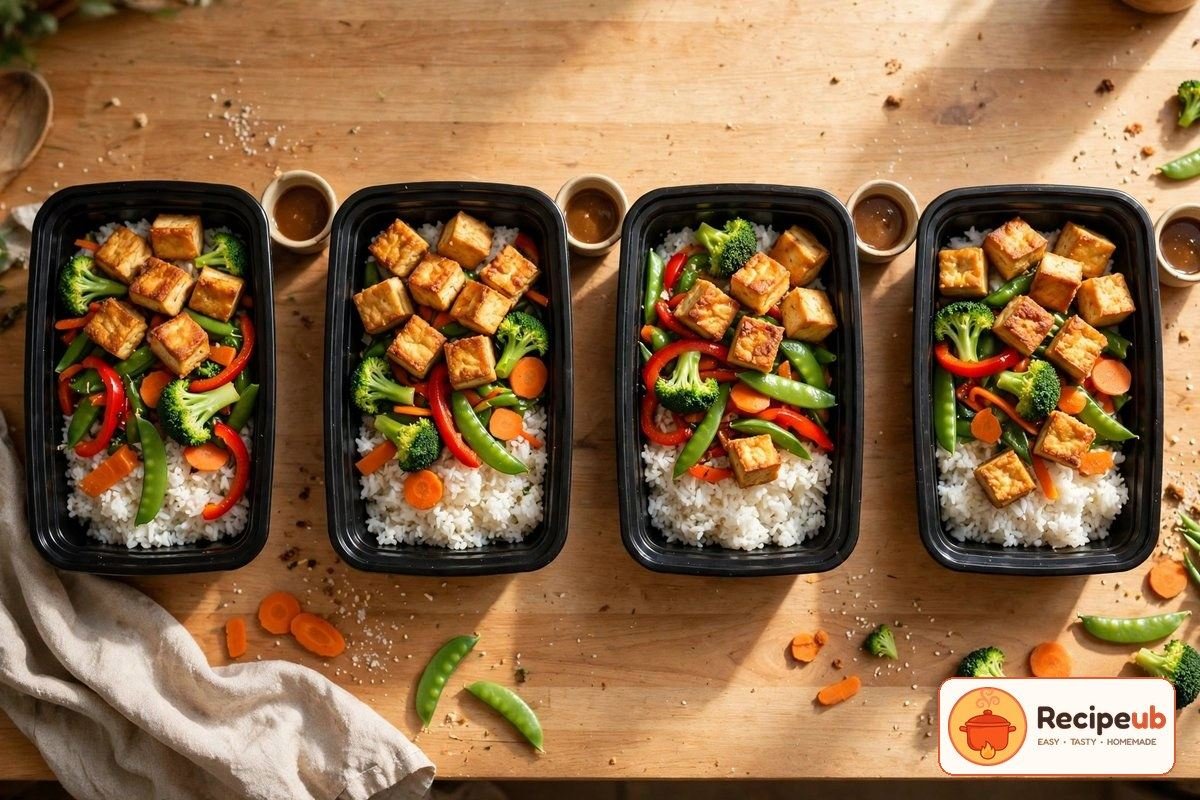
- The assembly: rice on the bottom, vegetables beside it, tofu on top, never buried, sauce cup on the side — position in the box is part of the system (the reheat-order rule in the card notes)
- The eat order: 4 boxes across the next 4 days, all inside the USDA 3-to-4-day window — there is no fifth box; boxes 3 and 4 of a double batch go to the freezer lane instead (the storage rule in the card notes)
- Time: 20 minutes prep (the 15-minute press runs hands-off inside it, stated openly) / 30 minutes cook (the rice simmers and rests while the tofu crisps and the vegetables stir-fry, all inside the same window, stated openly) / 50 minutes total
- Yield: 4 dinner boxes
- Calories: ≈560 per box (estimate); protein ≈28 g per box (estimate)
- Cost: ≈$1.95 per box (estimate) at November 2026 prices — the rice line is BLS-verified; the tofu line and every other line are labeled shelf estimates, and the Bureau publishes no tofu average price this page can cite; the full line-by-line table is The Priced Box below
- Storage: fridge 3 to 4 days at 40°F or below; the commute rides with an ice pack; crisped tofu, rice and sauce cups freeze well up to 2 months, the stir-fry vegetables soften a degree — the full rules are in the Storage section below
Why This Recipe Works
The failure is moisture, twice — and this build refuses it both times. A 14 oz block of extra-firm tofu is roughly three-quarters water by weight even after draining. What stays inside the cube steams the crust from within; what is poured over it on prep day steams it from without. Every soggy-box complaint in this lane traces to one of those two sources, and most holders fight only one of them — they press, and then they toss the crisped cubes in sauce and refrigerate the whole thing dressed. This build removes the first moisture and refuses the second: a 15-minute press that takes on the order of ¼ to ½ cup of liquid out of each block (the towel comes away soaked — that is the visible check, printed as one, not a lab figure), a cornstarch coat that gives the skillet something dry to turn into a crust, and a sauce that never touches the tofu until the box has been reheated. The Sauce Rule section below is the whole system stated as one rule.
The skillet is the vessel, and the batches are the point. Tofu crisps by contact. Cubes crowded into one layer-deep pan steam in their own escaping moisture; cubes spread across a hot skillet in two batches, with room between them, sear. That is why this build crisps in 2 batches of about 7 minutes each instead of one crowded batch of 14, and why the crust here is deep golden rather than pale at the edges. The Crisp Chart below prints the vessel comparison the lane scatters across four pages — baked, air-fried, boiled-then-fried, skillet — with the day-3 verdict beside each, so the choice reads as evidence instead of preference.
The category’s other meatless system is a soup, and the difference is the form. The meatless shelf-mate named in the intro cooks its protein into liquid; the category’s other meatless system is my lentil meal prep — a hot soup system, lentils simmered from dry into a spiced tomato-vegetable soup eaten warm all week; this post is a crisped solid over rice — there the legume is a soup; here the soy is a crisped cube that has to stay dry to stay itself. Two meatless systems, opposite relationships with water, different charts, different dinners. This one is built for the reader whose complaint was never flavor. It was texture on day 3.
The batch is sized to the window, and the window is the honest one. A cooked tofu-and-rice box keeps 3 to 4 days in the fridge — the USDA leftover window for a cooked mixed dish, and the only window this page prints. The holders scatter around it: cooked tofu “up to 5 days” on one page, “up to 4 days” on another, “a few days” on a third. Those longer numbers are claims, and this page names them as claims and designs against the standard instead: exactly 4 boxes, eaten across the 4 days after prep, no fifth box asking the food to outlast its window. Where a longer week is genuinely wanted, the answer is not a stretched fridge claim — it is the freezer lane in the Storage section, stated component by component, softening vegetables and all.
The cook runs in parallel, and the card says so. The 50 minutes on the card is a real 50 minutes, not a sum of separate shifts. The press runs hands-off inside the prep window while the rice is measured, the sauce whisked and the garlic and ginger prepped. Then the rice simmers 18 minutes and rests 10 while the tofu crisps in its two batches and the vegetables stir-fry in the same skillet — three jobs inside one 30-minute cook window, printed openly on the card and in the method, because a meal prep’s time claim is part of its honesty.
The Sauce Rule: Sauce After Reheating, Never Before
Here is the system this post exists to print, stated as one quotable rule: crisped tofu is stored dry and sauced after reheating — never before. A sauce poured over hot tofu on prep day steams the crust it just built, which is why meal-prep tofu is soft by day 3 even when it was crisp on day 1. The sauce rides in its own cup; the tofu sits on top of the box, not buried in the rice’s steam. Tofu does not lose its crust to time; it loses it to moisture — its own steam if it is sealed hot, and its sauce if it is stored dressed. Seal it cool, store it dry, sauce it last, and day 4 eats like day 2.
Every holder in this lane has hold of a piece of this. The technique holder advises keeping the sauce separate — in a prose tip, on pages whose carded builds then toss the tofu through a sauce. The jar holder goes the other way entirely and stores the tofu in its sauce on purpose, reframing the softening as the tofu soaking up flavor. Both pages are describing the same mechanism from opposite ends: sauce stored on crisped tofu re-softens the crust. The difference is whether that is printed as a warning or as a feature. Here it is printed as a measured system, for this batch:
- The batch: ¾ cup of sauce for 4 boxes — ⅓ cup low-sodium soy sauce, 3 Tbsp brown sugar, 2 Tbsp rice vinegar, ⅓ cup water, 1 Tbsp cornstarch, 1 tsp toasted sesame oil and 2 grated garlic cloves.
- Cooked, not whisked raw: the sauce is simmered 1 to 2 minutes until glossy. The cornstarch is what makes it cling instead of puddle, and a cooked sauce reheats without breaking — a raw whisked sauce poured over a hot box stays thin and separates.
- Cooled before it is portioned: the sauce cools before it goes into its cups, for the same reason the tofu cools before the boxes are sealed — hot food in a closed container is steam, and steam is the enemy this whole recipe is organized against.
- Portioned, not pooled: the cooled sauce is divided into 4 small sauce cups, about 3 Tbsp each, one per box, riding on the side of the box — never poured over, never mixed through, never packed under the tofu.
- Poured last, on purpose: at eating time the box is reheated first — microwaved 2 to 3 minutes until steaming hot throughout — and then the sauce cup is poured over. The sauce meets hot, crisped tofu minutes before the fork does, which is the only moment sauce and crust were ever meant to share.
The box’s architecture carries the same rule. Rice goes on the bottom, where its residual moisture does no harm. Vegetables sit beside it. The tofu goes on top — never buried — because a cube tucked down into warm rice spends four days in the rice’s steam, and a cube resting on top spends them in the box’s driest air. Position in the box is not plating. In a meal prep, position is the recipe.
Ingredients
For the tofu:
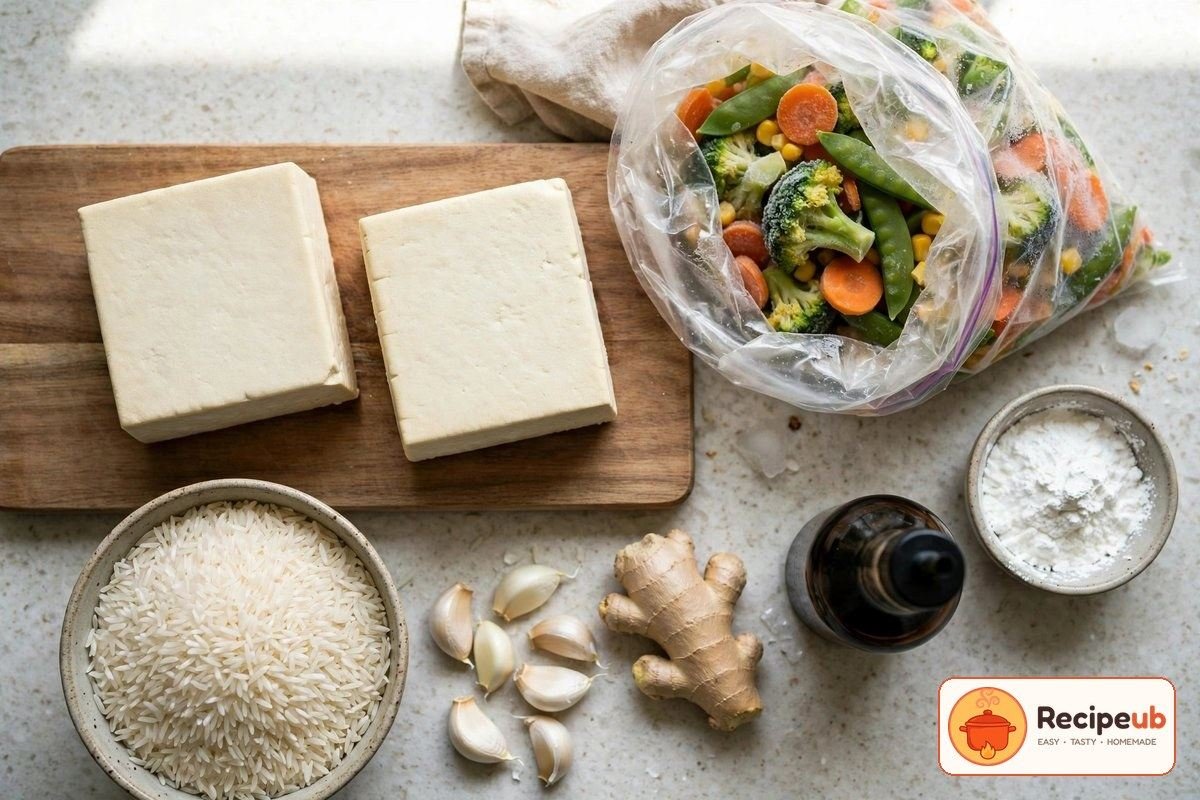
- 2 (14 oz) blocks extra-firm tofu, drained and pressed
- 3 Tbsp cornstarch
- ½ tsp kosher salt
- ¼ tsp black pepper
- 2 Tbsp neutral oil
For the rice:
- 1½ cups long-grain white rice
- 2¼ cups water
For the vegetables:
- 2 lb frozen stir-fry vegetable blend
- 3 cloves garlic, minced
- 1 Tbsp grated fresh ginger
For the sauce (¾ cup):
- ⅓ cup low-sodium soy sauce
- 3 Tbsp brown sugar
- 2 Tbsp rice vinegar
- ⅓ cup water
- 1 Tbsp cornstarch
- 1 tsp toasted sesame oil
- 2 cloves garlic, grated
Ingredient notes: The tofu is extra-firm, 2 (14 oz) blocks, drained and pressed 15 minutes under a heavy skillet — extra-firm because it is the grade that holds a cube through coating, crisping and four days of boxes; softer grades slump in the skillet and weep in the fridge. No press gadget is needed or bought: a clean kitchen towel, a plate and the heaviest skillet you own do the job, and the towel coming away soaked is the check that it worked. One dated note on product class, in the site’s standing form: the tofu recalled this fall — Hodo Chili Crisp Lightly Fried Tofu (Hodo Inc., recall initiated August 7, 2026, over possible ink contamination; UPC 850565007842) — is a pre-cooked, marinated, ready-to-heat product, a different product class from the plain block of extra-firm tofu this build presses and crisps, and is not an ingredient in this recipe; readers holding the Hodo Chili Crisp product should check the lot and follow the FDA notice. The cornstarch is 3 Tbsp for the coating, plus 1 Tbsp in the sauce — the same box doing both jobs in this recipe: a dry coat on the cubes, where it becomes the crust, and a gloss in the sauce, where it makes the sauce cling instead of puddle. The rice is long-grain white rice, 1½ cups in 2¼ cups water — long-grain because it cooks up separate and reheats fluffy rather than sticky, and it is the build’s one Bureau-anchored line, priced on the card off the Bureau’s white long-grain average. The vegetables are a 2 lb bag of frozen stir-fry blend, stir-fried from frozen — no thawing, which would waterlog them before they reach the skillet; the blend is the honest compromise of this box, sturdy in the fridge and the one component that softens a degree in the freezer lane, printed plainly in the Storage section. The sauce is a teriyaki-style soy-ginger build: low-sodium soy sauce so four days of boxes do not salt-creep, brown sugar for the gloss and the caramel edge, rice vinegar for the lift, toasted sesame oil at 1 tsp, in the sauce and not the skillet — sesame oil is a finishing flavor, and frying in it would burn the flavor off and spend the money twice. The garlic appears twice on purpose: minced with the vegetables, grated into the sauce, because grated garlic disperses through ¾ cup of sauce and minced garlic would sit in it in pieces.
How to Make Tofu Meal Prep Boxes
The method is three parallel jobs wearing one timeline, and the card prints that openly: the press runs hands-off inside the prep while the sauce is whisked and the garlic and ginger are prepped, and the rice simmers and rests while the tofu crisps and the vegetables stir-fry. The order that matters is the order of dryness — press before coating, coat before crisping, cool before sealing, sauce after reheating — because in this box, sequence is the texture. Everything is cooled to near room temperature before the lids go on; a box sealed hot is a box steaming its own crust, which is the failure the whole recipe exists to prevent.
- Press the tofu — it starts the prep and then runs itself. Drain the 2 (14 oz) blocks of extra-firm tofu, wrap each in a clean kitchen towel, set them on a plate and weight them with a heavy skillet. Leave them 15 minutes — the press runs hands-off inside the prep window while you measure the rice, whisk the sauce and prep the garlic and ginger (steps 2 and 3), stated openly rather than added on top. The towel should come away soaked; that liquid — on the order of ¼ to ½ cup per block — is moisture that will not be steaming your crust from inside.
- Whisk the sauce, but do not cook it yet. In a small saucepan, whisk the soy sauce, brown sugar, rice vinegar, water, 1 Tbsp cornstarch, sesame oil and grated garlic until the cornstarch dissolves. Set it aside uncooked for now — it simmers in step 6, after the skillet work, so it can cool while the boxes are assembled.
- Start the rice. Put the 1½ cups of rice and 2¼ cups water in a saucepan with a tight lid, bring to a boil, cover, and simmer on low for 18 minutes. Take it off the heat and let it rest, covered, 10 minutes. The simmer and the rest run inside the same 30-minute cook window as the tofu and vegetables — that parallel cook is the card’s cook time, stated openly.
- Cube and coat the tofu. Unwrap the pressed blocks and cut them into ¾-inch cubes — big enough to stay creamy inside the crust, small enough to crisp on every face. Toss the cubes gently in a large bowl with the 3 Tbsp cornstarch, ½ tsp kosher salt and ¼ tsp black pepper until every cube is evenly dusted. Coat right before crisping; cubes sitting in their coat reabsorb moisture and go gummy.
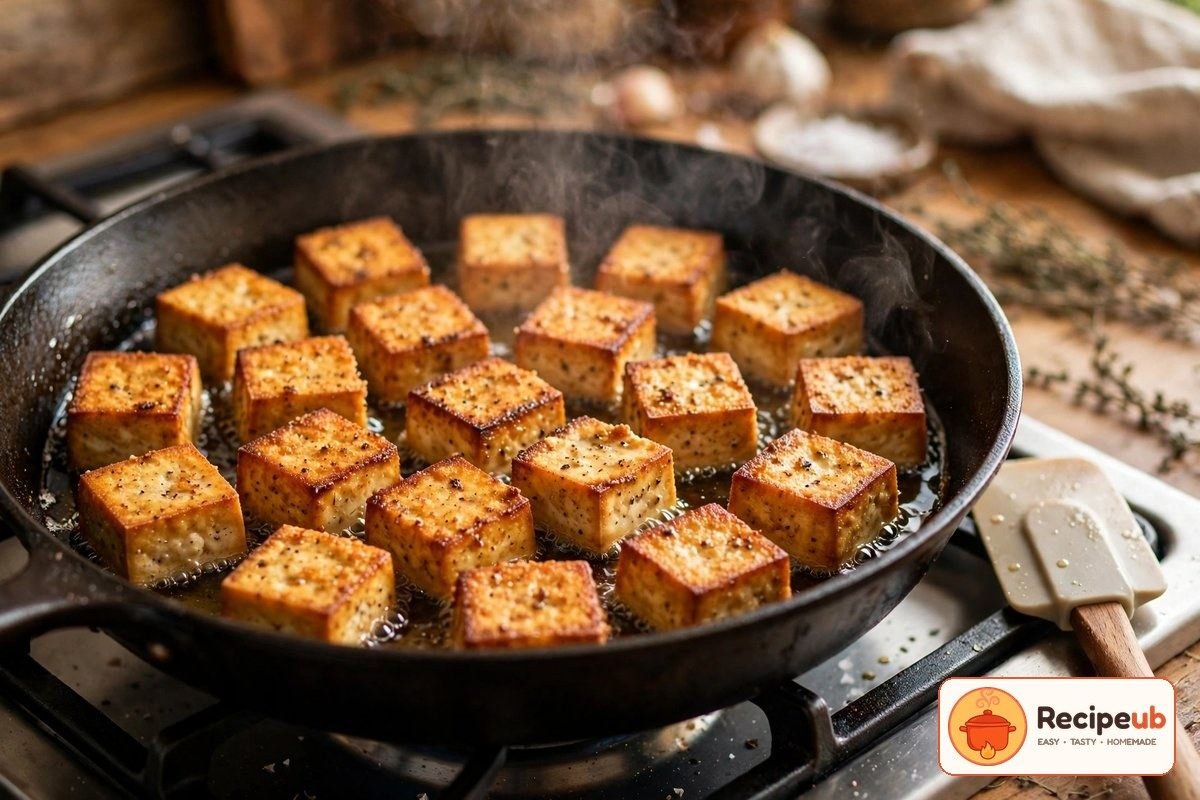
- Crisp the tofu in 2 batches. Heat 1 Tbsp of the neutral oil in a large skillet over medium-high heat until it shimmers. Add half the cubes in a single layer with room between them and cook about 7 minutes, turning every couple of minutes, until deeply golden on most faces. Lift them out to a plate, add the second 1 Tbsp of oil, and crisp the second batch the same way. Two batches is the rule, not a suggestion: one crowded batch steams, and steamed tofu never crisps in the same pan session.
- Stir-fry the vegetables in the same skillet, and simmer the sauce. In the same skillet, stir-fry the 2 lb frozen stir-fry blend straight from frozen with the minced garlic and grated ginger for about 7 minutes, until tender-crisp and any pan water has cooked off — vegetables that go into the box wet waterlog everything beside them. Meanwhile, bring the whisked sauce to a simmer and cook 1 to 2 minutes until glossy, then take it off the heat and let it cool.
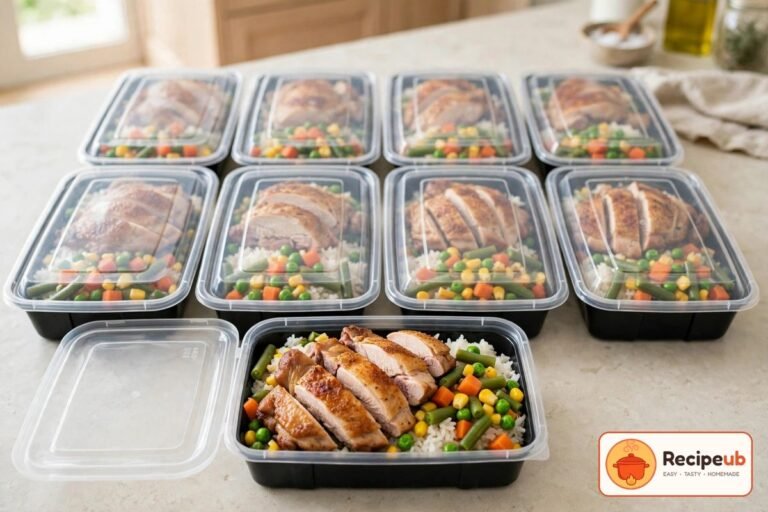
- Cool, then assemble — tofu on top, sauce on the side. Let the tofu, rice and vegetables cool to near room temperature, inside 2 hours of cooking. Fluff the rice and divide it among 4 meal prep containers as the bottom layer. Divide the vegetables beside the rice. Divide the tofu on top of each box — never buried in the rice. Portion the cooled sauce into 4 small sauce cups, about 3 Tbsp each, lid them, and set one with each box. Lid the boxes and refrigerate promptly at 40°F or below. At eating time, reheat the box first until steaming hot throughout, then pour the sauce over (the reheat-order rule in the card notes).
Tofu Meal Prep (4 Dinner Boxes, Under $2 a Box)
Ingredients
Equipment
Method
- Drain the tofu, wrap each block in a towel, and press under a heavy skillet for 15 minutes. Meanwhile, measure the rice, whisk all the sauce ingredients in a small saucepan (uncooked), and prep the garlic and ginger.
- Cook the rice in the 2¼ cups water: simmer, covered, 18 minutes, then rest off the heat, covered, 10 minutes.
- Cut the pressed tofu into ¾-inch cubes and toss gently with the 3 Tbsp cornstarch, salt and pepper until evenly dusted.
- Crisp the tofu in a large skillet in the oil, in 2 batches, about 7 minutes per batch, until deeply golden. Set aside on a plate.
- Stir-fry the frozen vegetables in the same skillet with the minced garlic and ginger, about 7 minutes, until tender-crisp and dry in the pan. Simmer the sauce 1 to 2 minutes until glossy, then cool it.
- Cool all the components to near room temperature, within 2 hours of cooking. Assemble each box: rice on the bottom, vegetables beside it, tofu on top. Portion the cooled sauce into 4 small cups, one per box. Lid and refrigerate.
- To eat: reheat the box until steaming hot throughout, then pour the sauce cup over.
Notes
Which Method Keeps Tofu Crisp? The Crisp Chart
Here is the chart the lane’s failure mode has been asking for. Every named holder’s method, converted to the same four columns — press, coating, vessel, and the crust verdict on day 1 versus day 3, taken from the holders’ own storage and test language — because the lane’s advice currently lives as four different press times (15 minutes, 15 to 30, 30, or a 5-minute boil instead) scattered across four pages, with no day-by-day verdict anywhere. Read down the day-3 column and the soggy boxes stop being bad luck. This recipe uses the bold row.
| Method (holder) | Press | Coating | Crust on day 1 | Crust on day 3 |
|---|---|---|---|---|
| No press, no coat, tossed in sauce (the default failure) | None | None | Soft | Soggy — the complaint that starts the search |
| Press + bake (Jessica in the Kitchen) | Towel + weight | Marinade | Lightly crisp edges | Soft — a component texture, not a crust |
| Press + cornstarch, baked (Kay Nutrition) | Yes | Cornstarch | Crisp | Good if unsauced; soft where the sauce sat |
| Press + cornstarch, air-fried (Love and Lemons’ favorite) | Yes | Cornstarch + oil | Crispest per piece | Small batches only — a 4-box batch is 3 basket loads |
| Boil 5 min in salted water, pan-fry (Meals with Maria) | Boil instead | None | Chewy, firm — not crisp | A different texture lane, named as one |
| Press 15 min + cornstarch, skillet in batches (THIS BUILD) | 15 min, towel + skillet | 3 Tbsp cornstarch | Deep golden crust | Crust survives — because the sauce was never on it |
How to read the chart: three columns decide the fourth. The press column is the water leaving before the cook — every row without one starts the skillet at a disadvantage no heat fully repays. The coating column is the crust’s raw material: a marinade flavors a cube but cannot crisp it, and cornstarch is the only coat in the set that dries into a shell. The vessel column is contact and capacity: an oven surrounds the cubes with their own escaping steam, an air fryer crisps beautifully a basket at a time — three loads for a 4-box batch — and a skillet gives direct contact in two fast batches. And one admission from the lane deserves printing in full, because this chart exists to answer it: the freshest holder in the set, the stir-fry technique post, reports from its own kitchen test that the tofu stayed crispy for two days in the refrigerator before it started to soften. Two days is what press-plus-coat-plus-sauce-separate-advice earns when the build itself is still stored as one dressed dish. This build’s row survives day 3 for a reason that is not in its press or its coat — it is in its storage: the sauce was never on it. The baked row is also where this site’s other batch vessel gets its honest mention: the sheet pan is this site’s other batch vessel — my sheet pan chicken meal prep — the batch-vessel neighbor, a protein that roasts on a sheet pan in its own juices; tofu crisps in a skillet instead, because it needs direct contact, not a pan of its own steam — chicken thighs forgive a pan of steam; a cornstarch crust does not, and the chart’s baked rows are the receipt.
What Does a Tofu Dinner Box Cost? The Priced Box
Here is the third thing this post prints that page 1 does not: the whole box, priced line by line, at November 2026 prices — with one line read directly from the Bureau of Labor Statistics, every other line labeled a shelf estimate, and one honesty sentence this page prints instead of working around: the Bureau of Labor Statistics publishes no average price for tofu that this page can cite. A tofu series was looked for and does not exist in the Bureau’s average-price program, so the tofu line below is a shelf estimate and is labeled as one, every time it appears. No holder in this lane prints a hot batch price at all — the lane’s only priced tofu prep is a cold salad whose premium lines, cashews and cranberries, cost more than its tofu.
| Line | Amount for the batch | Price basis | Batch cost |
|---|---|---|---|
| Extra-firm tofu | 2 (14 oz) blocks | Shelf estimate, labeled as one (≈$1.80 a block; no BLS average-price series for tofu exists that this page can claim) | ≈$3.60 |
| Long-grain white rice | 1½ cups (about 0.92 lb dry) | BLS October 2026 average — white long-grain rice, $1.101/lb (verified, series APU0000701312; exact item match) | $1.01 |
| Frozen stir-fry vegetable blend | 2 lb | Shelf estimate, labeled as one | ≈$2.00 |
| Sauce (soy sauce, brown sugar, rice vinegar, sesame oil, garlic, ginger, cornstarch) | ¾ cup + aromatics | Shelf estimate, labeled as one | ≈$0.80 |
| Frying oil, coating cornstarch, salt, pepper | Recipe amounts | Shelf estimate, labeled as one | ≈$0.35 |
| Batch total | 4 boxes | ≈$7.76 → ≈$1.95 per box |
How to read the table: it reconciles — the method portions 4 boxes, and the table divides by the same 4 — and its shape is the budget argument in miniature. The protein is the biggest line and it is still only ≈$3.60 for the whole batch; the one verified line, the rice, is a dollar; and no line hides. The title’s figure survives honest pricing because it is this table divided by 4, with the anchor verified, the tofu labeled a shelf estimate with the no-BLS-series fact stated, and nothing rounded in the recipe’s favor.
The Protein Swap
This is the arithmetic the lane’s “budget-friendly” adjectives never show, printed once, with both bases labeled every time the numbers appear. Price the protein line for the same 4 boxes two ways. With tofu: ≈$3.60 for 2 (14 oz) blocks — a shelf estimate, labeled as one, because the Bureau publishes no tofu average this page can cite. With ground beef: 1¾ lb at the BLS October 2026 average for ground beef of $6.755/lb (verified, series APU0000703112) = ≈$11.82. The beef figure is a comparison, never this recipe’s cost — no beef is bought, cooked or eaten in this build. The swap saves ≈$8.20 a batch on the protein line alone, which is more than this entire batch costs. That is the whole economic case for the dish, and it took one table and one multiplication — the lane simply never printed it. If the protein math is the whole point of your prep — grams per dollar across a rotation of proteins — that system already lives on this shelf: my cheap high-protein meal prep — protein math across five animal proteins, priced per gram across 10 meals; tofu is not among its proteins, and this post prints its protein, about 28 g a box, as a fact and its price as the frame does that accounting as its subject. This box’s math is the crisp first, the price second, both printed.
Storage and the 4-Day Eat Order
Fridge — all 4 boxes, eaten in 4 days: A cooked tofu-and-rice box keeps 3 to 4 days at 40°F or below — the USDA leftover window for a cooked mixed dish, and the only window this page prints. The four boxes are eaten across the four days after prep, in any order; the tofu is at its crispest on days 1 to 2 and — because it was stored dry, on top, with its sauce in a cup — still genuinely crisp-edged on day 4, which is two days longer than the lane’s own test note gives a dressed build. What this page will not print is the stretched version: the holders’ storage claims scatter from “up to 5 days” for cooked tofu to “up to 4 days” to “a few days,” and the scatter itself is the tell. Those are claims about someone else’s risk; 3 to 4 days is the standard, and the batch is designed so the question never has to stretch: it makes exactly 4 boxes and there is no fifth. Cool the components to near room temperature and lid the boxes within 2 hours of cooking — on this build the cooling step is a texture rule as well as a safety one, because a box sealed hot steams its own crust from inside the lid.
The eat order, printed plainly: there is no fragile box and no sturdy box in this batch — the sauce system makes the four boxes near-identical, which is the point of it — so the order is simply one box a day across the window. If a fifth dinner is wanted from the same shopping trip, it does not come from stretching these boxes; it comes from the freezer lane below, designed in from the start.
The sauce cups’ own clock: A cup of cooked soy-ginger sauce — no dairy, nothing perishable in the mixed-dish sense — keeps comfortably past the boxes’ own window in the fridge. That does not extend the boxes: they still close at day 4, and a leftover cup after the last box is a sauce for the next stir-fry, not a reason to stretch this batch.
The commute and the desk: The box travels in an insulated bag with an ice pack, and it goes back into a fridge on arrival — 2 hours total out of refrigeration is the cap, and the clock counts the commute, the desk-sitting and the meeting it sat through. The sauce cup rides inside the box or beside it; it is poured over only after reheating, at the desk as on the counter.
The raw-tofu note: This build opens both blocks and cooks them the same day, so no raw storage is needed. For the reader who buys a third block: an opened block of tofu keeps 3 to 5 days submerged in fresh water in the fridge, with the water changed daily; unopened, the package date governs.
The freezer lane, stated component by component: This is the honest version of the search stem’s own freezer completion, and it is real but partial, printed that way. The crisped tofu freezes well — freezing is itself a tofu technique, and thawed tofu turns firmer and chewier; a box frozen dry, with its sauce still in its cup, loses less than any sauced build would — freeze the tofu portion up to 2 months. The cooked rice freezes well up to 2 months in the same box. The sauce cups freeze clean, without loss. The stir-fry vegetables are the compromise: vegetables that were frozen, stir-fried, frozen again and reheated soften a degree — stated plainly, not hidden, because a page that promises a frozen box identical to a fresh one is selling something. So the printed design is this: make a double batch, eat boxes 1 and 2 fresh, and freeze boxes 3 and 4 — the second half of the batch is the freezer lane, thawed in the fridge overnight and reheated the same way, box first, sauce after.
Reheat rule: Microwave the box 2 to 3 minutes until steaming hot throughout — 165°F for leftovers — then pour the sauce cup over. The order is the system and the safety number in one step: sauce added before reheating spends the whole cycle steaming the crust it was kept off for four days to protect.
Emma’s Tips for the Best Tofu Meal Prep
Press with what you own, and check the towel. No tofu press is required, bought or improvised beyond a towel, a plate and your heaviest skillet. Fifteen minutes is the measure, and the soaked towel is the receipt — if the towel comes away merely damp, the blocks were wet ones and another 5 minutes is cheaper than a soggy batch. The holders who press 30 minutes are not wrong; they are buying insurance this build spends elsewhere, in the coat and the sauce rule. Fifteen, honestly done, is enough — the Crisp Chart prints the comparison.
Coat at the last second, and toss gently. Cornstarch goes on the cubes right before the skillet, never at the start of prep: a coat applied early sits on wetting cubes and turns to paste. Toss with your hands or a soft spatula, lifting rather than stirring — extra-firm holds a cube, but a cube knocked around in a bowl sheds its coat into the bowl, and the coat is the crust.
Never crowd the skillet — and let the first side set. Two batches, a single layer, space between the cubes. Then patience inside the batch: a cube turned too early leaves its half-formed crust stuck to the pan. Give each side its couple of minutes until it releases easily and turns deeply golden. The color is the cue — pale gold is a coat; deep gold is a crust, and only the crust survives the fridge.
Cook the pan dry after the vegetables. A frozen blend gives off water as it stir-fries, and that water is the box’s quiet saboteur. Keep the vegetables in the skillet until the pan looks dry again and the pieces are tender-crisp at the edges. Vegetables portioned wet will spend four days watering the rice and misting the tofu from below — the one moisture source the sauce rule cannot fix, because it was packed inside the box on day 0.
Know which box this is — and which it is not. This shelf’s other sub-$2.50 box is my tuna meal prep — the other under-$2.50 box, canned fish eaten cold with a mercury chart; this box is plant protein, eaten hot, with a crisp chart — two cheap boxes, opposite temperatures, opposite systems, and a week can hold both without either feeling like a repeat. And if the pantry is the point — a week built from what is already on the shelf — more cheap staples that behave like meals live in my cheap pantry dinners — the pantry dinner system, shelf-stable staples turned into a hot family dinner; this post is the pantry’s logic with a fresh protein that crisps. This box’s staples — rice, cornstarch, soy sauce, a frozen blend — are already pantry citizens; only the tofu is fresh, and it is the cheapest fresh protein in the store.
FAQs
Can you meal prep tofu?
Yes — it is one of the most reliable proteins you can prep ahead, with four numbers attached, and the numbers are this page. Press the tofu 15 minutes so it sears instead of steaming, coat it in cornstarch so it has a crust to keep, store it dry with the sauce in its own cup so the crust survives the fridge, and size the batch to the honest window: 4 boxes eaten inside 3 to 4 days. Prepped that way, day 4’s tofu is still crisp. Prepped the dressed-and-stored way — the way most of page 1 cards it — the soft day-3 box the searcher already knows is the true answer.
How long does cooked tofu last in the fridge?
3 to 4 days at 40°F or below — the USDA leftover window for a cooked dish, and the only window this page prints. The holders scatter around it: “up to 5 days” for cooked tofu on one page, “up to 4 days” on another, “a few days” on a third. The scatter is the tell: those are claims, and 3 to 4 days is the standard. This batch is designed so the question never has to stretch — exactly 4 boxes, eaten across the 4 days after prep, and for anything beyond the window, the freezer lane in the Storage section, stated component by component.
How do you keep tofu crispy for meal prep?
With the whole system, not one tip from it — the Crisp Chart above is the answer in table form. Press 15 minutes under a heavy skillet so the cube reaches the pan dry inside. Coat in cornstarch — 3 Tbsp for 2 blocks — so there is a shell to crisp. Crisp in a skillet, in 2 uncrowded batches, until deeply golden. Store it dry: cooled before sealing, sitting on top of the box rather than buried in the rice, with the sauce in its own cup. And sauce it last: reheat the box first, pour the sauce over after. Each step defends the crust against a different moisture, and skipping any one of them hands day 3 back to the steam.
Do you have to press tofu?
For a crisp prep, yes — and for this one, 15 minutes under a heavy skillet, no press gadget needed. Pressing is what lets tofu sear: an unpressed cube carries so much water into the pan that it steams in its own liquid, and a cornstarch coat on a steaming cube turns gummy instead of crisp. The towel coming away soaked is the check. One named alternative exists in the lane — boiling the tofu 5 minutes in salted water instead of pressing — and the Crisp Chart prints it as what it is: a different texture lane, chewy and firm rather than crisp, not a shortcut to this build’s crust. For a soup or a scramble, skip the press freely. For a crust that has to survive four days, the press is the recipe’s first ingredient.
Why is my meal prep tofu soggy by day 3?
Almost always one of two moisture causes, and both are fixable. Sealed hot: tofu and rice lidded while still warm steam inside the closed box, and the crust drinks its own vapor overnight — cool everything to near room temperature, within 2 hours of cooking, before the lids go on. Stored sauced: sauce packed on the tofu on prep day re-softens the crust continuously for as long as it sits — which is why the lane’s freshest holder’s own test gives crisp tofu two days before it softens. The fix is the Sauce Rule: sauce simmered, cooled, portioned into its own cup, and poured over only after reheating. Time is not what takes the crust. Moisture is — from inside the lid, or from on top of the cube.
Can you freeze tofu meal prep?
Component by component, because the honest answer is not a flat yes. The crisped tofu freezes well up to 2 months — freezing is itself a tofu technique, and thawed tofu turns firmer and chewier — and because this build freezes it dry, with the sauce still in its cup, it loses less than a sauced build would. The cooked rice freezes well up to 2 months in the same box, and the sauce cups freeze clean. The stir-fry vegetables are the compromise: frozen, stir-fried, frozen again and reheated, they soften a degree, and this page prints that instead of hiding it. The printed design is a double batch — eat boxes 1 and 2 fresh, freeze boxes 3 and 4 — thawed in the fridge overnight and reheated box first, sauce after.
How much protein is in a tofu meal prep box?
About 28 grams per box (estimate), itemized on the same basis as the calories: the tofu itself, 7 oz of extra-firm, contributes about 20 g, the rice about 5 g and the vegetables about 3 g. That figure is printed here as a fact, deliberately not as the frame — the “high protein” completion on the search stem is real, and this box answers it honestly, but the protein-per-dollar accounting across a whole rotation is another post’s subject, named in The Priced Box above. This post’s frame is the crisp and the price; 28 grams is simply what the box also happens to carry.
Is tofu cheaper than meat for meal prep?
On the protein line, decisively — and this page prints the arithmetic instead of the adjective. The protein for these 4 boxes is tofu at ≈$3.60 for 2 (14 oz) blocks, a shelf estimate labeled as one, because the Bureau of Labor Statistics publishes no average price for tofu that this page can cite. The same 4 boxes built on ground beef would carry 1¾ lb at the BLS October 2026 average of $6.755/lb ≈ $11.82 — a comparison figure, never this recipe’s cost. The swap saves ≈$8.20 a batch on the protein line alone. No holder in either lane prints this comparison — the tofu pages assert “budget-friendly” and the meat pages never mention tofu — which is why a shopper standing in the store with beef prices in front of them has had to do this math alone until now.
What sauce is best for tofu meal prep?
A cooked, cornstarch-glossed sauce that is packed separately — for this build, a teriyaki-style soy-ginger sauce: ⅓ cup low-sodium soy sauce, 3 Tbsp brown sugar, 2 Tbsp rice vinegar, ⅓ cup water, 1 Tbsp cornstarch, 1 tsp toasted sesame oil and grated garlic, simmered 1 to 2 minutes until glossy. Three properties make a sauce right for a prep, as opposed to a dinner: it is cooked, so it reheats without breaking or thinning; it is glossed with cornstarch, so it clings to crisped cubes instead of pooling under them; and it is packed in its own cup, so its four days are spent beside the tofu, not on it. The lane’s favorite alternative is a peanut sauce — it is the bowl holder’s build, whisked raw and portioned with the bowls — and it is named here as a variant with its fence, not built: a peanut sauce is a fine sauce eaten fresh, and this post’s system is the cooked sauce in the cup.
How much does one tofu meal prep box cost?
≈$1.95 a box (estimate) — a batch of ≈$7.76 for 4 boxes, priced line by line in The Priced Box above. One line is verified: the rice, 1½ cups at the BLS October 2026 average for white long-grain rice of $1.101/lb = $1.01. The tofu line, ≈$3.60 for 2 blocks, is a labeled shelf estimate — stated plainly here as everywhere on this page: the Bureau of Labor Statistics publishes no average price for tofu that this page can cite, so no verified anchor is claimed for it. Every other line — the frozen vegetables, the sauce, the oil and coating — is a labeled shelf estimate too. No holder in this lane prints a hot batch price to compare against: the lane’s only priced tofu prep is a cold salad box. This page dates its prices for the same reason it prints its window — both move, and the reader deserves to know which year’s numbers they are cooking from.
Final Thoughts
Tofu meal prep is not a hard dinner, and it is a badly answered one anyway — because the recipe was never the problem. It is two blocks of tofu, a pot of rice, a bag of frozen vegetables and fifty minutes. The problem is that page 1 leaves its searcher’s two actual questions — why is it soft by day 3, and what does the swap actually save — answered with tips and adjectives: press times scattered from 15 minutes to 30 across four pages, a sauce-separation tip printed on pages that card sauced builds, a two-day crisp admission buried in a paragraph, storage claims running from “a few days” to five against a 3-to-4-day standard, and not one hot batch price in the lane. What this page adds is the paperwork the other versions leave out — a sauce rule measured to the batch, the cup and the moment it is poured; a crisp chart that converts the whole lane to press, coat, vessel and a day-3 verdict; a priced box with its one verified anchor named, its tofu line honestly labeled a shelf estimate with the missing Bureau series stated out loud, and the protein swap multiplied through against beef at its verified average; and an eat order that treats the USDA window as a design constraint instead of an inconvenience. Press it, coat it, store it dry, sauce it last, price it on the page: that is the deal.
More Easy Budget Meal Prep Ideas
If a priced system with the chart printed is your kind of meal prep, the rest of this shelf runs on the same rules — every receipt shown, every window honest. The whole shelf is gathered in my budget meal prep ideas — the hub of every budget system on the site, priced pots, solo weeks, beginner batches, breakfast boxes and cold lunch boxes; this post is its 16th entry, the first tofu box and the first plant-protein box that crisps, and it sits there as the shelf’s hot dinner end — the one prep in the collection whose system is a sauce that waits in its own cup for the reheat to finish. One shelf, one standard — the batch is sized by the window, the price is dated on the page, the tofu is pressed and crisped, the sauce is poured last, and the week is handled.


Never Run Out of Dinner Ideas
One easy air fryer or slow cooker dinner in your inbox every week. No spam, ever.
You’re on the list — welcome to Recipeub!