
Tuna Meal Prep (4 Lunch Boxes, About $2.30 a Box)
Tuna meal prep is the lunch the search box describes in its own completions: tuna meal prep, tuna meal prep ideas, tuna meal prep lunch, tuna meal prep salad, tuna meal prep high protein, tuna salad meal prep for weight loss. Read those completions together and the searcher is not asking for a sandwich — they are planning a week of lunches built on one fish, and that is exactly the format where the question nobody prints becomes unavoidable: how much tuna is a week of tuna? Page 1 does not answer it. The head term itself is held by AI content guides and a Mediterranean tuna-and-white-bean salad; the real recipe holders sit one query over, and they are old — a lunch box priced in roughly 2022 money, a snack-box post from 2017 that sells its boxes “for the entire week,” a bento box from 2019 with no price at all. Their batches run 4 cans and 5 cans — four and five servings of the same fish across one week — and not one of them runs the FDA’s mercury chart against its own batch, compares the binder it asserts against the one the next result asserts, or prices the box at the prices canned seafood actually carries in November 2026. This page prints the three systems the lane leaves out: the Mercury Chart — the FDA/EPA fish advice converted into a batch size, which is why this batch is 3 cans of chunk light tuna across 4 boxes, with chopped egg making up the fourth can; the Binder Chart — mayonnaise vs Greek yogurt vs the 50/50 this recipe uses, with calories and the day-3 verdict for each; and the Priced Box — every line priced at November 2026 shelf levels. Four cold lunch boxes at about 600 calories and ≈$2.31 a box (both estimates, itemized on this page), in 30 minutes — and the only cooking in the whole prep is boiling the eggs.
Tuna already lives on this site, and the difference is worth naming before it looks like a repeat. Inside my cheap high-protein meal prep — the five-protein system, chicken, turkey, tuna and beans priced for protein per dollar across 10 boxes; this post is the dedicated tuna system, one fish portioned by the mercury chart into 4 complete lunch boxes, tuna appears as a tuna-and-white-bean salad in 2 of the 10 boxes — one protein in a rotation, there to make the protein math work. This post is the opposite shape: tuna is the whole subject. The salad here is the classic deli formula — celery, red onion, relish, Dijon, lemon — stretched with chopped egg instead of beans, packed as a complete lunch with crackers, cheddar, cucumber, celery sticks and grapes, and portioned by a chart a five-protein post has no room to carry. Same fish, different salad, different system: theirs is protein per dollar across a rotation; this one is the tuna week, sized correctly.
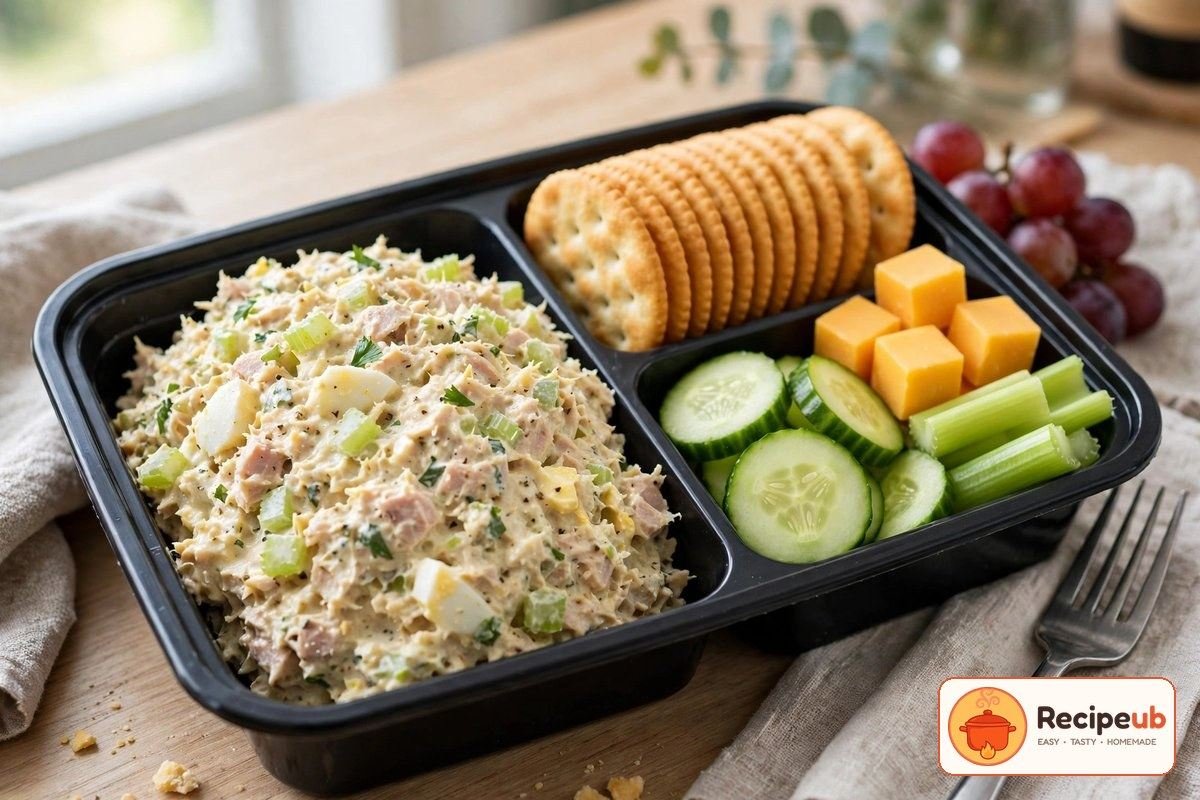
The short answer: Boil 3 large eggs (1 minute at a boil, then 9 minutes standing covered off the heat), cool, peel and chop. Drain 3 (5 oz) cans of chunk light tuna in water and flake into a bowl with the chopped eggs, ½ cup finely diced celery, ¼ cup finely diced red onion and ¼ cup dill pickle relish. Stir in ¼ cup mayonnaise and ¼ cup plain nonfat Greek yogurt — the 50/50 binder — with 1 Tbsp lemon juice, 1 tsp Dijon, ¼ tsp kosher salt and ¼ tsp black pepper. Divide across 4 lunch boxes, each with 10 round butter crackers packed dry in a separate compartment or bag, 1 oz cheddar cubes, cucumber slices, celery sticks and ½ cup grapes — four cold lunches at about 600 calories and ≈$2.31 each, in 30 minutes, eaten inside the next 4 days.
In This Recipe
The Plan at a Glance
- The tuna: 3 (5 oz) cans of chunk light tuna in water, drained — 3 cans, not 4: three cans across four boxes totals 3 FDA servings of a Best-Choice fish for the week, the top of the FDA’s 2-to-3-serving range and inside it (the mercury rule in the card notes)
- The stretch: 3 hard-boiled eggs, chopped into the salad — the egg replaces the fourth can, adding deli body and about ¾ of an egg to every box
- The binder: ¼ cup mayonnaise + ¼ cup plain nonfat Greek yogurt — the 50/50 from the Binder Chart below: mayo’s body at about half its calories (the binder rule in the card notes)
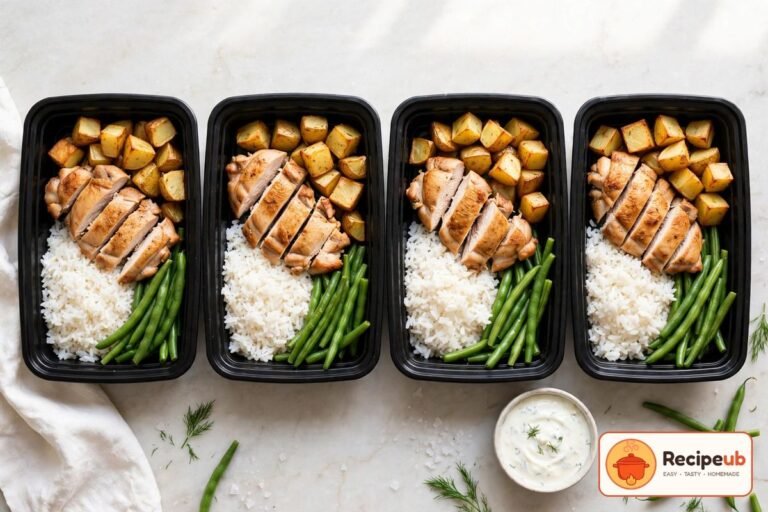
- The boxes: 4 — tuna salad in the main compartment; crackers in the dry compartment or a small bag, never touching the salad (the cracker rule in the card notes); 1 oz cheddar cubes, cucumber slices, celery sticks and ½ cup grapes alongside
- The eat order: 4 boxes across the next 4 days, all inside the USDA 3-to-4-day window for tuna salad — there is no fifth box, and nothing is frozen, because tuna salad does not freeze (the storage rule in the card notes)
- Time: 20 minutes prep / 10 minutes cook (the eggs only — 1 minute at a boil plus 9 minutes standing covered; everything else is no-cook, stated openly) / 30 minutes total
- Yield: 4 lunch boxes
- Calories: ≈600 per box (estimate); protein ≈33 g per box (estimate)
- Cost: ≈$2.31 per box (estimate) at November 2026 prices — the egg line is the BLS-verified anchor; the tuna and every other line are labeled shelf estimates; the full line-by-line table is The Priced Box below
- Storage: fridge 3 to 4 days at 40°F or below; the commute rides with an ice pack; tuna salad never sits out past 2 hours — the full rules are in the Storage section below
Why This Recipe Works
The batch is sized by the mercury chart, not by the can count that happens to be in the pantry. Every holder in this lane sizes the batch by appetite: 2 big cans, 4 cans, 5 cans — and the week quietly becomes 4 or 5 servings of the same fish. The FDA and EPA publish a fish chart for exactly this situation, and meal prep is the one format that runs straight into it: canned light tuna is a “Best Choice” at 2 to 3 servings a week, albacore is a “Good Choice” at 1 serving a week, and a serving is 4 ounces. Run those numbers against a 4-box week and the batch designs itself: 3 cans of chunk light, drained, is about 12 ounces of fish — 3 servings total, spread as ¾ of a serving in each box — which lands at the top of the Best-Choice range without crossing it. The Mercury Chart below prints the whole table. A batch can be generous or it can be portioned; this one is portioned, and the chart is the portioner.
The egg is in the salad because the fourth can is not. Take a can out of a tuna salad batch and the boxes come up short — that is the arithmetic that pushes every other recipe to 4 cans. The classic deli answer is the chopped egg: delis have folded hard-boiled egg into tuna salad for generations, for body and richness, and here it does a second job. Three chopped eggs add the bulk, the protein and the creamy bite the missing can would have carried, at about 19 cents of egg per box — and they change the salad’s identity not at all, because egg in tuna salad is not a substitution, it is one of the salad’s oldest forms. Eggs as the main event are a different system on this site — my egg meal prep breakfast boxes — the hot breakfast system, eggs as the body of the box over roasted potatoes; this post is the cold lunch system, where the egg works inside the salad and tuna is the body runs 2 eggs per box at breakfast. Here the egg is a supporting ingredient at ¾ of an egg per box, and the tuna stays the subject.
The binder is a compromise with the numbers printed, not a side taken. The two biggest holders in this lane split cleanly and silently: the budget holder builds on mayonnaise and never mentions yogurt; the snack-box holder builds on nonfat Greek yogurt and never mentions mayo. A searcher reads both pages and gets two assertions and no comparison. The Binder Chart below is the comparison — per batch, the all-mayo salad carries about 750 calories of binder and the all-yogurt salad about 65, and the texture verdicts run the other way: mayo holds its body to day 4, while an all-yogurt salad weeps whey by day 3 and needs a stir before it looks like food again. The 50/50 in this recipe — a quarter cup of each — is the chart’s middle row: about 410 calories of binder, the yogurt’s tang reading as brightness against the rich fish, and enough mayo in the mix to keep the body through the last box. It is not a timid half-measure; it is the row where the calories and the texture cross.
The box is a cold lunch that respects the cold rules. Tuna salad is a 3-to-4-day food — that is the USDA FoodKeeper line, and it governs here over the “entire week” framing a page-1 holder prints over the same food. So the batch makes exactly 4 boxes, eaten across the next 4 days, and there is no fifth box and no freezer bag, because tuna salad does not freeze: the binder separates on thawing and the celery comes back limp. The one technique the box does borrow — credited to the budget holder who proved it — is the cracker rule: crackers packed in the box’s dry compartment or a small bag on top, never touching the salad, because tuna salad’s moisture softens an unprotected cracker by day 2. A cold box lives or dies on its driest component staying dry.
It is the no-cook end of the budget shelf, priced like the rest of it. This category already runs cooked systems at every temperature — sheet-pan boxes, burrito wraps, priced soup pots. This is the prep with the stove essentially off: 10 minutes of cooking, all of it eggs, and the rest is draining, chopping and packing. The pantry is doing the work, the same pantry that carries dinner on this site — my cheap pantry dinners — the pantry dinner system, shelf-stable proteins turned into a hot family dinner; this post is the pantry’s cold lunch system, the same shelf discipline portioned into boxes — and like every system on this shelf, it prints its receipt: line by line, at current prices, with its one verified anchor named and every estimate labeled as one.
How Much Tuna Is a Week of Tuna? The Mercury Chart
Here is the chart this post exists to print. The FDA and EPA’s “Advice About Eating Fish” (revised October 2021) sorts fish into Best Choices, Good Choices and Choices to Avoid by mercury content, and gives the weekly cadence for each — written for people who are or might become pregnant, for breastfeeding parents and for children, with the FDA’s own note that everyone can follow it. Canned tuna sits in two different rows of that chart depending on which tuna is in the can, and meal prep is where the rows stop being trivia: a single tuna dinner is one serving either way, but a tuna week is a cadence decision, and every holder in this lane makes it silently. Here is the chart converted into the only unit a meal prepper actually buys — the batch. This recipe uses the bold row.
| Tuna | FDA/EPA list | Average mercury | Servings per week | What it means for a 4-box prep |
|---|---|---|---|---|
| Chunk light (skipjack) — this recipe | Best Choices | ~0.13 ppm | 2–3 | 3 cans across 4 boxes ≈ 3 servings total for the week — inside the guidance, with the chopped egg making up the fourth can’s bulk |
| Albacore (white) | Good Choices | ~0.35 ppm (about 3× light) | 1 | The same 4-box batch would total ~3 servings — three times the cadence; albacore is a once-a-week fish |
| Yellowfin | Good Choices | ~0.35 ppm | 1 | The same cadence problem as albacore |
| Bigeye | Choices to Avoid | ~0.69 ppm | 0 | Never a meal-prep tuna |
How to read the chart: start from the serving, because everything else is arithmetic. An FDA serving of fish is 4 ounces. A 5-ounce can of tuna, drained, gives about 4 ounces of fish — one can is roughly one serving. So a batch built on 4 cans and eaten across a week is 4 servings of that fish, and a 5-can batch is 5. Against the cadence column, the holders’ batches read plainly: the 4-can and 5-can light-tuna batches run past the Best-Choice range of 2–3, and the same batches built on albacore would run at three to five times a Good Choice’s 1-serving week. This recipe’s batch is the chart applied: 3 cans ≈ 12 ounces of drained fish ≈ 3 servings total, divided as 3 ounces — ¾ of a serving — in each of the 4 boxes, with the chopped egg carrying the bulk the fourth can would have added. Three servings is the top of the Best-Choice range, stated honestly: inside the guidance, not under it by a mile, and the reason the boxes still eat like full lunches is everything else in the box — the egg in the salad, the cheddar, the crackers, the grapes. And the albacore row has a home on this site, in its proper cadence: the same fish, hot, once — my tuna noodle skillet — the hot albacore dinner, solid white tuna in a creamy noodle bake eaten once at dinner; this post is chunk light, the Best-Choice tuna, portioned across a 4-day lunch week — is a Good-Choice fish eaten the way a Good-Choice fish is meant to be eaten, once, not four lunches running.
Ingredients
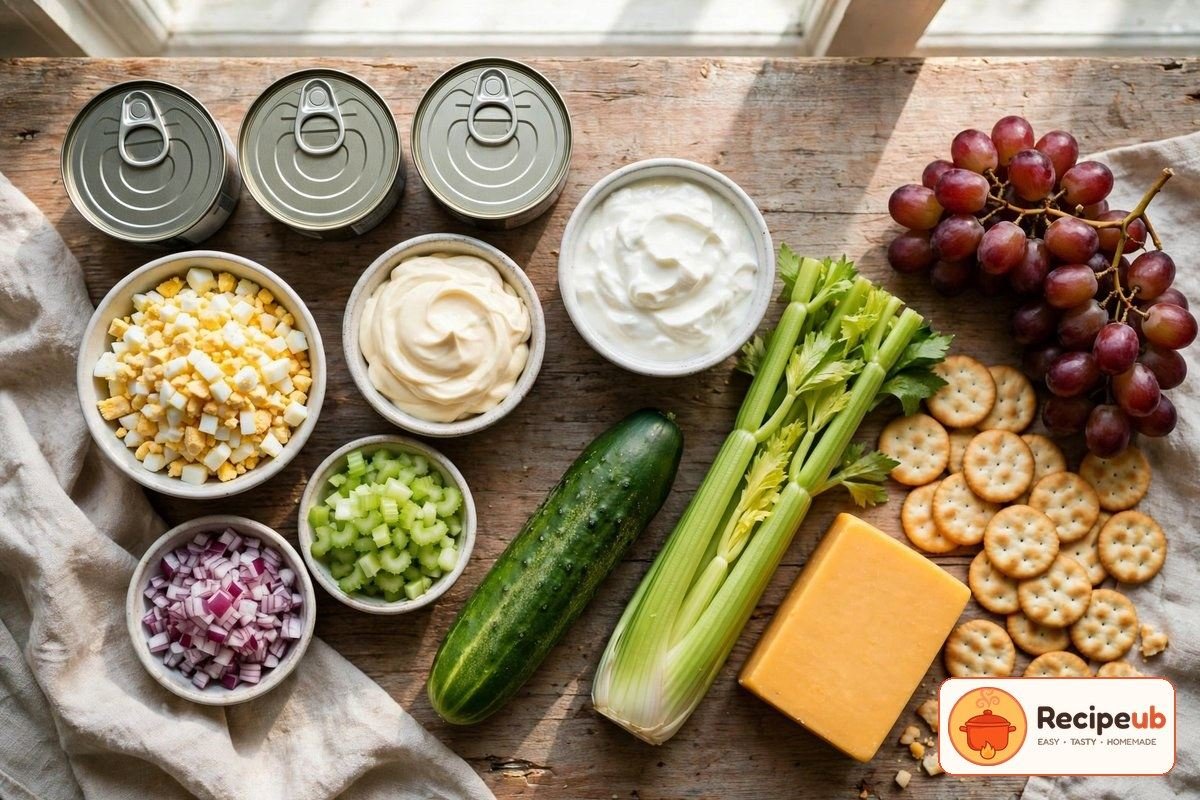
For the tuna salad:
- 3 (5 oz) cans chunk light tuna in water, drained
- 3 large eggs, hard-boiled and chopped
- ½ cup celery, finely diced
- ¼ cup red onion, finely diced
- ¼ cup dill pickle relish
- ¼ cup mayonnaise
- ¼ cup plain nonfat Greek yogurt
- 1 Tbsp lemon juice
- 1 tsp Dijon mustard
- ¼ tsp kosher salt
- ¼ tsp black pepper
For the boxes:
- 40 round butter crackers (10 per box, packed separately)
- 4 oz cheddar cheese, cubed
- 1 cucumber, sliced
- 4 celery stalks, cut into sticks
- 2 cups grapes
Ingredient notes: The tuna is chunk light tuna in water — 3 cans of 5 ounces, and the species and the count are both the recipe. Chunk light is mostly skipjack, the FDA/EPA Best-Choice tuna at about 0.13 ppm average mercury; albacore (sold as “white” tuna) carries about three times the mercury and a 1-serving weekly cadence, which is why it dinners once on this site and never preps. Water-packed, not oil-packed: the oil in an oil-pack can is oil you did not choose, at calories the box does not need, and the drained fish is the number the Mercury Chart is built on. One dated pantry note, in the site’s standing form: Tri-Union Seafoods’ recall of Genova canned tuna (an easy-open pull-tab defect) is still live — on January 16, 2026, the company announced that a distributor had inadvertently shipped quarantined recalled cans of Genova Yellowfin Tuna in Olive Oil (can codes S84N D2L, S84N D3L and S88N D1M, best-by dates in January 2028) to limited retailers in several states; this build’s chunk light tuna in water is a different species, a different product and a different brand, and is not the recalled product — readers holding Genova yellowfin cans should check their codes against the FDA’s list. The eggs are 3 large eggs, chopped into the salad — the stretch that replaces the fourth can (the Mercury Chart above is the reasoning; the deli tradition is the cover). At the BLS October 2026 average of $2.320 a dozen, the three eggs cost 58 cents — the cheapest bulk in the batch, and the one verified price on this page. The binder is ¼ cup mayonnaise plus ¼ cup plain nonfat Greek yogurt — the 50/50 from the Binder Chart below; either ingredient alone makes a different salad, and the chart prints both so the choice is yours with the numbers showing. The relish is dill pickle relish, not sweet — the deli salad’s brightness comes from the lemon and the relish’s brine, and sweet relish plus grapes in the same box doubles the sugar note. The crackers are round butter crackers, 10 per box, packed separately — in the container’s dry compartment if it has one, in a small bag laid on top if it does not; this is the cracker rule in the card notes, and it is the difference between a crisp cracker on day 4 and a soft one on day 2. The cheddar is 4 ounces, cubed — an ounce per box; buy a small block and cube it rather than paying the pre-cubed premium for the same cheese.
How to Make Tuna Meal Prep Lunch Boxes
The method is one short cook and one assembly, and the order matters for a cold box: the eggs cook first and cool while the vegetables are diced, the salad is mixed once and mixed gently, and the boxes are packed with the wet and the dry kept apart from the first minute — because in a lunch box, packing is the recipe. Everything is refrigerated promptly at the end; a tuna salad’s clock starts when the cans open, not when lunch does.
- Boil the eggs — the only cooking in the prep. Put the 3 eggs in a saucepan in a single layer, cover with cold water by an inch, and bring to a full boil over high heat. The moment the water boils, give it 1 minute, then take the pan off the heat, cover it, and let the eggs stand 9 minutes. Move them to a bowl of cold water until cool enough to handle, then peel and chop into small pieces. That is the card’s whole 10-minute cook time, stated openly — everything after this step is no-cook.
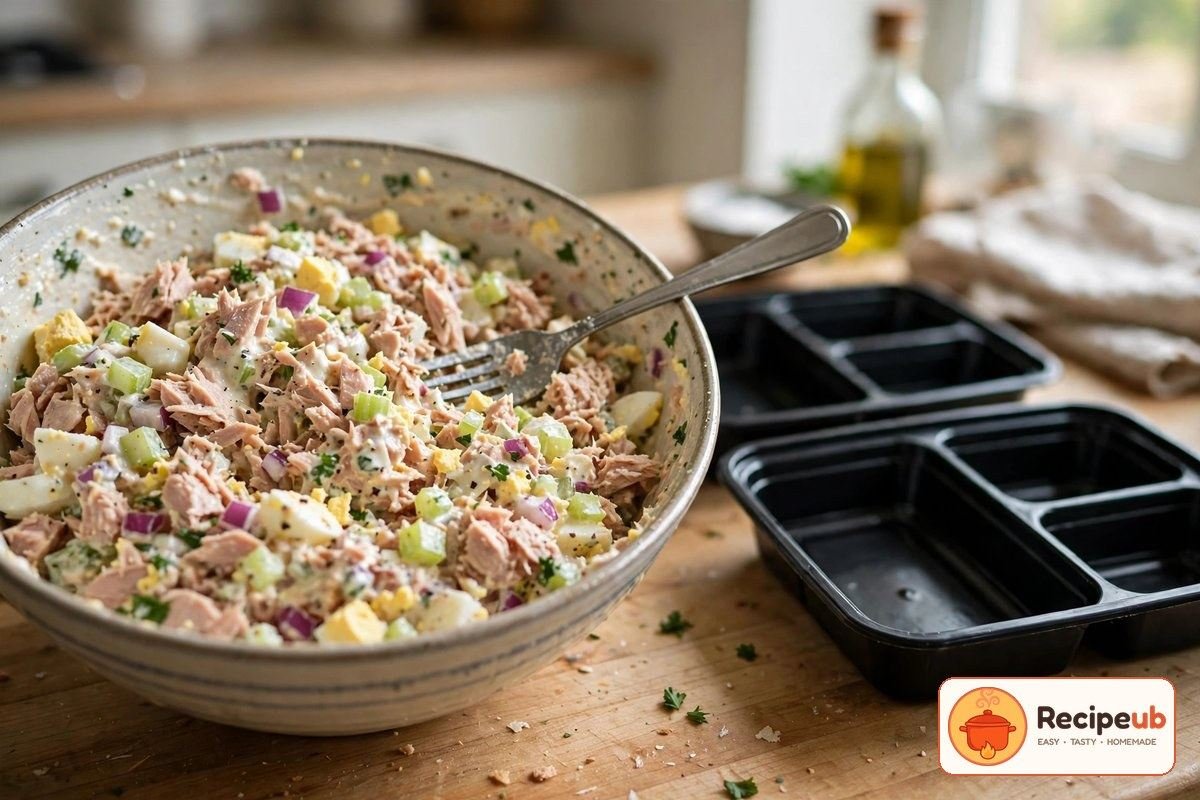
- Drain the tuna properly. Open the 3 cans and drain them thoroughly — press the lids down and let the water run out completely. Tuna salad goes watery from undrained fish far more often than from its binder, and a wet salad is also what soaks through to the crackers. Flake the drained tuna into a large mixing bowl, breaking the big chunks down with a fork but leaving real flakes, not a paste.
- Add the chopped egg and the vegetables. Fold the chopped eggs, diced celery and red onion through the tuna, then the dill pickle relish. The egg goes in as an ingredient, not a garnish — distributed through the salad, it is what makes 3 cans fill 4 boxes (the Mercury Chart above prints the math it is standing in for).
- Bind it, 50/50. Add the mayonnaise and Greek yogurt, the lemon juice, Dijon, salt and pepper, and fold everything together gently until just combined — overmixing breaks the flakes down and turns a deli salad into a spread. Taste and adjust the salt and lemon; canned fish varies, and this is the one moment the seasoning can be fixed for all four boxes at once.
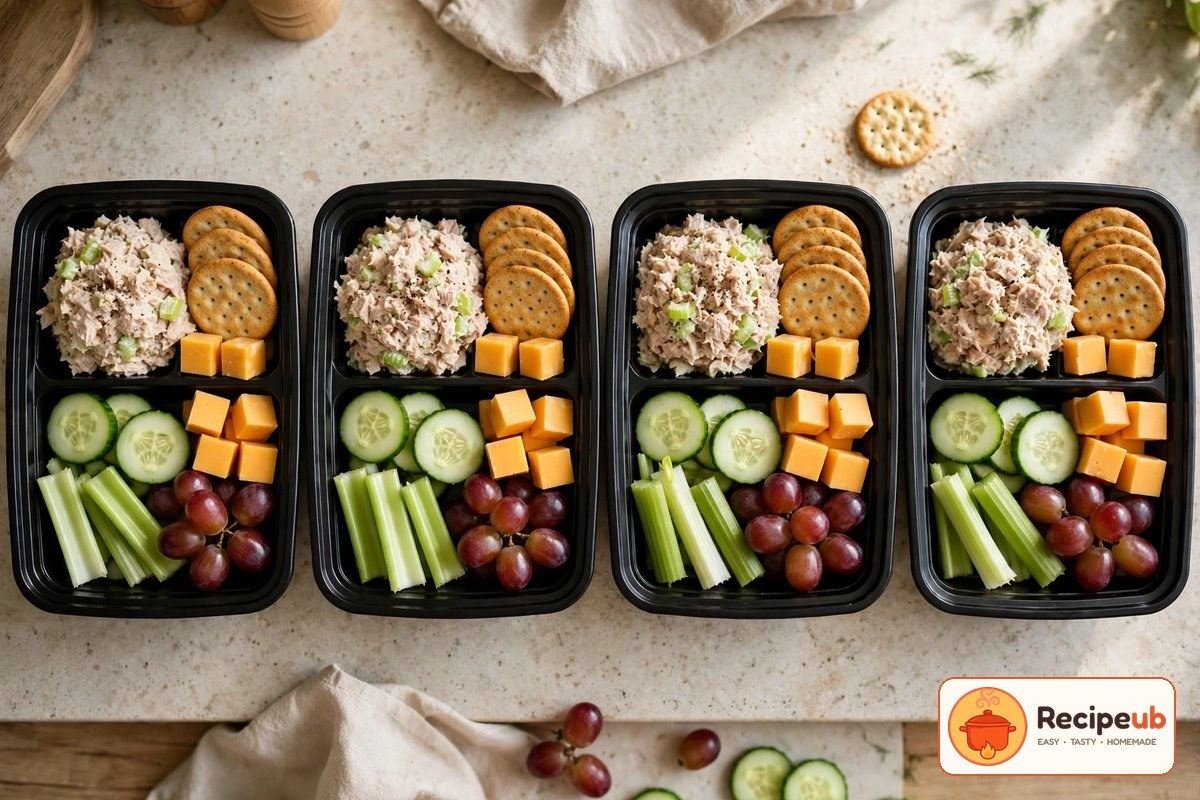
- Pack the boxes — wet and dry apart. Divide the salad among 4 meal prep containers, about 1¼ cups in each. Beside it in each box: 1 oz of cheddar cubes, cucumber slices, celery sticks and ½ cup of grapes. Then the crackers: 10 per box, into the dry compartment or a small bag laid on top — never against the salad (the cracker rule in the card notes). The grapes and cucumber can sit near the salad; the crackers cannot.
- Chill, and start the eat order. Lid the boxes and refrigerate promptly at 40°F or below — tuna salad never sits out past 2 hours total, and that clock includes the counter time during packing. The four boxes are eaten across the next 4 days, in any order; there is no fifth box and nothing goes to the freezer, by design (the storage rule in the card notes).
Tuna Meal Prep (4 Lunch Boxes, About $2.30 a Box)
Ingredients
Equipment
Method
- Put the eggs in a saucepan, cover with cold water and bring to a boil. Boil 1 minute, then cover, remove from the heat and let stand 9 minutes. Cool in cold water, peel and chop.
- Drain the tuna thoroughly and flake it into a large mixing bowl.
- Fold in the chopped eggs, celery, red onion and relish.
- Add the mayonnaise, Greek yogurt, lemon juice, Dijon, salt and pepper; fold gently until just combined.
- Divide the salad among 4 containers. Add 1 oz cheddar cubes, cucumber slices, celery sticks and ½ cup grapes to each box.
- Pack 10 crackers per box in the dry compartment or a small bag, never touching the salad. Lid and refrigerate promptly; eat within 3 to 4 days.
Notes
Mayo or Greek Yogurt? The Binder Chart
Here is the second chart, and it settles the argument the search results page stages without judging. The two biggest holders in this lane each assert one binder as if the other did not exist — the budget holder builds on mayonnaise, the snack-box holder on nonfat Greek yogurt — and a searcher who reads both gets a health claim and a tradition claim and no numbers from either. Here are the three builds side by side, costed on the same batch: ½ cup of binder for the whole salad. This recipe uses the bold row.
| Binder (½ cup per batch) | Batch calories | Batch protein | Day-3 texture verdict |
|---|---|---|---|
| All mayonnaise | ≈750 kcal | ≈1 g | Holds its body best; the richest and the heaviest |
| All nonfat Greek yogurt | ≈65 kcal | ≈11 g | Tangy and lean; weeps whey by day 3 — stir before serving |
| Half mayo + half Greek yogurt (this recipe) | ≈410 kcal | ≈6 g | Mayo’s body with about half its calories; the yogurt’s tang reads as brightness, not diet food |
How to read the chart: the calories column and the texture column pull in opposite directions, and the honest answer depends on which day your last box lands on. All-mayo is the deli original and it behaves like one — emulsified fat does not weep, so a day-4 salad tastes like the day-1 salad, only richer; the price is roughly 190 calories of binder in every box before the fish is counted. All-yogurt is the lean build and it is genuinely good on days 1 and 2 — bright, high-protein, about 16 calories of binder per box — but yogurt is a gel holding water, and by day 3 the gel lets go: a spoonful of whey pools in the container, and the salad needs a stir and eats a little thinner for it. That is a texture fact, not a failure, and if your prep is a 2-day prep it is the right row. The 50/50 exists for the 4-day week this post is built around: enough mayo to stabilize the emulsion through day 4, enough yogurt to cut the binder’s calories roughly in half and to bring the tang that makes cold tuna taste awake. Read the chart as a matching exercise, the same as every chart on this site: the binder is chosen by the length of your week — 2 days, yogurt; 4 days, the split or the original, with the calories printed either way.
What Does a Tuna Lunch Box Cost? The Priced Box
Here is the third thing this post prints that page 1 does not: the whole box, priced line by line, at November 2026 prices — with the one anchor line read directly from the Bureau of Labor Statistics, every other line labeled a shelf estimate, printed as one, because this page names its sources instead of rounding a receipt it never saw. It also reconciles: the method portions 4 boxes, and the table divides by the same 4.
| Line | Amount for the batch | Price basis | Batch cost |
|---|---|---|---|
| Chunk light tuna in water | 3 cans (5 oz) | Shelf estimate, labeled as one | ≈$3.75 |
| Grapes | About 2 cups | Shelf estimate, labeled as one | ≈$1.10 |
| Cheddar cheese | 4 oz | Shelf estimate, labeled as one | ≈$1.00 |
| Celery, cucumber, red onion, lemon | Box produce | Shelf estimate, labeled as one | ≈$1.00 |
| Round butter crackers | About 40 | Shelf estimate, labeled as one | ≈$0.90 |
| Large eggs, Grade A | 3 eggs | BLS October 2026 average, $2.320/dozen (verified, series APU0000708111) | $0.58 |
| Greek yogurt | ¼ cup | Shelf estimate, labeled as one | ≈$0.35 |
| Mayonnaise | ¼ cup | Shelf estimate, labeled as one | ≈$0.30 |
| Relish, Dijon, salt, pepper | Pantry amounts | Estimate, labeled as one | ≈$0.25 |
| Batch total | 4 boxes | ≈$9.23 → ≈$2.31 per box |
How to read the table: two honest things first. There is no BLS price for canned tuna on this page — the Bureau’s published averages do not offer a canned-tuna series this page can claim, so the tuna line is a labeled shelf estimate like the produce and the cheese, and the one verified line is the eggs. And the tuna is the batch’s biggest line at about $3.75 of the $9.23 — which is the November 2026 story in miniature: canned seafood is in a documented price squeeze, with the canned-seafood CPI running 6.2% above a year earlier (FMI’s May 2026 food-price briefing), more than double the 2.9% rise for food at home overall, on imported fish and the metal for the cans. That is the context the lane’s famous number needs: the budget holder’s tuna lunch box is priced at $1.92 a serving — in roughly 2022 money, built on 12-ounce cans at $1.99. Re-priced at this November’s shelf levels, the same idea lands at ≈$2.31 — and the honest comparison is not that this box costs more, it is that this box’s price is dated. A priced page dates its prices precisely because windows move; the egg line shows the other direction, with eggs at $2.320 a dozen making the salad’s stretch the cheapest bulk in the batch. If the protein math is the whole point of your prep — grams per dollar across a rotation — that system already lives on this shelf, named in the intro; this box’s math is cadence first, price second, both printed.
Emma’s Tips for the Best Tuna Meal Prep
Drain the tuna like you mean it. More tuna salads are ruined by can water than by any binder choice. Press the lid down into the can, invert it over the sink, and let it drain fully — a full minute, not a shake. Fish that goes into the bowl wet waters down the binder, dulls the seasoning, and is the moisture that eventually hunts down your crackers. The salad should be bound, not soupy, and the draining is where that is decided.
Chop the egg small and the celery fine. The egg is a batch ingredient here, not a garnish — chopped small, it disappears into the salad’s body the way it does in a deli case, and every spoonful carries some. Big egg chunks eat like a different dish sharing the box. The celery wants the opposite discipline in miniature: a fine dice gives crunch in every bite without a stalk’s worth of string in any one of them, and it is the crunch that survives to day 4.
Season after the binder, and taste the actual salad. Canned tuna varies in salt from brand to brand and can to can, so the ¼ teaspoon on the card is a starting point, not a verdict. Mix the salad completely, taste a spoonful, and adjust the salt and lemon then — it is the only moment all four boxes can be seasoned at once. Lemon especially: it fades a little across the days, so the salad should taste a touch brighter on prep day than you want Thursday’s box to taste.
Dry the produce before it goes in the box. Grapes and cucumber slices carry wash water straight into the container, and in a sealed cold box that water has nowhere to go but onto the cheddar and toward the crackers. A minute in a clean towel — or a spin for the grapes — is the cheapest insurance in the whole prep. The box’s dry side stays dry by discipline, not by luck.
Halve the batch if the week is smaller than the box count. Four boxes is a design for a four-lunch week, not a dare. Two lunches out, a work-from-home stretch, a trip on Thursday — halve everything (2 cans would overshoot the cadence math, so halve it as written: the salad scales by the same ratios, and 2 boxes eat inside the window with room to spare). Prepping for exactly one person as a standing system is a different post’s whole subject: my meal prep for one — the solo system, a week of meals sized for one person from the start; this post is the four-box household batch, halved when the week runs short builds the week at that size instead of shrinking this one. And if this is your first prep of any kind, the gentler on-ramp is my meal prep on a budget for beginners — the starter system, a first week of budget prep built step by step; this post assumes the habit and spends it on tuna — this box is a fine second prep, and a forgiving first one, but the beginner system teaches the container-and-eat-order habits this page assumes.
Storage and the 4-Day Eat Order
Fridge — all 4 boxes, eaten in 4 days: Tuna salad keeps 3 to 4 days at 40°F or below — the USDA FoodKeeper line for tuna salad, and the only window this page prints. The four boxes are eaten across the four days after prep, in any order; the salad is at its brightest on days 1–2 and entirely sound through day 4. Refrigerate the boxes promptly on prep day — tuna salad never sits at room temperature past 2 hours total (1 hour above 90°F), and that clock includes the packing time on the counter. What this page will not print is the stretched version: the “entire week” framing a page-1 holder puts over this same food is a claim about someone else’s risk, and the honest window is the one on this card. The eggs take the salad’s window too — a hard-boiled egg in its shell keeps up to a week, but chopped into a dressed salad it lives by the salad’s 3-to-4-day rule, which is the number this system is built on.
The commute and the desk: The box travels in an insulated bag with an ice pack, and it goes back into a fridge on arrival — the 2-hour clock is total time out of refrigeration, commute plus desk-sitting plus the walk back. A box that rides in a hot car and then sits out through a morning meeting has spent its budget before lunch. If there is no fridge at the destination, the ice pack is not optional equipment; it is the refrigeration.
The freezer — an honest no: Do not freeze tuna salad. The mayonnaise and yogurt binder separates on thawing into an oily, watery dressing, and the celery comes back limp — the two textures the salad is made of are the two freezing destroys. This batch is sized so the question never has to be negotiated: 3 cans, 4 boxes, 4 days, nothing left over to rescue. The box’s other components are not a freezer system either — crackers go stale-tasting, grapes freeze into a different (perfectly pleasant, entirely different) food, and cheddar turns crumbly. The freezer-first systems on this shelf are built on foods that freeze well; this one is built on the fridge window and the mercury chart agreeing on the same batch size, and it stays there.
Day-4 crackers, still crisp: The storage rule that makes the box eat like a box instead of a salad with garnish is the cracker rule from the card notes — crackers in the dry compartment or their bag until the moment of eating. A cracker packed against the salad on Sunday is soft by Tuesday; a cracker kept dry is crisp on Thursday. Everything else in the box is packed to be eaten cold, straight from the fridge, with no reheat — which is the last quiet virtue of the system: the only lunch on this shelf that asks nothing of a microwave.
FAQs
How long does tuna salad last in the fridge?
3 to 4 days at 40°F or below — the USDA FoodKeeper line for tuna salad, and the only window this page prints. The holders scatter around it (one sells its boxes as lunches “for the entire week,” another preps five days of tuna outright), and the scatter itself is the tell: those are claims, and 3–4 days is the standard. This batch is designed so the question never has to stretch — it makes exactly 4 boxes, eaten across the 4 days after prep, and there is no fifth box asking the food to outlast its window.
How much canned tuna can I eat in a week?
By the FDA/EPA fish advice, it depends on the tuna. Canned light tuna is a “Best Choice” — 2 to 3 servings a week. Albacore (white) tuna and yellowfin are “Good Choices” — 1 serving a week. Bigeye tuna is a choice to avoid. A serving is 4 ounces — about one drained 5-ounce can. This recipe’s whole batch is 3 cans of chunk light across 4 boxes, so the full week of lunches totals 3 servings of a Best-Choice fish: the top of the range, inside it. The full table, with the mercury averages, is the Mercury Chart above.
Is light tuna or albacore better for meal prep?
Light tuna, on all three counts that matter to a prep. Mercury: chunk light (mostly skipjack) averages about 0.13 ppm against albacore’s 0.35 — roughly a third — which is why light carries a 2-to-3-serving weekly cadence and albacore carries 1; a 4-day lunch week is only buildable on the light row. Price: chunk light is the cheaper can on the shelf, and this lane is a budget lane. Texture: albacore is firmer and milder and genuinely lovely eaten once — it is the tuna in this site’s hot skillet dinner — but in a dressed salad eaten across four days, chunk light’s flakes take the binder the way the deli original expects. Albacore is a once-a-week fish; meal prep is a several-times-a-week format. The chart decides it.
Can you freeze tuna salad?
No — and this recipe is designed so you never need to. The mayonnaise and yogurt binder separates on thawing into an oily, watery dressing, and the celery — the salad’s crunch — comes back limp; the two textures the salad is made of are the two freezing destroys. Every honest holder agrees, and this site’s protein-prep post prints the same verdict. The batch answers the freezer question by sizing: 3 cans, 4 boxes, 4 days, all inside the fridge window, with nothing left over to rescue.
Greek yogurt or mayonnaise in tuna salad?
Half and half — with the numbers in the Binder Chart above. All-mayo runs about 750 calories of binder per batch and holds its body to day 4; all nonfat Greek yogurt runs about 65 calories and about 11 g of protein, but weeps whey by day 3 and needs a stir before serving. The 50/50 in this recipe lands at about 410 calories with mayo’s stability and the yogurt’s brightness. The honest exception: if your boxes are all eaten by day 2, all-yogurt is the leaner right answer — the chart is a matching exercise, and the match is the length of your week.
How do I keep the crackers from going soggy?
Pack them dry — in the box’s dry compartment or a small bag — and never touching the salad. Tuna salad is a wet food in a sealed container, and its moisture migrates to the driest thing in the box, which is the cracker. A cracker packed against the salad on prep day is soft by day 2; a cracker kept separate is still crisp on day 4. It is the one proven technique in this format (the budget holder’s lunch box built its reputation partly on it), and it costs nothing but a baggie.
Can I meal prep tuna salad for 5 days?
No — two independent caps land on the same number, and both are printed on this page. The fridge window caps the food at 3 to 4 days (USDA), so a fifth day’s box is outside it. The mercury cadence caps the fish at 2 to 3 servings of light tuna a week, and a 5-box batch built the holders’ way — a can a day — runs to 5 servings. Four boxes and 3 cans is where the two caps meet. If the week genuinely needs a fifth packed lunch, it needs a different protein in it — the rotation systems on this shelf exist for exactly that.
Why is there egg in this tuna salad?
Two reasons, and the first is arithmetic. This batch is 3 cans, not 4 — the Mercury Chart portions it — and 3 chopped eggs supply the bulk, protein and richness the fourth can would have carried, at about 19 cents of egg per box. The second reason is older than meal prep: chopped egg is a classic deli tuna-salad ingredient, there for body, and it disappears into the salad rather than changing it. The egg is not a substitute the recipe apologizes for; it is the ingredient that makes the correctly sized batch possible.
How much does one tuna lunch box cost to make?
≈$2.31 a box (estimate) — a batch of ≈$9.23 for 4 boxes, priced line by line in The Priced Box above. The tuna is the biggest line (about $3.75 for 3 cans, a labeled shelf estimate — no BLS canned-tuna average exists for this page to claim), and the one verified line is the eggs, at the BLS October 2026 average of $2.320 a dozen. The famous comparison number, $1.92 a serving, is real — in roughly 2022 dollars, off 12-ounce cans at $1.99; with the canned-seafood CPI running 6.2% above last year, this page re-prices the same idea at November 2026 levels and dates the price on the page.
How long can a tuna lunch box sit out at work?
2 hours total out of refrigeration — 1 hour if the room or the car is above 90°F — and the clock counts everything: the commute, the desk, the meeting it sat through. The box should travel in an insulated bag with an ice pack and go into a fridge on arrival; if there is no fridge at work, the ice pack stays in the bag with the box and does the refrigerating. Tuna salad is a cold food with a warm-weather clock, and the system’s one non-negotiable is that the clock is respected.
Final Thoughts
Tuna meal prep is not a hard lunch, and it is a badly portioned one anyway — because the recipe was never the problem. It is three cans, three eggs and thirty minutes. The problem is that page 1 sizes the batch by appetite and never by the chart the FDA publishes for exactly this fish, asserts two binders at each other without ever comparing them, prices its one famous box in 2022 dollars, and stores a 3-to-4-day food “for the entire week.” What this page adds is the paperwork the other versions leave out — a mercury chart converted into a batch size, so the week totals 3 servings of a Best-Choice fish instead of 4 or 5 servings of anything; a binder chart where the calories and the day-3 texture sit in the same table; a priced box whose date is printed on it; and an eat order that treats the USDA window as a design constraint instead of an inconvenience. Three cans, the egg in the salad, the crackers kept dry, four boxes gone in four days: that is the deal.
More Easy Budget Meal Prep
If a priced system with the chart printed is your kind of meal prep, the rest of this shelf runs on the same rules — every receipt shown, every window honest. The whole shelf is gathered in my budget meal prep ideas — the hub of every budget system on the site, priced pots, solo weeks, beginner batches and breakfast boxes; this post is its newest entry, the cold tuna lunch box portioned by the mercury chart, and it sits there as the shelf’s no-cook end — the one prep in the collection whose only cooking is boiling the eggs. One shelf, one standard — the batch is sized by the chart, the price is dated on the page, the crackers stay dry, and the week is handled.



Never Run Out of Dinner Ideas
One easy air fryer or slow cooker dinner in your inbox every week. No spam, ever.
You’re on the list — welcome to Recipeub!