
Sheet Pan Chicken Meal Prep (5 Lunches, 1 Pan, 55 Minutes)
Sheet pan chicken meal prep is the Sunday hour that buys back my whole week: one big pan of chicken breast, sweet potato, broccoli, peppers and onion, roasted at 425°F and divided into five real lunches. Fifty-five minutes, most of it the oven’s work, and Monday through Friday stop being a daily negotiation. Each container runs about $2.83 at November 2026 prices, with about 455 calories and 43 grams of protein — and the ingredient list is chicken, vegetables, oil and spices. Nothing else. If you already make my Air Fryer Chicken Meal Prep Bowls, this is the same Sunday prep with a different machine: those roast in the air fryer in smaller batches, while this batch uses one big oven sheet pan and fills five containers at once.
What makes this version different is the failure it is built to prevent. Sheet pan meal prep goes wrong in one predictable place: everything lands on the pan at the same time, so the sweet potatoes come out hard, the broccoli comes out gray and steamed, and by Wednesday the whole project tastes like a chore. So this page prints the two systems I actually cook by: an Add-In Timing Chart that staggers the pan — dense vegetables first, chicken second, quick vegetables last — and a 5-Day Sauce Rotation that packs five different sauces separately, so one batch never tastes like the same lunch five times.
The timing is right, too. Meal prep searches climb from mid-December and peak in the first two weeks of January, and chicken is the cheap protein to ride that wave on: the Bureau of Labor Statistics put boneless chicken breast at a $4.099-a-pound average in October 2026, and USDA’s November outlook has chicken prices rising into 2027. Meal prep now, while breast is at $4.10 a pound, is the budget version of the January resolution.
The short answer: Sheet pan chicken meal prep roasts at 425°F for 35 minutes total — sweet potatoes go in first, chicken joins at minute 15, and the broccoli, peppers and onion at minute 25 — with the chicken cooked to 165°F. One batch makes 5 containers at about 455 calories and 43 grams of protein each. Keep them 4 days in the fridge and freeze the fifth container for Friday.
In This Recipe
The Plan at a Glance
- Batch: 5 containers, one large rimmed sheet pan (half sheet, 18×13 inches)
- Protein: 2 lb boneless skinless chicken breast, cut into 1-inch pieces
- Vegetables: sweet potato, broccoli, bell peppers, red onion
- Time: 20 minutes prep / 35 minutes cook / 55 minutes total
- Method: 425°F, staggered — dense vegetables get a 15-minute head start
- Cost: about $14.13 a batch, about $2.83 a container, at November 2026 prices
- Calories: about 455 per container, about 43 g protein; sauce packed separately adds about 25 kcal
- Fridge life: 4 days; the fifth container goes in the freezer for Friday
- Sauces: 5 different sauces, packed separately, added after reheating
Why This Recipe Works
The stagger is the recipe. Every disappointed sheet pan cook I know made the same move: chicken and vegetables in together, one timer, hope. Dense sweet potato needs 35 minutes; broccoli needs 10. Give them the same 35 and one of them loses. This recipe charts the entries instead — sweet potatoes alone for 15 minutes, chicken for its 20, the quick vegetables for the last 10 — so everything on the pan finishes at the same moment, browned instead of steamed. The full chart is below, with cut sizes, because the cuts are what make the minutes true.
The chicken is breast, cut small — on purpose. This is a sheet pan chicken breast meal prep because January asks for it: breast is the high-protein, lean build the meal prep searches actually want, at 43 grams of protein a container. Cutting it into 1-inch pieces is what makes breast work on a shared pan — the pieces cook through in 20 minutes, right alongside the vegetables, instead of needing the pan to themselves the way whole breasts do. Small pieces, cooked only to 165°F, stay moist. Big pieces, cooked long, are how chicken breast gets its reputation.
The sauce is packed separately, never cooked in. Sauce on the pan on Sunday is sauce baked onto everything by Tuesday. Sauce packed in its own little container stays bright, keeps the chicken from sitting in liquid all week (that is the day-4 dryness fix nobody prints), and turns one batch into five different lunches — lemon-herb Monday, peanut-ginger Friday. The searches agree: “sauce for sheet pan chicken and vegetables” is its own autocomplete suggestion. The rotation table is below.
The math is printed, with its date on it. Most meal prep pages print no cost at all, and the one page-1 cost table is built on chicken thighs. This one prices the breast build honestly — chicken at the BLS October 2026 average, everything itemized, about $2.83 a container — because a budget recipe whose numbers you cannot check is just a claim. The full table is in the cost section below.
When Does Everything Go on the Pan? The 425°F Add-In Timing Chart
Here is the chart I wish every sheet pan recipe printed. One oven temperature, 425°F, and four entry times — because “roast everything 35 minutes” is not a method, it is how sweet potatoes stay raw in the middle while the broccoli gives up. Every row assumes a single layer with a little space between pieces; a crowded pan steams, and steamed vegetables are soggy vegetables no matter what the clock says.
| When | What goes on the pan | Cut size | Why then |
|---|---|---|---|
| Minute 0 | Sweet potatoes | ½-inch cubes | The densest thing on the pan — they need the full 35 minutes |
| Minute 15 | Chicken breast pieces | 1-inch pieces | 20 minutes takes them to 165°F without drying them out |
| Minute 25 | Broccoli, bell peppers, red onion | Florets, 1-inch pieces, wedges | 10 minutes keeps them bright, firm-edged and roasted, not steamed |
| Minute 32 | Green beans or cherry tomatoes (optional) | Whole beans, halved tomatoes | The delicate row — a short blast; tomatoes just burst, beans stay snappy |
| Minute 35 | Everything comes off | — | Chicken at 165°F, sweet potatoes tender all the way through |
How to read the chart: the minute marks are when each row joins the pan, not separate timers — the sweet potatoes roast the whole 35 minutes, the chicken 20 of them, the vegetables the last 10. This is the chart that answers the question hiding in the searches — “how long to cook a chicken sheet pan dinner” — and the honest answer is: 35 minutes at 425°F, if the pan is staggered. If your pan is small and the pieces are touching, split the batch across two pans rather than piling it up; two pans of roasted beats one pan of steamed every time.
One Batch, Five Different Lunches: The 5-Day Sauce Rotation
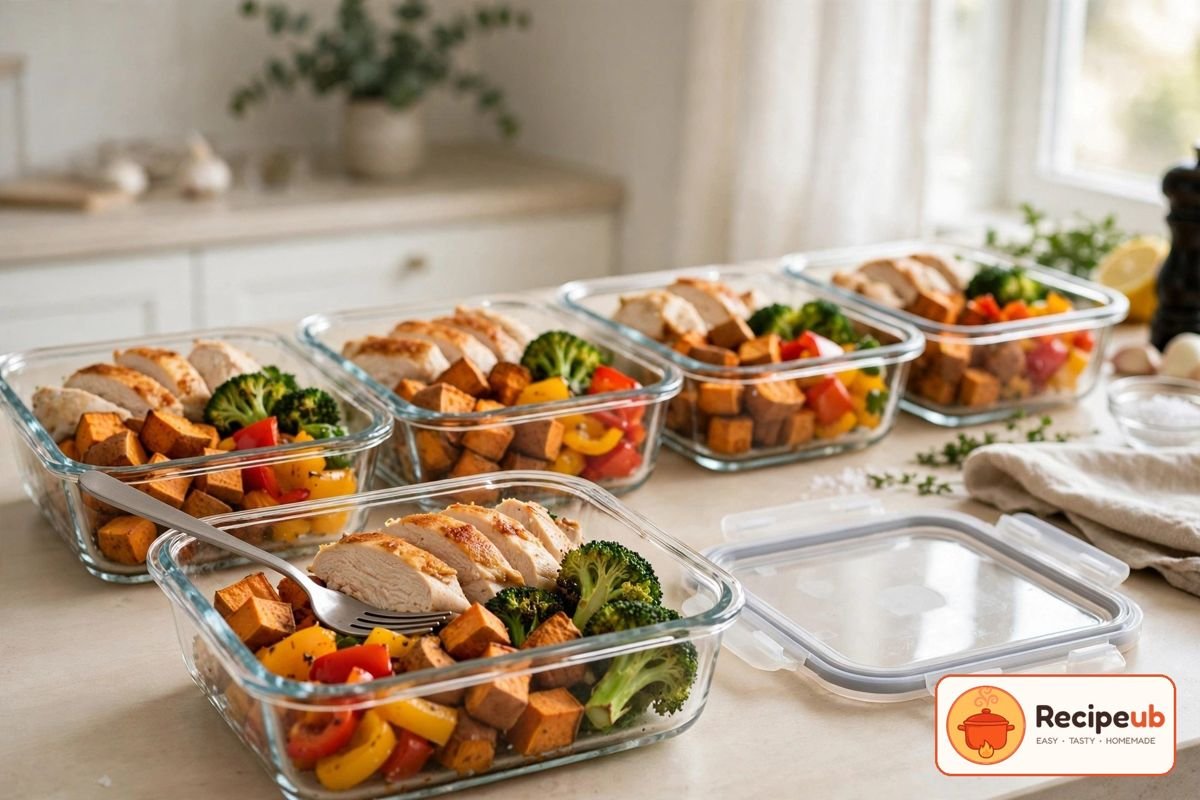
Cook the base batch once, and let the sauce do the variety. Each sauce is about 2 tablespoons per container, packed in its own small container on Sunday, and added after reheating — never before, never cooked in. Greek and fajita are the two flavors the searches ask for by name, so both earned a day; the yogurt-based sauces add about 25 calories, and every number below is an honest estimate from the sauce’s own ingredients.
| Day | Sauce | What is in it | Adds |
|---|---|---|---|
| Monday | Lemon-Herb | Lemon juice and zest, 1 tsp olive oil, garlic, chopped parsley | ~45 kcal |
| Tuesday | Greek Yogurt-Herb | Greek yogurt, lemon, oregano, garlic | ~25 kcal |
| Wednesday | Fajita-Lime | Greek yogurt, lime juice and zest, fajita seasoning | ~25 kcal |
| Thursday | Honey Mustard | Honey and Dijon mustard, about half and half | ~65 kcal |
| Friday | Peanut–Soy-Ginger | Peanut butter thinned with soy sauce, lime and grated ginger | ~70 kcal |
How the rotation works: the base chicken and vegetables are seasoned once, with a neutral rub — smoked paprika, garlic, salt and pepper — that plays well with all five sauces instead of fighting them. Sauces that sit on chicken for four days make it taste like leftovers; sauces added at the desk make it taste like lunch. And because the sauce is separate, the calorie count stays honest in both directions: the 455 on the card is the container without sauce, and the table above tells you exactly what your day’s sauce adds.
What Does Sheet Pan Chicken Meal Prep Cost? The Honest Math
The chicken math first. At the BLS October 2026 average of $4.099 a pound, the 2 pounds of chicken breast in this batch cost about $8.20 — and that number is worth dating, because USDA’s November outlook lowered its production forecasts and raised its 2027 wholesale chicken price forecast, while beef stays historically tight through 2027. Chicken is the relief protein right now, and $4.10-a-pound breast is the cheap window. The rest of the pan — sweet potatoes, broccoli, peppers, onion, oil and seasonings — comes to about $5.93, for a batch total of about $14.13, or about $2.83 a container across five containers. It is the same honest-accounting habit as my Walmart meal prep on a budget: the full build, priced in full. If your cart comes from the other store, my Aldi meal prep plan prices the same kind of week the same honest way.
| Ingredient | Basis | Cost |
|---|---|---|
| Chicken breast, 2 lb | $4.099/lb (BLS Oct 2026 average) | $8.20 |
| Sweet potatoes, 1½ lb | About $0.92/lb | $1.38 |
| Broccoli, 12 oz | — | $1.50 |
| Bell peppers, 2 | About $1.00 each | $2.00 |
| Red onion, 1 | — | $0.60 |
| Olive oil + seasonings | — | $0.45 |
| Batch total | $14.13 |
The honest framing: the only other cost table on page 1 for this dish prints $2.87 a serving — built on chicken thighs, which are the cheaper cut. Ours is the breast build, the high-protein one the January searches actually ask for, and it still comes in under that number at $2.83, because the vegetables on this pan are cheap and the chicken price is dated and checkable. No rounding tricks, no store-brand-only assumptions: regular prices, printed basis, real total.
Ingredients
- 2 lb boneless skinless chicken breast, cut into 1-inch pieces
- 1½ lb sweet potatoes, cut into ½-inch cubes
- 12 oz broccoli florets
- 2 bell peppers (I use one red, one green), cut into 1-inch pieces
- 1 red onion, cut into wedges
- 3 Tbsp olive oil, divided
- 2 tsp garlic powder
- 2 tsp smoked paprika
- 1½ tsp kosher salt
- 1 tsp black pepper
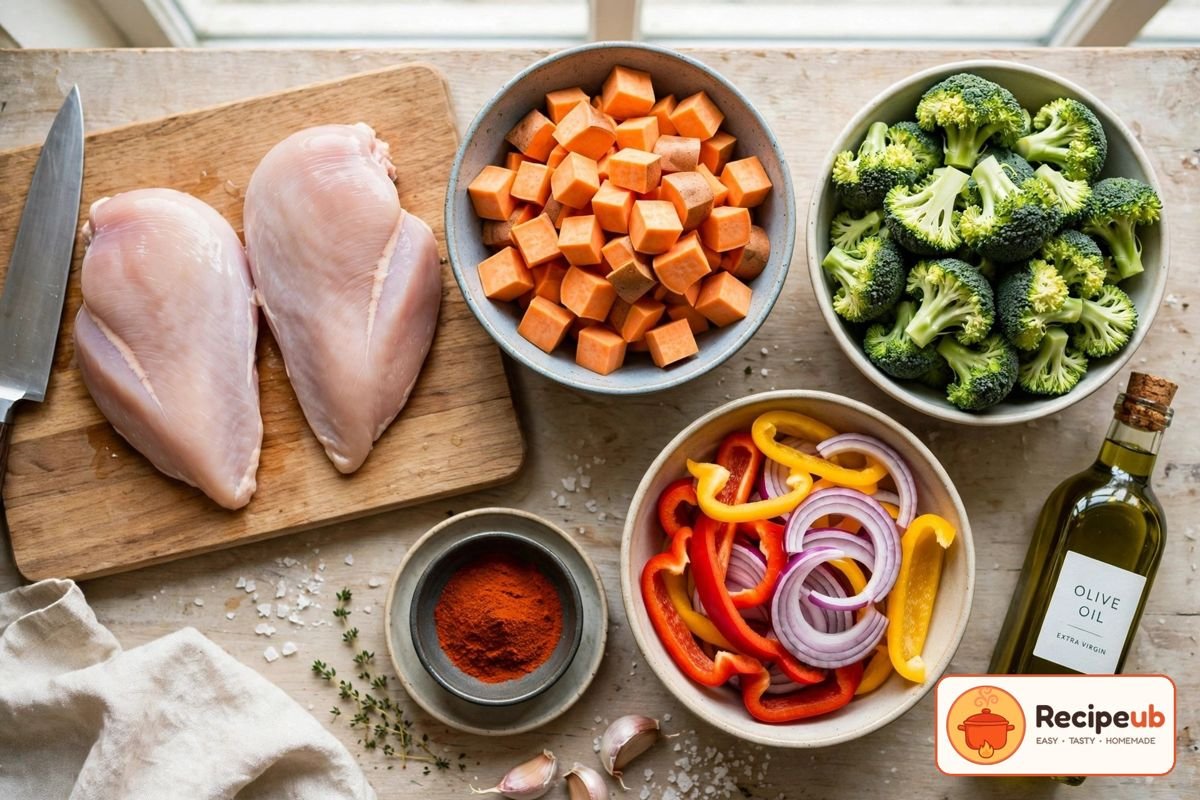
Ingredient notes: The cut sizes are not fussiness — they are the timing chart. A ½-inch sweet potato cube cooks through in 35 minutes; a 1-inch cube does not, and no timer can fix a cut that is too big. Cut the chicken into even 1-inch pieces so every piece reaches 165°F in the same 20 minutes, and pat it dry before seasoning: wet chicken steams instead of browning, even in a hot oven. Keep the broccoli florets on the larger side — small florets shrink and scorch in their 10 minutes. Chicken thighs swap in at the same weight and the same timing if your house prefers them; they run about 40 more calories a container and stay juicier on day 4, and the full answer is in the FAQs. The seasoning is deliberately neutral — paprika and garlic, no lemon, no herbs — because the sauce rotation brings a different flavor every day and the base has to get along with all five.
How to Make Sheet Pan Chicken Meal Prep
- Heat the oven and set the pan. Heat the oven to 425°F. Line a large rimmed sheet pan with parchment if you like easy cleanup, or leave it bare for the best browning on the sweet potatoes.
- Start the sweet potatoes (minute 0). Toss the sweet potato cubes with 1 tablespoon of the olive oil and about a third of the garlic powder, smoked paprika, salt and pepper. Spread them in a single layer and roast for 15 minutes. This head start is the whole chart — do not wait for the chicken to be ready first.
- Season the chicken while the potatoes roast. Pat the chicken pieces dry, then toss them with 1 tablespoon of olive oil and another third of the seasoning until every piece is coated. Even pieces, even coat.
- Add the chicken (minute 15). Take the pan out, push the sweet potatoes to make room, and add the chicken in a single layer — pieces not touching where you can manage it. Back in the oven.
- Toss the vegetables while the chicken starts. Broccoli, bell peppers and onion get the last tablespoon of olive oil and the last of the seasoning. Keep them in their bowl for now.
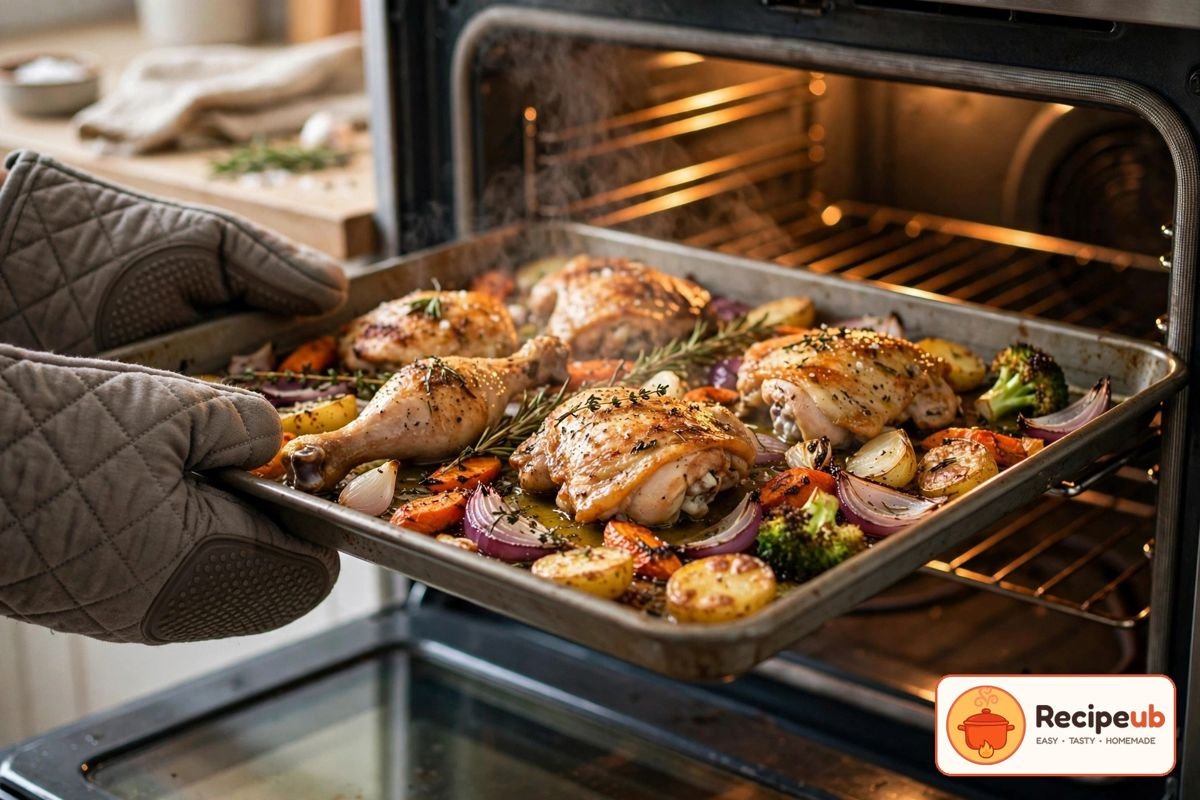
- Add the vegetables (minute 25). Scatter the broccoli, peppers and onion around and between the chicken. Everything is on the pan now; roast the final 10 minutes. If you are using green beans or cherry tomatoes, they go on at minute 32, for the last 3 minutes.
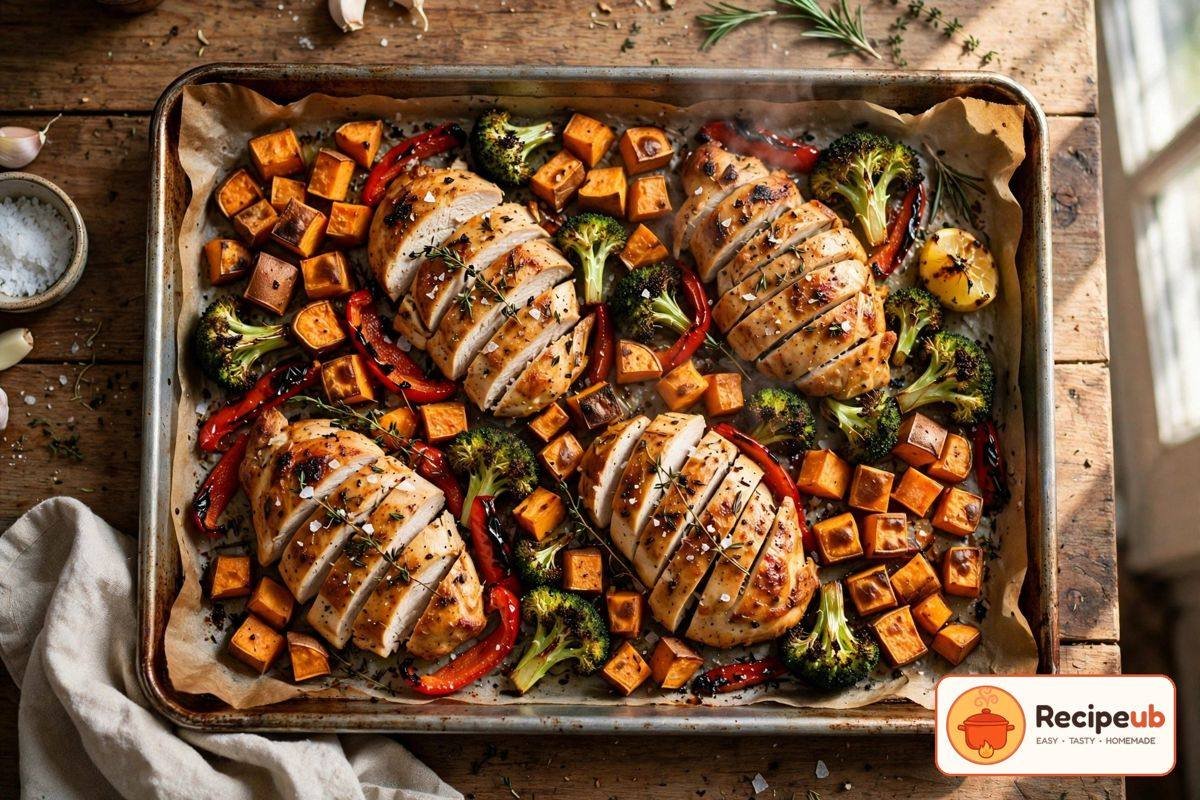
- Check the chicken (minute 35). The thickest chicken piece should read 165°F and the sweet potatoes should be tender all the way through. If the chicken needs another minute or two, give it that — the vegetables can take it — but pull the pan the moment the chicken is there. Every extra minute is day-4 dryness.
- Cool before you pack. Let the pan rest 20 to 30 minutes, until the food is no longer steaming. Trapped steam is the quiet cause of soggy meal prep vegetables.
- Pack the five containers. Divide the chicken, sweet potatoes and vegetables evenly across 5 containers. Spoon each day’s sauce into its own small container. Refrigerate four containers; the fifth goes into the freezer for Friday (see Storage — cooked chicken’s honest fridge window is 4 days).
Sheet Pan Chicken Meal Prep
Ingredients
Equipment
Method
- Heat the oven to 425°F. Toss the sweet potato cubes with 1 Tbsp olive oil and a third of the seasoning; spread in a single layer on a large rimmed sheet pan and roast 15 minutes.
- Meanwhile, pat the chicken pieces dry and toss with 1 Tbsp olive oil and a third of the seasoning.
- At minute 15, add the chicken to the pan in a single layer and return to the oven.
- Toss the broccoli, bell peppers and onion with the remaining 1 Tbsp olive oil and the remaining seasoning.
- At minute 25, scatter the vegetables around the chicken. Roast the final 10 minutes (delicate green beans or cherry tomatoes, if using, go on at minute 32).
- At minute 35, check that the thickest chicken piece reads 165°F and the sweet potatoes are tender. Pull the pan immediately.
- Rest 20 to 30 minutes, until no longer steaming, then divide evenly into 5 containers. Pack each sauce separately, about 2 Tbsp per small container, and add it after reheating.
- Refrigerate 4 containers and freeze the fifth for Friday (cooked chicken’s fridge window is 4 days).
Notes
- Timing chart in brief (all at 425°F): sweet potatoes ½-inch cubes at minute 0 · chicken 1-inch pieces at minute 15 · broccoli, peppers and onion at minute 25 · green beans or cherry tomatoes at minute 32 · everything off at minute 35, chicken at 165°F. Cut sizes are what make the minutes true.
- Sauces packed separately, about 2 Tbsp each, added after reheating: lemon-herb ~45 kcal · Greek yogurt-herb ~25 kcal · fajita-lime ~25 kcal · honey mustard ~65 kcal · peanut–soy-ginger ~70 kcal. None of these are counted in the 455 kcal on this card.
- Storage: fridge 4 days in airtight containers (the USDA window for cooked chicken) — freeze the fifth container on prep day and thaw it Thursday night for Friday. Frozen containers keep 2 to 3 months, packed without sauce; broccoli and peppers soften on thawing.
- Thigh swap: boneless skinless thighs at the same weight and the same timing for 1-inch pieces; about +40 kcal per container, juicier on day 4.
- Reheat: air fryer 375°F for 4 to 5 minutes (best texture), oven 350°F for 10 to 12 minutes, or microwave 2 to 3 minutes with a splash of water. Add the sauce after reheating, never before.
Emma’s Tips for the Best Sheet Pan Chicken Meal Prep
Give the pan room, or use two pans. Crowding is the number one cause of pale, steamed sheet pan anything. The pieces need a little air between them so the oven heat roasts instead of steaming. If your batch does not fit one half-sheet pan in a single layer, split it across two pans and rotate them halfway — two pans of roasted beats one pan of steamed, and the timing chart still holds.
Cut size is the timer. Every number in the Add-In Timing Chart assumes its cut: ½-inch sweet potato cubes, 1-inch chicken pieces. Double the sweet potato cube and it needs ten more minutes the chart never promised; halve the chicken and it dries before the vegetables land. When in doubt, match the chart’s cuts first and adjust the minutes second.
Dry chicken browns; wet chicken steams. Thirty seconds with a paper towel before the oil and seasoning go on is the cheapest browning upgrade there is. It is also why the seasoning sticks in an even coat instead of sliding off in the pan juices.
Cool it before you seal it — every time. Sealing a steaming container traps that steam against the vegetables all week, and it is the difference between broccoli that is still bright on Thursday and broccoli that gave up on Monday night. Twenty to thirty minutes on the counter, lids on only when the steam stops, and into the fridge within 2 hours.
Cooking this pan for tonight instead of the week? Then skip the containers and serve it straight off the pan — but know that the dinner version of this idea, built for the table rather than the fridge, is my One-Pan Chicken and Potatoes: same one-pan logic, no Sunday prep, no portioning. This page is the meal prep system; that one is dinner.
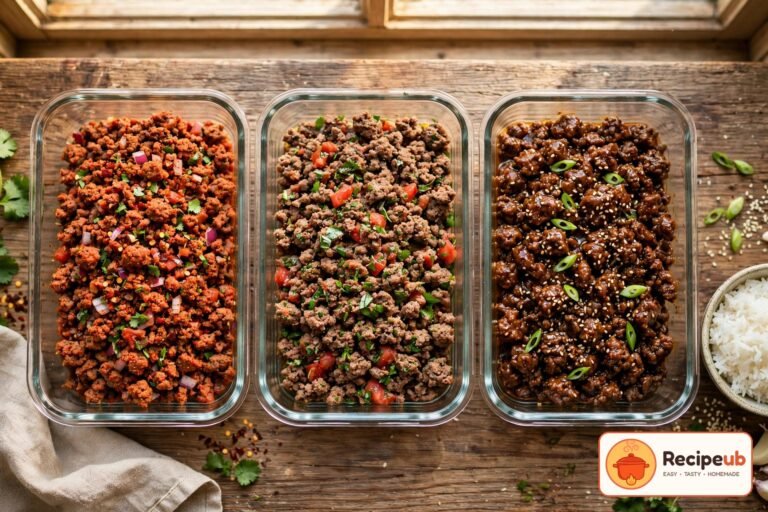
Rotate the protein next week. Five days of chicken is a system; ten days of chicken is a rut. The same Sunday slot runs my ground beef meal prep the following week — one tray of seasoned beef, a week of lunches and dinners — and the two rotations alternate in my kitchen all winter without either one getting old.
Storage and Reheating
Fridge: In airtight containers, the chicken and vegetables keep 4 days — that is the USDA window for cooked chicken, and this page treats it as the real number rather than rounding it up to a work week. So the system is: four containers in the fridge for Monday through Thursday, and the fifth container in the freezer from Sunday, moved to the fridge Thursday night for Friday. You still get five lunches; the fifth one just takes the safe road.
Freezer: Packed without sauce, the containers freeze for up to 2 to 3 months. The chicken and sweet potatoes come back beautifully; the broccoli and peppers soften on thawing — still good eating, just not crisp — which is one more reason the Friday container is a fine one to freeze. Thaw overnight in the fridge and reheat as below.
Reheating: The method matters more by Thursday than it did on Monday, because the vegetables soften a little more each day. All three methods end at the same place — steaming hot, chicken back to 165°F — and the sauce always goes on after, never before.
| Method | Time | The result |
|---|---|---|
| Microwave (with a splash of water) | 2 to 3 minutes | Fastest; the softest vegetables of the three |
| Oven, 350°F | 10 to 12 minutes | Best sweet potato edges; the weekend-style reheat |
| Air fryer, 375°F | 4 to 5 minutes | Best overall texture — edges come back, chicken stays moist |
The day-3 note: by midweek the microwave’s softening is noticeable, and that is when the oven and air fryer earn their keep — five minutes of dry heat puts the edges back on the sweet potatoes and wakes the whole container up. Whichever method you use, the splash of water is for the chicken, not the vegetables: a teaspoon over the chicken pieces before reheating keeps day-4 breast moist.
FAQs
How long does sheet pan chicken meal prep last in the fridge?
Four days in airtight containers — that is the USDA guidance for cooked chicken, and it is the honest number. So this recipe is built around it: four containers go in the fridge for Monday through Thursday, and the fifth goes into the freezer on prep day and thaws in the fridge Thursday night for Friday. Five lunches, none of them past the safe window.
How long do you cook sheet pan chicken meal prep, and at what temperature?
At 425°F, for 35 minutes total — but staggered, not all at once. Sweet potatoes roast alone for the first 15 minutes, chicken pieces join for 20 minutes, and the broccoli, peppers and onion go on for the last 10. The chicken is done when the thickest piece reads 165°F. The full Add-In Timing Chart is above, with the cut size for every row.
Can I use chicken thighs instead of breasts?
Yes — boneless skinless thighs, the same 2 pounds, cut into the same 1-inch pieces, on the exact same timing chart. Thighs are juicier and more forgiving, especially on day 4, and they add about 40 calories a container (roughly 495 total). Breasts are the pick on this page because they are the high-protein, lean build — 43 grams of protein a container — but the method does not change with the cut.
Why did my sheet pan vegetables turn out soggy?
Almost always one of three causes, and all three happen before the containers come out. First, crowding: pieces piled or touching steam each other instead of roasting — use a single layer, or two pans. Second, everything in at once: broccoli given 35 minutes is broccoli that gave up. Third, sealing the containers while the food is still steaming. The timing chart, a single layer, and a 20-to-30-minute cool before the lids fix all three.
Can I freeze sheet pan chicken meal prep?
Yes. The chicken and sweet potatoes freeze well for up to 2 to 3 months in airtight containers. The broccoli and peppers soften on thawing — fine for eating, just not crisp — and the sauces should never be frozen on the food; pack them fresh for the week you eat the container. Thaw overnight in the fridge and reheat in the oven or air fryer for the best texture.
What is the best way to reheat meal prep chicken and vegetables?
The air fryer, if you have one: 375°F for 4 to 5 minutes brings back the roasted edges and keeps the chicken moist. The oven at 350°F for 10 to 12 minutes is close behind. The microwave (2 to 3 minutes with a splash of water over the chicken) is fastest but softest. The full comparison table is in the Storage and Reheating section — and whatever you use, add the sauce after reheating.
Can I prep the ingredients ahead of time?
Yes — cut the chicken and vegetables up to 2 days ahead and store them separately in airtight containers in the fridge. Keep the seasoning off until roast day: salted chicken sitting for two days gives up moisture, and wet chicken does not brown. On Sunday, everything gets tossed with oil and seasoning as it goes on the pan, and the active prep drops to about 10 minutes.
What vegetables work best on a sheet pan meal prep?
Think in the chart’s tiers. Dense vegetables that need the full roast: sweet potatoes, regular potatoes, carrots. Middle vegetables that want about 10 minutes: broccoli, bell peppers, red onion, cauliflower, zucchini. Delicate ones that need only a blast at the end: green beans, cherry tomatoes, asparagus. Any vegetable works if it enters at its tier — the chart above is the map.
How do I keep chicken breast from drying out by day 4?
Four small things, all in this recipe. Cut it into 1-inch pieces so it cooks fast and evenly. Cook it only to 165°F — every degree past that is moisture lost. Keep the sauce packed separately and add it at serving, so the chicken is not sitting in liquid all week. And reheat with a splash of water over the chicken. Do those, and day-4 breast eats like day-2.
Should I let the food cool before sealing the containers?
Yes — 20 to 30 minutes on the counter, until it stops steaming. Sealing hot food traps steam inside the container, and that steam is what turns roasted vegetables soft in the fridge. Cooling first is the single easiest texture upgrade in meal prep. Just do not leave it out indefinitely: containers should be in the fridge within 2 hours of cooking.
Final Thoughts
Sheet pan chicken meal prep earns its Sunday hour the honest way: one pan, a staggered chart that respects the fact that sweet potatoes and broccoli do not cook at the same speed, five sauces so the week never tastes like one long leftover, and a cost per container — about $2.83, chicken priced at a dated, checkable $4.099 a pound — that holds up against the only other number on page 1, which was built on a cheaper cut. About 455 calories and 43 grams of protein a lunch, four days in the fridge and the fifth riding safely in the freezer. Learn the chart once, and every sheet pan after this one — any protein, any vegetable — falls into line behind it.
More Easy Budget Meal Prep
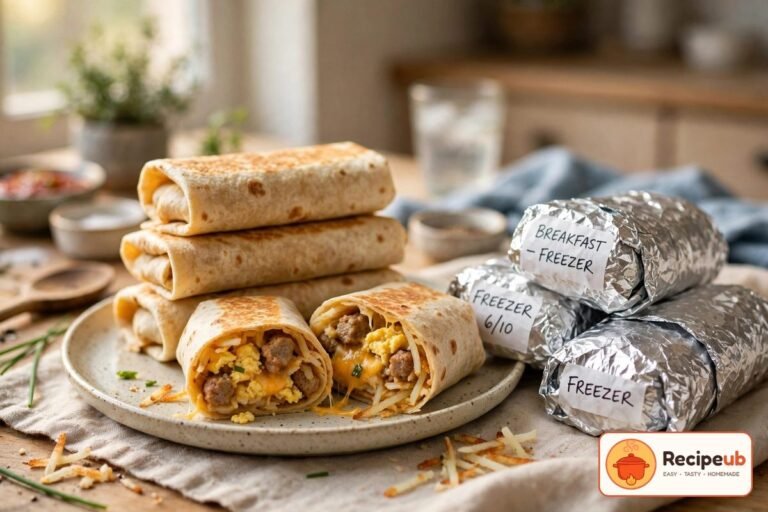
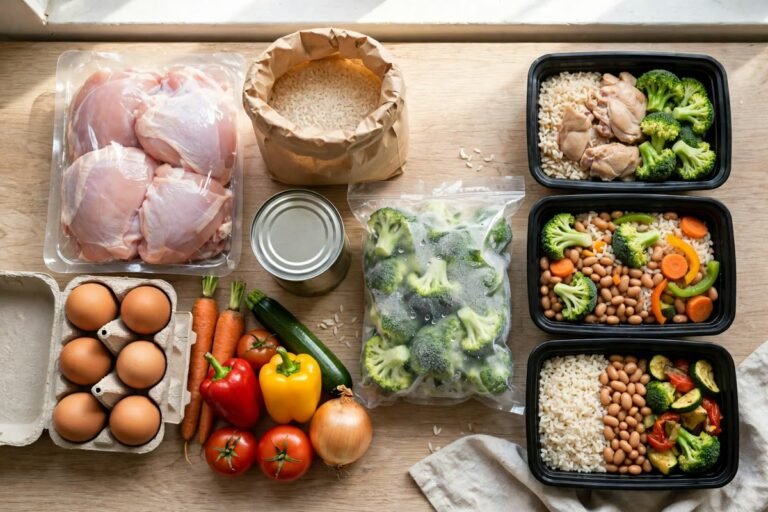
If one Sunday pan makes your weekdays easier, the rest of my budget prep shelf runs on the same rules — big honest batches, real numbers, food that reheats like it means it. For the mornings, my freezer breakfast burritos put ten breakfasts in the freezer at about $1.10 each, so the same week that has lunches handled has breakfasts handled too. And if protein per dollar is the whole January project, my cheap high-protein meal prep costs out a full week of high-protein eating per serving, with nothing quietly left out of the count — the same accounting habit as this page, aimed at the whole week instead of one pan.


Never Run Out of Dinner Ideas
One easy air fryer or slow cooker dinner in your inbox every week. No spam, ever.
You’re on the list — welcome to Recipeub!