
Skillet Lasagna (One Pan, 40 Minutes, No Oven)
Skillet lasagna is the weeknight answer to a dish that normally costs you a Sunday: the noodles break into pieces and simmer right in the marinara, in one pan, on the stovetop — no boiling pot, no layering, no oven, no broiler. One pound of ground beef, one jar of marinara, 8 ounces of noodles and three cheeses, and dinner for six is on the table in 40 minutes, scooped straight out of the skillet.
Read the top recipes for this dish closely and two quiet problems show up. Half of them finish in the oven anyway — a broiler blast here, a 30-minute bake there — which is not what anyone typing “skillet lasagna” at 5:40 p.m. is asking for. And every single one hands you exactly one pan, one noodle and one cheese, with no help for the three decisions the searches prove people are stuck on: what size skillet, how much liquid for the noodles, and ricotta or cottage cheese. This page prints all three as charts, with the numbers, and keeps the whole recipe on the stovetop where it belongs.
It also completes a set on this site. When you have the afternoon for it, there is the slow cooker lasagna that slices clean, for the days you can plan ahead — whole noodles layered in the crock, served in wedges. When you want the flavors spoonable, there is the lasagna soup version — same flavors, spoonable, in the crockpot. This one is the third speed: same dish, tonight, in one pan. Soup, slow-cooker bake, stovetop skillet — pick by the clock you have.
The short answer: Brown 1 lb of ground beef in a 12-inch deep skillet, add one 24 oz jar of marinara + 2 cups water, scatter in 8 oz of regular lasagna noodles broken into 2-inch pieces, cover and simmer 20 minutes, stirring at 5 and 12 minutes. Off the heat, dollop 1½ cups of ricotta, top with mozzarella, lid on 5 minutes. Six servings, about 590 calories each, 40 minutes total, no oven.
In This Recipe
The Plan at a Glance
- Pan: one 12-inch deep skillet (about 3.5 to 4 quarts) with a tight-fitting lid — the Skillet Size × Batch Chart below scales it down and up
- Build: 1 lb 85% lean ground beef + one 24 oz jar marinara + 2 cups water + 8 oz regular lasagna noodles, broken into 2-inch pieces
- Cheese system: 1½ cups whole-milk ricotta dolloped + 1½ cups shredded mozzarella (half stirred in, half on top) + ½ cup Parmesan, all melted under the lid — no broiler
- Time: 10 minutes prep / 30 minutes cook / 40 minutes total — the 5 minutes under the lid and a short rest happen while the table gets set
- Yield: 6 servings, about 1⅔ cups each
- Calories: ~590 per serving (estimate, basis printed in full below); about 33 g protein; the cottage cheese swap lands at about 540
- Cost angle: 1 lb of beef across 6 servings, at a moment when ground beef averaged $6.76 a pound (BLS, October 2026) — the math is in its own section below
- Storage: cool and refrigerate within 2 hours; fridge 3 to 4 days; freeze up to 3 months; reheat to 165°F
Why This Recipe Works
The noodles cook in the sauce, and the sauce is measured for it. Broken noodles are not a shortcut that happens to work — they drink the sauce as they soften, and the sauce has to be portioned for the drinking. America’s Test Kitchen built the canonical version on exactly this principle: tomatoes plus water measured to a fixed total (a quart, for their batch) for a fixed weight of noodles. What nobody did was generalize it. The Noodle Liquid Chart below does: a per-4-ounce liquid number for regular noodles, oven-ready noodles and the bowtie swap, so the ratio survives any batch size.
It is genuinely stovetop-only, and that is rarer than the search results suggest. The famous versions of this dish broil the top, bake the pan, or both. Here the cheese finish is engineered for the lid instead: half the mozzarella stirred into the hot noodles so it melts through, ricotta dolloped so it stays in soft pockets, the rest of the mozzarella scattered on top, lid on, heat off. Five minutes of trapped steam does the broiler’s job — a fully melted top with no oven preheat and no second pan.
One pound of beef feeds six, on purpose. The traditional build layers up to 2 pounds of meat. This one browns 1 pound and lets the noodles, tomatoes and cheese carry the pan — a design choice that mattered less in 2019 than it does in November 2026, with ground beef at record prices (the sourced numbers are in the beef section below). Six real servings from a single pound is the recipe’s whole economic argument.
The cheese question gets numbers, not a shrug. “Cottage cheese” appears in seven of the eight autocomplete stems for this dish, “ricotta” in six — the swap is the single most-searched variation, and every top recipe just picks one and moves on. The verdict table below prints both, per cup: calories, protein, texture, and exactly what changes in the pan (including the blend-it-smooth trick and the roughly 300 calories the swap saves the batch).
It is a January dinner published in November on purpose. Lasagna is cold-weather food — the big brands refresh their lasagna pages heading into winter, and comfort terms peak in mid-January on this site’s own trend research. A 40-minute, one-pan lasagna that is already indexed when the January wave arrives is the same publish-ahead play as the rest of this month’s posts.
What Size Skillet Do You Need? The Skillet Size × Batch Chart
“How big is a large skillet?” is a literal question in the FAQ of a ranking recipe for this dish — because every recipe names its pan in passing and none of them tells you what changes if yours is different. Here is the scaling, printed. The one number that rules the whole chart: the noodles need depth to swim. A wide, shallow pan evaporates the sauce before the noodles finish; a deep skillet or Dutch oven holds the liquid where the noodles are.
| Pan | Noodles | Total liquid (marinara + water) | Beef | Serves |
|---|---|---|---|---|
| 10-inch deep skillet (about 3 qt) | 4 oz, broken | 1½ cups marinara + 1 cup water | ½ lb | 3 |
| 12-inch deep skillet (about 3.5 to 4 qt) — the recipe | 8 oz, broken | 24 oz jar marinara + 2 cups water | 1 lb | 6 |
| 5.5-qt Dutch oven | 12 oz, broken | 36 oz marinara (1½ jars) + 3 cups water | 1½ lb | 8–9 |
How to read the chart: everything scales with the noodle weight, and the noodle weight scales with the pan’s depth, not just its width. The cheese scales too — halve and double the ricotta, mozzarella and Parmesan with the batch (¾ cup each cheese for the 10-inch; about 2¼ cups for the Dutch oven). What never changes is the method: same simmer, same two stirs, same lid finish. If your 12-inch skillet is a standard shallow one rather than a deep one, treat it as the 10-inch row and make the half batch — a shallow pan full to the rim is how noodles end up crunchy on top and scorched underneath.
How Much Liquid Do Broken Noodles Need? The Noodle Liquid Chart
This is the second chart this post exists to print. Every recipe for this dish gives you the liquid for its own batch and stops there; the ratio underneath — the thing you actually need when your noodle box or batch size differs — is nowhere on page 1. Here it is, per 4 ounces of noodles, in a beef-marinara sauce like this one.
| Noodle form | Total liquid per 4 oz | Covered simmer | Note |
|---|---|---|---|
| Regular lasagna noodles, broken into 2-inch pieces | About 2½ cups | 18–20 minutes | The recipe’s default; stir twice |
| Oven-ready / no-boil, broken | About 2¼ cups | 15–18 minutes | Thinner sheets drink less; check at 15 |
| Bowtie / farfalle swap (same weight) | About 2½ cups | 12–14 minutes | The autocomplete swap; not lasagna in shape, same sauce math |
How to read the chart: “total liquid” means everything wet in the pan — the marinara counts. This recipe’s 24 oz jar (3 cups) plus 2 cups of water is 5 cups for 8 ounces of regular noodles, which is the chart’s 2½ cups per 4 ounces, doubled. The basis is the measured builds underneath the famous versions: America’s Test Kitchen’s quart of tomato liquid plus tomato sauce for about 10 noodles, Food & Wine’s 28 ounces of tomatoes plus 1½ cups of water for 6 ounces, and the 5 cups of liquid one well-known lighter version uses for 8 ounces of short pasta. Three kitchens, one ratio — this chart is just the first place it is written down as a rule. Two failure modes to know: too little liquid shows up as noodles that are still chalky at 20 minutes (add water ¼ cup at a time and give them 3 more minutes), and too much shows up as soup (lid off for the last 3 to 4 minutes and let it breathe down).
Ricotta or Cottage Cheese? The Verdict
The loudest question in the searches for this dish — louder than the pan, louder than the noodles — is which white cheese goes in. Ricotta is the classic; cottage cheese is the swap half the internet swears by and the other half won’t touch. Both camps cook from recipes that never print the comparison. Here it is, per cup, from USDA standard reference values (rounded, so read them as approximate):
| Per 1 cup | Whole-milk ricotta | Cottage cheese (4%) |
|---|---|---|
| Calories | About 430 kcal | About 220 kcal |
| Protein | About 28 g | About 25 g |
| Texture in the skillet | Rich, holds its dollops | Looser; blend it smooth to mimic ricotta |
| Verdict | The classic — use it for the dollop finish | The lighter swap — same 1½ cups, saves about 300 kcal per batch |
How to read the table: the protein is nearly a tie — cottage cheese gives up almost nothing there — so the decision is calories and texture. Cottage cheese curds stay visibly curdy if you dollop them straight from the tub, which is the whole reason some people dislike the swap; thirty seconds in a blender or food processor takes it smooth, and dolloped smooth it behaves like ricotta at roughly half the calories. Run the swap and this recipe lands at about 540 calories a serving instead of 590. Keep the ricotta and you get the traditional finish: distinct soft pockets that hold their shape against the hot noodles. My default is the ricotta — it is the dish’s signature — but the swap is printed on the card, in the notes, because the numbers say it is a legitimate one.

How Does 1 Pound of Beef Feed Six? The Honest Math
Because the noodles and cheese do the filling, and because November 2026 is the wrong month to be casual about beef. The number, sourced: ground beef, 100% beef, averaged $6.76 a pound in October 2026, in the Bureau of Labor Statistics average price data released November 10, 2026 — just under the all-time record of about $6.92 set in August 2026, with the U.S. cattle herd at its smallest since 1951 and prices expected to stay tight through 2027. A traditional baked lasagna layers up to 2 pounds of that beef. This pan uses 1 pound, browned and drained, and stretches it across 6 servings with 8 ounces of noodles, a jar of marinara and three cheeses — the beef becomes the seasoning-rich backbone instead of the bulk. The swaps hold the same line: half beef and half Italian sausage (the build one famous version uses), ground turkey, or the mushroom-and-lentil vegetarian route the searches ask about — each is in the FAQs and the card notes, and each keeps the 1-pound total.
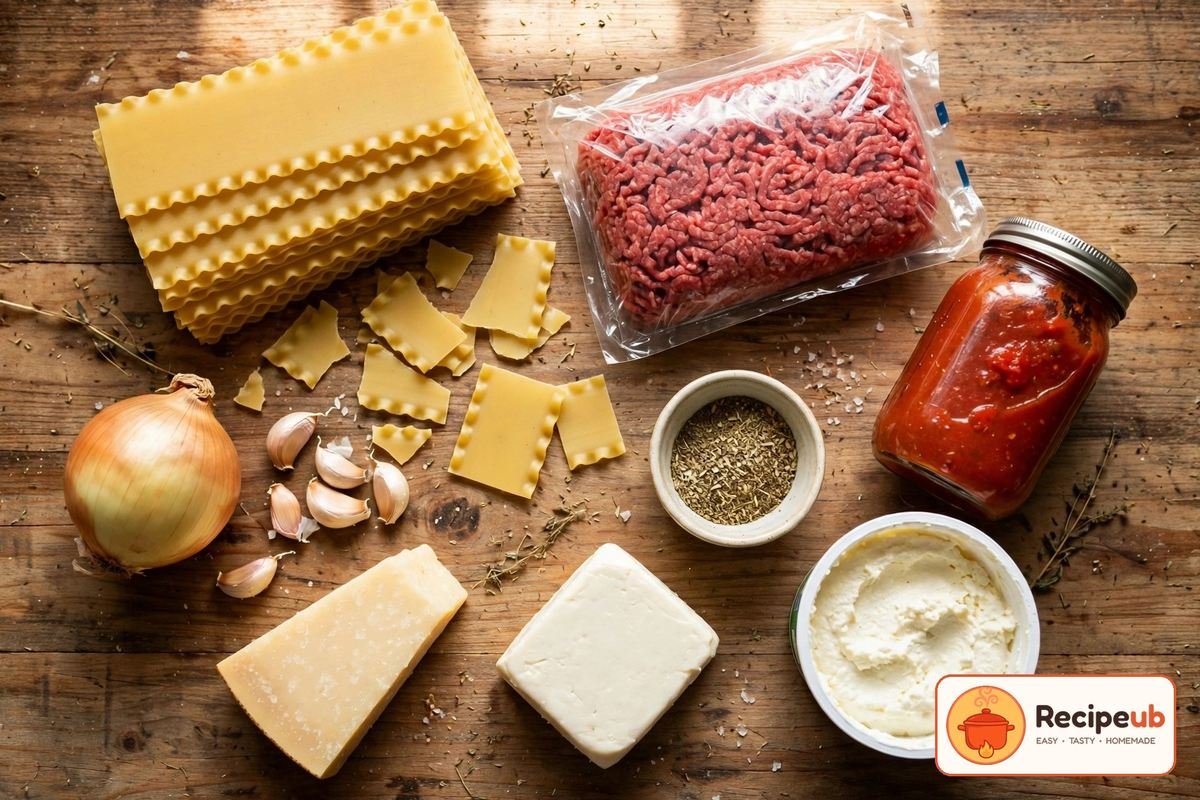
Ingredients
- 1 Tbsp olive oil
- 1 lb 85% lean ground beef
- 1 medium yellow onion, diced
- 3 garlic cloves, minced
- 1 tsp Italian seasoning
- ½ tsp kosher salt, plus more to taste
- ¼ tsp red pepper flakes (optional)
- 1 (24 oz) jar marinara sauce
- 2 cups water
- 8 oz regular lasagna noodles (about 9 sheets), broken into 2-inch pieces
- 1½ cups (12 oz) whole-milk ricotta
- 1½ cups (6 oz) shredded low-moisture mozzarella, divided
- ½ cup grated Parmesan
- Fresh basil leaves, torn, for serving (optional)
Ingredient notes: The noodles are ordinary regular lasagna noodles on purpose — not the oven-ready box. Regular noodles are the cheaper, always-in-the-pantry box, and the chart above is built on them; the oven-ready row is there if that is what you have. Break them into roughly 2-inch pieces (the size the canonical versions settled on): much bigger and they cook unevenly and won’t submerge, much smaller and the dish turns into pasta bake. The beef is 85% lean because the pan needs some fat for flavor and the draining step removes the excess — the drained weight is what the calorie basis uses. The marinara is a full 24 oz jar, and it counts as 3 of the 5 cups of total liquid, which is why the added water is 2 cups and not more. Whole-milk ricotta, not part-skim: the dollops are the finish, and part-skim weeps into the sauce. Low-moisture mozzarella, not fresh: fresh mozzarella floods a skillet. And the basil is a finish, not a cooking ingredient — it goes on at the table.
How to Make Skillet Lasagna
- Brown the beef. Heat the olive oil in a 12-inch deep skillet over medium-high heat. Add the ground beef and cook 6 to 7 minutes, breaking it into small crumbles, until well browned with no pink left. Drain the fat and return the beef to the pan.
- Build the aromatics. Add the diced onion to the beef and cook about 3 minutes, until softened at the edges. Stir in the garlic, Italian seasoning, kosher salt and red pepper flakes (if using) and cook 30 seconds, until fragrant.
- Add the sauce and water. Pour in the jar of marinara and the 2 cups of water and stir to combine. Bring the sauce to a lively simmer — the noodles need to land in liquid that is already moving.
- Scatter the noodles. Scatter the broken noodle pieces evenly over the surface and press them down into the sauce with the back of a spoon until they are mostly submerged. Do not dump them in one pile and do not stir hard — a gentle fold or two is enough. They will look crowded; they settle as they soften.
- Cover and simmer. Drop the heat to low, cover with the tight lid, and simmer 20 minutes. Stir twice — once at 5 minutes and once at 12 — pressing any dry-looking pieces back under the sauce each time. Those two stirs are the whole anti-sticking system (the FAQ below explains why).
- Check the noodles. At 20 minutes, bite one of the thickest pieces: it should be tender all the way through with no chalky core. If it is not, add ¼ cup of water, cover and give it 3 more minutes. If the sauce looks loose instead, leave the lid off for the last few minutes and let it breathe down.
- Cheese it, off the heat. Take the pan off the burner. Stir in half the mozzarella and all the Parmesan until melted through. Dollop the ricotta over the top in spoonfuls, then scatter the remaining mozzarella over everything.
- Lid on, rest, scoop. Cover and let the pan sit off the heat for 5 minutes, until the mozzarella on top is fully melted and the ricotta dollops are warmed through. Rest another 5 minutes so the sauce settles and clings, shower with torn basil if you like, and scoop straight from the skillet — this lasagna is scooped, not sliced.


Skillet Lasagna (One Pan, 40 Minutes, No Oven)
Ingredients
Equipment
Method
- Heat the olive oil in a 12-inch deep skillet over medium-high heat. Brown the ground beef 6 to 7 minutes, breaking it into small crumbles, until no pink remains. Drain the fat.
- Add the diced onion and cook about 3 minutes, until softened. Stir in the garlic, Italian seasoning, salt and red pepper flakes (if using); cook 30 seconds.
- Pour in the marinara and 2 cups water; stir and bring to a lively simmer.
- Scatter the broken noodle pieces evenly over the sauce and press them down until mostly submerged. Do not stir hard — a gentle fold or two is enough.
- Cover with a tight lid and simmer on low for 20 minutes, stirring gently at 5 minutes and at 12 minutes, pressing dry pieces back under the sauce.
- Check a thick noodle piece for tenderness — no chalky core. If needed, add ¼ cup water, cover and cook 3 more minutes. If the sauce is loose, simmer uncovered for the last few minutes.
- Off the heat, stir in half the mozzarella and all the Parmesan. Dollop the ricotta over the top and scatter the remaining mozzarella over everything.
- Cover and rest off the heat 5 minutes, until the top cheese is melted. Rest 5 more minutes, top with torn basil if you like, and scoop to serve.
Notes
- The three charts on the page run this recipe: Skillet Size × Batch (10-inch = half batch, 3 servings; 5.5-qt Dutch oven = 12 oz noodles, 8–9 servings), Noodle Liquid (per 4 oz: regular broken about 2½ cups total liquid, 18–20 min; oven-ready about 2¼ cups, 15–18 min; bowtie swap about 2½ cups, 12–14 min), and the Ricotta vs Cottage Cheese Verdict (per cup: ricotta about 430 kcal / 28 g protein; cottage cheese about 220 kcal / 25 g protein — blend cottage cheese smooth to mimic ricotta; the swap saves about 300 kcal per batch, about 540 kcal a serving).
- Cheese finish is lid-only: half the mozzarella stirred in, ricotta dolloped, the rest of the mozzarella on top, lid on off the heat for 5 minutes. No broiler, no oven — that is the point of the recipe.
- Meat swaps, same 1 lb total: half ground beef / half Italian sausage; all ground turkey; or vegetarian — 8 oz sliced mushrooms plus 1 cup cooked lentils in place of the beef (brown the mushrooms hard first).
- Storage (USDA): refrigerate within 2 hours, in shallow containers rather than the whole deep pan; fridge 3 to 4 days at 40°F or below; freeze up to 3 months (noodles soften — it reheats as a softer, scoopable bake). Reheat to 165°F with 1–2 Tbsp water or marinara per portion.
Emma’s Tips for the Best Skillet Lasagna
- Break the noodles to 2 inches, and break them over the box. Much bigger and the pieces bridge across the pan and cook unevenly — crisp edges sticking out of the sauce, gummy middles. Much smaller and you have made a pasta bake, which is fine eating but is not this dish. Break each sheet into thirds or quarters, and do it over the noodle box or a bowl, because the ruffled edges shed shards everywhere.
- The two stirs are not optional. Noodles simmered in sauce stick in two places: to each other, where two flat pieces land face to face, and to the pan bottom, where the sauce is thickest. The stir at 5 minutes separates the pieces while they are still stiff enough to move without breaking; the stir at 12 minutes catches the bottom layer before it scorches. Set timers. A cook who stirs twice gets clean noodles; a cook who “checks on it later” gets a lasagna pancake.
- Keep the simmer low and the lid honest. The noodles need a gentle, steady simmer — lazy bubbles around the edges. A hard boil evaporates the measured liquid before the noodles finish drinking, and a lid that leaks steam does the same thing slower. If your lid fits loosely, lay a sheet of foil under it. And resist lifting it to peek: every peek is steam the noodles were counting on.
- Dollop the ricotta, never stir it in. Stirred in, ricotta disappears into the sauce and the dish loses its signature — those soft, distinct pockets are what make a bite taste like lasagna instead of pasta with meat sauce. Dollop it after the heat is off, in spoonfuls across the whole surface, and let the lid warm it through. Same rule for the cottage cheese swap: blend it smooth first, then dollop.
Storage and Reheating
Fridge: Leftovers keep 3 to 4 days at 40°F or below — the USDA window for cooked leftovers, and the number this recipe prints (you will see 3 to 5 days elsewhere; 3 to 4 is the conservative, sourced one). Two handling rules matter more than the day count: refrigerate within 2 hours of cooking, and portion the leftovers into shallow containers instead of storing the whole deep skillet — a deep pan of pasta holds heat in the middle for hours, and the shallow transfer is what gets it cold fast.
Freezer: Freeze portions for up to 3 months, thawed overnight in the fridge. One honest note: the noodles soften in the freeze, so a thawed portion reheats as a softer, scoopable bake rather than a firm one. It is still good — plan it as a cozy lunch, not a dinner-party serve.
Reheating: Heat to 165°F, and add 1 to 2 tablespoons of water or marinara per portion before you start — the noodles drank the sauce once and will drink again, and the splash of liquid is what re-steams them instead of drying the edges. Microwave in short bursts, stirring once, or cover a portion in a small skillet over medium-low. In the oven, 350°F, covered, about 20 minutes works — the one time this recipe will not judge you for turning the oven on.
FAQs
Do you have to boil lasagna noodles for skillet lasagna?
No — that is the entire point of the dish. Regular lasagna noodles, broken into 2-inch pieces, cook directly in the sauce in 18 to 20 minutes, as long as the liquid is measured for them: about 2½ cups of total liquid per 4 ounces of noodles (the marinara counts toward that total). It is the method the canonical versions are built on — noodles scattered over the meat sauce, covered, simmered. Boiling first would give you a second pot, a colander, and noodles that go soft in the sauce anyway.
Can I use cottage cheese instead of ricotta in skillet lasagna?
Yes — same amount, 1½ cups, and it is the most-searched variation of this dish for a reason. Per cup, cottage cheese (4%) runs about 220 calories and 25 g protein against whole-milk ricotta’s roughly 430 calories and 28 g protein, so the swap saves about 300 calories across the batch and lands a serving at about 540 instead of 590. The one technique that makes it work: blend the cottage cheese smooth before dolloping. Straight from the tub, the curds stay visibly curdy; blended, it dollops and melts in like ricotta.
What size skillet do I need for skillet lasagna?
For the full batch — 8 ounces of noodles, 1 pound of beef, 6 servings — you need a 12-inch deep skillet, about 3.5 to 4 quarts, with a tight-fitting lid. Depth matters more than width: the noodles have to sit submerged in sauce. A 10-inch deep skillet takes the half batch (4 oz noodles, ½ lb beef, 3 servings), and a 5.5-quart Dutch oven takes the big one (12 oz noodles, 1½ lb beef, 8 to 9 servings). The full scaling is in the Skillet Size × Batch Chart above. If your 12-inch pan is shallow rather than deep, make the half batch in it.
How long do you cook skillet lasagna?
The noodles take about 20 minutes at a covered, low simmer — that is the number every serious version of this dish converges on, and it assumes the sauce was already simmering when the noodles went in. The whole recipe is 40 minutes: 10 minutes of prep, then browning the beef (6 to 7 minutes), the aromatics (about 3), the 20-minute simmer, and the cheese finish under the lid. If a thick noodle piece still has a chalky core at 20 minutes, add ¼ cup of water and give it 3 more minutes.
Can I make skillet lasagna with no-boil (oven-ready) noodles?
Yes. Break them the same way, into 2-inch pieces, and change two numbers: oven-ready sheets are thinner and drink less, so use about 2¼ cups of total liquid per 4 ounces instead of 2½, and check them at 15 minutes — they finish in 15 to 18. One caution: oven-ready pieces are more fragile once soft, so the two scheduled stirs should be gentle folds, not real stirring, or the pieces break down into the sauce.
Can I use bowtie pasta instead of lasagna noodles?
Yes — it is a real search for this dish, and it works by the same math. Swap in the same weight of bowtie (farfalle) pasta, keep the liquid at about 2½ cups per 4 ounces, and shorten the covered simmer to 12 to 14 minutes, since bowties are thinner than broken lasagna sheets. You lose the lasagna-sheet identity — nobody will mistake it for lasagna at a glance — but the sauce, cheese system and timing logic are identical, and kids tend to vote for the bowties.
How do I keep the noodles from sticking to the skillet?
Four things, in order of importance. One: enough liquid — the pieces need to be mostly submerged, which is what the liquid chart is for. Two: press every piece under the sauce when they go in; a dry corner sticking out stays dry. Three: stir twice, at 5 minutes and at 12 — the first stir separates pieces that landed face to face, the second lifts the bottom layer before it scorches. Four: a low, steady simmer rather than a boil, in a deep pan. Sticking in this dish is almost never a pan problem; it is a liquid-and-stirring problem.
Can I make skillet lasagna without ricotta?
Yes — “no ricotta” is its own search for this dish, and there are three good routes. The closest is the cottage cheese swap above (blended smooth, same amount). The simplest is to skip the white cheese entirely and raise the mozzarella to 2 cups, which gives you a cheesier, more pasta-bake finish. And the dairy-light route is a dollop of plain Greek yogurt at the table, off the heat — never simmered, or it splits. What does not work is leaving the layer out and changing nothing else; the pan eats fine but reads as meat-sauce pasta, not lasagna.
Can I make skillet lasagna vegetarian?
Yes, and the searches ask for it often enough that the swap is printed on the card: replace the pound of beef with 8 ounces of sliced mushrooms plus 1 cup of cooked lentils. Brown the mushrooms hard and undisturbed first — they need real color, because they are carrying the beef’s whole savory job — then proceed exactly as written, lentils in with the sauce. The liquid chart does not change. Keep an eye on seasoning at the end; the vegetarian pan usually wants the full ½ teaspoon of salt and the red pepper flakes stop being optional.
How long does skillet lasagna last in the fridge? Can I freeze it?
In the fridge, 3 to 4 days at 40°F or below — the USDA window for cooked leftovers — as long as it was refrigerated within 2 hours of cooking and moved into shallow containers rather than stored in the deep pan. Frozen, it keeps up to 3 months at best quality; thaw overnight in the fridge. Either way, reheat it to 165°F with a tablespoon or two of water or marinara per portion so the noodles re-steam instead of drying out. The full handling notes are in Storage and Reheating above.
Final Thoughts
Skillet lasagna is the lasagna that fits a Tuesday: the same beef, tomato and three-cheese architecture as the baked original, rebuilt around one pan, a measured pot of sauce and a lid. What this page adds is the paperwork the other versions leave out — a chart for the pan you actually own, a liquid ratio that survives any noodle in the cupboard, and the ricotta-versus-cottage-cheese question answered with numbers instead of allegiance. One pound of beef, six servings, forty minutes, and no oven to preheat: that is the whole argument, and it holds up every time the pan hits the stove.
More Easy One-Pot & Skillet Dinners
If one-pan pasta nights are your kind of weeknight system, the rest of my skillet shelf runs on the same rules — real times, the cheese question answered, dinner in one pan. For the other creamy one-pan pasta on rotation here, my one-pot creamy garlic chicken pasta is another one-pot pasta night — chicken this time, with the sauce built in the same pan the pasta cooks in. When the table wants the famous one, marry-me chicken pasta brings the sun-dried tomato cream sauce in the same single-pan format, and my one-pot taco pasta takes the whole method southwest — taco-seasoned beef, pasta simmered in its sauce, cheese melted over the top. And on the nights the beef needs its own five-ingredient lane, the 5-ingredient ground beef skillet is the stripped-down version of this pan’s first ten minutes. One shelf, one pan, no sink full of pots — that is the deal.


Never Run Out of Dinner Ideas
One easy air fryer or slow cooker dinner in your inbox every week. No spam, ever.
You’re on the list — welcome to Recipeub!