
Stovetop Chicken and Dumplings (From Scratch, 45 Minutes)
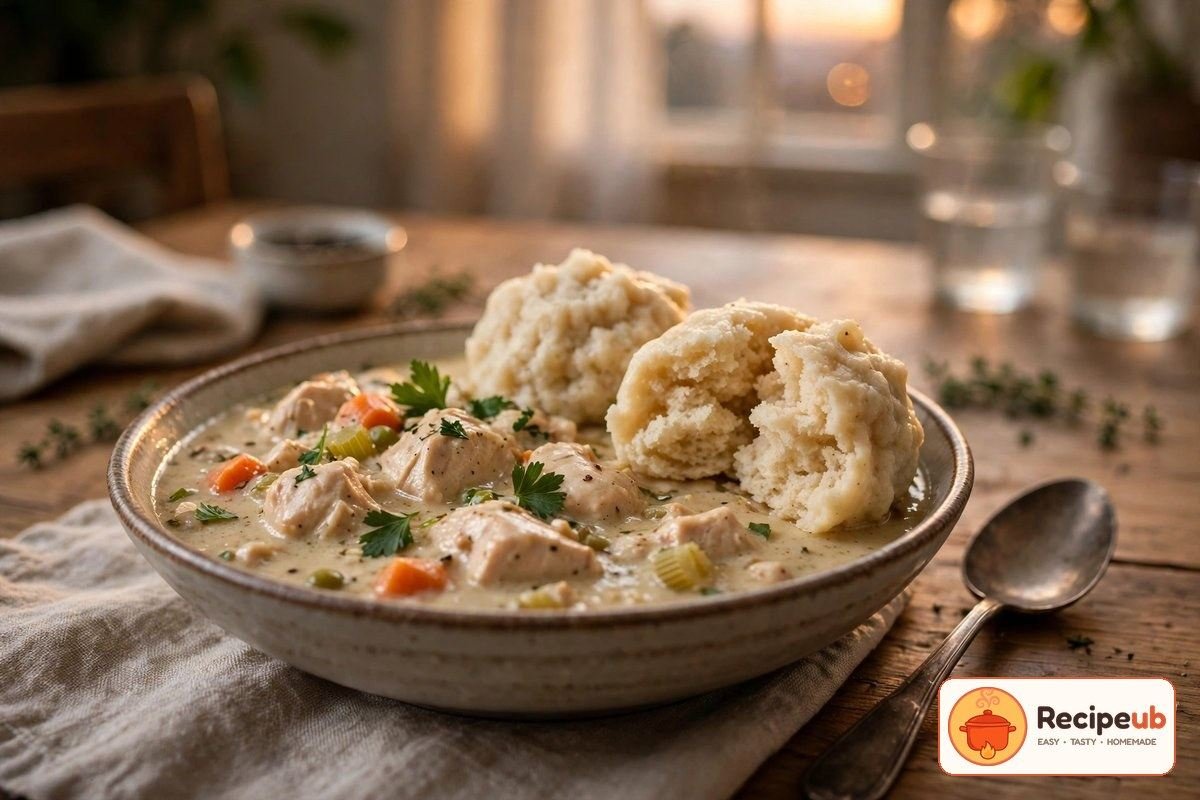
Chicken and dumplings is the dinner the search box describes by its dough: chicken and dumplings with canned biscuits, chicken and dumplings with bisquick, chicken and dumplings with frozen dumplings, chicken and dumplings from scratch, chicken and dumplings with cheddar bay biscuits, chicken and dumplings with crescent rolls, chicken and dumplings with drop dumplings. Read the completions on the stovetop stem alone and five of the ten name the dough — before the searcher has typed a single ingredient, the question is already which dumpling? Page 1 answers it the way it answers everything in this lane: by silently picking one lane and defending it. The shortcut seat drops Bisquick balls into a thigh stew and cards 882 calories doing it. The from-scratch seats are slower and slower — 85 minutes for the bone-in deep build, 55 for the skillet build, 50 for the closest dough on the page, and the lane’s authority offers only a shrug: “on the table in less than an hour.” And the dish’s second question — should chicken and dumplings be thick or soupy?, printed word for word in a page-1 holder’s own FAQ block — gets an answer in adjectives: “creamy and spoonable.” This page prints the three systems the cluster leaves out: the Dumpling Chart — every dough lane the search box types, converted to dough work, covered steam time, finished texture and the catch, in one table; the Body Chart — the thick-or-soupy question answered as a number, cups of flour across 5½ cups of liquid, instead of an adjective; and the Priced Pot — the whole batch costed at November 2026 prices, on a lane where no holder prints a price. The build itself takes the lane the stovetop and homemade stems type: from-scratch drop dumplings — flour, baking powder, milk and melted butter, stirred until just combined — steamed 15 minutes over a stew of 1½ pounds of boneless chicken breast pieces browned in the same Dutch oven, with onion, carrots, celery and peas in a broth-and-milk body thickened by a one-minute roux. Six servings at about 480 calories and ≈$1.90 a serving (both estimates, itemized on this page), in 45 minutes — faster than every from-scratch seat on page 1, beaten only by a baking mix.
It also knows its nearest neighbor on this site, because this shelf already cooks this exact dish — in the other vessel, with the other dough. That is my slow cooker chicken and dumplings — the same dish low and slow, biscuit dumplings steamed over a stew that has been reducing for 5 hours 20; this post is its stovetop twin, from-scratch drop dumplings over a stew made in the same 45 minutes it is eaten in. The fence is two facts and both are printed: the vessel (a slow cooker’s wide, shallow bath that has hours to reduce, against a Dutch oven’s stew built and finished inside one clock) and the dough (a can of biscuits quartered and dropped, against a scratch dough mixed while the stew simmers). The search box draws the same line from the other side — on the crockpot stem, the completions overwhelmingly ask for biscuit dumplings; on the stovetop stem, from scratch is the typed lane. Same dish, two honest versions, and the lane’s own authority prices the conversion for anyone who doubts the stovetop clock: her slow-cooker adaptation gives the dumplings alone 45 minutes on HIGH — this post’s entire total.
The short answer: Cut 1½ lb of boneless skinless chicken breast into 1-inch pieces, season with salt and pepper, and brown 4 minutes in 2 Tbsp of butter in a Dutch oven; set aside. Soften a diced onion, 2 sliced carrots and 2 sliced celery ribs in the same pot 5 minutes (garlic in the last 30 seconds), stir in ¼ cup of flour for 1 minute, then pour in 4½ cups of low-sodium chicken broth and 1 cup of whole milk with thyme and a bay leaf, return the chicken, and simmer 5 minutes. While it simmers, stir the dumpling dough — 2 cups of flour, 1 Tbsp of baking powder, 1 tsp of salt, ¾ cup of milk and 3 Tbsp of melted butter — until just combined. Stir in 1 cup of frozen peas, drop the dough by the tablespoon over the stew, cover, and steam 15 minutes at a bare simmer without lifting the lid. Check the largest chicken piece reads 165°F — six servings at about 480 calories and ≈$1.90 each, in 45 minutes.
In This Recipe
The Plan at a Glance
- The dough: from-scratch drop dumplings — 2 cups flour, 1 Tbsp baking powder, 1 tsp salt, ¾ cup milk, 3 Tbsp melted butter, stirred until just combined and dropped by the tablespoon (the dumpling rule in the card notes)
- The steam: 15 minutes, covered, at a bare simmer, lid never lifted — the dumplings cook in the steam trapped over the stew, and one peek costs the centers
- The body: ¼ cup of flour across 5½ cups of liquid (4½ cups broth + 1 cup milk) — the spoonable middle of the Body Chart below; thicker and thinner are rows on the same chart, not other recipes
- The chicken: 1½ lb boneless skinless breast, cut into 1-inch pieces — browned 4 minutes for color, finished in the simmer, checked at 165°F; thighs are the charted swap at the same clock (the chicken rule in the card notes)
- What is NOT in it: no canned biscuits, no baking mix, no can of condensed soup — the mix lane and the soup-can lane are rows on the Dumpling Chart and the Body Chart, named and declined there, not used silently here
- The clock: the dumpling dry goods are measured and the dough is mixed while the stew simmers — inside the cook time, stated openly, which is part of how the total is 45 minutes and not 60
- Time: 15 minutes prep (chicken cutting 5 + vegetables 6 + measuring 4) / 30 minutes cook (browning 4 + softening 5 + flour 1 + simmer 5 + steaming 15, stated openly) / 45 minutes total
- Yield: 6 servings
- Calories: ≈480 per serving (estimate); protein ≈33 g per serving (estimate)
- Cost: ≈$1.90 per serving (estimate) at November 2026 prices — the chicken line is a BLS average with its disclosure printed; every other line is a labeled shelf estimate; the full line-by-line table is The Priced Pot below
- Storage: fridge 3 to 4 days; the stew freezes up to 3 months and takes fresh dumplings at the reheat — the honest split is in the Storage section below
Why This Recipe Works
The dough is mixed inside the simmer, and that is where the 45 minutes comes from. Read page 1’s from-scratch clocks again: 85, 55, 50, and one “less than an hour.” None of those pots is doing anything this pot does not do — brown protein, soften vegetables, thicken, simmer, steam. The minutes leak out in the sequencing: dough measured after the stew is built, dumplings treated as a second recipe that starts when the first one ends. This build runs the two recipes in parallel, the way the dish was always cooked in a home kitchen: the stew needs 5 undisturbed minutes to finish the chicken pieces, and 5 minutes is exactly what the dough needs — dry goods whisked, milk and melted butter stirred in, the bowl set by the stove. When the lid goes on, nothing has waited for anything. The saving is real and it is stated where it comes from: the overlap, never a shortened steam. The dumplings still get their full 15 covered minutes, because that number is not negotiable — it is the difference between a dumpling and a gummy center, and the chart below prints every lane’s steam time so the claim can be checked.
The chicken flavors the liquid it finishes in. The breast pieces are browned first, in butter, in the pot the stew is built in — the browned bits stay on the pot’s floor when the pieces come out, the vegetables soften over them, the flour cooks in what is left, and the broth lifts the whole layer into the stew before the chicken goes back in to finish. It is the same one-pot logic this shelf runs in its other chicken-cooked-in-its-own-pot system — my chicken bog — the Lowcountry pot, chicken poached in the same pot to make the broth its rice then cooks in; this post browns its chicken in the stew pot instead, and steams dough over the liquid rather than cooking rice in it — the protein seasons the liquid, and the liquid finishes the protein. Nothing is cooked in a separate pan and married at the end, and no bouillon paste is asked to impersonate the fond.
Breast is the priced lane, and the page says why. Nearly every holder on page 1 cards thighs. Thighs are a fine choice — richer, more forgiving — and they are the charted swap below, at the same clock. But no verifiable average price exists that this page can claim for boneless thighs, and a post whose third chart is a price cannot build its protein on a number it cannot source. Breast is a first-class lane in this dish — the lane’s own authority cards “breast or thighs” on the same recipe — and breast carries the Bureau of Labor Statistics’ October 2026 average, read directly: $4.099 a pound. So the build takes breast, prints the anchor with its disclosure, and lets the thigh swap be what it honestly is: the richer version, priced as a labeled shelf estimate. The trade is stated, not hidden: breast pieces ask for one discipline in return — they finish in a 5-minute simmer and a covered steam, not a long braise, and the largest piece is checked at 165°F when the lid comes off.
The body is a ratio, not a hope. Every chicken and dumplings pot is thickened by something, and the lane’s answers to its own printed question — thick or soupy? — are adjectives because nobody converts their roux to the liquid it thickens. This build’s number is small enough to say in one breath: ¼ cup of flour, cooked 1 minute, across 5½ cups of liquid. That is the spoonable middle — the stew coats a spoon and pools slowly — and the Body Chart below prints the rows on both sides of it, from the zero-flour row (a soup with dumplings floating on it) to the gravy-leaning ⅓-cup row the authority pages cook at without ever dividing. A reader who wants their pot thicker or thinner does not need another recipe; they need the chart and a tablespoon measure, which is what a chart is for.
Which Dumpling? The Dumpling Chart
Here is the first chart this post exists to print, and it answers the question the search box asks five ways on this dish’s own stem — with canned biscuits, with bisquick, with frozen dumplings, from scratch, with cheddar bay biscuits, with crescent rolls, with drop dumplings are all typed completions, and every page-1 holder answers by picking one lane silently and defending it. Here are the lanes side by side instead: what goes in, how much dough work each one asks, how long it steams, what lands on the spoon, and the catch nobody prints next to their own choice. This recipe uses the bold row.
| Lane | What goes in | Dough work | Covered cook | The texture | The catch |
|---|---|---|---|---|---|
| Canned biscuits (Grands) | 1 (16.3 oz) can, each biscuit quartered | None — open the can | ~10 min, steamed | Puffy, bread-like, a biscuit’s crumb | Biscuit sweetness and sodium; deflates fastest in leftovers |
| Bisquick drop | 2 cups mix + ⅔ cup milk | 2 minutes of stirring | 10 min, steamed | Soft, light, cake-like | A mix sets the flavor ceiling — and the lane’s leading card prints 882 kcal |
| From-scratch drop — THIS BUILD | Flour, baking powder, milk, melted butter | 5 minutes | 15 min, steamed | Fluffy outside, biscuit-hearted; holds its shape in leftovers | Overmixing makes it tough — stir until just combined |
| Rolled flat (chicken and pastry) | Scratch dough rolled thin, cut in strips | ~15 min + rolling | ~10–12 min, simmered IN the broth | Silky, noodle-like ribbons | A different dish’s texture — and the strips thicken the broth themselves |
| Frozen dumplings | 1 package frozen flat dumplings | None | ~15–20 min, simmered | Dense, chewy | Regional availability; the longest cook of the five |
How to read the chart: the lanes are one trade, priced in two currencies — minutes of dough work before the lid goes on, and the texture that comes out from under it. The canned biscuit lane spends nothing and gets a biscuit: puffy and pleasant on night one, the fastest to deflate in the fridge, and sweet in a way a pepper-and-thyme stew never asked for. The Bisquick lane spends two minutes and gets the softest dumpling on the chart — and its leading holder’s card, built on 2 pounds of thighs, prints 882 calories a serving, which is what the shortcut costs when nobody divides. The rolled lane spends the most and changes the dish: those silky strips are chicken and pastry, a comparison the search box types itself (chicken and dumplings vs chicken and pastry), and the strips are simmered in the broth rather than steamed on it — they thicken the pot as they cook, which is why that dish has no Body Chart problem and this one does. The frozen lane is honest convenience with the longest cook and a regional shopping list. And the scratch drop lane — this build — spends 5 minutes, most of them inside the stew’s own simmer, and gets the only dumpling on the chart that is fluffy at the center, holds its shape on day three, and carries no mix’s flavor ceiling. It is also worth naming the family’s other dough, because the search box asks the two against each other by name — chicken and dumplings vs chicken pot pie is a typed comparison, and the difference is the dough’s position: my slow cooker chicken pot pie filling — the family’s other dough dish, a stew that waits for a separate crust baked on top; this post’s dough steams in the stew itself, which is the whole difference is a fine dinner, and it is not this one. A crust sits on a stew. A dumpling cooks in it. Everything else — the chicken, the vegetables, the creamy body — the two dishes genuinely share.
Ingredients
For the stew:
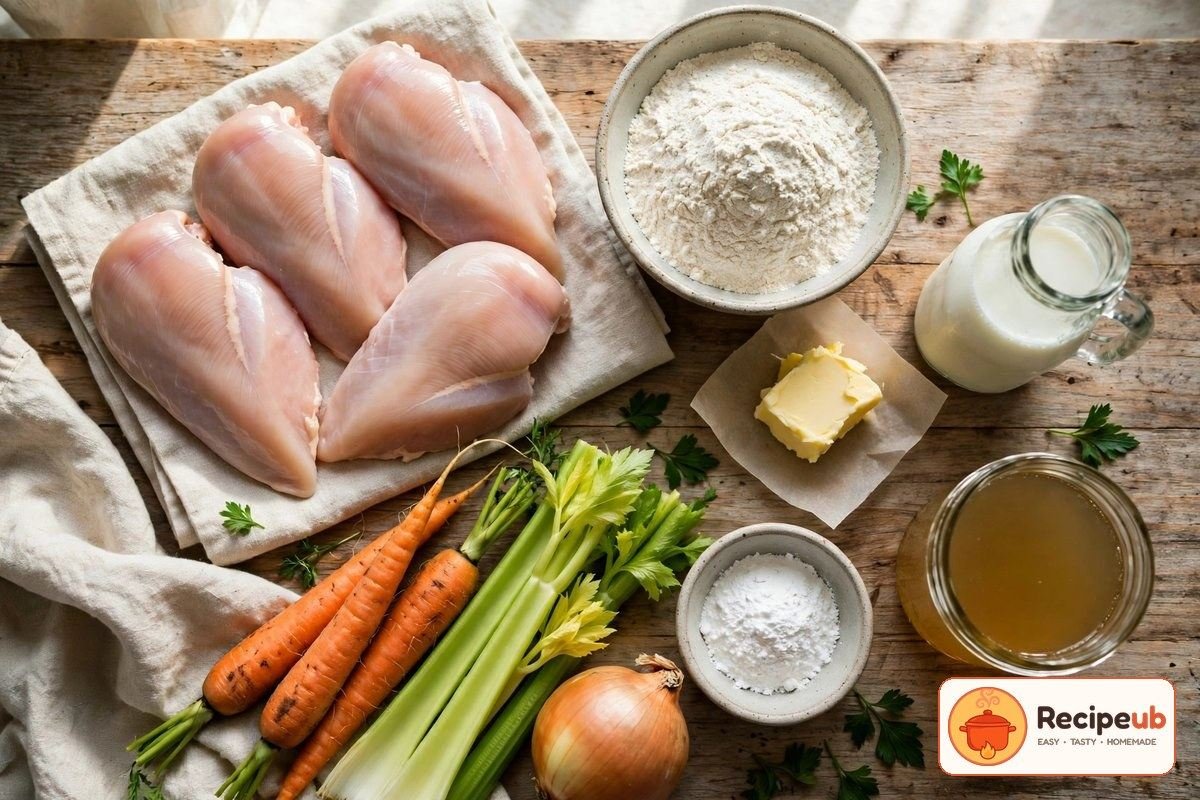
- 1½ lb boneless skinless chicken breast, cut into 1-inch pieces
- 1 tsp kosher salt, plus more to taste
- ½ tsp black pepper
- 2 Tbsp unsalted butter
- 1 medium yellow onion, diced
- 2 medium carrots, sliced
- 2 celery ribs, sliced
- 2 garlic cloves, minced
- ¼ cup all-purpose flour
- 4½ cups low-sodium chicken broth
- 1 cup whole milk
- ½ tsp dried thyme
- 1 bay leaf
- 1 cup frozen peas
- 2 Tbsp chopped fresh parsley (optional finish)
For the dumplings:
- 2 cups all-purpose flour
- 1 Tbsp baking powder
- 1 tsp kosher salt
- ¾ cup whole milk
- 3 Tbsp unsalted butter, melted
Ingredient notes: The chicken is boneless skinless breast, 1½ pounds, cut into 1-inch pieces — breast by design, for the reason printed in Why This Recipe Works: it is the lane with a verifiable price anchor, and the lane’s own authority cards breast on this dish. Pieces, not whole breasts simmered and shredded: a 1-inch piece browns in 4 minutes, finishes in a 5-minute simmer, and eats in the same spoonful as a dumpling, where a shredded breast eats as a separate event. The swap is real and it is charted: boneless thighs in the same pieces — same clock, a richer stew, priced as a shelf estimate only (≈$5.25 for 1½ lb at typical shelf prices, labeled as one) with the calories rising toward the holders’ range. The same poach-in-broth chicken, portioned for a different week entirely, is my shredded chicken meal prep — the batch system, chicken poached and pulled with its broth for a week of meals; this post browns its chicken in pieces and finishes it in the stew instead. The flour does two jobs in this recipe, and they are different flours in effect if not in bag: ¼ cup cooks into the roux that bodies the stew, and 2 cups become the dumplings — the Body Chart below is entirely about the first ¼ cup, and the Dumpling Chart entirely about the other 2 cups. One dated check belongs in this note, because this build cooks with all-purpose flour: the FDA enforcement report records a Class II recall of El Ruisenor De Mexico all-purpose flour (undeclared wheat; recall H-0132-2027, reported October 28, 2026; a single regional brand, 300 lb in clear plastic units with no UPC, distributed mainly in California; status terminated) — a different, regional brand from the national all-purpose flour this build uses, named here so a reader holding that brand can check their bag. The broth is low-sodium, 4½ cups — low-sodium because the pot is seasoned at three separate points (the chicken, the dough, the finish) and a full-sodium broth spends that salt budget before the cook can taste anything. The milk is whole, in both the stew and the dough — the stew’s cup is part of the 5½ cups the Body Chart divides, and the dough’s ¾ cup is what makes a drop dumpling tender rather than bready. The peas go in frozen, at the end, stirred through in the minute before the dumplings drop — cooked any longer they go olive and sweeten the stew; added frozen they also take the pot’s edge off just as the dough goes on, which settles the stew to the bare simmer the steam wants. The butter is unsalted, 5 Tbsp across the whole pot — 2 for the browning, 3 melted into the dough — and melted is the dough’s whole instruction: butter melted into a drop dough gives a biscuit-hearted crumb; the lane’s deep build grates frozen butter into its dough instead, which is a fine technique priced in the chart’s dough-work column, not this build’s.
How to Make Stovetop Chicken and Dumplings
The method is one pot in one order, and the order is the recipe: chicken browned for its fond, vegetables softened over it, flour cooked for one minute, liquid in and the chicken back, and then — while the stew takes its 5-minute simmer — the dough mixed in the same window, so the lid goes on a pot that has everything it needs. Two rules govern the whole cook and both are printed where they happen: the dough is stirred until just combined and no further, and once the dumplings are on, the lid does not lift for 15 minutes — the steam trapped over the stew is the cooking medium, and a peek is not a check, it is a cost. A large Dutch oven is the vessel: wide enough that a tablespoon of dough has room to puff without crowding its neighbor, heavy enough to hold a bare simmer without scorching the milk in the stew.
- Season and brown the chicken — color, not cooked through. Pat the chicken pieces dry, season with the 1 tsp salt and ½ tsp black pepper, and melt the 2 Tbsp butter in a large Dutch oven over medium-high heat. Add the chicken in a single layer and cook 4 minutes, turning once, until the pieces carry real color on two sides. They will not be cooked through — they finish in the simmer — and they are not meant to be: the browning is for the fond, the browned layer they leave on the pot’s floor, which is the stew’s first seasoning. Lift the chicken out to a plate and leave every browned bit behind.
- Soften the vegetables over the fond. Drop the heat to medium. Add the diced onion, sliced carrots and sliced celery to the same pot and cook 5 minutes, stirring and scraping the pot’s floor as the vegetables give off their moisture — the fond lifts into them as they soften. Add the minced garlic in the last 30 seconds and stir until fragrant.
- Cook the flour — one minute, no more guessing. Sprinkle the ¼ cup of flour over the vegetables and stir 1 minute, until the flour coats everything and loses its raw look. This is the roux, and its ratio to the liquid that follows is the Body Chart below: ¼ cup across 5½ cups is the spoonable middle. One minute cooks the raw taste out; the flour does its thickening later, in the simmer, not here.
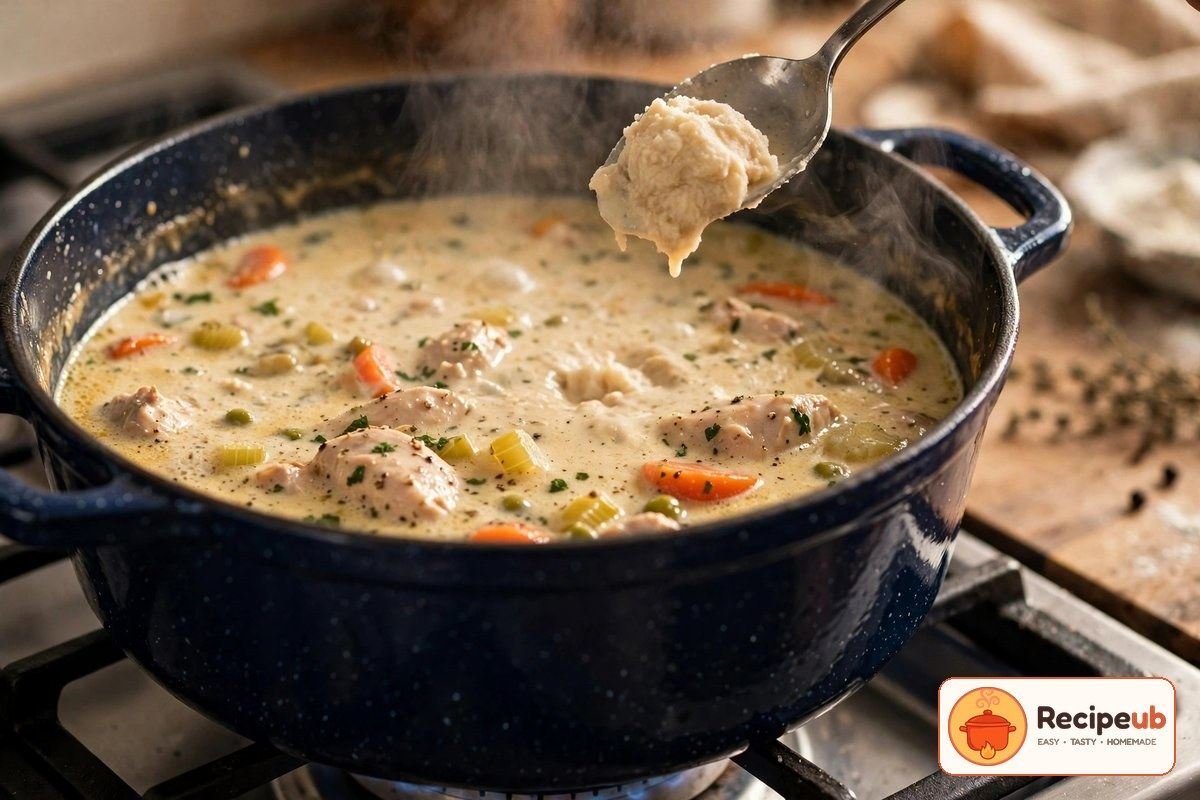
- Liquid in, chicken back, and the simmer that mixes the dough. Pour in the 4½ cups of broth slowly, stirring as it goes in so the roux takes it up smoothly, then the 1 cup of whole milk, the thyme and the bay leaf. Return the chicken and any juices on its plate to the pot, bring it to a gentle simmer, and let it simmer 5 minutes — the pieces finish cooking in the stew they are flavoring. This is the window: while the stew simmers, make the dumpling dough (step 5). The overlap is the recipe’s clock, stated openly — the dough’s 5 minutes live inside these 5.
- Mix the dough — until just combined, then stop. In a bowl, whisk the 2 cups of flour, 1 Tbsp of baking powder and 1 tsp of salt. Pour in the ¾ cup of milk and the 3 Tbsp of melted butter and stir with a spoon until just combined — a shaggy, sticky dough with no dry flour showing, and then stop. Every stir past that point develops the flour and toughens the dumpling; the lane’s own FAQ names overmixing first among the causes of tough, gummy dumplings, and this is the step where it happens or does not. And a standing care, printed once: do not taste the raw dough — it contains raw flour.
- Peas in, dumplings dropped. Stir the 1 cup of frozen peas into the stew — they cool the pot’s edge and settle it to a bare simmer, which is what the steam wants. Drop the dough by the tablespoon over the surface of the stew, spacing the drops so each has a little room to puff; a heaped tablespoon gives a dumpling that steams through in the chart’s time, and drops much larger than that are the second cause of gummy centers.
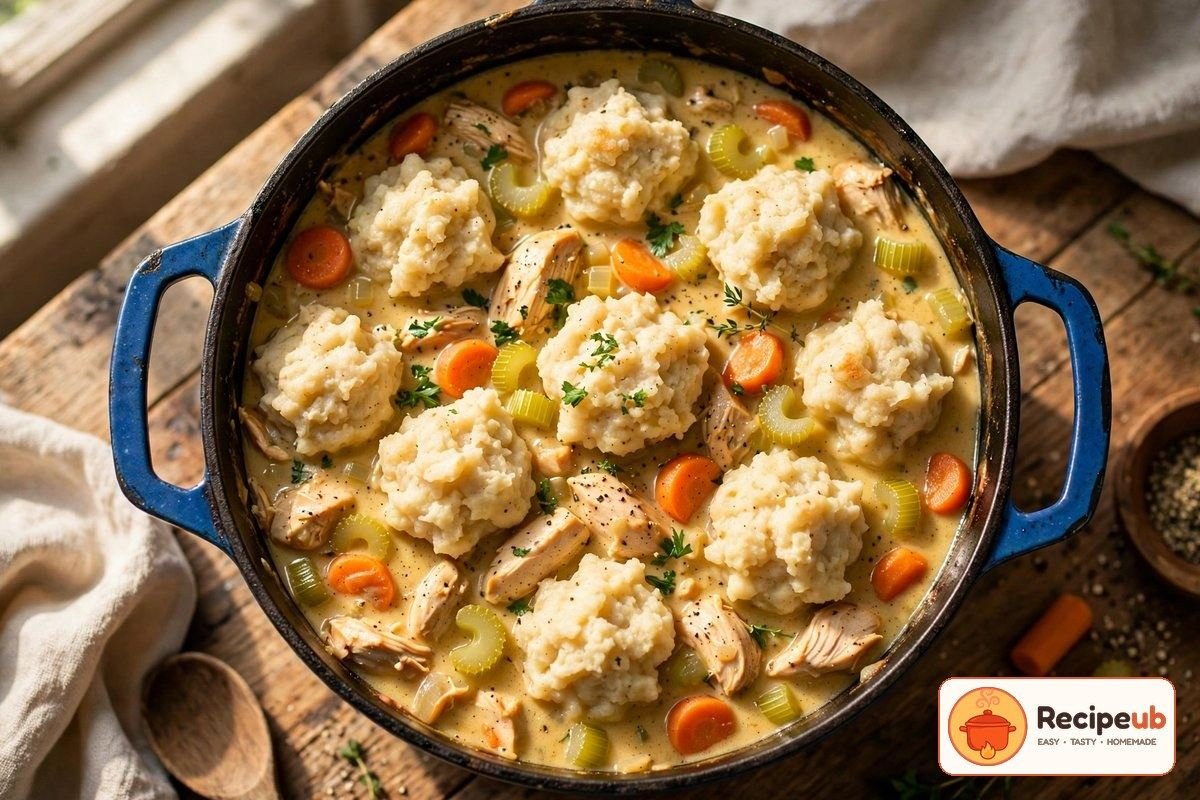
- Cover and steam — 15 minutes, no peeking. Set the lid on, hold the pot at a bare simmer, and steam 15 minutes without lifting the lid. The dumplings are not boiling in the stew; they are cooking in the steam trapped above it, and lifting the lid pours that steam out and drops the temperature exactly where the dumpling centers are still setting. At 15 minutes the dumplings should be puffed, firm to a fingertip’s press, and dry-looking on top.
- Check, rest, serve. Lift the lid and check two things: a dumpling cut open at its center is fluffy and cooked through, with no wet dough line, and the largest chicken piece reads 165°F on an instant-read thermometer — the temperature is the rule, not the minutes. Take the pot off the heat, lift out the bay leaf, and let it rest 2 minutes while the bowls come out (a serving step, not a clock line). Scatter the parsley over the top if you are using it, taste the stew for salt, and serve straight from the pot.

Stovetop Chicken and Dumplings
Ingredients
Equipment
Method
- Season the chicken pieces with the salt and pepper and brown in the butter in a large Dutch oven over medium-high heat for 4 minutes, turning once. Remove to a plate, leaving the browned bits in the pot.
- Soften the onion, carrots and celery in the same pot for 5 minutes, scraping up the fond; add the garlic for the last 30 seconds. Stir in the ¼ cup flour and cook 1 minute.
- Pour in the broth, stirring as it goes in, then the milk, thyme and bay leaf. Return the chicken and its juices and simmer 5 minutes. While the stew simmers, whisk the dumpling flour, baking powder and salt, then stir in the milk and melted butter until just combined — do not overmix, and do not taste the raw dough.
- Stir the frozen peas into the stew. Drop the dough by the tablespoon over the surface of the stew, spacing the drops.
- Cover and steam at a bare simmer for 15 minutes without lifting the lid. Check a dumpling’s center is fluffy and cooked through and the largest chicken piece reads 165°F. Rest 2 minutes, remove the bay leaf, scatter parsley if using, and serve.
Notes
- The dumpling rule: stir the dough until just combined and no further — every extra stir toughens it — and do not lift the lid in the 15 minutes of steaming. The dumplings cook in the steam trapped over the stew; one peek pours the steam out and leaves the centers gummy.
- The body rule: ¼ cup of flour across 5½ cups of liquid is the spoonable middle — the stew coats a spoon and pools slowly. The Body Chart on the page moves it either way: 2 Tbsp for a brothier pot, ⅓ cup for a gravy-leaning one. The test at the pot is a spoon dragged across the bottom: a brief visible trail means stew body.
- The chicken rule: breast pieces are checked at 165°F when the lid comes off — the temperature is the rule, not the minutes. Boneless thighs swap in at the same clock for a richer stew; the clock does not change and neither does the temperature.
- The leftovers rule: refrigerate within 2 hours and eat within 3 to 4 days, reheated to 165°F; the dumplings soften a degree each day. For the freezer, freeze the stew alone for up to 3 months and drop fresh dumplings on it at the reheat — a frozen dumpling never steams back to its first day.
Thick or Soupy? The Body Chart
Here is the second chart, and it answers the question a page-1 holder prints in her own FAQ block word for word — “Should chicken and dumplings be thick or soupy?” — and answers in adjectives: “creamy and spoonable: thicker than clear chicken soup but looser than a casserole filling.” She is not wrong; she is unmeasured. Body is not a mood, it is a ratio: cups of flour across the pot’s liquid — and in this dish the liquid is 5½ cups (4½ of broth, 1 of milk), so every holder’s roux can be converted to the same row. This recipe uses the bold row.
| Flour across ~5½ cups of liquid | The body | Whose lane |
|---|---|---|
| None | A broth soup with dumplings floating on it | The thin end — a soup lives at this row |
| 2 Tbsp | Lightly coated, still brothy | — |
| ¼ cup — THIS BUILD | Spoonable stew: coats a spoon, pools slowly | The weeknight middle |
| ⅓ cup | Gravy-leaning; stands up on the spoon | The authority pages’ end — neither prints it as a ratio |
| A can of condensed soup instead | Thick by the can | The typed shortcut lane — named and declined: the roux takes 1 minute |
How to read the chart: the rows are one dial, and the dial is set in the 1 minute the flour cooks, before the liquid goes in — which is why the decision cannot be rescued later by simmering longer (a thin pot reduced is a salty pot, not a thick one) or fixed by stirring at the end. Turn it down and the pot slides toward soup: at zero flour it is one, which is not a failure but a different dinner — this site’s own soup sits at exactly this row of the chart, with noodles where the dumplings would go: my slow cooker chicken noodle soup — the soup build, chicken and vegetables in a clear broth with noodles, 6 hours 35 in the slow cooker; this post is the same shelf’s thickened, dumpling-capped pot, in 45 minutes on the stove. Turn it up to ⅓ cup and the stew leans toward gravy — the end the from-scratch authority and the deep stovetop build both cook at, at 445 kcal and 85 minutes respectively, without ever printing the number that puts them there. The middle row is the target for a weeknight pot: thick enough to coat a spoon and hold a dumpling up, loose enough to pool around it. And the chart has a test as well as a number, borrowed from the lane’s deepest build and credited to him: drag a spoon across the bottom of the pot — if it leaves a brief visible trail before the stew closes over it, the body is right (the spoon-track test is Flavoreal’s, printed in his prose where a chart row belongs; here it is printed as one). The condensed-soup row is on the chart because the search box types it (canned biscuits and cream of chicken soup is a completion) — it thickens, certainly, and it spends the stew’s flavor on a can’s seasoning to do it, against a roux that takes 1 minute and tastes of the pot it is in.
What Does the Pot Cost? The Priced Pot
Here is the third thing this post prints that page 1 does not: the whole pot, priced line by line, at November 2026 prices — with one line read directly from the Bureau of Labor Statistics and its disclosure printed next to it, and every other line labeled a shelf estimate, printed as one, because this page names its sources instead of rounding a receipt it never saw. It also reconciles: the method serves 6, and the table divides by the same 6. No holder on either stem — stovetop or head — prints a price for this dish at all.
| Line | Amount for the batch | Price basis | Batch cost |
|---|---|---|---|
| Boneless skinless chicken breast | 1½ lb | BLS October 2026 average, $4.099/lb (series APU0000FF1101, read directly from api.bls.gov; the series identity — chicken breast, boneless, per lb — is as recorded from the Bureau’s series listing, stated plainly) | $6.15 |
| Flour (dumplings + roux) | 2¼ cups | Shelf estimate, labeled as one | ≈$0.35 |
| Butter | 5 Tbsp | Shelf estimate, labeled as one | ≈$0.60 |
| Milk (stew + dough) | 1¾ cups | Shelf estimate, labeled as one | ≈$0.85 |
| Low-sodium chicken broth | 4½ cups | Shelf estimate, labeled as one | ≈$1.60 |
| Onion, carrots, celery | 1 onion, 2 carrots, 2 ribs | Shelf estimate, labeled as one | ≈$1.10 |
| Frozen peas | 1 cup | Shelf estimate, labeled as one | ≈$0.45 |
| Baking powder, salt, thyme, bay, parsley | Recipe amounts | Shelf estimate, labeled as one | ≈$0.35 |
| Batch total | 6 servings | ≈$11.45 → ≈$1.90 per serving |
How to read the table: the shape of this receipt is the opposite of the bog pot’s on this shelf, and the contrast is the lesson. There, the dish’s namesake ingredient was the cheapest line; here, the chicken is more than half the batch — $6.15 of $11.45 — and everything else, the entire dumpling dough included, costs less than the protein does. That is also why the chicken’s line is the one this page sourced: when a single line carries half the receipt, it is the line whose number has to be real. The dough, by contrast, is nearly free — 35 cents of flour and part of the butter and milk lines — which reframes the chart war above it: the from-scratch lane’s 5 minutes of work buy the best dumpling on the Dumpling Chart for less than a can of biscuits costs, and the shortcut lanes are not even saving money. They are only saving the 5 minutes — the 5 minutes this build spends inside the stew’s own simmer anyway. Priced, the dish’s reputation holds: a scratch dumpling pot at about $1.90 a serving, with the one big line verified and every small line labeled.
Emma’s Tips for the Best Stovetop Chicken and Dumplings
Size the drops like you mean the steam to work. A heaped tablespoon is the unit — roughly a golf ball of dough — and it is not an aesthetic choice. Tablespoon drops steam through in the chart’s 15 minutes; drops twice that size are still wet at the center when the edges are done, and no extra lid time fully rescues them, because the outside overcooks while the middle catches up. If a drop lands big, split it with the spoon before the lid goes on. Twelve to fourteen even drops across the pot’s surface is the batch’s shape.
Hold the simmer at a bare simmer — the stew should shiver, not boil. A rolling boil does two kinds of damage under a lid of dumplings: it knocks the drops around and erodes their bottoms into the stew, and it can break the milk in the body. What the dumplings want is a stew that barely moves — an occasional bubble breaking at the edge — with the steam doing the work above the surface. If the pot comes up too hot when the lid goes on, pull it off the heat for a minute and let it settle before the clock starts.
Season in the order the pot is built. The chicken is seasoned before it browns, the dough carries its own teaspoon of salt, and the stew is tasted once, at the end — that order is why the broth is low-sodium. A full-sodium broth plus three salted layers is a pot that tastes salted before it tastes of chicken. Taste after the rest, when the dumplings have given back a little of their seasoning to the stew, and adjust then; the number on the card is a floor, not a ceiling.
Cut the chicken against the clock, not against the board. One-inch pieces are the build’s timing device: they brown in the 4 minutes the card gives them and finish in the 5-minute simmer without drying, because breast’s window is narrow and a piece is done before it is tired. Whole breasts simmered and shredded — the authority page’s method — need their own 10-plus minutes and a resting step the 45-minute clock does not carry. If you prefer shredded, that is the slow lane of the same dish, and this site’s slow-cooker version is built for it.
Test the body before the dumplings go on, not after. The spoon-track test belongs to the simmer, while the pot can still be adjusted: drag the spoon, look for the brief trail. Too thin and a teaspoon of flour whisked into a splash of cold milk can still go in; too thick and a splash of broth loosens it. Once the dumplings are dropped, the body is whatever it is — the lid rule means the next look at the stew is 15 minutes later, at the table’s edge.
Storage and Reheating
Fridge: Leftovers keep 3 to 4 days at 40°F or below — the USDA window for cooked chicken in a stew, and the window this page prints. Refrigerate within 2 hours of cooking. The texture note, printed honestly: the dumplings soften a degree each day — a scratch drop dumpling in a stew is drinking its surroundings at a slow rate even in the fridge, and day three’s dumpling is a softer relative of day one’s, not a spoiled one. The stew itself holds beautifully; it is the dough that is on a clock, which is why the freezer rule below splits the two apart.
Reheating: In a pot on the stove, over low heat, with a splash of broth or milk — the stew thickens in the fridge as the dumplings and flour keep drinking, and the splash hands the moisture back — covered, stirring gently and rarely, until steaming hot throughout and the chicken is back to 165°F. In the microwave: covered, in short bursts with one gentle stir. Reheat once and eat it hot; a dumpling reheated twice has been steamed past what its crumb can repay.
Freezer — the honest split: The stew freezes well for up to 3 months; the dumplings freeze softer than they went in — that is the holders’ own storage experience and this page prints it instead of a blanket yes. So the printed design is the split: freeze the stew on its own, in portions, and at the reheat, bring it back to a bare simmer and drop a fresh batch of dumplings on it — the dough is 5 minutes of work and 35 cents of flour, and a fresh dumpling on a thawed stew eats like the first night, which no frozen dumpling honestly does. Thaw the stew in the fridge overnight before reheating.
The batch habit: This pot is at its best as a full batch eaten across two nights — night one for the dumplings at their peak, night two knowing the dough has softened a degree and the stew has, if anything, improved. Plan the 6 servings that way and the dish’s one real trade is spent where it costs least.
FAQs
Which dumplings are best for chicken and dumplings — canned biscuits, Bisquick or from scratch?
It depends on what you are spending, and the Dumpling Chart above is the full answer. Canned biscuits cost zero dough work and give a puffy, bread-like dumpling that deflates fastest in leftovers and sweetens the stew slightly. Bisquick costs 2 minutes and gives the softest, most cake-like dumpling — and its lane’s leading recipe cards 882 calories a serving on a thigh build. From-scratch drop dumplings cost 5 minutes — spent, in this build, inside the stew’s own simmer — and give the only dumpling that is fluffy at the center, biscuit-hearted, and still holding its shape on day three. This page’s verdict is the scratch lane, not because the others are bad, but because it is the only lane whose cost is time the recipe was already spending.
How long do dumplings take to cook on the stovetop?
15 minutes, covered, for tablespoon-size from-scratch drop dumplings — this build’s number. The lanes differ, and the Dumpling Chart prints each: canned biscuit pieces and Bisquick drops take about 10 minutes covered; rolled flat dumplings (chicken and pastry) simmer in the broth for about 10 to 12; frozen flat dumplings take the longest, 15 to 20. What all of them share is the condition: the pot at a bare simmer and the lid on, because stovetop dumplings cook in steam, not in the liquid — the timing question searchers type for both vessels (how long to cook chicken and dumplings on stove) is really a steam question.
Why are my dumplings tough or gummy?
Almost always one of three causes, and all three are in the cook’s hands. Overmixed dough — the first cause the lane’s own FAQ names: every stir past “just combined” develops the flour, and a developed drop dough steams up tough. Oversized drops — a dumpling much bigger than a heaped tablespoon is still wet at the center when its edges are done, which reads as gumminess no matter how good the dough was. A lifted lid — the steam that cooks the centers pours out at the peek, the temperature drops, and the middle sets late and dense. Stir to just combined, drop by the tablespoon, and let the 15 minutes run unopened, and the texture problem this dish is famous for mostly does not happen.
Should chicken and dumplings be thick or soupy?
Spoonable — and here is the number instead of the adjective: ¼ cup of flour across 5½ cups of liquid. That ratio gives a stew that coats a spoon and pools slowly, which is what the adjective answers in this lane are reaching for. The Body Chart above prints the whole dial: no flour and the pot is a broth soup with dumplings floating on it; 2 Tbsp and it is lightly coated and still brothy; ⅓ cup and it leans toward gravy, which is where the authority pages cook without printing the ratio. The test at your own pot is a spoon dragged across the bottom — a brief visible trail means the body is right.
Can I make chicken and dumplings with rotisserie chicken?
Yes — it is typed on three of the dish’s search stems, and the build absorbs it cleanly. Skip the browning step, build the stew on the vegetables, flour, broth and milk alone, and stir the picked rotisserie chicken in just before the dumplings drop, so it warms through in the steam without cooking a second time. One honest adjustment: this build’s chicken flavors the stew as it browns and simmers, and a rotisserie bird has already spent that flavor elsewhere — so the broth line rises to 5 cups to keep the pot’s liquid at the Body Chart’s ratio, and the stew wants a more assertive hand with salt and pepper at the end. The dumplings, the body and the clock do not change.
What is the difference between chicken and dumplings and chicken pot pie?
Where the dough cooks. In chicken and dumplings, the dough is dropped into the stew itself and steams in it — the dumpling and the stew are one pot, cooked together, and the dumpling drinks a little of the stew as it sets. In chicken pot pie, the stew is a filling that waits for a separate crust baked on top — the dough never touches the stew until the serving spoon does. It is the first comparison the search box types on this dish (chicken and dumplings vs chicken pot pie), and this site cooks both sides of it: the pot pie version is the slow cooker filling on this shelf, and the fence between the two pages is exactly this paragraph.
Can I use chicken thighs instead of breast?
Yes — thighs are the charted swap, and nearly every page-1 holder builds on them. Use boneless skinless thighs cut into the same 1-inch pieces: the clock does not change, the temperature does not change (165°F), and the stew comes out richer, because thigh meat gives more to the pot than breast does. Two honest costs: the calories rise toward the holders’ range (the skillet seat’s thigh build prints 610 at four servings), and the price becomes a shelf estimate — about $5.25 for 1½ lb at typical shelf prices, labeled as one — because this page can claim a verified federal average for breast and does not pretend one for thighs. Breast is this build’s choice because it carries the anchor and keeps the pot at the lean end; it is a priced decision, not a claim that thighs are wrong.
Why can’t I lift the lid while the dumplings cook?
Because the steam is the cooking medium, and the lid is what holds it. A drop dumpling sitting on a stew is not boiling — the part above the surface cooks entirely in the steam trapped over the pot, and that steam is also what sets the dumpling’s center. Lift the lid once and the steam pours out, the temperature above the stew falls, and the centers — the last part to set — lose the minutes they needed; the result is the gummy middle of the FAQ above. Every from-scratch holder on page 1 prints the rule in their method; this page prints the reason with it. Set a timer for 15 minutes and let the pot keep its secret.
How long do leftovers keep, and can I freeze chicken and dumplings?
Fridge: 3 to 4 days at 40°F or below, refrigerated within 2 hours of cooking — the USDA window. Reheat on the stove with a splash of broth or milk, covered, to 165°F; the dumplings soften a degree each day in the fridge, which is expected and printed in the Storage section. Freezer: the honest split — the stew alone freezes well for up to 3 months, and frozen dumplings come back softer than they went in, so the design is to freeze the stew and drop a fresh batch of dumplings on it at the reheat: 5 minutes of work for a first-night texture, instead of a blanket yes the dish cannot cash.
Can I make this in a slow cooker instead?
Yes — and this site already does: the slow cooker version on this shelf cooks the same dish in 5 hours 20 with biscuit dumplings, and it is the right build when the afternoon, not the cook, is doing the work. One honest caveat, priced by the lane’s own authority on her slow-cooker conversion: in a slow cooker the dumplings alone need 45 minutes on HIGH at the end — as long as this stovetop version’s entire clock — because a slow cooker’s steam is lazier than a Dutch oven’s. Choose the vessel by the day you are having: the slow cooker for a dinner that waits for you, the stove for a dinner that takes 45 minutes when you get home.
Final Thoughts
Chicken and dumplings is not a hard dinner, and it is an oddly unexamined one anyway — because the recipe was never the problem. It is a pound and a half of chicken, a bowl of flour and a pot of stew. The problem is that page 1 answers the dish’s two actual questions — which dumpling, and how thick — with a silent choice and an adjective: five dough lanes typed into the search box and each holder defending the one they picked, a thick-or-soupy FAQ answered as “creamy and spoonable,” from-scratch clocks scattered from 50 minutes to 85 behind a shortcut carding 882 calories, and not one price on a pot whose whole reputation is feeding a family cheaply. What this page adds is the comparison the other versions leave out: a dumpling chart that converts every typed lane into dough work, steam time, texture and the catch; a body chart that turns the adjective into a ratio — ¼ cup of flour across 5½ cups of liquid — with the spoon-track test to check it at the pot; a priced pot with its one big line verified and every small line labeled; and a 45-minute build that finds its speed in the overlap, mixing the dough inside the simmer instead of shortening the steam. Dough stirred to just combined, lid down for 15, body at the chart’s middle row: that is the deal — a from-scratch dumpling pot a slow-cooker traditionalist would recognize, at about $1.90 a serving.
More Easy One-Pot Dinners
If a one-pot system with the chart printed is your kind of cooking, the rest of this shelf runs on the same rules — every ratio stated, every difference named. For the shelf’s other creamy chicken pot, my creamy Tuscan chicken — the cream-sauce skillet, chicken in a garlic-Parmesan cream sauce with spinach and mushrooms; this post is the broth-and-milk pot, where the body is a roux and the top is dumplings instead of a sauce shows the same protein finished in a sauce rather than a stew, and for the shelf’s plainest weeknight chicken pan, my one-pan chicken and potatoes — the roasted pan dinner, chicken and potatoes cooked together in a hot oven; this post never turns the oven on, and its chicken is browned and simmered on the stove proves the one-vessel idea works at both ends of the kitchen. One shelf, one standard — the dough is a chart, the body is a ratio, the price is on the page, and dinner is handled.


Never Run Out of Dinner Ideas
One easy air fryer or slow cooker dinner in your inbox every week. No spam, ever.
You’re on the list — welcome to Recipeub!