
Pasta Salad Meal Prep (4 Lunch Boxes, About $2.25 a Box)
Pasta salad meal prep is the lunch the search box describes in its own completions: pasta salad meal prep, pasta salad meal prep ideas, pasta salad meal prep high protein, pasta salad meal prep lunch, pasta salad meal prep healthy, pasta salad meal prep vegetarian, pasta salad meal prep for the week — and one completion that is a question outright: can you meal prep pasta salad. That last stem is the whole lane in one line. The searcher is not doubting the salad; they are doubting the fridge. They have made pasta salad before, eaten a bright box on day 1 and a dry, bland one on day 3, and they are asking whether the format survives a week at all. Page 1 does not really answer them. The head term is held by two vegan brands and small blogs; the budget query is held by a crowd build designed to feed a picnic and a 2018 leftover-clearout post portioned at 3 servings in 2018 prices. Every holder’s own page admits the failure — pasta keeps absorbing dressing as it sits, one holder even prints “reserve half the dressing to refresh” — and then nobody measures it: no ratio, no split, no per-box refresh. And the storage numbers scatter across the results like nobody checked: “up to 5 days,” “4–5 days,” one brand printing “up to a week” in its storage line and “up to five days” in its own intro, against the USDA’s 3-to-4-day window for a mixed perishable salad. This page prints the three systems the lane leaves out: the Dressing Split — the batch’s ¾ cup of dressing divided on purpose, ½ cup tossed in on prep day and ¼ cup held back, 1 Tbsp per box before eating, because cold pasta keeps drinking dressing and a salad dressed once is a salad that dries out by day 3; the Pasta-to-Dressing Chart — every named holder’s build converted to cups of dressing per pound of pasta, so the dry boxes stop being a mystery; and the Priced Box — the batch priced line by line at November 2026 prices, with two lines anchored to verified Bureau of Labor Statistics averages. Four cold lunch boxes at about 650 calories and ≈$2.25 a box (both estimates, itemized on this page), in 35 minutes — and the only cooking in the whole prep is boiling the rotini.
The cold lunch box already lives on this site, and the difference is worth naming before it looks like a repeat. My tuna meal prep — the tuna box, a deli tuna salad portioned by the FDA mercury chart with crackers kept dry; this post is the pasta box: no tuna, no crackers, and a dressing system instead of a mercury chart is a protein salad packed with dry goods beside it. This post is the other cold shape: the pasta itself is the body of the box, the chickpeas ride inside the salad, and the system is not a cadence chart but a dressing schedule. It is also a first for this site’s pasta: every pasta here until now has been a hot dinner — a tuna noodle skillet, taco pasta, fajita pasta, spaghetti with meat sauce, all served the night they are cooked. This is the first cold one: pasta cooked, rinsed, cooled and dressed, built to be eaten across four days instead of one evening. Same shelf, new temperature — and the temperature is exactly why the rules change.
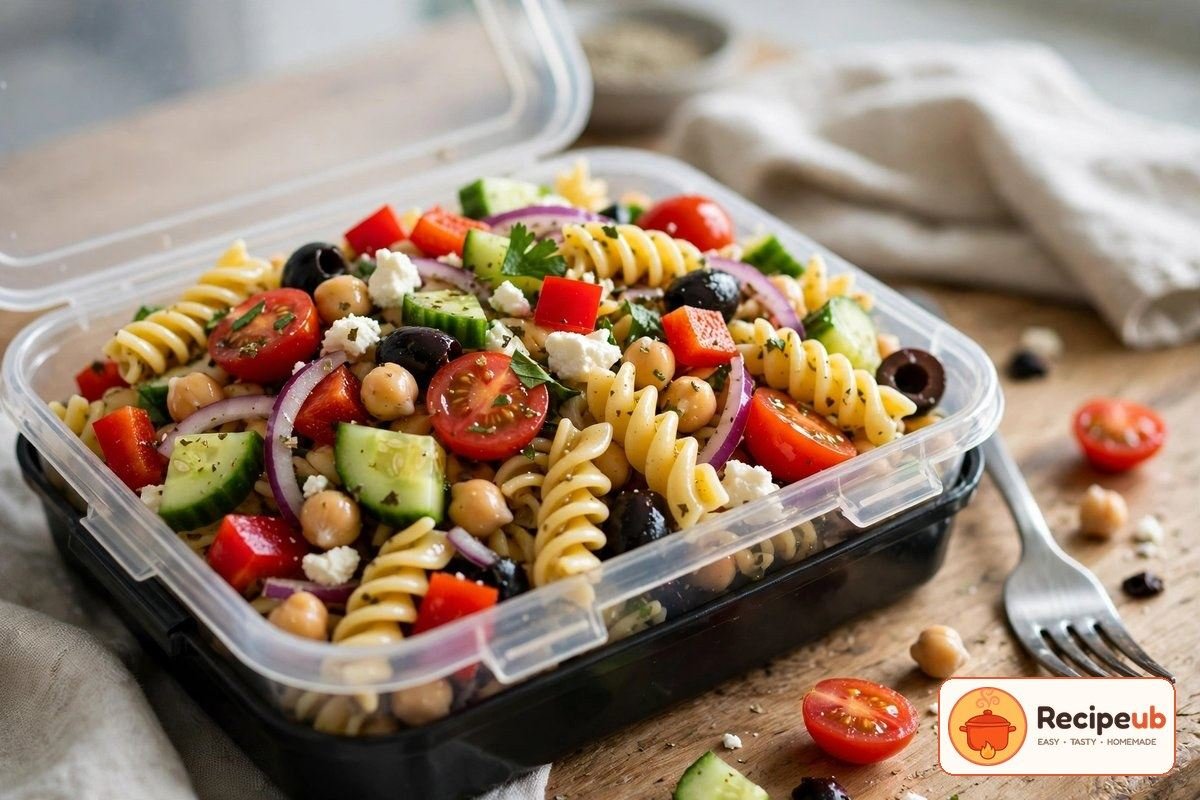
The short answer: Boil 12 oz of rotini in salted water for 1 minute less than the package time, rinse it cold until cool and drain it well. While it boils, chop 1 English cucumber, 1 red bell pepper and ½ red onion, halve 1½ cups of cherry tomatoes, and drain and rinse 1 (15 oz) can of chickpeas. Whisk ¾ cup of dressing (5 Tbsp olive oil, 3 Tbsp red wine vinegar, 1 Tbsp lemon juice, 2 Tbsp water, 1 tsp Dijon, 1½ tsp Italian seasoning, ½ tsp garlic powder, ¾ tsp salt, ¼ tsp pepper) and set ¼ cup aside in a jar. Toss the pasta, chickpeas, vegetables and ½ cup of sliced black olives with ½ cup of the dressing, divide across 4 lunch boxes and crumble ½ cup of feta over the tops. From day 2 on, stir 1 Tbsp of the reserved dressing into each box before eating — four cold lunches at about 650 calories and ≈$2.25 each, in 35 minutes, eaten inside the next 4 days.
In This Recipe
The Plan at a Glance
- The pasta: 12 oz rotini, cooked 1 minute under the package time and rinsed cold — the al dente buffer and the rinse are the texture system (the pasta rule in the card notes)
- The dressing: ¾ cup total for the batch — ½ cup tossed in on prep day, ¼ cup reserved in a jar, 1 Tbsp stirred into each box before eating from day 2 on (the split rule in the card notes). That is 1 cup of dressing per pound of pasta, the lane’s richest measured ratio — with the refresh held back instead of spent on day 1
- The protein: 1 (15 oz) can of chickpeas, drained and rinsed — the lane’s native budget protein and the #1 seat’s own shape; not tuna, not chicken (the fences are named in the intro and the protein FAQ)
- The feta: crumbled over each box at portioning, not tossed through the batch (the feta rule in the card notes); the olives go in the toss
- The eat order: 4 boxes across the next 4 days, all inside the USDA 3-to-4-day window — there is no fifth box, and nothing is frozen, because pasta salad does not freeze (the storage rule in the card notes)
- Time: 25 minutes prep / 10 minutes cook (the rotini only — it boils while the vegetables are chopped, stated openly) / 35 minutes total. A 30-minute chill before the first box is recommended for flavor and is NOT counted in the card times — stated here rather than buried
- Yield: 4 lunch boxes
- Calories: ≈650 per box (estimate); protein ≈18 g per box (estimate)
- Cost: ≈$2.25 per box (estimate) at November 2026 prices — the pasta and tomato lines are BLS-verified anchors; every other line is a labeled shelf estimate; the full line-by-line table is The Priced Box below
- Storage: fridge 3 to 4 days at 40°F or below; the commute rides with an ice pack; the assembled salad never goes to the freezer — the full rules are in the Storage section below
Why This Recipe Works
The split is the fix for the failure every holder documents and nobody measures. Read the lane’s pages back to back and the same confession appears in different words: pasta salad dries out as it sits. One holder gives it a whole section (“why pasta salads often fail”), another prints an “al dente buffer” tip, a third tells you to reserve half the dressing to refresh the salad later in the week — and stops there, half of an unmeasured amount, for an unstated batch. The mechanism is not mysterious: cooked pasta keeps absorbing dressing in the fridge, continuously, for days. A salad dressed once, at whatever ratio, is on a one-way trip to dry. What was missing from the lane was not the idea but the numbers, and numbers are what this page prints: a stated batch (¾ cup for 12 oz of pasta), a stated split (½ cup on prep day, ¼ cup reserved), a stated refresh (1 Tbsp per box before eating, from day 2 on). The Dressing Split section below is the whole system in one place, and the chart under it shows every holder’s ratio converted to the same unit, so you can see exactly why the #1 seat’s box is the driest on the page by day 3.
The shape is part of the system, not a preference. Rotini is not in this recipe because it is cheerful. A grooved, twisted short pasta holds dressing in its spirals — the budget-query holder prints the observation inside its crowd post, that rotini and fusilli “act like little scoops for the dressing” while penne lets it slide off — and for a salad that has to stay dressed for four days, grip is the mechanism the whole format stands on. A smooth tube sheds its dressing into the bottom of the box on day 1 and has nothing left to absorb on day 3. The shape rule is printed as a rule here because in a meal prep, the pasta shape is a storage decision.
The protein is the lane’s own, priced like the lane’s own. The head term’s actual holders are chickpea builds — the #1 seat is a garbanzo-bean salad, and the two brand builds beside it are bean-and-vegetable forms too. That is not an accident of one SERP: a canned chickpea is the protein that fits a cold pasta box at a budget price with no cooking, no mercury cadence and no chicken to keep cold-chain honest. This site’s legume with a hot system of its own is my lentil meal prep — the hot legume system, lentils simmered from dry into a spiced soup eaten warm all week; this post’s chickpeas are a canned, no-cook salad component inside a pasta system, not the subject — there the legume is the post; here the chickpea is a component, and the subject is the pasta-and-dressing system it rides in. One can across four boxes lands at about 95 calories and roughly 5 grams of protein per box (estimates), and the box’s full protein figure — about 18 grams, most of it from the pasta itself — is printed as a fact in the Plan above rather than sold as the frame.
The batch is sized to the window, and the window is the honest one. A mixed pasta salad is a 3-to-4-day food — that is the USDA leftover window, and it governs here over the lane’s scatter of “up to 5 days,” “4–5 days” and “up to a week.” So the batch makes exactly 4 boxes, eaten across the 4 days after prep, and there is no fifth box and no freezer bag, because the assembled salad does not freeze: the pasta turns mushy on thawing and the cucumber and tomato collapse. The holders who print the longer windows are printing claims; this page prints the standard and designs the batch to fit it, which is the same discipline this shelf applies to every cold box it publishes.
The cook is one pot, and it runs inside the prep. Ten minutes of cooking, all of it the rotini — and the rotini boils while the vegetables are chopped, so the card’s 35 minutes is a real 35 minutes and not a sum of two shifts. The rinse does double duty: it stops the cooking (the texture rule) and it cools the pasta fast (the safety rule — a cold salad’s clock is managed from the first minute, not from the fridge door). Everything after the pot is assembly: whisk, toss, portion, crumble. It is the second no-cook-but-one prep on this shelf, and like the first, it prints its receipt — line by line, at current prices, with its verified anchors named and every estimate labeled as one.
Dress It Twice: The Dressing Split
Here is the system this post exists to print, stated as one rule: dress pasta salad twice — half the dressing on prep day, half before eating. Cold pasta keeps drinking dressing in the fridge, so a salad dressed once is a salad that dries out by day 3. The split is what makes day 4 taste like day 1. Every holder in this lane has met the problem — it is confessed in their failure sections, their refresh tips and their storage notes — and exactly one of them prints the workaround, in prose, with no measure attached: half of a dressing whose total is given for a different pasta amount, to be added “before eating later in the week.” A workaround you cannot measure is a rumor. Here it is as a system, for this batch:
- The batch: ¾ cup of dressing for 12 oz of dry rotini — 1 cup per pound of pasta, the richest measured ratio in the lane (the chart after the recipe card converts every holder to the same unit).
- On prep day: ½ cup goes into the bowl with the pasta, chickpeas and vegetables, and is tossed through while everything is fresh. This is the seasoning coat — it flavors the pasta itself, and the pasta will spend the next four days absorbing it.
- Held back: ¼ cup stays in a small jar in the fridge door. Not in the boxes — a box pre-dressed with its refresh portion is just a box dressed once, later. The reserve has to wait outside the salad to do its job.
- Before eating: from day 2 on, stir 1 Tbsp of the reserved dressing into the box before it is eaten. The reserved quarter cup covers days 2, 3 and 4 with a spoonful to spare for whichever box looks driest. The refresh lands on pasta that has already absorbed its first coat, so it sits on the surface the way day 1’s dressing did — glossy, sharp, present — instead of disappearing into the pasta like a fourth day of the first coat would.
The arithmetic underneath it is worth printing once. A pound of dry rotini cooks up to roughly 2½ pounds of pasta, and its surface — plus the chickpeas’ skins — takes on dressing continuously in the fridge; there is no day on which the absorption politely stops. The holders’ one-shot builds put ½ to ¾ cup on a full pound and still report dry day-3 boxes, because the problem was never only the amount: it is the timing. All the dressing on day 0 is all the dressing absorbed by day 3. This build spends its richer ratio in two installments, and the second installment is timed to the eating, not the making. That is the entire invention, and it costs one small jar.
Ingredients
For the salad:
- 12 oz rotini
- 1 (15 oz) can chickpeas, drained and rinsed
- 1½ cups cherry tomatoes, halved
- 1 English cucumber, diced
- 1 red bell pepper, diced
- ½ red onion, finely diced
- ½ cup sliced black olives
- ½ cup crumbled feta
For the dressing (¾ cup):
- 5 Tbsp olive oil
- 3 Tbsp red wine vinegar
- 1 Tbsp lemon juice
- 2 Tbsp water
- 1 tsp Dijon mustard
- 1½ tsp Italian seasoning
- ½ tsp garlic powder
- ¾ tsp kosher salt
- ¼ tsp black pepper
Ingredient notes: The pasta is rotini, 12 ounces, cooked 1 minute under the package time and rinsed cold — the shape is the system (grooves hold dressing; smooth penne sheds it, and the chart below prints the rule beside the ratios), the undercook is the al dente buffer (absorption in the fridge finishes the texture, so pasta cooked fully on day 0 is mushy by day 3), and the rinse stops the cooking, sheds the surface starch that would glue the spirals together, and cools the pasta fast. The price on the card is priced off the Bureau’s spaghetti-and-macaroni average — rotini rides the same shelf and the same average class. One dated note on product class, in the site’s standing form: the pasta recalled this fall — Bettergoods Authentic Italian Lemon Alfredo Fettuccine, a frozen ready-to-eat prepared pasta meal sold at Walmart, recalled September 15, 2026 and expanded to all lot codes on October 1, 2026 (FDA Class I; UPC 194346442706) — is a frozen prepared meal, a different product class from the dry rotini this build cooks from a box, and is not an ingredient in this recipe; readers holding that frozen meal should follow the FDA notice. The chickpeas are 1 (15 oz) can, drained and rinsed — rinsing takes off the canning liquid’s starch and a good share of its sodium, and the chickpea goes in as the salad’s protein component, at about 95 calories and 5 grams of protein per box (estimates); the legume that carries a whole post on this site is the lentil, named in Why This Recipe Works above — this salad’s subject is the pasta and its dressing. The tomatoes are cherry tomatoes, 1½ cups halved (about ¾ lb) — halved so their juice joins the dressing instead of bursting whole in the box, and priced on the card off the Bureau’s field-grown tomato average with the honest label that cherry tomatoes typically run higher on the shelf. The cucumber is 1 English cucumber — thin-skinned and nearly seedless, so it gives crunch without watering the box the way a slicing cucumber’s seed core does; even so, it is the first texture to soften, and day 4’s box is a softer-crunch box (a texture note, printed in the Storage section, not a safety one). The feta is ½ cup crumbled, added at portioning, not in the toss — tossed through the whole batch on prep day it breaks down, smears through the salad and salts it unevenly across four days; crumbled over each box it stays in crumbles (the feta rule in the card notes). The olives are the opposite call: ½ cup sliced black olives go in the toss, because an olive has nothing to break down and its brine is part of the seasoning. The dressing’s 2 Tbsp of water is a measured part of the batch, not a thinning afterthought — it brings the whisked total to the printed ¾ cup and loosens the emulsion just enough to coat spirals instead of pooling under them.

How to Make Pasta Salad Meal Prep Boxes
The method is one short cook and one assembly, and the two run at the same time: the rotini boils while the vegetables are chopped, so the prep is a single 35-minute shift and not a cooking session followed by a chopping session. The order inside the assembly matters for a cold box the way packing mattered for the tuna box — the pasta is cooled before it meets the dressing, the dressing is split before anything is tossed, and the feta goes on last, per box — because in a lunch box, assembly is the recipe. Everything is refrigerated promptly at the end; a pasta salad’s clock starts when the pasta is drained, not when lunch does.
- Boil the rotini — the only cooking in the prep, and it starts the clock. Bring a large pot of salted water to a boil, add the 12 oz of rotini and cook it 1 minute less than the package time — the al dente buffer: the pasta will keep taking on dressing in the fridge, and absorption finishes the texture, so pasta cooked fully today is mushy by day 3. Drain it and rinse under cold water until the pasta is cool, then let it drain well for a full 2 minutes, shaking the colander — surface water clinging to the spirals dilutes the first dressing coat, and the rinse is also the cooling, so the salad never sits warm on the counter. That is the card’s whole 10-minute cook time, stated openly.
- Whisk the dressing, and split it immediately. While the pasta boils, whisk the olive oil, red wine vinegar, lemon juice, water, Dijon, Italian seasoning, garlic powder, salt and pepper in a small bowl or measuring jug until emulsified — ¾ cup in all. Before anything is tossed, pour ¼ cup into a small jar, lid it and put it in the fridge door. The split happens now, at the whisk, not as an afterthought at portioning: the reserved dressing is the system’s second half, and it waits outside the salad (the split rule in the card notes).
- Chop the vegetables and prep the chickpeas. In the same boiling window: drain and rinse the chickpeas, halve the cherry tomatoes, dice the cucumber and bell pepper, and finely dice the red onion. Everything is cut to spiral size — pieces a fork picks up together with the pasta, not chunks the pasta has to carry.
- Toss with the first dressing. Put the cooled, well-drained rotini in a large mixing bowl with the chickpeas, tomatoes, cucumber, bell pepper, red onion and sliced black olives. Pour over the ½ cup of dressing and toss gently but thoroughly, until the spirals are glossy all through. Taste a piece of pasta and adjust the salt now — it is the only moment all four boxes can be seasoned at once, and the pasta should taste a touch sharper than you want day 4’s box to taste, because absorption mellows it.
- Portion, and crumble the feta per box. Divide the salad among 4 meal prep containers, about 2 cups in each. Crumble the feta over each box — 2 Tbsp per box — rather than tossing it through the batch: in the toss it breaks down and smears across four days; on top of each box it stays in crumbles (the feta rule in the card notes).
- Chill, and start the eat order. Lid the boxes and refrigerate promptly at 40°F or below — the assembled salad goes into the fridge within 2 hours of cooking, and the rinse means it goes in cold, not warm. A 30-minute chill before the first box lets the flavors settle and is recommended; it is not counted in the card’s times, and this page says so instead of burying it. From day 2 on, stir 1 Tbsp of the reserved dressing into each box before eating. The four boxes are eaten across the next 4 days; there is no fifth box and nothing goes to the freezer, by design (the storage rule in the card notes).


Pasta Salad Meal Prep (4 Lunch Boxes, About $2.25 a Box)
Ingredients
Equipment
Method
- Cook the rotini in salted water 1 minute less than the package time. Drain, rinse under cold water until cool, and drain well for 2 minutes.
- Whisk all the dressing ingredients (¾ cup total). Pour ¼ cup into a small jar, lid it and refrigerate it — that is the reserved refresh.
- While the pasta boils, drain and rinse the chickpeas, halve the tomatoes, and dice the cucumber, bell pepper and red onion.
- Toss the cooled rotini, chickpeas, tomatoes, cucumber, bell pepper, red onion and olives with ½ cup of the dressing until glossy. Taste and adjust the salt.
- Divide among 4 containers and crumble the feta over each box.
- Lid and refrigerate promptly; eat within 3 to 4 days. From day 2 on, stir 1 Tbsp of the reserved dressing into each box before eating.
Notes
How Much Dressing Per Pound of Pasta? The Pasta-to-Dressing Chart
Here is the chart that explains the lane’s day-3 problem in one column. Every named holder’s build, converted to the same measure — cups of dressing per pound of dry pasta — with the split column beside it, because the ratio alone is only half the story. Read down the ratio column and the dry boxes stop being bad luck: the #1 seat runs the leanest dressing in the set, all of it on day 0, and then stores the salad for five days. This recipe uses the bold row.
| Build | Pasta | Dressing as published | Per lb of pasta | Split? |
|---|---|---|---|---|
| Best of Vegan (the #1 seat) | 1 lb | ½ cup (balsamic, lemon, 2 Tbsp oil) | ≈½ cup | No |
| PlantYou | 1 lb | ≈½ cup (oil, red wine vinegar, lemon) | ≈½ cup | No |
| Cook with Carol (the budget-query holder) | 1 lb | ¾ cup (½ cup oil + ¼ cup vinegar) | ¾ cup | No |
| Budget Bytes (2018) | 8 oz | ⅓ cup bottled Italian | ≈⅔ cup | No |
| Ados Kitchen | 3 cups cooked (≈6–7 oz dry) | ½ cup, “half now, half later” | ≈1¼ cups (richest) | Yes — unmeasured |
| This recipe | 12 oz | ¾ cup total | 1 cup | Yes — ½ cup now / ¼ cup reserved, 1 Tbsp per box |
How to read the chart: two columns decide how a box eats on day 4, and they multiply. The ratio column is the supply: at ½ cup per pound, there is barely enough dressing to coat the pasta once, and nothing left for the absorption that runs for four days — the salad does not dry out because it was stored badly, it dries out because it was under-dressed on day 0 and fully absorbed by day 3. The split column is the timing: the richest ratio on the page belongs to the framework holder, and it is also the only split — but its split is “half now, half later” of a loosely stated batch, with no per-box measure, so a cook cannot reproduce it twice the same way. This recipe’s row is the two columns combined and quantified: 1 cup per pound, split ½ cup now and ¼ cup reserved, with the refresh measured per box. And the shape rule rides with the chart, because ratio is only what the pasta can hold: rotini holds dressing in its grooves; penne sheds it. For a salad that has to stay dressed for four days, the shape is not a preference — it is the mechanism. A lean ratio on a smooth shape is the lane’s standard build, and its day-3 box is the lane’s standard complaint.
What Does a Pasta Salad Lunch Box Cost? The Priced Box
Here is the third thing this post prints that page 1 does not: the whole box, priced line by line, at November 2026 prices — with two lines read directly from the Bureau of Labor Statistics, every other line labeled a shelf estimate, printed as one, because this page names its sources instead of rounding a receipt it never saw. It also reconciles: the method portions 4 boxes, and the table divides by the same 4. No holder in this lane prints a current batch price at all — the lane’s one priced pasta salad is a 2018 leftover post at 3 portions, and the budget-query holder’s swap table asserts savings (feta to olives “saves $4.00”) without ever totaling the bowl it is saving them on.
| Line | Amount for the batch | Price basis | Batch cost |
|---|---|---|---|
| Rotini | 12 oz | BLS October 2026 average — spaghetti and macaroni, $1.384/lb (verified, series APU0000701322; rotini priced off that average, labeled) | $1.04 |
| Cherry tomatoes | About ¾ lb | BLS October 2026 average — field-grown tomatoes, $2.084/lb (verified, series APU0000712311; cherry tomatoes typically run higher on the shelf, labeled) | $1.56 |
| Red bell pepper | 1 | Shelf estimate, labeled as one | ≈$1.25 |
| Feta | ½ cup crumbled | Shelf estimate, labeled as one | ≈$1.10 |
| Chickpeas | 1 (15 oz) can | Shelf estimate, labeled as one | ≈$0.95 |
| English cucumber | 1 | Shelf estimate, labeled as one | ≈$0.90 |
| Black olives | ½ cup | Shelf estimate, labeled as one | ≈$0.80 |
| Olive oil | 5 Tbsp | Shelf estimate, labeled as one | ≈$0.65 |
| Red onion | ½ | Shelf estimate, labeled as one | ≈$0.40 |
| Vinegar, lemon, Dijon, seasoning, salt, pepper | Dressing amounts | Estimate, labeled as one | ≈$0.35 |
| Batch total | 4 boxes | ≈$9.00 → ≈$2.25 per box |
How to read the table: the shape of this receipt is the opposite of the tuna box’s. There, the protein was the batch’s biggest line and the squeeze around it was the story; here the two verified lines — pasta at $1.04 and tomatoes at $1.56 — are the spine, the chickpeas cost less than the bell pepper, and no single line runs away with the batch. That is what a vegetable-led box does to a receipt: the most expensive decision in the recipe is a fresh pepper, and the whole protein costs 95 cents a can. It is also why the title’s figure survives honest pricing: ≈$2.25 a box is not a promotional number rounded down from a kind estimate — it is this table divided by 4, with the two anchor lines verified and the rest labeled. One honest caution travels with it: the tomato line is priced off the field-grown average, and cherry tomatoes on a November shelf typically run higher — if your store’s pint is proud of itself, the box lands a few cents over the title, and the table is built so you can see exactly which line moved. If the protein math is the whole point of your prep — grams per dollar across a rotation — that system already lives on this shelf: my cheap high-protein meal prep — the protein-math system, five proteins priced per gram across 10 boxes; this post prints its protein, about 18 g a box, as a fact inside a dressing system, not as the frame does that accounting as its subject. This box’s math is the split first, the price second, both printed.
Storage and the 4-Day Eat Order
Fridge — all 4 boxes, eaten in 4 days: A mixed pasta salad keeps 3 to 4 days at 40°F or below — the USDA leftover window for a cooked pasta dish and mixed salad, and the only window this page prints. The four boxes are eaten across the four days after prep, in any order; the salad is at its brightest on days 1–2 and entirely sound through day 4 — sounder than any holder’s day 4, because this one gets its second dressing. What this page will not print is the stretched version: the lane’s storage claims scatter from “up to 5 days” to “4–5 days” to one brand’s “up to a week” — a claim that page contradicts in its own intro, which says five — and the scatter itself is the tell. Those are claims about someone else’s risk; 3–4 days is the standard, and the batch is designed so the question never has to stretch: it makes exactly 4 boxes and there is no fifth. Refrigerate promptly on prep day — the assembled salad goes in within 2 hours of cooking (1 hour above 90°F) — and the rinse is what makes that easy: the pasta arrives at the bowl already cold, so the batch never sits warm on the counter “cooling” through the danger zone.
The reserved dressing’s own clock: The jar in the fridge door is oil, vinegar, lemon and seasoning — no dairy, nothing perishable in the mixed-salad sense — and it keeps comfortably past the salad’s own window. That does not extend the salad: the boxes still close at day 4, and any dressing left in the jar after the last box is a vinaigrette for the next salad, not a reason to stretch this one.
The commute and the desk: The box travels in an insulated bag with an ice pack, and it goes back into a fridge on arrival — 2 hours total out of refrigeration is the cap, and the clock counts the commute, the desk-sitting and the meeting it sat through. If there is no fridge at the destination, the ice pack stays in the bag with the box and does the refrigerating.
Component clocks, printed honestly: Inside the salad, the parts age at different speeds, and the page prints that instead of pretending the box is uniform. The sturdy vegetables — bell pepper, red onion, olives — outlast the window without changing. The chickpeas and pasta hold their texture to day 4, which is what the al dente buffer and the split were for. The cucumber is the first texture to go: day 4’s box is a softer-crunch box than day 1’s. That is a texture note, not a safety one — the salad is sound; it is simply less snappy — and it is printed because a page that promises four identical boxes is selling something. The feta and the reserved dressing keep past the window on their own; the salad as a whole still closes at day 4.
The freezer — an honest no: Do not freeze the assembled pasta salad. Cooked pasta turns mushy on thawing, and the cucumber and tomato collapse into the dressing — the two fresh textures the salad is made of are the two freezing destroys, and no refresh of dressing repairs a collapsed cucumber. This batch is sized so the question never has to be negotiated: 12 oz of pasta, 4 boxes, 4 days, nothing left over to rescue. The freezer-first systems on this shelf are built on foods that freeze well; this one is built on the fridge window and the dressing split agreeing on the same batch size, and it stays there.
Emma’s Tips for the Best Pasta Salad Meal Prep
Drain like you mean it — twice. The first dressing coat can only season pasta it can touch, and rotini comes out of the rinse holding water in every spiral. Shake the colander hard, then walk away for a full 2 minutes and shake it again. Pasta that goes into the bowl wet waters down the emulsion, dulls the salt, and spends the split’s first installment on dilution instead of flavor. The salad should be dressed, not damp, and the draining is where that is decided.
Salt the pasta water — it is the only seasoning the pasta gets from inside. Everything else in this recipe seasons a surface: the dressing coats, the feta salts a bite, the olives brine a forkful. The pasta itself — the biggest component in the box — is seasoned in exactly one place, its cooking water. Pasta boiled in plain water tastes flat at the center of every bite no matter how good the dressing is, and across four days of absorption the flatness is what reads as “bland” in the holders’ day-3 complaints. Salt the water like soup, and the split has something worth refreshing.
Refresh at eating time, never the night before. The reserved dressing works because it lands on the pasta minutes before the fork does. Stir it in the evening before, out of efficiency, and it is absorbed by morning — the box becomes a salad dressed once, later, which is the exact build this recipe exists to replace. The jar lives in the fridge door precisely so the refresh is a 20-second habit at lunch, not a second prep session.
Cut everything to spiral size. The cucumber, pepper and onion are diced to the size of a rotini twist so a fork picks up pasta and vegetable in the same bite, in every bite, for four boxes. Pieces cut bigger segregate — the pasta settles, the chunks ride on top, and the last box out of the bowl is all pasta. Even boxes are a cutting decision before they are a portioning one; portion from a well-tossed bowl and stir the bowl between boxes.
Halve it, or hand the habit to a cheaper shelf. Two lunches out or a short week? Halve everything exactly — 6 oz of rotini, half a can’s worth of chickpeas (freeze the rest of the can for a soup), half the vegetables, and a 6-Tbsp dressing batch split 4 Tbsp now and 2 Tbsp reserved. The ratios are the recipe, and they scale in both directions. If the pantry is the point — a week built from what is already on the shelf — more cheap staples that behave like meals live in my cheap pantry dinners — the pantry dinner system, shelf-stable staples turned into a hot family dinner for about 75 cents a serving; this post is the pantry’s cold lunch cousin, a fresh-shop box built on the same shelf discipline. And if this is your first prep of any kind, the gentler on-ramp is my meal prep on a budget for beginners — the starter system, a first week of budget prep built step by step; this post assumes the habit and spends it on a dressing schedule — this box is a forgiving first prep, but the beginner system teaches the container-and-eat-order habits this page assumes.
FAQs
Can you meal prep pasta salad?
Yes — it is one of the easiest, most reliable meals you can make ahead, with two numbers attached, and the numbers are this page. The autocomplete stem itself asks the question (“can you meal prep pasta salad”), because everyone who has tried it has met the day-3 box: dry, bland, the dressing gone. The format survives the fridge when the batch is dressed twice — ½ cup on prep day, ¼ cup reserved and stirred in 1 Tbsp per box before eating — and when the batch is sized to the honest window: 4 boxes eaten inside the USDA’s 3 to 4 days. Prepped that way, day 4 tastes dressed. Prepped the one-shot way, the answer the searcher already knows is the true one.
How long does pasta salad last in the fridge?
3 to 4 days at 40°F or below — the USDA leftover window for a mixed perishable salad, and the only window this page prints. The holders scatter around it: “up to 5 days” from the #1 seat, “4–5 days” from the 2018 budget post, “up to three days” from the one holder inside the window, and “up to a week” from the brand holder — whose own intro says five days, so the page disagrees with itself before it disagrees with the standard. The scatter is the tell: those are claims, and 3–4 days is the standard. This batch is designed so the question never has to stretch — exactly 4 boxes, eaten across the 4 days after prep, and no fifth box asking the food to outlast its window.
Why does pasta salad dry out in the fridge?
Because cooked pasta keeps absorbing dressing as it sits — continuously, for days. The dressing you toss in on prep day does not stay on the surface; it migrates into the pasta, and by day 3 a one-shot salad has spent its whole coat. The lane knows this: one holder gives the failure its own section, another prints a refresh tip. What the lane does not print is the measured fix, which is the Dressing Split above: hold back ¼ cup of the batch, keep it in a jar outside the boxes, and stir 1 Tbsp into each box before eating from day 2 on. The refresh lands on pasta that has already absorbed its first coat, so it sits on the surface the way day 1’s dressing did. Dry day-3 pasta salad is not a storage failure — it is a scheduling one.
How much dressing does pasta salad meal prep need?
¾ cup for 12 oz of pasta — 1 cup per pound — split ½ cup now and ¼ cup reserved. That is the Pasta-to-Dressing Chart’s answer, and the chart is why the number is what it is: the #1 seat runs about ½ cup per pound, all at once, and its box is the driest on the page by day 3; the crowd build runs ¾ cup per pound, also all at once; the one split in the lane is unmeasured. A meal prep needs more than a same-day salad because it is feeding four days of absorption, not one sitting — and it needs the last quarter cup late, not more on day 0. If you scale the batch, scale the split with it: two-thirds on prep day, one-third in the jar, 1 Tbsp per box before eating.
Should you rinse pasta for pasta salad?
Yes — for a cold salad, rinsing is the rule, and the hot-pasta rule does not apply. Rinsing under cold water does three jobs at once: it stops the cooking (with the 1-minute undercook, it locks in the al dente buffer the texture depends on), it sheds the surface starch that would glue the spirals together and cloud the dressing, and it cools the pasta fast, which is a food-safety step as much as a texture one — the salad goes into the fridge cold instead of cooling slowly through the danger zone on the counter. The never-rinse rule belongs to hot pasta, where the starch helps a sauce cling. A cold salad has no sauce to cling to; it has a dressing to stay separate from until the split says otherwise.
What is the best pasta shape for meal prep pasta salad?
Rotini — or fusilli, its twin. The grooves and twists are the point: a spiral holds dressing in its folds, carries it into the fridge, and still has some on the surface days later. Smooth shapes shed — penne’s slick tubes let dressing slide off into the bottom of the box on day 1, which is the budget-query holder’s own observation, printed inside a crowd post and promoted to a rule here. For a salad eaten the same day, shape is a preference. For a salad that has to stay dressed for four days, the shape is the mechanism: grooved, short, and sturdy enough not to break down under four days of tossing and absorption. This recipe is built on rotini for exactly that reason.
Can you freeze pasta salad?
No — and this recipe is designed so you never need to. Cooked pasta turns mushy on thawing, and the cucumber and tomato collapse into the dressing; the two fresh textures the salad is made of are the two freezing destroys, and no amount of reserved dressing repairs a collapsed cucumber. The batch answers the freezer question by sizing instead: 12 oz of pasta makes exactly 4 boxes, the boxes fit the 3-to-4-day fridge window, and nothing is left over to rescue. If you want a freezer-first prep, build it on a food that freezes well — this shelf has them — and let the pasta salad be the fridge system it is.
What protein can I add to pasta salad meal prep?
Start with what is in the box: the chickpeas are the build — the lane’s native budget protein, about 95 calories and 5 grams of protein per box (estimates), no cooking, no cold-chain drama, 95 cents a can on the priced table. The two proteins searchers ask for by name are real variants, and both already have homes on this site, which is why they are named here instead of built. Chicken — shredded or rotisserie folded through the salad — is a fine box, and chicken prep as a system belongs to this site’s chicken boxes and shredded-chicken batch. Tuna is the fenced one: this site’s other pasta-and-tuna meeting is a hot dinner, my tuna noodle skillet — the hot albacore dinner, tuna in a creamy noodle bake eaten once the night it is cooked; a tuna pasta salad would be a cold third meeting, and tuna already has its own cold box on this site — and the tuna lunch box itself is the mercury-chart post named in the intro. A tuna pasta salad would collide with both at once, so this page prints the chickpea build and names the fence. The variant discipline is the same as the storage discipline: every protein gets the format its own rules design.
How do I keep the vegetables crunchy for 4 days?
Build the batch on sturdy vegetables and print the one honest exception. Bell pepper, red onion and olives hold their texture past the window; the chickpeas and pasta hold theirs because of the al dente buffer and the split. The exception is the cucumber: it is the first texture to soften, and day 4’s box is a softer-crunch box than day 1’s — a texture note, not a safety one, and this page prints it instead of promising four identical boxes. Two habits protect what crunch there is: dice the cucumber in real pieces rather than thin slices (more interior, less cut surface to weep), and keep anything watery out of the batch entirely — no fresh tomato wedges weeping into the dressing, no lettuce in any form. If the crunch matters more than the cucumber, swap it for a second pepper and the box eats identically crisp on day 4.
How much does one pasta salad lunch box cost?
≈$2.25 a box (estimate) — a batch of ≈$9.00 for 4 boxes, priced line by line in The Priced Box above. The two verified lines are the pasta (12 oz at the BLS October 2026 spaghetti-and-macaroni average of $1.384/lb = $1.04) and the tomatoes (about ¾ lb at the field-grown average of $2.084/lb = $1.56, with cherry tomatoes labeled as typically higher on the shelf). Every other line is a labeled shelf estimate — the bell pepper is the batch’s priciest single item at about $1.25, and the protein, a can of chickpeas, costs about 95 cents. No holder in this lane prints a current price to compare against: the one priced pasta salad on page 1 is from 2018, at 3 portions, and the budget-query holder’s swap table never totals its bowl. This page dates its prices for the same reason it prints its window — both move, and the reader deserves to know which year’s numbers they are cooking from.
Final Thoughts
Pasta salad meal prep is not a hard lunch, and it is a badly answered one anyway — because the recipe was never the problem. It is a box of rotini, a can of chickpeas and thirty-five minutes. The problem is that page 1 leaves its searcher’s actual question — the one typed into the autocomplete stem, can you meal prep pasta salad — answered with a yes and no system: a split-dressing workaround with no measure on it, ratios scattered from ½ cup to 1¼ cups per pound with no two holders in the same unit, storage claims running from three days to a week on the same food, and not one current price in the lane. What this page adds is the paperwork the other versions leave out — a dressing split with the batch, the fraction and the per-box refresh all stated, so day 4 tastes like day 1; a chart that converts the whole lane to one ratio and prints the shape rule beside it; a priced box with two verified anchors and every estimate labeled; and an eat order that treats the USDA window as a design constraint instead of an inconvenience. Dress it twice, size it to four days, price it on the page: that is the deal.
More Easy Budget Meal Prep Ideas
If a priced system with the chart printed is your kind of meal prep, the rest of this shelf runs on the same rules — every receipt shown, every window honest. The whole shelf is gathered in my budget meal prep ideas — the hub of every budget system on the site, priced pots, solo weeks, beginner batches, breakfast boxes and cold lunch boxes; this post is its newest entry, the first cold pasta box, built on a dressing split, and it sits there as the shelf’s pasta end — the one prep in the collection whose system is a schedule for a jar of dressing. One shelf, one standard — the batch is sized by the chart, the price is dated on the page, the dressing is split, and the week is handled.



Never Run Out of Dinner Ideas
One easy air fryer or slow cooker dinner in your inbox every week. No spam, ever.
You’re on the list — welcome to Recipeub!