
Slow Cooker Lasagna (Uncooked Noodles — Slices Clean, Never Soupy)
Ask ten people why their crockpot lasagna failed and you will hear the same two answers: the noodles turned to mush, or the whole thing sliced like soup. Both failures get blamed on the slow cooker, and both are actually information problems. Recipes for this dish tell you to cook it anywhere from 3 to 6 hours on LOW, they argue about regular noodles versus no-boil noodles without ever printing a number for either, and they scatter the resting time anywhere from 10 to 40 minutes — or skip it entirely. This is the lasagna I make when I want the real, layered, slice-it-into-squares kind: regular dry noodles that go in uncooked, a browned meat sauce built on a jar of marinara, a ricotta filling set with an egg, and a system behind all of it — a noodle chart with the liquid amounts printed, a layer map measured in cups, and one standing rule that makes the slices come out clean.
One naming note, because this site keeps its lasagnas honest: this is the layered casserole you cut into squares. If what you want is the spoonable, ladle-it-into-a-bowl version, that is my Slow Cooker Lasagna Soup — same flavors, completely different dinner. This page owns the layers.
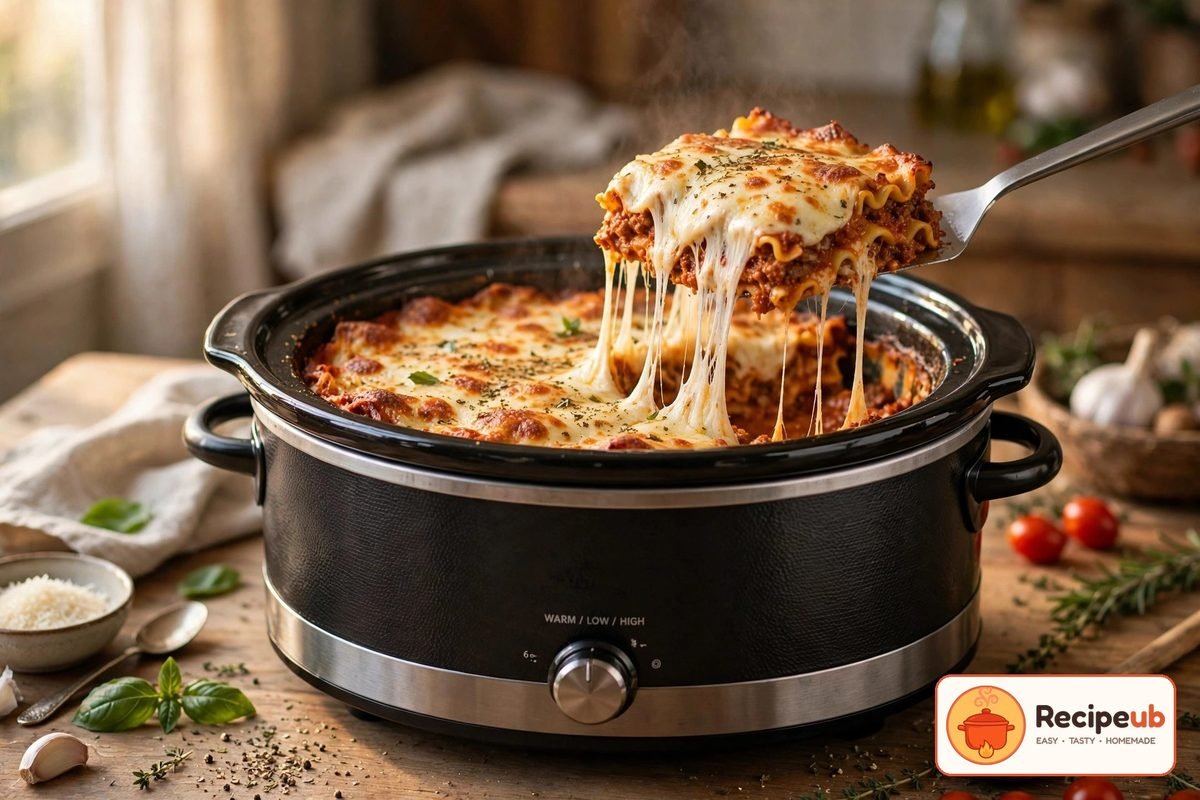
The short answer: Lasagna takes 4 hours on LOW in the slow cooker — never HIGH — and the noodles go in dry and uncooked: regular lasagna noodles, not no-boil, with every edge tucked under sauce. Brown the meat, layer sauce, noodles, ricotta and mozzarella three times, melt the final cheese in the last 15 minutes, then let it stand 20 minutes before you cut it. That stand is the difference between slices and soup.
In This Recipe
The Plan at a Glance
- Noodles: regular dry lasagna noodles, 12 oz — uncooked, never no-boil for the best texture
- Setting and time: LOW for 4 hours (knife test at 3½) — HIGH scorches the edges before the center softens
- The system: the Noodle System chart + the Layer Map, both below — every amount in cups
- The finish: final 2 cups of mozzarella in the last 15 minutes, so the cheese pull survives slicing
- The rule: 20 minutes standing, cooker off, lid ajar, before the first cut
- Serves: 8 real slices in a 6-quart oval slow cooker, about 560 calories and roughly $2.25 a slice
Why This Recipe Works
Regular noodles, because they hold their shape. The single most important choice in this recipe happens at the store. Regular dry lasagna noodles are thick enough to drink sauce for 4 hours and still come out as distinct, sliceable sheets. No-boil (oven-ready) noodles are rolled thinner — that is what makes them oven-ready — and in a slow cooker they go soft a full hour sooner. Searchers use “uncooked noodles” and “no-boil noodles” like they mean the same thing; they do not, and the Noodle System below separates them with numbers.
The meat is browned and drained — that is the anti-soupy step. A watery lasagna is almost never the sauce’s fault. It is the fat and liquid that raw or undrained beef gives up over 4 hours, pooling under the layers. Browning the beef first, draining it properly, and then building the sauce on a good jarred marinara gives you a sauce that starts thick and stays thick. The jar is deliberate: it is how most of us actually make this on a weeknight, and a decent marinara plus browned beef, garlic and Italian seasoning tastes like Sunday anyway.
Egg in the ricotta is the slice. Ricotta on its own is a soft cheese that slumps when it heats. One egg whisked through it turns the filling into a gentle custard that sets as it cooks — it is the quiet difference between a layer you can see in the slice and a layer that slides out of it. Whole-milk ricotta, not part-skim: the fat is part of the set, and part of why a slice of this tastes like lasagna instead of a compromise.
The stand is part of the recipe, not a serving suggestion. In the oven, lasagna rests because we were all taught to rest it. In a slow cooker the rest does three jobs at once — the noodles absorb the last of the free liquid, the cheese drops below the temperature where it runs, and the layers settle into a block that a knife can cut. Twenty minutes, explained properly in its own section below. Skip it and you have not made a bad lasagna; you have made a good one you served too early.
The Noodle System: Which Noodles for Slow Cooker Lasagna?
Here is the chart no other recipe for this dish prints. Every slow cooker lasagna question — do I cook the noodles first, can I use no-boil, why did mine turn to mush — is really a question about which noodle, how much liquid it needs, and how long it can sit in hot sauce before it gives up. So here is each noodle with its numbers:
| Noodle Type | How It Goes In | Extra Liquid | Time on LOW | The Result |
|---|---|---|---|---|
| Regular dry (this recipe) | Dry and uncooked, every edge tucked under sauce | None in the sauce — plus ¼ cup water poured around the edges ONLY if your cooker runs hot | 4 hours (knife test at 3½) | Firm-tender sheets that slice clean — the pick |
| No-boil / oven-ready | Dry, edges tucked under sauce | +¼ cup water stirred into the sauce | 3–3½ hours, maximum | Works in a pinch; the thinner sheet goes soft, and past 3½ hours it turns mushy |
| Pre-cooked / boiled | — | — | — | Do not. Already hydrated, they dissolve into the layers over a long cook |
| Fresh pasta sheets | — | — | — | Do not. Too delicate for 4 hours — they fall apart into the sauce |
How to read the chart: the whole argument in this recipe is the first row. Regular dry noodles are the only ones built for a 4-hour cook — thick enough to absorb sauce slowly and finish tender at the same moment the filling sets. The ¼ cup of edge water in row one is a cooker correction, not a recipe ingredient: some slow cookers run hot on one side, and a splash of water around the rim protects the edge noodles in those pots (it is the trick the best-tested recipes in this dish’s history use). If your cooker cooks evenly, skip it — extra liquid is exactly what this recipe is engineered to avoid. The no-boil row exists because the question is real — yes, you can use them, with the extra ¼ cup in the sauce and a hard stop at 3½ hours — but know you are trading texture for convenience. And the two “do not” rows are there because nobody prints them: boiled noodles and fresh sheets fail in this pot every single time, and it is kinder to read it here than to learn it at dinner.
The two rules that ride with the chart: every noodle edge gets tucked under sauce or filling — a dry edge left exposed cooks up hard and chewy no matter which noodle you chose — and at 3½ hours you run the knife test: slide a thin knife into the center; the noodles are done when it passes through with no resistance. If it catches, give it the last 30 minutes and test again.
The Layer Map: Exact Amounts for a 6-Quart Oval
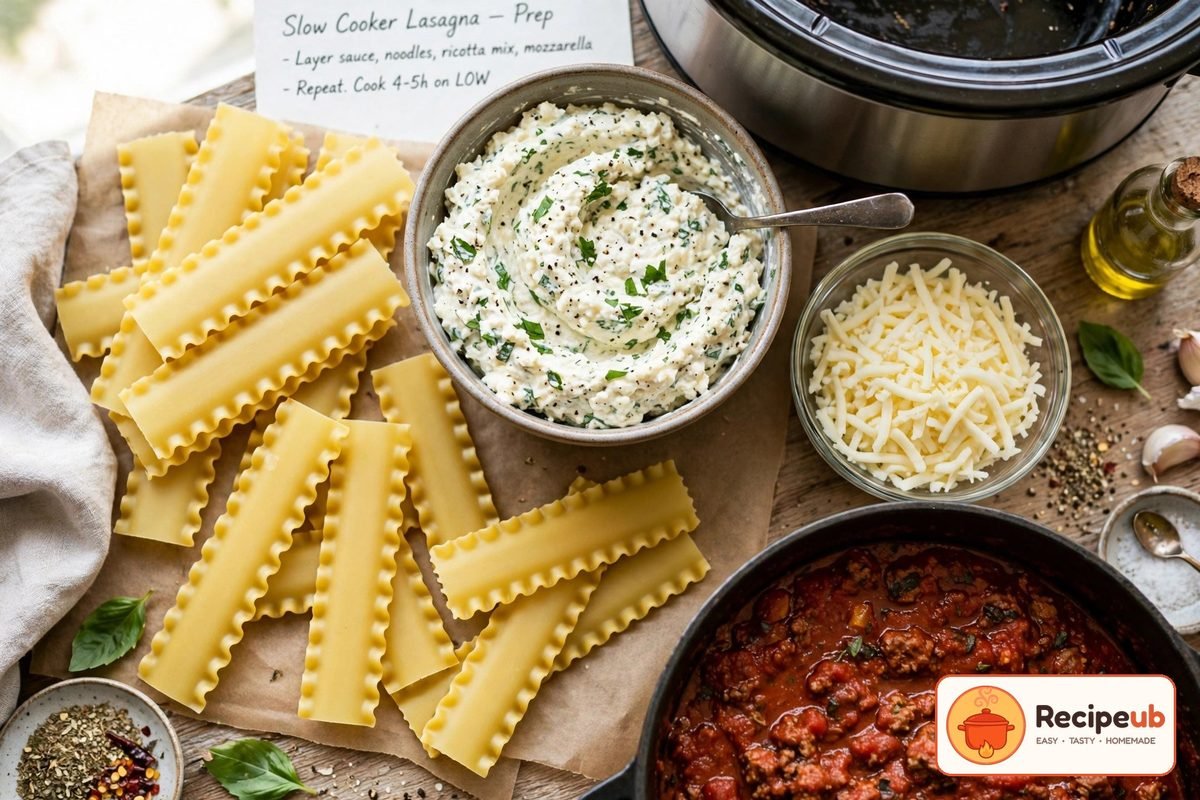
“Repeat the layers” is not a measurement, so here is the map — every layer, in cups, for a standard 6-quart oval cooker. The whole build is three noodle layers from one bowl of meat sauce (about 4½ cups once the beef is in the marinara), one bowl of ricotta mixture (about 3 cups), and 3 cups of mozzarella, divided on purpose: a little inside, most of it on top at the end.
| Layer | What Goes In | Amount |
|---|---|---|
| 1 | Meat sauce, spread across the bottom | 1½ cups |
| 1 | Noodles — 3 whole, plus broken pieces filling the curved ends | About 4 noodles |
| 1 | Ricotta mixture | ⅓ of the bowl, about 1 cup |
| 1 | Mozzarella | ½ cup |
| 2 | Meat sauce → noodles → ricotta mixture → mozzarella | Same amounts as Layer 1 |
| 3 | Noodles → last ⅓ of the ricotta mixture → remaining meat sauce spread over the top | About 4 noodles; 1½ cups sauce |
| Finish | Mozzarella, added in the last 15 minutes of cooking | 2 cups |
Round cooker? Break the noodles into a mosaic. A round 6-quart takes the same amounts — nothing changes but the geometry. Break the dry noodles into large pieces and lay them in overlapping by about ½ inch, with no gaps: a gap is a spot where filling bubbles through and the layers merge. Expect 4 shorter layers instead of 3, dividing the sauce and ricotta into quarters (about 1¼ cups sauce and a scant ¾ cup ricotta per layer), and keep the same 2-cup mozzarella finish. The slices come out just as clean; the layers are simply a little thinner.
Different size? Scale the map, not the method. A 4-quart cooker takes ⅔ of everything (2 layers is usually all that fits — that is fine). A 3-quart takes ½. A 7-quart uses the recipe exactly as written; the layers spread wider and thinner, so start the knife test at 3¼ hours. Whatever the size, fill the cooker no more than three-quarters full, and never change the noodle row — regular dry, tucked under sauce, in every size.
Ricotta or Cottage Cheese? The Verdict, With Numbers
Search asks this question on three different phrasings, and most recipes answer it with a shrug — “either works!” Both do cook. They do not slice the same, and here is the honest trade:
Whole-milk ricotta + 1 egg (this recipe) is the sliceable classic. Ricotta is a fresh, fine-curd cheese; with the egg whisked in, it sets into a distinct, tender layer that holds its line in the slice. Fifteen ounces runs about 740 calories for the bowl and gives the filling its rich, traditional flavor. If clean slices are the goal — and the title of this recipe says they are — this is the filling.
Cottage cheese is the budget-and-protein swap, and it slices softer. Swapping in the same amount of cottage cheese (about 2 cups) saves roughly a dollar and adds protein — it is the build the lighter, high-protein versions of this dish use, at around 430 calories a slice in their smaller, leaner builds. The trade is texture: cottage cheese curds melt into a looser, wetter filling, so the slices slump a little and the layer line blurs. It is a fine weeknight lasagna; it is not the one you photograph. If you split the difference, half ricotta and half cottage cheese gets you most of the set with some of the savings — the swap is a true 1:1, so blend in any ratio.
Whichever you choose, two rules hold: low-moisture mozzarella for the layers and top (fresh mozzarella weeps water into the pot), and let the standing rule do its work — even the ricotta version will slump if you cut it at minute two.
What a Slice Costs This Winter
Ground beef is near its seasonal low right now and mozzarella is well supplied heading into the holidays, so this is a good winter to make this dish: the pot costs roughly $18 all in — a pound of beef, a jar of marinara, the ricotta, a bag of mozzarella, noodles and an egg — which is about $2.25 a slice for eight real slices. That is a this-winter number, not a forever promise, and it is printed the same honest way as the calories: a delivery lasagna runs more than that per slice before the tip, and it does not leave leftovers. Like my Slow Cooker Beef Chili, it is the slow cooker doing what it does best — turning a short grocery list into a dinner that feeds a crowd twice.
Ingredients
- 1 lb 90% lean ground beef
- 1 small yellow onion, finely diced
- 3 cloves garlic, minced
- 1 jar (24 oz) marinara sauce
- 1 tsp Italian seasoning
- ½ tsp kosher salt, plus more to taste
- ½ tsp black pepper, divided
- 15 oz whole-milk ricotta (about 1¾ cups)
- 1 large egg
- ½ cup grated Parmesan, divided
- ¼ cup chopped fresh parsley (optional)
- 12 regular lasagna noodles (12 oz), uncooked — NOT no-boil
- 3 cups shredded low-moisture part-skim mozzarella (12 oz), divided
- Olive oil spray, for the cooker
Ingredient notes: Regular noodles are the recipe — check the box does not say “oven-ready” or “no-boil,” because that one word changes the whole timing (the Noodle System above has the swap if no-boil is what you have). The marinara is your sauce base, so buy one you would eat with a spoon; the beef, garlic and seasoning build on it. Whole-milk ricotta only — part-skim is wetter and sets softer. Low-moisture mozzarella is the other water rule: the fresh, milky kind releases liquid all through the cook. Ninety-percent lean beef still needs draining after browning; leaner is not a shortcut around the colander. And measure the mozzarella division before you start — ½ cup for each of the first two layers, and the final 2 cups held back for the finish. It is the one division in the recipe worth being exact about.
How to Make Slow Cooker Lasagna
- Brown the beef. Cook the ground beef and onion in a large skillet over medium-high heat for 7 to 8 minutes, breaking the beef into small crumbles, until it is well browned. Stir in the garlic for the last 30 seconds. Drain thoroughly — this is the anti-soupy step, do not rush it.
- Build the meat sauce. Return the drained beef to the skillet (or a bowl), stir in the marinara, Italian seasoning, salt and ¼ teaspoon of the black pepper. You should have about 4½ cups of meat sauce. Set aside.
- Mix the filling. In a medium bowl, whisk the ricotta, egg, ¼ cup of the Parmesan, the remaining ¼ teaspoon black pepper and the parsley, if using, until smooth and combined.
- Grease the cooker. Spray a 6-quart oval slow cooker insert generously with olive oil spray — lasagna releases much more politely from a greased insert, especially at the edges.
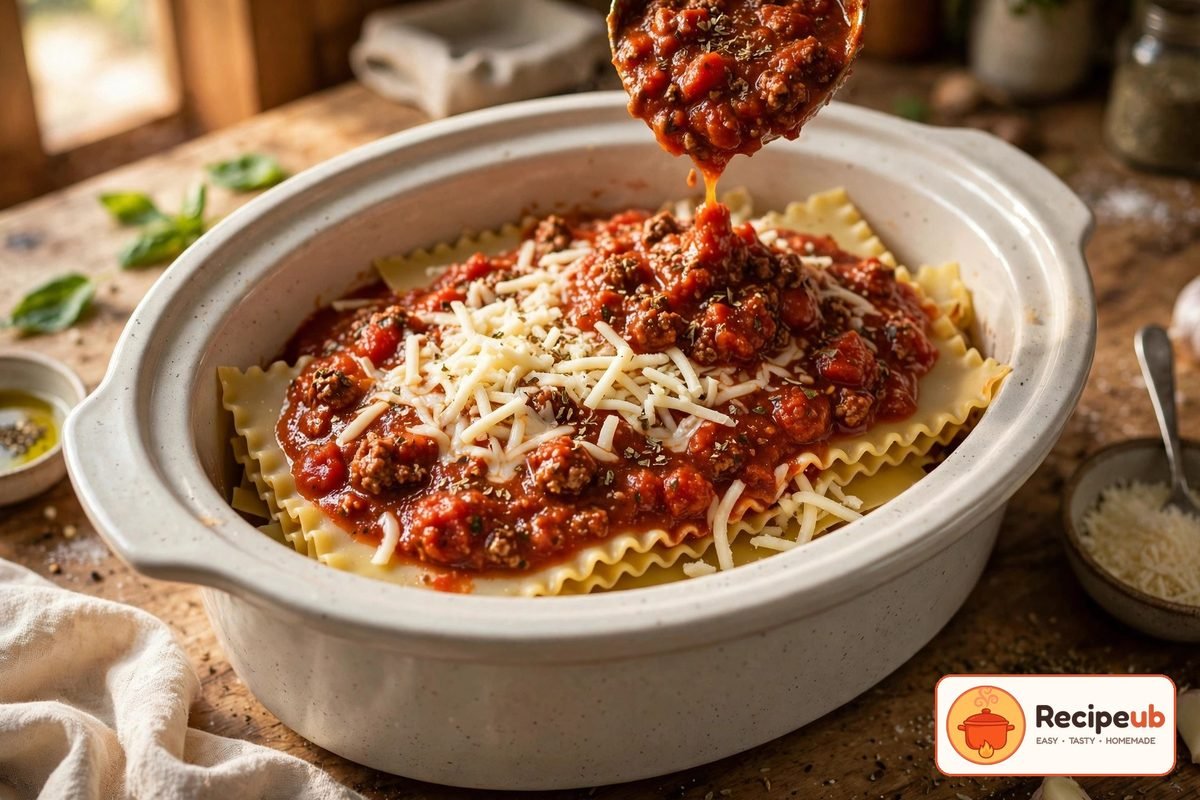
- Layer, following the map. Spread 1½ cups of meat sauce across the bottom. Lay in about 4 noodles (3 whole, broken pieces filling the curved ends), every edge tucked under sauce. Spread over ⅓ of the ricotta mixture (about 1 cup) and sprinkle ½ cup mozzarella. Repeat for Layer 2. For Layer 3, lay in the last noodles, spread the last ⅓ of the ricotta, then spread the remaining 1½ cups of meat sauce over the top so every noodle is covered. Sprinkle the remaining ¼ cup Parmesan over the sauce.
- Cook on LOW. Cover and cook on LOW for 4 hours. Do not cook on HIGH — the edges scorch before the center noodles soften. At 3½ hours, run the knife test: a thin knife slid into the center should pass through the noodles with no resistance. If it catches, cover and give it the final 30 minutes.
- The cheese finish. In the last 15 minutes of cooking, lift the lid, scatter the final 2 cups of mozzarella evenly over the top, and cover again until it melts into a glossy blanket. This timing is the point: cheese that goes on at the start bakes down into the layers for 4 hours; cheese that goes on at the end stays on top, and pulls.
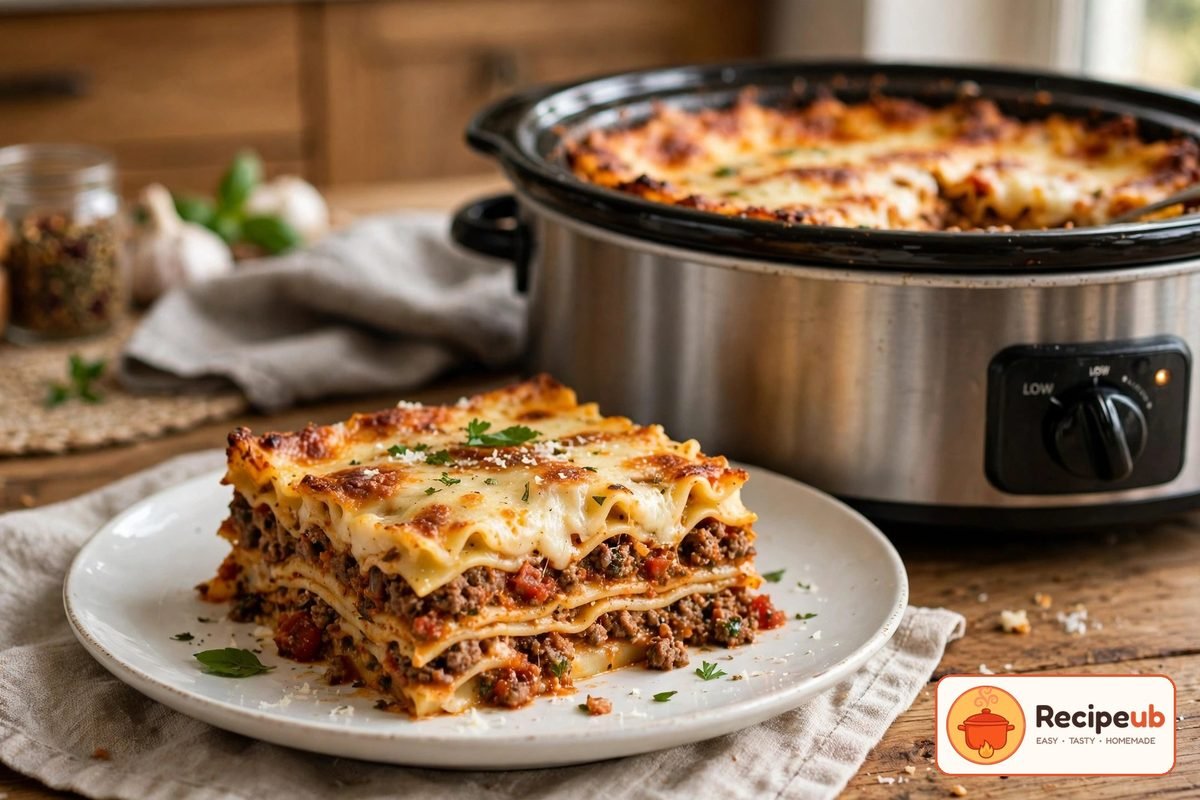
- Stand, then slice. Turn the cooker OFF, set the lid ajar, and let the lasagna stand for 20 minutes (the rule in the next section). Then cut into 8 slices with a sharp knife and lift each one out with a wide spatula — they will hold their layers.
Slow Cooker Lasagna (Uncooked Noodles — Slices Clean, Never Soupy)
Ingredients
Equipment
Method
- Brown the beef and onion in a large skillet over medium-high heat, 7 to 8 minutes, breaking into small crumbles. Add the garlic for the last 30 seconds. Drain thoroughly.
- Stir the marinara, Italian seasoning, salt and ¼ teaspoon black pepper into the drained beef — about 4½ cups of meat sauce.
- Whisk the ricotta, egg, ¼ cup Parmesan, remaining ¼ teaspoon black pepper and parsley until smooth.
- Spray a 6-quart oval slow cooker insert with olive oil spray. Layer: 1½ cups meat sauce → about 4 noodles (3 whole + broken pieces at the ends, edges tucked under sauce) → ⅓ of the ricotta mixture (about 1 cup) → ½ cup mozzarella. Repeat for Layer 2.
- Layer 3: last noodles → last ⅓ of the ricotta → remaining 1½ cups meat sauce over the top. Sprinkle with the remaining ¼ cup Parmesan.
- Cover and cook on LOW for 4 hours (do NOT use HIGH). Knife test at 3½ hours: a thin knife should slide through the center noodles with no resistance.
- In the last 15 minutes, scatter the final 2 cups mozzarella over the top and cover until melted.
- Turn the cooker OFF, lid ajar, and stand 20 minutes. Cut into 8 slices and lift out with a wide spatula.
Notes
- The Noodle System: regular dry noodles — dry in, no extra liquid (¼ cup water around the edges only for hot-spot cookers), LOW 4 hours. No-boil noodles: +¼ cup water in the sauce, LOW 3–3½ hours maximum. Never pre-cooked or fresh sheets — they fall apart.
- The 20-Minute Standing Rule: cooker OFF, lid ajar, 20 minutes before cutting — the noodles absorb the last free liquid and the cheese sets to slicing temperature. Cutting earlier is the #1 cause of soupy slices.
- Never cook on HIGH: the edges scorch before the center noodles soften. Round cooker: break noodles into an overlapping mosaic, no gaps, 4 thinner layers, same amounts. 4-qt cooker = ⅔ of the recipe; 3-qt = ½.
- Edges: browned, crisp edges on the top layer are the slow cooker’s signature — a feature. Burnt edges mean HIGH or a cook past 4½ hours.
The 20-Minute Standing Rule: Why Slow Cooker Lasagna Must Rest
Every recipe for this dish gives a different rest — 10 minutes, 25, 30, some say nothing at all — so here is the unified rule this kitchen cooks by, and why it works. When the cook finishes, turn the cooker OFF, set the lid ajar, and wait 20 minutes before the first cut.
Three things happen in those 20 minutes. First, the noodles finish drinking: a slow cooker traps steam, so at the end of the cook there is always free liquid sitting in the layers that an oven lasagna would have evaporated — the standing noodles absorb it. Second, the cheese set drops below slice temperature: mozzarella at serving heat flows, and mozzarella 20 minutes later holds a cut edge. Third, the layers settle into one block, so the slice you cut is the slice you lift. The lift test tells you it worked: cut a square, slide a wide spatula under it, and lift — a rested lasagna comes up in one piece with its layers showing. If a slice slumps, the lasagna was fine; it just needed its 20 minutes. Give it the time and cut again.
One honest word about edges while we are here, because slow cooker lasagna has a signature and it is not a flaw: the edges of the top noodle layer brown and crisp a little against the hot insert — the best-tested recipes in this dish’s history call it a feature, and it is, a toasty frame around the tender center. Burnt edges are a different thing, and they have exactly two causes: cooking on HIGH, or a cook stretched past about 4½ hours. Cook on LOW, knife-test at 3½, and if your cooker drips condensation onto the top layer, lay a clean kitchen towel under the lid for the last hour to catch it.
Emma’s Tips for the Best Slow Cooker Lasagna
Tuck every edge. The noodle rule that matters most is not which noodle — it is coverage. Any corner of dry noodle left poking out of the sauce cooks in steam instead of liquid and comes out hard and chewy, even in a perfect lasagna. When you lay each layer, run a spoon around the rim and push every edge down into sauce or filling.
Drain like you mean it. The beef goes in a colander, gets pressed with the spoon, and waits a full minute. That unglamorous minute removes more water from the final dish than any other step in the recipe — it is the real answer to “why is my lasagna watery,” ahead of the sauce, ahead of the cheese.
Use the knife test, not just the clock. Cookers vary by a full half-hour in how fast they run. At 3½ hours, slide a thin knife into the center: no resistance means the noodles are done even if the clock disagrees, and resistance means give it the last 30 minutes even if a different recipe promised less. It is the same doneness honesty I build into my Slow Cooker Pot Roast, where the fork, not the timer, makes the final call.
Sauce the top noodles twice as carefully. The bottom layers sit in sauce; the top layer only has what you spread over it. If any top noodle looks dry when you close the lid, it will still look — and chew — dry at serving. Steal a spoonful from the sides and cover it.
Cut with a knife, lift with a spatula. Sawing at lasagna with the serving spoon is how clean layers die. One confident knife cut around your square, then a wide spatula underneath, lifted straight up. The first slice is the hardest; after it, you have room to work and the rest come out like a bakery box.
Storage and Reheating
Fridge: Cool the lasagna, then refrigerate slices in airtight containers for up to 4 days. Slices actually hold together better on day two — the set firms up in the chill, which makes this a genuinely good make-ahead dinner.
Reheating: For a slice, the microwave is fine: cover loosely and heat until the center reaches 165°F, about 2 to 3 minutes depending on your microwave. For several slices, put them in a baking dish, cover with foil and warm at 350°F for 20 to 25 minutes. A spoonful of marinara over the top before reheating keeps the top noodles supple.
Freezing: This lasagna freezes well two ways. Baked: cool completely, wrap slices (or the whole insert’s worth, transferred to a freezer dish) tightly and freeze up to 3 months; thaw overnight in the fridge and reheat as above. Assembled and unbaked: layer it in a freezer-safe dish instead of the insert, wrap tightly and freeze up to 3 months; thaw overnight in the fridge, transfer to the cooker if needed, and cook on LOW for 4½ hours — the extra 30 minutes covers the cold start. It joins the freezer rotation that keeps my January sane, right alongside the 13 Slow Cooker Dinners for Busy Weeknights I pull from on the weeks nobody wants to think about dinner.
FAQs
Do you have to cook lasagna noodles before putting them in the slow cooker?
No — and in this recipe you must not. Regular dry lasagna noodles go in uncooked, layered straight from the box with every edge tucked under sauce; they absorb liquid from the sauce as they cook and finish tender in the same 4 hours. Pre-cooked (boiled) noodles are the one kind that truly fails here: already full of water, they keep softening until they dissolve into the layers. The Noodle System chart above has every noodle type with its liquid and time.
How long does lasagna take in the slow cooker on LOW? On HIGH?
On LOW, 4 hours for this recipe, with a knife test at 3½ hours — the noodles are done when a thin knife slides through the center with no resistance. On HIGH, the honest answer is: do not. Every well-tested version of this dish warns the same thing — on HIGH the edges scorch and crisp past pleasant while the center noodles are still firm; tested HIGH runs come out with dark, chewy edges and a raw middle. If you are short on time, the no-boil variation in the chart (3 to 3½ hours on LOW) is the faster route that still works.
Can you use no-boil (oven-ready) noodles in a slow cooker?
Yes — it is the second row of the Noodle System, with two adjustments: stir an extra ¼ cup of water into the sauce (the thinner sheets need the help at the start), and hold the cook to 3 to 3½ hours on LOW, maximum. Past that, oven-ready noodles go mushy — readers and testers of the big recipe sites report the same thing. Regular dry noodles are still the better slice; no-boil is the workable pinch, not the pick.
Why is my slow cooker lasagna watery — and how do I fix it?
Four causes cover nearly every case. The beef was not drained after browning (the biggest one — drain it thoroughly). The sauce started thin (a watery jar plus beef liquid is soup waiting to happen; this recipe’s sauce is thick before it goes in). Fresh mozzarella was used instead of low-moisture (it weeps all through the cook). Or the lasagna was cut without standing — free liquid that the noodles would have absorbed in 20 minutes ends up on the plate instead. Fix all four and the soupy slice disappears.
How long should slow cooker lasagna rest before slicing?
Twenty minutes — the Standing Rule in this recipe. Turn the cooker off, set the lid ajar, and wait the full 20: the noodles absorb the last free liquid, the cheese drops below the temperature where it runs, and the layers set into a block that cuts clean. The lift test confirms it — a square that holds its layers on the spatula. Ten minutes is not enough for a slow cooker (it holds more steam than an oven), and past about 40 the lasagna starts to cool toward lukewarm, so 20 is the tested middle.
Can I assemble slow cooker lasagna the night before?
Yes. Assemble the whole lasagna in the insert, cover it and refrigerate overnight, then cook the next day on LOW for about 4½ hours — add roughly 30 minutes for the cold start, and use the knife test as the real finish line. One honest caution you will find from some bakers: noodles sitting in sauce overnight soften at the edges, so an overnight assemble can come out a touch softer than a same-day build. In my testing the difference is small and the convenience is real — but if perfect edges matter for guests, assemble in the morning instead.
What size slow cooker do I need — and does oval vs. round matter?
A 6-quart is the size this recipe is built for. Oval is the natural fit — whole noodles lie flat with just the ends broken to fill the curves. Round works with the Layer Map’s mosaic method: noodles broken into large pieces, overlapped about ½ inch with no gaps, in 4 thinner layers of the same amounts. For a 4-quart cooker, make ⅔ of the recipe; for a 3-quart, make ½. Whatever the size, fill no more than three-quarters full.
Ricotta or cottage cheese — which is better here?
For slices, whole-milk ricotta with an egg whisked in — it sets into a distinct, tender layer that holds its line when you cut. Cottage cheese is the honest budget-and-protein swap: about a dollar less, more protein, but a looser, wetter filling that slices softer (it is the build behind the ~430-calorie high-protein versions of this dish). The swap is 1:1 by volume, and half-and-half is a respectable middle. The full verdict with numbers is in the cheese section above.
Can you put raw (unbrowned) meat in slow cooker lasagna?
You can, and it will be safe and edible — but know the trade before you choose it. Raw ground beef cooked in the layers gives up its fat and liquid into the lasagna (the watery problem again, with no way to drain it mid-cook), and the meat steams into a softer, finer texture instead of browned crumbles. If a day truly has no 8 minutes for the skillet, use the leanest beef you can buy, break it very fine, and expect a softer slice. Browning is this recipe’s method because the flavor and the dryness both depend on it.
Can you freeze slow cooker lasagna, and how do you reheat leftovers?
Yes — freeze it baked (cool completely, wrap tightly, up to 3 months) or assembled and unbaked (freeze in a freezer-safe dish, thaw overnight, cook on LOW 4½ hours). Thaw baked lasagna overnight in the fridge before reheating. Leftover slices reheat in the microwave, covered, to 165°F in the center — about 2 to 3 minutes — or a covered dish of slices warms at 350°F for 20 to 25 minutes. A spoonful of marinara over the top before reheating keeps the top noodles from drying.
Final Thoughts
Slow cooker lasagna fails for boring, fixable reasons: the wrong noodle with no numbers attached, meat that was never drained, and a knife that arrived 20 minutes too early. This recipe is just those fixes written down in order — regular dry noodles with a chart that finally says what every noodle needs, a layer map measured in cups instead of “repeat layers,” a cheese finish timed for the pull, and a standing rule with a test attached. Make it once by the system and the system becomes habit: the lasagna that slices like it came out of an oven, from a pot that did the work while you were somewhere else.
More Easy Slow Cooker Dinners
If this lasagna joins your winter rotation, the rest of the slow cooker shelf is built with the same measured honesty. My Marry Me Chicken Pasta is the Italian-pasta sibling — creamy, one-pot and weeknight-fast where this one is layered and slow — and the Slow Cooker Pot Roast is the other Sunday centerpiece, a whole chuck roast with real gravy from the drippings for the days the table wants beef instead of layers. When the week needs something that ladles instead of slices, the whole family of pots is gathered in my 13 Slow Cooker Dinners for Busy Weeknights — and yes, the soup version of this very dish lives there too, for the nights a spoon beats a knife.






Never Run Out of Dinner Ideas
One easy air fryer or slow cooker dinner in your inbox every week. No spam, ever.
You’re on the list — welcome to Recipeub!