
Taco Meal Prep Bowls (5 Bowls, Under $3 a Bowl)
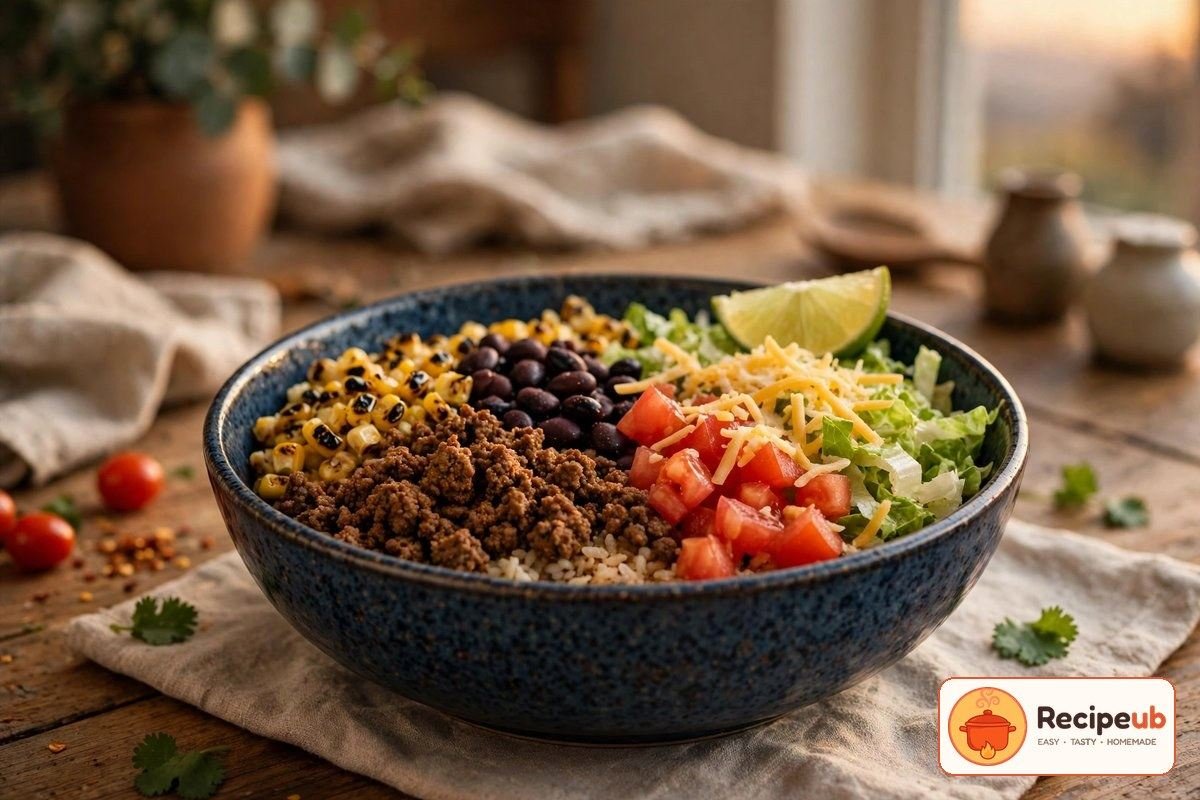
Taco meal prep is the dinner the search box describes by its protein: taco meal prep bowls, taco meal prep bowls damn delicious, mexican meal prep bowls, taco salad meal prep bowls, turkey taco meal prep bowls, chicken taco meal prep bowls, beef taco meal prep bowls, healthy taco meal prep bowls — one brand and a row of protein variants, and not one price word anywhere among them. The beef variant is typed, and it is the one no page 1 holder actually serves as a system. The branded seat — the post the stem completes to by name — is a 2016 recipe whose whole method is three steps: cook rice, brown 2 lb of ground beef, divide and top, with the diced tomatoes packed into the hot containers and no storage window printed anywhere on the page. The strongest holder is a dinner recipe with a meal-prep section, toppings kept separate as one prose step, and a storage claim of “up to 4-5 days” — over the USDA window for cooked ground beef, uncorrected on the page. Around them: a hospital’s turkey-bowl handout, a turkey-and-cauliflower-rice post last updated about 4.7 years ago, a chicken bowl with a formula table and no price, and — on the budget query — a taco salad asserting “under $3.00” with no priced table behind it, and a guide whose cost table prices beef at $5.50 a pound, a stale estimate. Meanwhile the classic build’s own arithmetic has quietly inverted: at the Bureau of Labor Statistics’ October 2026 average for ground beef — $6.755 a pound, read directly from the Bureau — the branded holder’s 2 lb of beef is a $13.51 line, and nobody on page 1 prints that number or the fix for it. This page prints the three systems the lane leaves out: The Hot/Cold Split — every component assigned a home, hot box or cold cup or day-of, with the reason and the day-4 verdict, because a taco bowl’s failure mode is not the meat, it is the toppings; The Stretch — a can of black beans simmered into the meat, halving the classic build’s beef from 2 lb to 1 lb, priced against the classic at the verified average; and The Priced Bowl — the batch priced line by line at November 2026 prices, with the two biggest lines anchored to verified Bureau averages. Five bowls at about 600 calories and ≈$2.83 a bowl (both estimates, itemized on this page), in 40 minutes.
One fence belongs right here, because this site already cooks taco-seasoned ground beef. That post is my ground beef meal prep — the protein-portion system, 3 lb of beef browned once and divided into taco, Italian and Korean-style piles packed as building blocks for the week’s dinners; this post is a composed bowl, a finished meal with beans simmered into the meat, rice under it and the toppings split into cold cups — and the differences are the whole post. Post 46’s taco pile is beef alone, dry spices and water, portioned at about ¾ cup to be used in dinners later; nobody eats it as dinner. This bowl is eaten as-is: a different mixture (the beans are in the meat, changing its texture, its moisture and its price), a different form (a finished bowl, not a building block), and a different search — the search box itself keeps the two apart, since the “ground beef meal prep” stem’s completions contain no taco completion at all, while the taco-bowls stem completes to proteins and a brand. Same shelf, same protein, two systems that never meet on a plate. And this is a hot box, deliberately: the last two boxes on this shelf were a cold tuna box and a cold pasta salad box, and between them sits a hot tofu box — the rotation turns back to a dinner that is reheated, with the cold parts tipped on after, the way a taco bowl was always supposed to land.
The short answer: Cook 1½ cups of long-grain white rice and finish it warm with the juice of 1 lime, ¼ cup chopped cilantro and ½ tsp salt. While it cooks, soften a diced onion in 1 Tbsp neutral oil, brown 1 lb of ground beef (80/20) to 160°F, drain it, and stir in the homemade taco seasoning (1 Tbsp chili powder, 1½ tsp cumin, 1 tsp smoked paprika, ½ tsp each garlic powder, onion powder and oregano, 1 tsp kosher salt, ¼ tsp black pepper) with 1 (15 oz) can of black beans, drained and rinsed, and ¼ cup water — the beans simmered into the meat 4 to 5 minutes. Char 1½ cups of frozen corn in the dry skillet. Build 5 hot boxes — rice, beef-and-bean mix, corn — and pack the cold parts separately, per bowl: 2 Tbsp cheddar, ¼ cup pico de gallo, 2 Tbsp Greek yogurt, ½ cup romaine in its own cup, and a lime wedge. Reheat the box, tip the cup on after: five bowls at about 600 calories and ≈$2.83 each, in 40 minutes, bowls 1 to 4 eaten inside the next 4 days and bowl 5’s hot box frozen on prep day.
In This Recipe
The Plan at a Glance
- The meat: 1 lb ground beef (80/20) browned to 160°F with a diced onion, drained, and simmered with the homemade taco seasoning and 1 (15 oz) can of black beans stirred into the meat — the stretch that fills 5 bowls on half the classic build’s beef (the temperature rule and the split rule are in the card notes)
- The base: cilantro-lime rice — 1½ cups long-grain white rice, finished warm with lime juice, ¼ cup chopped cilantro and ½ tsp salt; charred corn, 1½ cups frozen, cooked in the dry skillet until dark spots appear
- The split: the hot box carries rice, beef-and-bean mix and corn; the cold cups carry cheddar, pico de gallo, Greek yogurt and romaine, and are tipped on only after reheating — and one familiar topping is day-of only, never prepped at all; the full chart is The Hot/Cold Split below
- The eat order: bowls 1 to 4 across the next 4 days, inside the USDA 3-to-4-day window; bowl 5’s hot box is frozen on prep day and thawed overnight for day 5, with its cold cup made fresh — there is no fifth fresh bowl
- Time: 15 minutes prep (dicing the onion and pico vegetables, rinsing the beans, stirring the seasoning blend, juicing the limes, portioning the cold cups at assembly) / 25 minutes cook (the rice simmers and rests while the skillet work runs inside the same window, stated openly) / 40 minutes total
- Yield: 5 bowls
- Calories: ≈600 per bowl (estimate); protein ≈33 g per bowl (estimate)
- Cost: ≈$2.83 per bowl (estimate) at November 2026 prices — the beef and rice lines are anchored to verified BLS October 2026 averages read directly, the tomato line rides the Bureau’s field-grown series with its note printed, and every other line is a labeled shelf estimate; the full line-by-line table is The Priced Bowl below
- Storage: fridge 3 to 4 days at 40°F or below for boxes and cups alike; the hot box freezes well up to 2 to 3 months, the cold cups are never frozen — the full rules are in the Storage section below
Why This Recipe Works
The failure is the toppings, not the meat — and it is a cooking failure, not a storage one. A taco bowl packed as one container is reheated as one container, which means everything in it gets cooked twice: the cheddar melts into a mat on day 1 and turns rubbery by day 3, the cut tomato weeps into the rice it was packed against, the yogurt thins and splits, and the romaine wilts under the steam. The branded holder’s method packs diced tomatoes directly into the hot containers; the strongest holder keeps toppings “in small containers or bags” as a single prose step, without saying which toppings, why, or what happens by day 4. Every holder knows the toppings die in the box — the advice survives as fragments across five pages — and nobody prints the component-level chart. This build prints it: The Hot/Cold Split below assigns every component a home with its reason and its day-4 verdict, and the method is built so the split costs nothing — the cold cups are portioned at assembly, while the boxes cool.
The beans go in the meat, and that one move does three jobs. Every holder in this lane plates the beans in a stripe beside the meat. Simmered into the meat instead — drained, rinsed, stirred through with a splash of water and the seasoning — a can of black beans stretches the protein line (1 lb of beef doing the work the classic build asks of 2 lb, priced in The Stretch below), gives the mix a saucy body that plain crumbled beef loses in the fridge, and holds the seasoning in suspension, so day 4’s bowl tastes seasoned through rather than salted on top. A crumbled-beef portion reheats dry enough to need a serving plan; this mix carries its own moisture into the microwave. The beans are not a side in this recipe. They are the mechanism — budget, texture and flavor in one can.
The batch is sized to the window, and the window is the honest one. A cooked beef-and-rice bowl keeps 3 to 4 days in the fridge — the USDA leftover window for a cooked meat dish, and the only window this page prints. The lane’s windows scatter around it: “up to 4-5 days” from the strongest holder, “up to 4 days” from a small blog, no window at all from the branded holder. Those longer numbers are claims, and this page names them as claims and designs against the standard instead: a 5-bowl batch in which bowls 1 to 4 are eaten across the four days and bowl 5’s hot components are frozen on prep day, thawed overnight for day 5 with a fresh cold cup — the same honest-window pattern this shelf’s egg boxes and tofu boxes already run. Where a longer week is genuinely wanted, the answer is the freezer, not a stretched fridge claim.
The cook runs in parallel, and the card says so. The 40 minutes on the card is a real 40 minutes, not a sum of separate shifts. The rice simmers 18 minutes and rests 10, and inside that one window the onion softens, the beef browns and simmers with the beans, and the corn chars in the same skillet — three jobs inside one 25-minute cook window, printed openly on the card and in the method, because a meal prep’s time claim is part of its honesty. The prep is sequenced the same way: the pico vegetables are diced and the seasoning blended while the rice goes on, and the cold cups are portioned at assembly, not as a separate session.
The Hot/Cold Split: What Reheats and What Never Does
Here is the system this post exists to print, stated as one quotable rule: a taco bowl is two meals stored as one — a hot box that reheats (meat, rice, corn) and a cold cup that never does (cheese, pico, yogurt, lettuce). Every taco bowl that disappoints by day 3 was packed as one container. The toppings did not go bad; they were cooked a second time. Pack them apart, reheat the box, tip the cup on after, and day 4 eats like day 1. Here is the measured form for this build — every component assigned, with the verdict the holders never print:
| Component | Lives in | Why | Day-4 verdict |
|---|---|---|---|
| Taco beef-and-bean mix | Hot box | Reheats evenly; the beans hold moisture the beef loses | Juicy — the mix reheats better than beef alone |
| Cilantro-lime rice | Hot box | The base; the lime and cilantro are cooked in, not dressed on | Fluffy, with a splash of water at reheat |
| Charred corn | Hot box | A cooked vegetable; it chars once and reheats fine | Sweet, the edges still dark |
| Shredded cheddar | Cold cup | Packed on hot rice it melts into a mat on day 1 and a rubbery sheet by day 3 | Melts fresh over the reheated bowl — because it meets heat once |
| Pico de gallo | Cold cup | Cut tomato weeps; in the hot box it waters the rice — the branded holder packs it in | Bright and firm — it was never cooked or steamed |
| Greek yogurt | Cold cup | Dairy splits and thins if it is reheated in the box | Cool and tangy against the hot bowl |
| Shredded romaine | Cold cup (its own) | Lettuce wilts under steam and heat | Crisp — added at eating, like the salad it came from |
| Avocado | Day-of only — never prepped | Cut avocado browns in hours, no matter the container | Not a prep component; the chart says so instead of pretending |
How to read the chart: the middle column is the whole recipe. The hot box is everything that was cooked and wants to be hot again; the cold cup is everything whose job is to be the contrast — cool, crisp, bright, sharp — and contrast does not survive a microwave. Note where the familiar mistakes land. The tomato row is the branded holder’s method, packed into the hot containers in 2016 and copied ever since: cut tomato in a sealed warm box spends four days watering the rice, and by day 3 the base is porridge at the edges. The cheddar row is the dinner versions’ habit — cheese melted over the skillet is right for a dinner eaten that night and wrong for a box eaten Thursday. And the avocado row is the chart’s honest refusal: there is no container, trick or acid bath that makes a cut avocado a four-day prep component, so the chart does not assign it one. It is cut at eating, or the bowl goes without, and both are fine.
This shelf has run a smaller version of this rule before. The chicken bowl system on this site keeps one sauce separate and adds it after reheating — my chicken meal prep bowls — the chicken bowl system, seasoned chicken and rice with the sauce of choice kept in its own container and added after reheating; this post takes the same instinct four components further and prints the verdict for each one — and that one separation is the seed of this chart. A taco bowl simply has more to separate: four cold components with four different failure modes, plus one component that cannot be prepped at all. The instinct scales; the chart is what it scales into. The reheat order is the system in one line: microwave the hot box until steaming, then tip the cold cup on — the cold parts meet heat exactly once, at the moment of eating, which is the only meeting that was ever going to go well.
Ingredients
For the cilantro-lime rice:
- 1½ cups long-grain white rice
- 1 lime, juiced (about 2 Tbsp)
- ¼ cup chopped fresh cilantro
- ½ tsp kosher salt
For the beef-and-bean mix:
- 1 Tbsp neutral oil
- 1 medium yellow onion, diced
- 1 lb ground beef (80/20)
- 1 Tbsp chili powder
- 1½ tsp ground cumin
- 1 tsp smoked paprika
- ½ tsp garlic powder
- ½ tsp onion powder
- ½ tsp dried oregano
- 1 tsp kosher salt
- ¼ tsp black pepper
- 1 (15 oz) can black beans, drained and rinsed
- ¼ cup water
For the charred corn:
- 1½ cups frozen corn
For the cold cups (packed separately, per bowl: 2 Tbsp cheddar, ¼ cup pico, 2 Tbsp yogurt, ½ cup romaine, 1 lime wedge):
- ⅔ cup shredded cheddar
- 1¼ cups pico de gallo (store-bought, or homemade: 3 Roma tomatoes, diced; ¼ red onion, finely diced; ¼ cup chopped cilantro; juice of ½ lime; ¼ tsp kosher salt)
- ⅔ cup plain Greek yogurt (2%)
- 2½ cups shredded romaine
- 1 lime, cut into 5 wedges
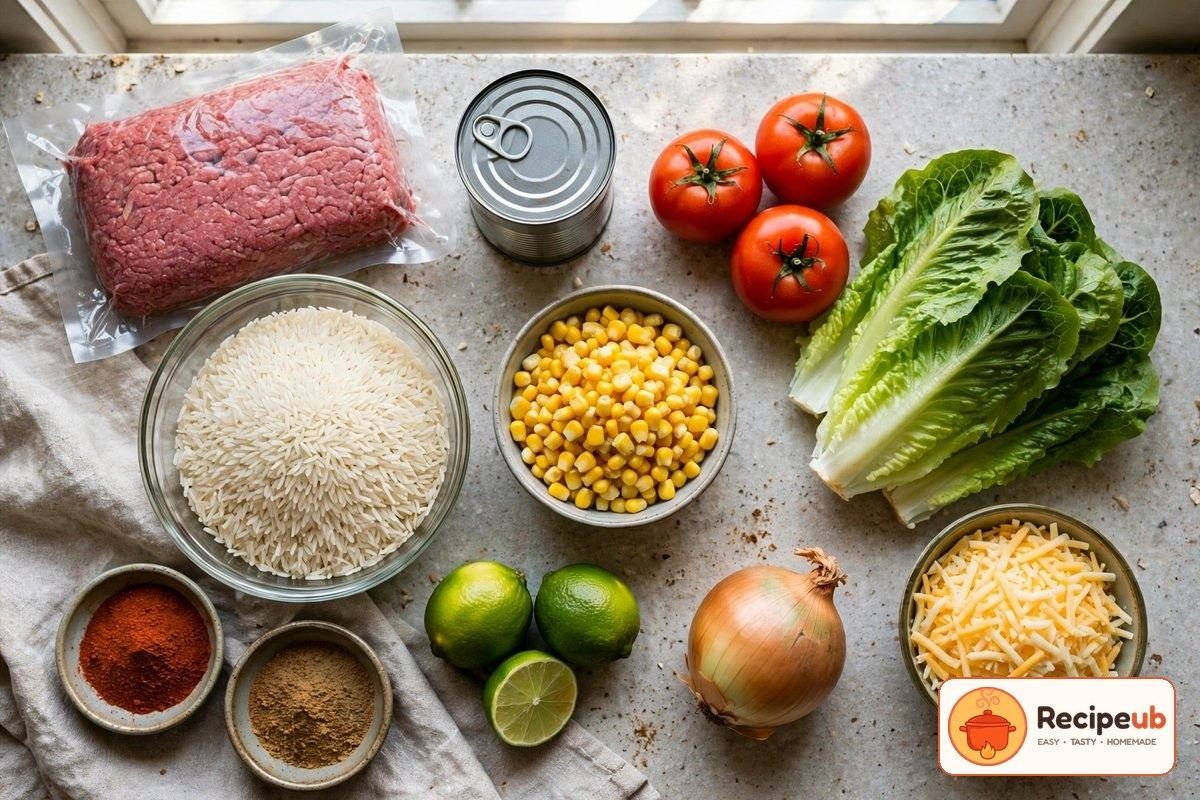
Ingredient notes: The beef is ground beef, 80/20, 1 lb — 80/20 because a leaner grind dries out across four days of reheating, and the fat that renders is drained off after browning, so the bowl eats rich without sitting in grease. One pound is the build, not a shortage: the beans below bring the mixture back up to a 2-lb batch’s volume. The beef is cooked to 160°F and checked with a thermometer — the FSIS rule for ground beef, and the only protection this recipe relies on. One dated note belongs with it, stated plainly and in full: the U.S. Department of Agriculture’s Food Safety and Inspection Service is carrying an active investigation (2027-01, opened October 2026) into E. coli O157:H7 illness with ground beef listed as the suspect product; no recall has been issued and no brand or product has been named. An investigation is not a recall, and this page does not print it as one — it prints the fact, once, here, and the standing rule that has always applied to ground beef: cook it to 160°F and check the thickest part with a thermometer, which this recipe’s card does. The black beans are 1 (15 oz) can, drained and rinsed, and they go into the meat — rinsed because the canning liquid is starchy and salty enough to muddy the seasoning, and into the meat because that is the system: stirred through with ¼ cup water and simmered 4 to 5 minutes, they take on the taco seasoning, gloss the mixture, and hold moisture the beef alone would lose by day 3. Any sentence in any version of this recipe that plates the beans beside the meat has broken the recipe. The seasoning is homemade, nine pantry spices at about $0.35 a batch (shelf estimate) — against a 1 oz packet at about $0.85 (shelf estimate) that also brings typically around 2,100 mg or more of sodium across the batch on its label (a typical-label figure, printed as one); the blend above lets the cook set the salt, and it is the same family of blend this site portions onto its ground beef prep, mixed here for a meat that gets eaten as a bowl rather than used as a block. The rice is long-grain white, 1½ cups dry — long-grain because it cooks up separate and reheats fluffy rather than sticky, and it is one of the build’s two Bureau-anchored lines, priced on the card off the Bureau’s white long-grain average; it is limed and cilantroed warm, because warm rice drinks the juice in instead of wearing it. The corn is frozen, 1½ cups, charred in the dry skillet after the meat — no oil, no thawing, left undisturbed until dark spots appear; frozen corn chars honestly, and the char is the one cooked flavor in the box that a microwave cannot give it later. The pico de gallo is store-bought or homemade, both honest — the homemade version is five ingredients and six minutes of the prep time, and the store-bought shortcut is labeled as one wherever it appears; either way it lives in the cold cup, because cut tomato is the chart’s weepiest row. The yogurt is plain Greek yogurt (2%), this build’s sour-cream swap — it carries the same tang with more body, it does not split the way a thinner dairy would if a spoonful catches the bowl’s residual heat, and at 2 Tbsp a bowl it is a condiment, not a sauce. The cheddar is shredded from a block if you can — pre-shredded cheese is coated to keep it from clumping, and that coating is exactly what turns it rubbery when it finally meets heat; in the cold cup it only ever meets heat once, at eating, and fresh-shredded melts the way it should.
How to Make Taco Meal Prep Bowls
The method is two parallel jobs wearing one timeline, and the card prints that openly: the rice simmers and rests while the skillet does the onion, the beef-and-bean mix and the corn, one after another in the same pan. The order that matters is the order of the split — hot components cooked and cooled, cold components never cooked at all — because in this box, packing is the recipe. Everything hot is cooled to near room temperature before the lids go on; a box sealed hot steams its own rice gummy and sits warm in the danger zone doing it.
- Start the rice — it sets the clock for everything else. Put the 1½ cups of rice in a saucepan with water per the package (about 2¼ cups), bring to a boil, cover, and simmer on low for 18 minutes. Take it off the heat and let it rest, covered, 10 minutes. The simmer and the rest are the window the skillet work runs inside — that parallel cook is the card’s cook time, stated openly. While the rice goes on, dice the onion and the pico vegetables and stir the seasoning blend together.
- Soften the onion and brown the beef. Heat the 1 Tbsp neutral oil in a large skillet over medium-high heat. Add the diced onion and cook about 3 minutes, until softened at the edges. Add the 1 lb ground beef, break it into crumbles, and cook about 8 minutes, until browned throughout and the thickest crumbles read 160°F on a thermometer — the temperature is the rule, not the color. Drain off the rendered fat.
- Season, and simmer the beans INTO the meat. Return the skillet to medium heat. Sprinkle the chili powder, cumin, smoked paprika, garlic powder, onion powder, oregano, salt and pepper over the beef and stir for 30 seconds, until the spices coat the crumbles and smell toasted. Stir in the drained and rinsed black beans and ¼ cup water, and simmer 4 to 5 minutes, stirring now and then, until the beans are hot through and the mix is glossy and spoonable — the beans should look like part of the meat, not a layer on it, because they are.
- Char the corn in the dry skillet. Lift the beef-and-bean mix out to a bowl. Return the empty skillet to medium-high heat with nothing in it, add the 1½ cups frozen corn in one layer, and leave it undisturbed 3 to 4 minutes, until dark charred spots appear on the undersides; stir once and give it another minute. Frozen corn chars honestly if it is left alone — stirring early just steams it.
- Finish the rice. Fluff the rested rice with a fork and, while it is still warm, fold in the lime juice, ¼ cup chopped cilantro and ½ tsp salt. Warm rice drinks the lime in; cold rice would only wear it on the surface.
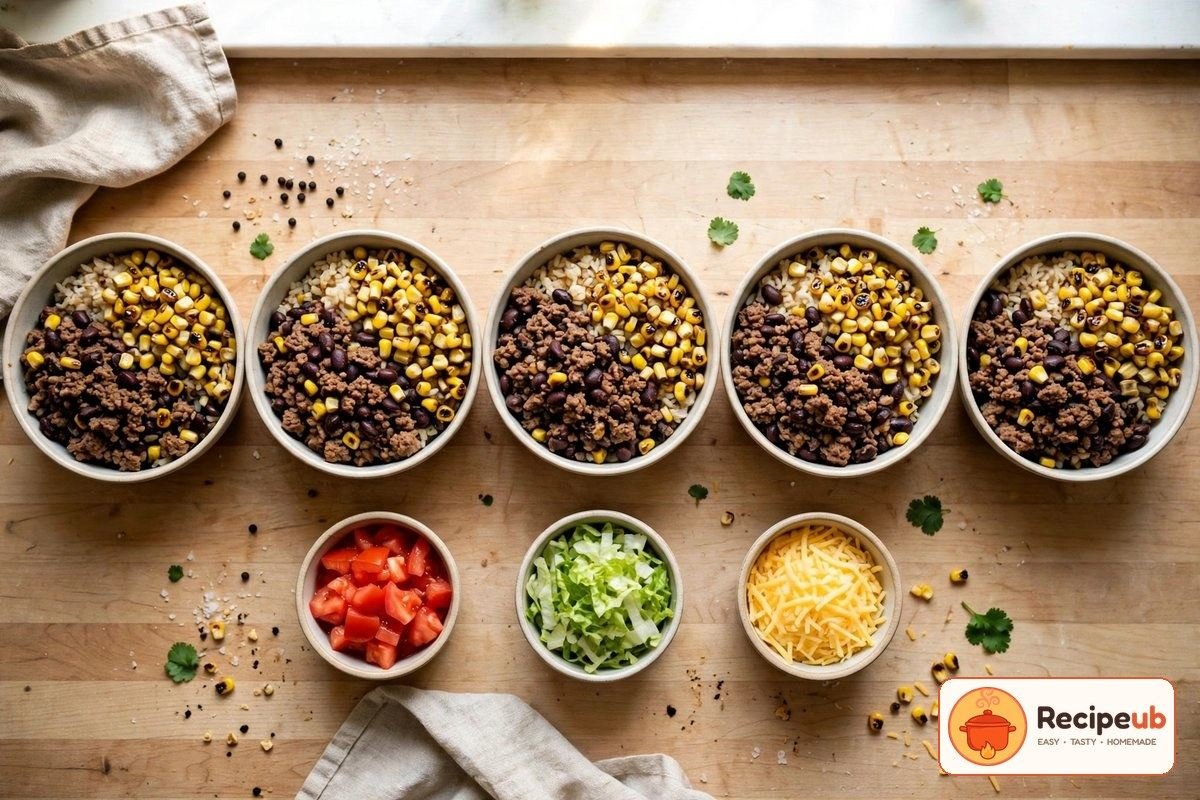
- Cool, then assemble — hot box and cold cups. Let the rice, the beef-and-bean mix and the corn cool to near room temperature, inside 2 hours of cooking. Divide among 5 meal prep containers: rice on the bottom of each, the beef-and-bean mix beside it, the corn over the rice. Then portion the cold cups, one set per bowl: 2 Tbsp cheddar, ¼ cup pico de gallo, 2 Tbsp Greek yogurt, ½ cup romaine in its own small cup or bag, and a lime wedge. Lid everything and refrigerate promptly at 40°F or below. At eating time, reheat the hot box first until steaming hot throughout, then tip the cold cup on (the reheat-order rule in the card notes).

Taco Meal Prep Bowls
Ingredients
Equipment
Method
- Cook the rice: simmer, covered, 18 minutes, then rest off the heat, covered, 10 minutes. While it cooks, dice the onion and pico vegetables and stir the seasoning blend together. Fluff the warm rice and fold in the lime juice, cilantro and ½ tsp salt.
- Meanwhile, soften the onion in the oil in a large skillet, about 3 minutes. Add the ground beef and brown about 8 minutes, crumbling, until the thickest crumbles read 160°F. Drain the fat.
- Stir the seasoning blend over the beef for 30 seconds. Stir in the drained, rinsed black beans and ¼ cup water and simmer 4 to 5 minutes, until the beans are hot and the mix is glossy — the beans IN the meat.
- Lift the mix out. Char the frozen corn in the dry skillet, undisturbed, 3 to 4 minutes, until dark spots appear; stir once and cook 1 minute more.
- Cool the rice, meat mix and corn to near room temperature, within 2 hours of cooking. Divide among 5 containers: rice, beef-and-bean mix, corn. Portion the cold cups per bowl — 2 Tbsp cheddar, ¼ cup pico, 2 Tbsp yogurt, ½ cup romaine in its own cup, 1 lime wedge. Lid and refrigerate.
- To eat: reheat the hot box until steaming hot throughout (165°F for leftovers), then tip the cold cup on.
Notes
- The split rule: a taco bowl is two meals stored as one. The hot box (beef-and-bean mix, rice, corn) is the only part that is ever reheated; the cold cup (cheddar, pico de gallo, Greek yogurt, romaine) is tipped on after reheating and never before — cheese packed in melts into a rubbery mat, cut tomato waters the rice, yogurt splits, and romaine wilts.
- The temperature rule: ground beef is a 160°F food — brown it until the thickest crumbles read 160°F on a thermometer, not until they merely look done, and reheat leftovers to 165°F. The black beans are simmered INTO the meat, never plated beside it: in the meat is where they stretch the beef, hold the seasoning and keep day 4’s bowl juicy.
- The storage rule: a cooked beef-and-rice bowl keeps 3 to 4 days in the fridge at 40°F or below — the USDA window, and the only one this card prints, whatever longer windows other recipes claim. This batch is designed to it: bowls 1 to 4 are eaten across the 4 days, and bowl 5’s hot box is frozen on prep day and thawed overnight for day 5, with its cold cup made fresh. The cold cups are never frozen.
- The reheat-order rule: reheat the box first, tip the cup on after — the order is printed because it is the system. Microwave the hot box 2 to 3 minutes with a splash of water over the rice, until steaming hot throughout, then add the cheddar, pico, yogurt, romaine and the squeeze of lime. Cold components reheated inside the box spend the whole cycle becoming the thing the split exists to prevent.
The Stretch: How One Pound of Beef Fills Five Bowls
Here is the second system, stated as arithmetic: the classic taco bowl build — the one the search box completes to by brand — uses 2 pounds of ground beef for 5 bowls. At the Bureau of Labor Statistics’ October 2026 average of $6.755 a pound, that is $13.51 of beef. Simmer one can of black beans into 1 pound of the same beef and the protein line falls to $6.76 plus about $0.95 of beans: the same five bowls, taco flavor in every bite, about 33 g of protein a bowl — and a batch whose entire cost (≈$14.13) is barely more than the classic build’s beef alone. The saving, printed exactly: the second pound of beef not bought is $6.76; the can of beans that replaces it is ≈$0.95 (a shelf estimate, labeled as one); the stretch is worth ≈$5.80 a batch, every batch, for the rest of the recipe’s life.
The stretch is the oldest budget trick in this dish, and the reason it has never read as one is that every holder performs it halfway: the beans are on page 1’s bowls — in a stripe, beside the meat, where they read as a topping. Moved into the meat, the same can does three jobs at once, and the moisture is the one nobody prices. A drained can of black beans stirred into a pound of taco meat gives the mix a saucy body that plain crumbled beef loses in the fridge — beef alone reheats drier each day, and by day 4 a beef-only bowl is a bowl being rescued with hot sauce. The bean mix carries its own moisture into the microwave, so day 4 reheats juicy. The beans also hold the seasoning in suspension: in a beef-only mix the spices sit on the crumbles’ surfaces and the last bites taste plainer than the first; in the bean mix the seasoning is glossed through the whole mixture, and the bowl tastes seasoned rather than salted-on-top. Stretch, moisture, distribution — one can, three jobs, and the first of them is worth $5.80.
Beans carry the opposite job elsewhere on this shelf, and the difference is worth naming. When beans are the protein itself, cooked from scratch as the whole system, that is my rice and beans meal prep — the dry-bean system, beans soaked and simmered from dry as the protein of the box; here the beans are a canned stretcher inside a beef meat, which is the opposite job — there, the bean is the headline and the beef is absent; here, the bean is the supporting mechanism inside someone else’s headline. Both posts print the bean’s price; neither pretends the other’s system is its own.
The seasoning rides in this section because it is the stretch’s smaller sibling — the same move at condiment scale. The classic build seasons 2 lb of beef with 2 seasoning packets; this build seasons 1 lb with a homemade blend. A 1 oz packet runs about $0.85 (shelf estimate) and its label typically carries around 2,100 mg or more of sodium across the batch (a typical-label figure, printed as one, never as a sourced fact). The homemade blend — chili powder, cumin, smoked paprika, garlic and onion powders, oregano, salt, pepper — runs about $0.35 of pantry spices (shelf estimate) with the salt set by the cook’s hand at 1 tsp for the batch. Neither figure is the point on its own; together they are the recipe’s whole method in miniature: the packaged version of anything in this bowl costs more and salts more, and the from-pantry version takes ninety seconds.
What Does a Taco Bowl Cost? The Priced Bowl
Here is the third thing this post prints that page 1 does not: the whole bowl, priced line by line, at November 2026 prices — with the two biggest lines and the pico’s tomato read directly from the Bureau of Labor Statistics, and every other line labeled a shelf estimate, printed as one. The lane’s priced figures, by contrast, are assertions: “under $3.00 per hearty serving” in an overview box with no table behind it, and a guide whose beef line is $5.50 a pound — an unsourced estimate a full $1.25 under the verified October 2026 average, which is what unanchored pricing does. This page names its sources instead.
| Line | Amount for the batch | Price basis | Batch cost |
|---|---|---|---|
| Ground beef (80/20) | 1 lb | BLS October 2026 average — ground beef, $6.755/lb (verified, series APU0000703112; read directly from api.bls.gov) | $6.76 |
| Long-grain white rice | 1½ cups dry (about 0.92 lb) | BLS October 2026 average — white long-grain rice, $1.101/lb (verified, series APU0000701312; read directly) | $1.01 |
| Roma tomatoes (for the pico) | 3 (about 0.75 lb) | BLS October 2026 average — field-grown tomatoes, $2.084/lb (series APU0000712311; Roma are a field-grown tomato, printed with that note — cherry and grape tomatoes typically run higher on the shelf) | $1.56 |
| Black beans | 1 (15 oz) can | Shelf estimate, labeled as one (no claimable BLS series verified) | ≈$0.95 |
| Frozen corn | 1½ cups | Shelf estimate, labeled as one | ≈$0.75 |
| Cheddar, shredded | ⅔ cup (about 2½ oz) | Shelf estimate, labeled as one | ≈$0.90 |
| Greek yogurt (2%) | ⅔ cup | Shelf estimate, labeled as one | ≈$0.80 |
| Romaine, limes, cilantro, onion | Recipe amounts | Shelf estimate, labeled as one | ≈$1.05 |
| Homemade seasoning | Pantry spices | Shelf estimate, labeled as one | ≈$0.35 |
| Batch total | 5 bowls | ≈$14.13 → ≈$2.83 per bowl |
How to read the table: it reconciles — the method portions 5 bowls, and the table divides by the same 5 — and its shape is the stretch’s receipt. Even after halving, the beef is still the biggest line at $6.76, which is exactly why it is the line that gets halved and the line that gets a verified anchor: at 2 lb it would be $13.51, or 96% of everything this batch costs, spent on one ingredient. The title’s figure survives honest pricing because it is this table divided by 5 — the anchors verified, the tomato’s caveat printed on its own row, and nothing rounded in the recipe’s favor. Set the bowl against the shelf it joins: the cheapest box here is a plant protein eaten hot at about $1.95 — my tofu meal prep — the shelf’s cheapest hot box, crisped tofu over rice at about $1.95 a box; this bowl is the beef answer at about $2.83, and the $0.88 between them is the honest price of beef in November 2026 — and the beef bowl’s premium over it is not a failure of budgeting. It is the market, printed. And if the protein math is the whole point of your prep — grams per dollar across a rotation — that accounting already lives on this shelf as its own subject: my cheap high-protein meal prep — protein math across five proteins, priced per gram across 10 meals; this bowl prints its ≈33 g as a fact and its price as the frame does that arithmetic as the headline. This bowl’s frame is the split and the stretch; the 33 grams are simply what it also carries.
Storage and the 5-Bowl Eat Order
Fridge — 4 bowls eaten fresh, inside the window: A cooked beef-and-rice bowl keeps 3 to 4 days at 40°F or below — the USDA leftover window for a cooked meat dish, and the only window this page prints. The lane’s claims scatter around it: “up to 4-5 days” from the strongest holder, “up to 4 days” from a small blog, and no window at all from the branded holder, on a meal-prep post. Those are claims about someone else’s risk; 3 to 4 days is the standard, and this batch is designed so the question never has to stretch — it makes 5 bowls and the fifth is not a fresh bowl. Cool the hot components to near room temperature and lid the boxes within 2 hours of cooking — on this build the cooling step is a texture rule as well as a safety one, because hot rice sealed in a box steams itself gummy and warms everything packed against it.
The eat order, printed plainly: bowls 1 to 4 are eaten across the four days after prep, and the order inside those four is set by the cold cups, not the boxes — the hot boxes are near-identical all four days (the bean mix sees to that), while cut tomato and shredded romaine are at their best in the first 3 days. So the pico-heaviest, romaine-fullest bowls go early in the week, and the plainest bowl — the one you would happily eat with just cheddar and yogurt — is the natural day-4 bowl. Nothing in the batch is wasted and nothing is stretched: the order spends the freshest components first, which is all an eat order ever is.
Bowl 5 — the freezer is the design, not the rescue: Bowl 5’s hot box — beef-and-bean mix, rice and corn in one container — is frozen on prep day, before it ever spends a night as a fresh bowl. It thaws in the fridge overnight and is eaten on day 5, with a fresh cold cup made that morning: 3 minutes of shredding, spooning and cutting a lime wedge. That is the honest answer to the 5-bowl batch in a 4-day window, and it is the same pattern this shelf’s egg boxes and tofu boxes run — the window is treated as a design constraint, not an inconvenience to be argued with.
The cold cups’ own clock: The cups are fridge food too — packed cold, refrigerated with the boxes, and eaten within the same 4 days. The yogurt and cheddar would individually keep longer, and that does not extend anything: the cups travel with their bowls and close when the bowls close. A leftover cup after the last bowl is a taco topping for the next dinner, not a reason to stretch this batch. And the cups are never frozen — cheddar turns crumbly, yogurt splits, romaine and pico collapse — which is why bowl 5’s cup is made fresh rather than frozen with its box.
The freezer lane, stated component by component: The hot box freezes well — the beef-and-bean mix, the rice and the corn in one container, up to 2 to 3 months; the beans, again, are the mix’s protection, keeping it spoonable after thawing where beef alone would dry. The cold cups do not freeze (above). Thaw the box in the fridge overnight, reheat it to steaming, and tip on a fresh cup. A frozen bowl built this way is a planned day-5 dinner, not a leftover being rescued.
The commute and the desk: The box and its cups ride in an insulated bag with an ice pack, and they go back into a fridge on arrival — 2 hours total out of refrigeration is the cap, and the clock counts the commute, the desk-sitting and the meeting the box sat through. The cups ride inside the bag beside the box; they are tipped on only after reheating, at the desk as on the counter.
Reheat rule: Microwave the hot box 2 to 3 minutes, with a splash of water over the rice, until steaming hot throughout — 165°F for leftovers — then tip the cold cup on. The order is the system and the safety number in one step: the cheese meets heat once and melts fresh, the pico stays bright, the yogurt stays cool against the hot bowl, and the romaine stays a salad.
Emma’s Tips for the Best Taco Meal Prep Bowls
Char the corn like you mean it — then leave it alone. The corn goes into a dry skillet, in one layer, and is not stirred for 3 to 4 minutes. Every stir in the first minutes is steam escaping instead of a char forming; the dark spots are the whole point, because the char is the one cooked flavor in the box that reheating cannot give it later. If the pan is crowded, the corn steams — 1½ cups in a large skillet is a layer, not a pile, and that is why the recipe chars it after the meat comes out, in the pan to itself.
Drain the beef before the spices go on, not after. The rendered fat carries flavor, and draining feels like losing it — but spices stirred into a pool of fat coat the fat, not the meat, and the finished mix greases the rice for four days. Drain first, season second, and let the beans’ simmering liquid be the mix’s moisture: it is seasoned liquid, which is the difference between a juicy bowl and a greasy one.
Rinse the beans, and keep their replacement water measured. The canning liquid is starchy and salty enough to muddy a blend you just balanced, so it goes down the drain and the beans get rinsed. Then the mix gets exactly ¼ cup of water back — enough to make the simmer glossy and to let the beans and beef become one mixture, not so much that the box carries free liquid into the fridge. If the mix ever looks wet rather than glossy at the end of the simmer, give it one more uncovered minute; a wet mix waters the rice from above all week.
Lime the rice warm, and lime it once. The lime juice and cilantro go into the rice while it rests warm from cooking, because warm grains drink the juice into the batch evenly. Liming at assembly — or worse, at eating, bowl by bowl — gives five bowls five different acid levels and a first bite that is all lime. The wedge in each cold cup is for the eater to adjust at the table; the base seasoning is the cook’s job, done once, in the pot.
Keep the romaine in its own cup, away from the pico. The chart gives romaine its own cup for a reason beyond the microwave: shredded lettuce packed against cut tomato spends four days in tomato juice and arrives pre-wilted even before heat gets a vote. Two small cups — or one cup and one small bag — cost nothing and are the difference between a day-4 bowl with a salad on it and a day-4 bowl with a garnish it is polite about. The wettest component and the crispest component never share a container in this recipe.
FAQs
How long do taco meal prep bowls last in the fridge?
3 to 4 days at 40°F or below — the USDA leftover window for a cooked meat dish, and the only window this page prints. The holders scatter around it: the turkey holder says “between 3 to 4 days,” a small blog says “up to 4 days,” the strongest holder says “up to 4-5 days,” and the branded holder prints no window at all. The scatter is the tell: those are claims, and 3 to 4 days is the standard. Which raises the fair question — why does this batch make 5 bowls? Because the fifth is not a fresh bowl: bowl 5’s hot box is frozen on prep day and thawed overnight for day 5, with its cold cup made fresh. The batch is designed to the window instead of stretched past it.
Can you freeze taco meal prep bowls?
Component by component, because the honest answer is a split, not a yes. The hot box freezes well — beef-and-bean mix, rice and corn in one container, up to 2 to 3 months; the beans keep the mix spoonable after thawing where beef alone would dry out. The cold cups are never frozen: cheddar turns crumbly, Greek yogurt splits, and romaine and pico collapse into the liquid they were keeping out of your rice. Thaw the box in the fridge overnight, reheat it until steaming, and make the cold cup fresh — 3 minutes of assembly. That split is also how this batch’s fifth bowl works, so the freezer is part of the recipe, not an afterthought.
What do you put in a taco meal prep bowl?
Whatever you put in it, it goes in one of three places — and the place is the answer. In the hot box: the taco beef-and-bean mix, cilantro-lime rice and charred corn — everything that was cooked and wants to be hot again. In the cold cup: shredded cheddar, pico de gallo, Greek yogurt and shredded romaine, plus a lime wedge — everything whose job is to be the cool, crisp contrast, tipped on after reheating. And day-of only: avocado, cut at eating or not at all, because no container makes a cut avocado a four-day component. Other pages answer this question with a shopping list; this one answers it with the storage system the list has to survive.
How do you keep taco bowls from getting soggy?
With the split, plus one sealing rule. The sogginess in a taco bowl is almost never the meat — it is the toppings: cut tomato weeping into rice it was packed against (the branded holder’s method, tomatoes in the hot containers), cheese melting into a mat under the box’s own warmth, yogurt thinning into the base. The Hot/Cold Split above is the fix printed as a chart — every component in the container its physics wants. The second rule is cooling: hot rice and meat sealed immediately steam in their own vapor, and the rice goes gummy inside its own lid. Cool the components to near room temperature, within 2 hours of cooking, then lid and refrigerate. Split the components and seal them cool, and there is nothing left in the box that can make it soggy.
Do you add the cheese and sour cream before or after reheating?
After — it is the split’s sharpest row. Cheese packed into the box on prep day melts into a mat against the warm rice, then reheats into a rubbery sheet; cheese tipped on after reheating meets heat exactly once and melts fresh over the hot bowl, the way it does at the table. Dairy behaves the same way: a cream topping reheated inside the box thins and splits, and the same spoonful added cold stays cool and tangy against the hot bowl. This build uses Greek yogurt as its sour-cream swap — the same tang, more body, and it holds up better if a spoonful catches the bowl’s residual heat — but the rule is identical for sour cream itself: it is a cold-cup component, added after the reheat, never before it.
Can I make taco meal prep bowls with ground turkey or chicken?
Yes — the search box types both variants, and the split and the stretch work exactly the same, beans included. Ground turkey is this site’s other taco protein, and it belongs to a dinner first: my ground turkey taco skillet — the turkey side of taco night, a fresh skillet dinner with beans and corn simmered in and the cheese melted over the pan; these bowls are the beef batch built for the fridge, where nothing is melted until you eat — if you build the bowls on turkey instead, the one number that changes is the temperature: ground turkey cooks to 165°F, not beef’s 160°F. Chicken works too — seasoned breast pieces in place of the beef — and its price can be anchored the same way: the Bureau of Labor Statistics’ October 2026 average for boneless chicken breast is $4.099/lb (series APU0000FF1101, read directly from api.bls.gov; the series identity is as recorded from the Bureau’s series listing), which puts a chicken batch’s protein line below the beef’s. What does not change with any protein: the beans go in the meat, the toppings ride in cups, and the window is 3 to 4 days.
What rice is best for taco meal prep bowls?
Cilantro-lime long-grain white rice — and it is the priced answer, not just the tasty one. Long-grain cooks up separate, reheats fluffy instead of sticky, and takes lime and cilantro evenly when it is finished warm; at the Bureau’s October 2026 average of $1.101/lb it is also one of the cheapest lines in the bowl. The alternatives are named lanes, not mistakes: brown rice is the branded holder’s base — nuttier, and it carries a longer cook that changes the batch’s clock; cauliflower rice is the turkey holder’s lane, a different and lighter bowl that eats as a salad with warm meat, not as this bowl. For a reheated rice base that has to be fluffy on day 4, long-grain is the answer this site prints.
How much protein is in a taco meal prep bowl?
About 33 grams per bowl (estimate), itemized on the same basis as the calories: the beef contributes about 18 g, the black beans about 5 g, the rice about 4 g, the cheddar about 3.5 g and the Greek yogurt about 3 g. That figure is printed here as a fact, deliberately not as the frame — the “high protein” completion on the search stem is real, and this bowl answers it honestly, but the protein-per-dollar accounting across a whole rotation of proteins is another post’s subject, named in The Priced Bowl above. This post’s frame is the split and the price; 33 grams is simply what the bowl also happens to carry — respectable for a bowl whose beef was deliberately halved.
How much does one taco meal prep bowl cost?
≈$2.83 a bowl (estimate) — a batch of ≈$14.13 for 5 bowls, priced line by line in The Priced Bowl above. Two lines are verified anchors and one carries its note in the open: the beef, 1 lb at the BLS October 2026 average for ground beef of $6.755/lb = $6.76; the rice, at the BLS October 2026 average for white long-grain rice of $1.101/lb = $1.01; and the pico’s Roma tomatoes on the Bureau’s field-grown tomato series at $2.084/lb, printed with the note that Roma are a field-grown tomato and cherry and grape tomatoes typically run higher on the shelf. Every other line — beans, corn, cheddar, yogurt, produce, spices — is a labeled shelf estimate. For scale: the classic build’s beef line alone, 2 lb at the same verified average, is $13.51 — the lane’s only other figures are an asserted “under $3.00” with no table and a guide built on beef at $5.50 a pound. This page dates its prices for the same reason it prints its window: both move, and the reader deserves to know which year’s numbers they are cooking from.
Packet or homemade taco seasoning?
Both work; the homemade blend is this recipe’s choice, and the arithmetic is why. A 1 oz seasoning packet runs about $0.85 (shelf estimate), and its label typically carries around 2,100 mg or more of sodium across the batch (a typical-label figure, printed as one) — the salt is set by the packet, not by you. The homemade blend in this recipe — chili powder, cumin, smoked paprika, garlic and onion powders, oregano, salt and black pepper — runs about $0.35 of pantry spices (shelf estimate) with the salt in the cook’s hand. One honest fence: this site’s other homemade taco blend already has a job — it seasons the taco pile in the ground beef prep linked in the intro, a building block for other dinners. This blend is mixed for a meat that gets eaten as a bowl, simmered with its beans, and the two are cousins, not copies. If a packet is what your pantry holds tonight, use it without apology — halve the added salt in the blend’s place and keep everything else in this recipe exactly as written.
Final Thoughts
Taco meal prep is not a hard dinner, and it is a badly answered one anyway — because the recipe was never the problem. It is a pound of beef, a can of beans, a pot of rice and forty minutes. The problem is that page 1 leaves its searcher’s three actual questions — why are the toppings dead by day 3, what does the classic build actually cost now, and how long does the bowl honestly keep — answered with fragments and adjectives: a toppings tip scattered as prose across five pages, a “saves you money” claim on a post whose beef line is $13.51 at the current federal average and who never prints it, an asserted “under $3” with no table, a guide pricing beef a dollar and a quarter under the verified average, and storage windows running from nothing-at-all to 4-5 days against a 3-to-4-day standard. What this page adds is the paperwork the other versions leave out — a hot/cold split that assigns every component a home with its reason and its day-4 verdict, the day-of row’s refusal included; a stretch that is printed as arithmetic, one pound of beef and a can of beans doing a two-pound job for ≈$5.80 less a batch; a priced bowl with its anchors named and its estimates labeled; and an eat order that treats the USDA window as a design constraint — four bowls fresh, the fifth frozen on purpose — instead of an inconvenience. Pack them apart, put the beans in the meat, reheat the box and tip the cup: that is the deal.
More Easy Budget Meal Prep Ideas
If a priced system with the chart printed is your kind of meal prep, the rest of this shelf runs on the same rules — every receipt shown, every window honest. The whole shelf is gathered in my budget meal prep ideas — the hub of every budget system on the site, priced pots, solo weeks, beginner batches, breakfast boxes and cold lunch boxes; this post is its 17th entry, the first composed taco bowl and the first beef bowl system in the collection, and it sits there as the shelf’s split-system dinner — the one prep whose toppings are never cooked twice, whose beef was halved by a can of beans, and whose fifth bowl is in the freezer on purpose. One shelf, one standard — the batch is sized by the window, the price is dated on the page, the beans are in the meat, the cold parts ride in their own cups, and the week is handled.



Never Run Out of Dinner Ideas
One easy air fryer or slow cooker dinner in your inbox every week. No spam, ever.
You’re on the list — welcome to Recipeub!