
Skillet Shepherd’s Pie (Ground Beef, Golden Mash, 50 Minutes)
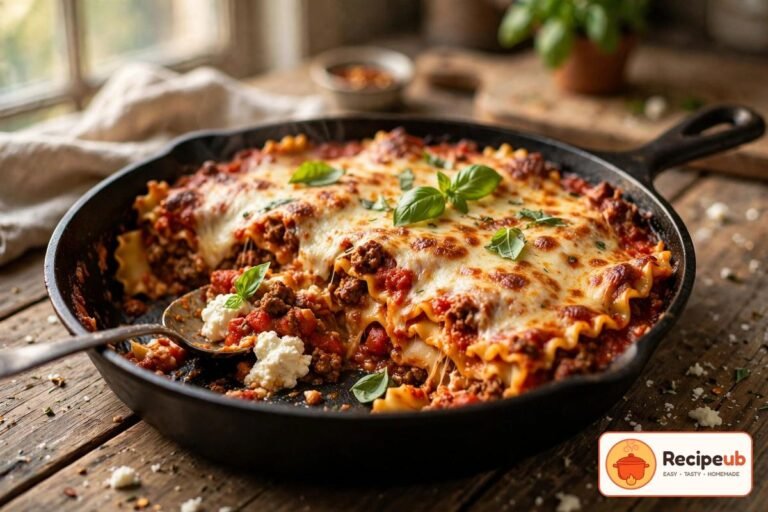
Skillet shepherd’s pie is the comfort dinner the search box describes in its own completions: skillet shepherd’s pie, skillet shepherd’s pie recipe, skillet shepherd’s pie no oven, easy skillet shepherd’s pie, one skillet shepherd’s pie — and, typed right onto the shepherd’s stem, skillet cottage pie, twice. Read those completions together and the searcher is carrying two unanswered questions into the results page: which meat actually makes it shepherd’s pie — and does the skillet version need an oven at all? Page 1 answers neither with an object. The #1 seat on the exact phrase is a VA dietitian’s PDF handout — a half-scale turkey diet build, 270 calories, serves 3. The named skillet recipe is from 2016 and seasons its filling with an onion soup-mix packet. One holder’s potatoes are simply “prepared” — somebody else’s mash, unpriced in time. The freshest build is a casserole that visits a skillet on its way to a 45-minute bake. And the name — the dish’s most-asked question — gets one defensive aside, one shrug in an ingredient line (“ground beef or lamb”), and silence from everyone else. This page prints the four systems the cluster leaves out: the Name Chart — lamb vs beef vs turkey vs half-and-half, with each meat’s browning temperature and its November 2026 cost, so the honesty is priced instead of waved away; the Gravy Chart — the four ways page 1 thickens this filling (flour, a cornstarch slurry, tomato paste alone, a packet) converted to one printed ratio; the Cap Chart — every named holder’s potato-to-meat ratio, which runs from 1:1 to about 2.4:1 and is stated by none of them; and the Priced Pie — the whole batch costed at November 2026 prices, in a month when ground beef sits near its record. The build itself: 1½ pounds of 90% lean ground beef browned all the way to 160°F in a 12-inch oven-safe skillet, a flour-and-tomato-paste gravy built in the pan, and 2½ pounds of russet potatoes mashed stiff, spread over the filling in the same skillet, fork-ridged and broiled 3 to 4 minutes until the ridges gold. Six servings at about 500 calories and ≈$2.85 a serving (both estimates, itemized on this page), in 50 minutes.
It also knows its nearest neighbor on this site, because this shelf already runs beef and potatoes together. This post is the skillet build — ground beef in a pan-built flour gravy under a mashed-potato cap, the two layers doing opposite jobs. If the beef-and-potatoes dinner you want is the slow one, that is my slow cooker beef and potatoes — the slow-cooker build, chunks of beef and sliced potatoes cooked together in gravy for 8 hours; this post is ground beef in a skillet gravy under a mashed-potato cap, same two headline ingredients, opposite architecture. Same two ingredients, opposite architecture — chunks in a pot all day vs a layered pie in a pan in under an hour. And this build is beef, not lamb, on purpose and in the open: the title carries the searcher’s words, and the first chart below tells the truth inside them.
The short answer: Put 2½ lb of peeled, cubed russet potatoes into cold salted water, bring to a boil and boil 15 minutes. While they cook, heat 1 Tbsp of olive oil in a 12-inch oven-safe skillet and brown 1½ lb of 90% lean ground beef, crumbled, for 7 minutes, all the way through to 160°F. Cook 1 diced onion and 2 diced carrots in the drippings 5 minutes; add 3 minced garlic cloves, 2 Tbsp of tomato paste and 2 Tbsp of flour for 2 minutes. Pour in 1½ cups of beef broth with 1 Tbsp Worcestershire, 1 tsp thyme, 1 tsp salt and ½ tsp pepper and simmer 4 minutes to a gravy that coats a spoon; stir in 1 cup of frozen peas and 1 cup of frozen corn for 1 minute. Mash the drained potatoes stiff with 4 Tbsp of butter and ½ cup of warm milk, spread over the filling, fork-ridge the top and broil 3 to 4 minutes until golden. Rest 5 minutes — six servings at about 500 calories and ≈$2.85 each, in 50 minutes.
In This Recipe
The Plan at a Glance
- The meat: 1½ lb ground beef, 90% lean, crumbled and browned all the way to 160°F BEFORE the gravy is built — after that, the broil is finishing a top, not cooking meat (the name rule in the card notes)
- The name: with beef, this is cottage pie by the textbook — the page is titled with the words US searchers type, and the Name Chart below prints which meat makes it shepherd’s, with the temperatures and the prices
- The gravy: 2 Tbsp flour + 2 Tbsp tomato paste per 1½ cups of broth — simmered 4 minutes until it coats the back of a spoon and a drawn line holds for a second (the gravy rule in the card notes)
- The cap: 2½ lb russets over 1½ lb of beef = ≈1.7 lb of potato per pound of meat, mashed stiff with warm milk added a splash at a time, so it spreads without sinking (the cap rule in the card notes)
- The finish: broil 3 to 4 minutes — the filling is already fully cooked, so the oven’s only job is the golden ridges; no broiler, the lid finish works instead (the finish rule in the card notes)
- The clock: the potatoes and the filling cook at the same time — the boil runs inside the filling’s build, which is why the total is 50 minutes and not 70
- Time: 20 minutes prep / 30 minutes cook (potatoes boil 15 while the filling builds; mash and spread 4 + broil 4 + rest 5, stated openly) / 50 minutes total
- Yield: 6 servings (about 1¾ cups each)
- Calories: ≈500 per serving (estimate); protein ≈26 g per serving (estimate)
- Cost: ≈$2.85 per serving (estimate) at October 2026 prices — the beef line (≈59% of the batch) and the potato line (≈14%) are both BLS-verified anchors; the exits are priced in the Name Chart below
- Storage: fridge 3 to 4 days; freezes up to 2 months with a softer cap — the rules are in the Storage section below
Why This Recipe Works
It is a pie of two layers with opposite jobs — and the recipe is the treaty between them. The filling’s gravy has one job: hold a line. It must be thick enough that a scoop stands instead of spreading, because the cap is going to sit on it, lean on it, and be sliced through it. The cap has the opposite job: hold a ridge. It must be stiff enough to fork into peaks that gold under the broiler instead of slumping flat and steaming. Every failure this dish is famous for is one layer quitting its job — a soupy filling that soaks up into the mash and serves as stew with a potato lid, or a loose cap that sinks into the filling until the two layers marry into one beige layer. That is why this page prints the two ratios instead of two vibes: the gravy ratio in the Gravy Chart, and the potato ratio in the Cap Chart. Get both numbers right and the architecture takes care of itself.
It knows what it becomes on the shelf’s plain skillet. This site already runs the ground-beef skillet in its simplest form — my 5-ingredient ground beef skillet — the plain build, five ingredients and 25 minutes with no topping and no second layer; this post is what that skillet becomes with a gravy system under a fork-ridged mash cap — and that post is a good weeknight dinner exactly because it stops where it stops. This post is the same protein in the same vessel, carried two systems further: a measured gravy where the plain skillet has pan juices, and a cap where the plain skillet has nothing. Neither post pretends to be the other; the difference is named because the reader choosing between them deserves to know which dinner they are actually making.
The beef is browned all the way before the gravy — a safety fact that is also the method. Ground beef cooks to 160°F, and crumbles distributed through a gravy under a potato cap cannot be temped piece by piece at the end — by then the pie is assembled and the thermometer has nowhere honest to go. So the beef is browned fully at the start: 7 minutes, crumbled small, no pink anywhere, and only then does the pan become a gravy pan. After that point, everything the recipe does is about layers and finishes — the 4-minute simmer is thickening a gravy, not cooking meat, and the broil is coloring a cap, not rescuing an undercooked filling. The temperature work is done early, in the open, where it can be seen. It is also, not coincidentally, how every holder on page 1 builds the dish; this page is just the one that says why.
The clock is parallel, and the total says so. A shepherd’s pie reads like an hour-plus dinner because its parts are usually added end to end: boil the potatoes, then build the filling, then assemble, then bake. Read the builds again and the boil and the filling never needed each other — the potatoes want 15 minutes of unattended boiling, and the filling wants about 19 minutes of attended pan work. Run them at the same time and the dish is a 50-minute dinner whose longest single step is a pot of water. The concurrency is printed on the card, not hidden inside it: prep 20, cook 30, total 50, with the overlap stated in the open. The 40-minute bake the named skillet holder finishes with is the other half of the arithmetic — her filling is already cooked too, and the bake is reheating it under a raw-ish cap. This build’s cap goes on hot mash, over a hot filling, and needs only the broiler’s 3 to 4 minutes to gold.
Shepherd’s or Cottage? The Name Chart
Here is the first chart this post exists to print, and it answers the question the search box itself types onto this dish’s stem — skillet cottage pie, offered as a completion on the skillet shepherd’s pie search, twice. The rule is one sentence: the meat names the pie. Lamb was the shepherd’s animal, so a lamb pie is shepherd’s pie; the beef version fed the cottage table, so a beef pie is cottage pie. Page 1’s relationship to that rule is one defensive aside from the named holder (“technically, shepherd’s pie is supposed to be made with lamb… if you order shepherd’s pie in pretty much any restaurant around here, it’s made with beef” — true, and then nothing is built on it), one shrug from the freshest holder (“ground beef or lamb: you’ll need 1½ pounds”), and silence from the rest — including the one holder whose lamb build is technically honest and never explains why. Here is the fact printed as a system instead: each meat with its honest name, its browning temperature, what actually changes in the pan, and what the honesty costs at November 2026 prices. This recipe uses the bold row — and says so.
| Meat (1½ lb) | The honest name | Browning temperature | What changes | Cost per serving |
|---|---|---|---|---|
| Ground beef, 90/10 | Cottage pie — sold as shepherd’s in the US | 160°F | The build as written; no draining needed at 90% lean | ≈$2.85 (beef at the BLS October 2026 average) |
| Ground lamb | Shepherd’s pie, textbook | 160°F | Richer, gamier fat — drain the pan if the lamb is fatty; the thyme carries, and rosemary is the classic partner if you keep it | ≈$3.40 (labeled shelf estimate — no BLS lamb series exists to claim) |
| Ground turkey | Neither, honestly — a turkey cottage-style pie (the VA handout’s build) | 165°F | Leanest and palest — the tomato paste and Worcestershire do the color work beef gives for free; the gravy wants its full simmer | ≈$2.25 (labeled shelf estimate) |
| Half beef + half turkey | Cottage pie, lighter | 165°F (the poultry in the mix sets the number) | Beef’s flavor at most of turkey’s price | ≈$2.55 (labeled shelf estimate) |
How to read the chart: the name follows the shepherd, and this page follows the searcher — US menus and US search boxes call the beef build shepherd’s pie, so the title uses the words people type, and the chart inside tells the truth those words skip. But the meat decision was never only pedantry, and the columns are the proof: it moves the temperature (turkey and any mix containing it cook to poultry’s 165°F, not beef’s 160°F), it moves the fat (lamb’s richness wants draining and carries a gamier note the thyme has to stand up to), and in November 2026 it moves the price by more than a dollar a serving — the lamb honesty costs about 55 cents a serving over beef, and the turkey exit saves about 60. November 2026 is the month to print that arithmetic, because the beef row itself is sitting at a near-record price (the Priced Pie below has the receipts). Choose the row by which column matters to your table — the textbook name, the temperature you’re willing to temp to, or the receipt — but choose it as a decision, with the numbers showing, which is more than any page that ranks for this dish currently offers.

Ingredients
For the cap:
- 2½ lb russet potatoes, peeled and cut into 1-inch chunks
- 4 Tbsp unsalted butter
- ½ cup whole milk, warmed
- Kosher salt, for the potato water and the mash
For the filling:
- 1 Tbsp olive oil
- 1½ lb ground beef, 90% lean
- 1 medium yellow onion, diced
- 2 medium carrots, diced small
- 3 cloves garlic, minced
- 2 Tbsp tomato paste
- 2 Tbsp all-purpose flour
- 1½ cups low-sodium beef broth
- 1 Tbsp Worcestershire sauce
- 1 tsp dried thyme
- 1 tsp kosher salt
- ½ tsp black pepper
- 1 cup frozen peas
- 1 cup frozen corn
Ingredient notes: The beef is 90% lean ground beef, 1½ pounds — lean enough to brown in the oil without a draining step, which keeps the drippings (and the vegetables’ start) in the pan; the lamb, turkey and half-and-half swaps are all printed in the Name Chart above, with their temperatures and prices. The beef browns fully, to 160°F, before the gravy is built on it — that is the build’s one non-negotiable (the name rule in the card notes). The potatoes are russets, 2½ pounds — a floury potato that mashes dry and stiff, which is what the cap needs; a waxy potato mashes gluey and loose, and a loose mash sinks (the Cap Chart below prints the ratio and the stiffness rule together). The flour and the tomato paste are a pair, 2 tablespoons of each — the Gravy Chart’s system: the paste is the flavor base and the color, the flour is the structure, and neither does the other’s job. The broth is 1½ cups, low-sodium — the third number in the gravy ratio, and low-sodium because the filling is salted separately and a salty broth under a salted mash gives you no way back. The peas and corn are frozen, 1 cup of each, stirred in at the very end, off the boil — they are already blanched, they need warming through and nothing more, and a simmer turns them dull and split; frozen mixed vegetables are the sanctioned shortcut (the holders split on it — peas-and-corn here, the mixed bag there — and the FAQs take it up). The milk is warmed before it meets the potatoes — cold milk cools the mash and loosens it unevenly, and a cap’s stiffness is decided in the mashing bowl, not at the spreading.

How to Make Skillet Shepherd’s Pie
The method runs on two tracks that meet at the cap: the potatoes boil unattended while the filling is built in the skillet, and neither track waits for the other — that overlap is the whole 50-minute claim, stated here the way it is stated on the card. It is the same assemble-and-serve-from-the-skillet discipline as this shelf’s other layered skillet dinner — my skillet lasagna — the stovetop lasagna, whole noodles layered with ricotta under a top in the same pan; this post is a ground-beef filling under a mashed-potato cap, the skillet as pie dish instead of pasta pan — with the layers swapped: there, noodles under a top; here, a filling under a cap. A 12-inch oven-safe skillet (cast iron is the classic) and one pot for the potatoes are the vessels; the broil at the end is why oven-safe is not a suggestion.
- Start the potatoes — then leave them alone. Put the potato chunks in a pot, cover with cold water by an inch, salt the water, and bring to a boil. Boil 15 minutes, until a chunk crushes easily against the side of the pot with a fork. Do not stand over this pot: every filling step below happens inside this boil, and the potatoes will be ready within a minute or two of the filling either way.
- Brown the beef, all the way. While the potatoes come up, heat the olive oil in a 12-inch oven-safe skillet over medium-high heat. Add the ground beef and cook 7 minutes, breaking it into small crumbles, until it is browned through with no pink left and the crumbles read 160°F. Do not rush this step and do not build the gravy on half-cooked beef — the meat’s cooking happens here, in the open, completely (the name rule in the card notes). At 90% lean there is no fat worth draining; leave the drippings in the pan.
- Vegetables in the drippings. Drop the heat to medium. Cook the onion and carrots in the drippings for 5 minutes, until the onion has softened and the carrots have lost their raw edge — the carrot is the filling’s one fresh vegetable that needs real cooking, and it gets it here, before any liquid arrives.
- Garlic, paste and flour — the gravy base. Add the garlic, tomato paste and flour and cook 2 minutes, stirring constantly, until the paste darkens a shade and the flour smells toasty instead of raw. This is the step the packet build skips and the gravy is made of: paste cooked in fat is depth, flour cooked in fat is structure, and both go dull if they are stirred into liquid raw.
- Build the gravy. Pour in the beef broth and stir in the Worcestershire sauce, thyme, salt and pepper, scraping the pan’s bottom clean. Simmer 4 minutes, stirring now and then, until the gravy coats the back of a spoon and a line drawn through it with a finger holds for a second — that is the Gravy Chart’s ratio made visible. If it is still soupy at 4 minutes, give it another minute before anything else joins it; a filling capped while loose never firms up under the potatoes.
- Peas and corn, off the boil. Stir in the frozen peas and frozen corn and cook 1 minute, just until they are warmed through and bright. Take the skillet off the heat. The filling is now completely cooked and should be holding still in the pan — loose gravy would move; this should barely ripple when the pan is tilted.
- Mash stiff. Drain the potatoes and return them to their hot pot. Add the butter and mash until it melts in, then add the warm milk a splash at a time, mashing as you go, and salt to taste. Stop while the mash is stiff — it should hold a peak on the masher and mound on a spoon, not pour or slump. You may not need every drop of the milk; the stiffness is the specification, not the cup measure (the cap rule in the card notes).
- Cap, ridge, broil, rest. Spoon the mash over the filling in dollops, then spread it gently to the skillet’s edges, sealing the filling in. Drag a fork across the top in rows to raise ridges — the ridges are surface area, and surface area is what golds. Broil 3 to 4 minutes, watching closely, until the ridge peaks are deep golden and the edges bubble. (No broiler: lid on, lowest heat, 5 minutes — the cap warms through and stays pale; the Finish Rule below prints the trade honestly.) Rest 5 minutes before serving — the gravy sets as it stands, and a pie cut at minute zero slumps. Serve straight from the skillet.
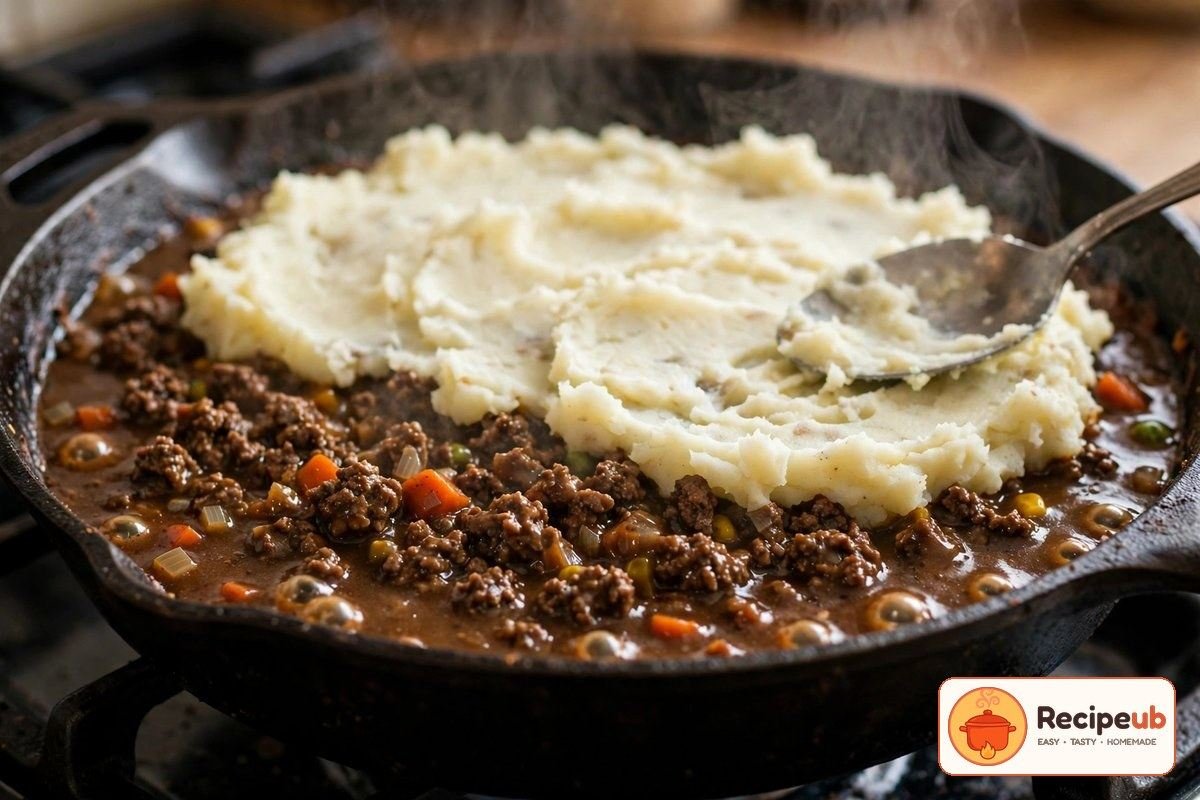

Skillet Shepherd’s Pie (Ground Beef, Golden Mash, 50 Minutes)
Ingredients
Equipment
Method
- Put the potato chunks in a pot, cover with cold salted water, bring to a boil and boil 15 minutes, until fork-tender. While they cook, build the filling.
- Heat the olive oil in a 12-inch oven-safe skillet over medium-high. Brown the ground beef 7 minutes, crumbled small, until cooked through to 160°F with no pink left.
- Cook the onion and carrots in the drippings 5 minutes. Add the garlic, tomato paste and flour for 2 minutes, until the paste darkens.
- Pour in the beef broth; stir in the Worcestershire sauce, thyme, salt and pepper. Simmer 4 minutes, until the gravy coats the back of a spoon.
- Stir in the frozen peas and corn for 1 minute, until warmed through. Remove from the heat.
- Drain the potatoes; mash with the butter, then the warm milk a splash at a time, to a stiff mash that holds a peak. Salt to taste.
- Spoon the mash over the filling, spread to the edges and fork-ridge the top. Broil 3 to 4 minutes, until the ridges are deep golden. Rest 5 minutes before serving.
Notes
What Thickens the Gravy? The Gravy Chart
Here is the second chart, and it settles the system page 1 uses four different ways without ever comparing. Read the holders’ fillings side by side and the thickening is a different religion on every page: flour in a simmer, a cornstarch slurry with sour cream, tomato paste and reduction with no starch at all, and a soup-mix packet over plain broth. None of them prints a ratio, and none of them names what its choice eats like against the others. Here they are in one table, converted where conversion is possible. This recipe uses the bold row.
| System | Who cooks it | The measure | What it eats like |
|---|---|---|---|
| Flour + tomato paste | THIS RECIPE (the VA handout runs 1 Tbsp flour per ⅔ cup broth at half scale; The Kitchn simmers flour into its filling) | 2 Tbsp flour + 2 Tbsp tomato paste per 1½ cups broth, for 1½ lb of meat | A gravy that coats the spoon and holds a slice line under the cap |
| Cornstarch slurry + sour cream | Taste of Home | 1 Tbsp cornstarch in ½ cup water with bouillon; sour cream stirred in at the end | Glossy and tangy; thins a little as it sits, and the sour cream cannot boil |
| Tomato paste + reduction, no starch | The Defined Dish | Paste and wine, reduced in the pan | The loosest honest gravy — a sauce, not a set; the premium build’s slices slump |
| Soup-mix packet, no thickener | Jo Cooks | None — 1 cup of broth, unthickened, the packet as the entire seasoning system | The thinnest gravy on the page; the filling is a stew wearing a cap |
How to read the chart: the gravy’s job is structural — it is the layer the cap sits on, and the cap is heavy. Under-thickened (the packet row, or a flour measure halved by a nervous hand), the filling stays soupy, soaks up into the mash from below while the pie rests, and serves as stew with a potato lid. Over-thickened (a heavy hand with the flour, or a gravy simmered down past coating in the name of safety), it eats pasty under the mash and the slice stands like a brick. The middle is a number, not a feel: the flour and the paste above, cooked together in the drippings for 2 minutes, the broth in, simmered 4 minutes, until the gravy coats the back of a spoon and a line drawn through it holds for a second. Taste of Home’s slurry is the chart’s legitimate shortcut row — cornstarch thickens at about half the flour’s measure — with its two conditions printed rather than discovered: it thins a little as it sits, and its sour cream goes in off the boil or it breaks. And it is worth naming what kind of gravy this is not: this site’s other real gravy is my slow cooker pot roast — the roast build, whose gravy is made from a whole chuck roast’s drippings accumulated over 8 hours; this post’s gravy is built in the pan in 4 minutes with flour and tomato paste, the two gravies named against each other — dripping gravy is a by-product of patience, and pan gravy is a construction. Both are honest; they are not interchangeable, and a Tuesday skillet only has time for one of them.
How Many Potatoes Per Pound of Meat? The Cap Chart
Here is the third chart, and it prints a number that exists nowhere else in this cluster: the potato-to-meat ratio. Every holder picks a potato load, and the loads are wildly different dinners wearing the same title — from a diet handout’s 1:1 skim to a build that is nearly two and a half pounds of potato for every pound of beef. None of them states the ratio, so a reader following two recipes in a month cannot tell why one pie ate like a pie and the other ate like mashed potatoes with a beef layer. Here they are, weighed and divided. This recipe uses the bold row.
| Build | Potatoes | Meat | Ratio |
|---|---|---|---|
| VA Nutrition (the diet handout) | ½ lb | ½ lb turkey | 1:1 — the diet cap |
| Taste of Home | 3½ cups prepared mash (≈1¾ lb) | 1 lb beef | ≈1.75:1 |
| THIS RECIPE | 2½ lb russets | 1½ lb beef | ≈1.7:1 |
| The Kitchn | 3 lb russets | 1½ lb beef or lamb | 2:1 |
| Jo Cooks | 6 large (≈3 lb) | 1¼ lb beef | ≈2.4:1 — mostly mash |
How to read the chart: under about 1¼ pounds of potato per pound of meat, the cap is a garnish — a skim of mash over what is really a beef skillet, which is the VA handout’s diet arithmetic and not a pie. Over about 2:1, the pie is a potato dish with a beef layer, and the meat — at $6.755 a pound this November — is not what the plate is mostly made of, whatever the title says. The working band is about 1½ to 2 pounds of potato per pound of meat, and this build sits at its low-middle on purpose: cap thick enough to fork-ridge and gold, filling still the point of the dinner. Two rules travel with the ratio. The mash must be stiff — warm milk a splash at a time, stopping while it holds a peak, because a loose mash sinks into a hot filling and the two layers marry into one (the named holder’s own FAQ admits the store-bought version of this failure — “if they’re too loose, you’ll lose that fluffy top layer” — without ever quantifying the fix). And the fork ridges are surface area — a smoothed cap steams pale under the broiler while a ridged one golds at the peaks, which is the entire reason every holder forks the top and none of them says why. Leftover mashed potatoes are the chart’s sanctioned shortcut: about 5 cups of stiff leftover mash caps this build — warm it with a splash of milk so it spreads without tearing the filling’s surface.
The Finish Rule. One more system page 1 splits on, and it is the one the search box asks about outright — skillet shepherd’s pie no oven is a typed completion on the dish’s own stem. Notice first what every build on page 1 has in common: the filling is fully cooked before the cap goes on, in all of them. So the oven’s only remaining job is the top — and page 1 spends that job four ways: covered on the stovetop, about 5 minutes (Taste of Home — no oven at all), broiled 4 to 5 minutes (the VA handout), baked 27 to 30 minutes at 400°F (the premium build), baked 40 minutes at 350°F (the named skillet holder). This build’s rule: broil 3 to 4 minutes — the ridges gold, the edges bubble, and the pie is on the table while the 40-minute version is still reheating a cooked dinner. No broiler, or no wish to heat one: lid on, lowest heat, 5 minutes — Taste of Home’s proof that it works, with the honest trade printed beside it: the cap warms through and stays pale. Golden is a broiler’s 4 minutes; an oven’s 40 is a habit, not a requirement.
What Does the Pie Cost? The Priced Pie
Here is the fourth thing this post prints that page 1 does not: the whole pie, priced line by line, at November 2026 prices — with two lines read directly from the Bureau of Labor Statistics, every other line labeled a shelf estimate, printed as one, because this page names its sources instead of rounding a receipt it never saw. It also reconciles: the method serves 6, and the table divides by the same 6.
| Line | Amount for the batch | Price basis | Batch cost |
|---|---|---|---|
| Ground beef, 90% lean | 1½ lb | BLS October 2026 average, $6.755/lb (verified) | $10.13 |
| Russet potatoes | 2½ lb | BLS October 2026 white-potato average, $0.990/lb (verified; russets priced off the white-potato average, labeled) | $2.48 |
| Frozen peas | 1 cup | Shelf estimate, labeled as one | ≈$0.65 |
| Frozen corn | 1 cup | Shelf estimate, labeled as one | ≈$0.65 |
| Beef broth | 1½ cups | Shelf estimate, labeled as one | ≈$0.75 |
| Yellow onion | 1 medium | Shelf estimate, labeled as one | ≈$0.60 |
| Olive oil, flour, tomato paste, Worcestershire, thyme, salt, pepper | Pantry amounts | Estimate, labeled as one | ≈$0.60 |
| Unsalted butter | 4 Tbsp | Shelf estimate, labeled as one | ≈$0.55 |
| Carrots | 2 medium | Shelf estimate, labeled as one | ≈$0.50 |
| Whole milk | ½ cup | Shelf estimate, labeled as one | ≈$0.30 |
| Batch total | 6 servings | ≈$17.21 → ≈$2.85 per serving |
How to read the table: two lines are the story, and they run in opposite directions. The beef is $10.13 of the $17.21 — about 59% of the pie — in a month when ground beef sits near its record: the Bureau’s October 2026 average of $6.755 a pound stands against a series record of $6.923 set in August 2026, with herd supply at a 75-year low and prices expected to stay high into next year. And the whole potato cap — the layer that makes it a pie — is $2.48, about 14% of the batch, at a verified 99 cents a pound. Shepherd’s pie in November 2026 is a cheap cap over an expensive filling, and that arithmetic is the Name Chart’s real argument: the meat row you choose moves this receipt more than everything else in the skillet combined. The turkey row lands at about $2.25 a serving, the half-and-half at about $2.55, and the lamb honesty at about $3.40 — each labeled a shelf estimate, because the Bureau publishes no ground lamb or ground turkey average for this page to claim, and this page does not claim one. What none of the rows changes is the system: the gravy ratio, the cap ratio, the finish and the 50 minutes all hold under every meat on the chart.
Emma’s Tips for the Best Skillet Shepherd’s Pie
Let the filling settle for a few minutes before capping, if it is bubbling hard. The gravy should be holding still when the mash lands on it. A filling at a rolling boil will steam up through a fresh cap, loosen its underside, and blur the line between the layers before the broiler ever gets its turn. Off the heat while you mash — which the method already does — is usually enough; if the pan is still bubbling vigorously, give it 2 to 3 minutes. Calm filling, clean layers.
Warm the milk — it is a stiffness decision, not a nicety. Cold milk hitting hot potatoes cools the mash on contact and loosens it unevenly: the first splash soaks in, the later splashes sit on a cooler mash and pool. Warm milk incorporates at the potatoes’ own temperature, so each splash behaves like the last and you can stop the moment the mash holds a peak. A minute in the microwave or a small pan while the potatoes drain is the whole cost.
Ridge the cap with a fork, not a spoon. A spoon smooths; a fork raises. The tines dragged across the surface lift dozens of small peaks, and those peaks are the surface area that golds under the broiler while the valleys stay pale and creamy — the two-tone top is texture, not decoration. Work in rows, lift the fork at the end of each pass, and do not press the cap down flat again to fix a rough patch; rough is the point.
The skillet must be oven-safe — the broil is why. Everything before the finish is stovetop work any deep skillet can do, but the last 4 minutes happen inches from a broiler element. Cast iron is the classic for a reason: it holds the filling’s heat through the rest and goes from burner to broiler without a thought. A skillet with a plastic or wooden handle cannot make that trip — if yours is one, transfer the filling to a baking dish before capping (the named holder prints the same workaround, at the cost of “one extra dish”), or use the lid finish from the Finish Rule and skip the broiler entirely.
Salt the potato water like you mean it. The cap is nearly half the bite, and it is seasoned in exactly two places: its cooking water and its mashing bowl. Potatoes boiled in plain water come up bland all the way through, and no amount of salt on the surface fixes a bland middle — the salt has to be in the water the potatoes drink as they cook. Taste the finished mash before it goes on the filling; it should taste like something you would eat on its own, because half the plate, it is.
Storage and Reheating
Fridge: Leftovers keep 3 to 4 days at 40°F or below — the USDA window for cooked beef, and the window this page prints. Refrigerate within 2 hours, covered, ideally in shallow containers so portions cool promptly. The cap dries at the edges as it sits — that is the honest texture note, printed because it decides the reheat below: day-two pie is a slightly drier-capped pie, not a spoiled one, and the reheat is built for it.
Reheating: Covered, with a splash of milk or broth spooned over the cap before the heat — the splash hands back the moisture the edges lost, and the cover keeps it there as steam. In the oven: 350°F, covered, until steaming hot throughout (165°F) — about 25 minutes for a family-size portion, less for a single serving. In the microwave: covered, at reduced power, with the same splash, until steaming — faster, and the cap stays pale, which by day three is a trade most tables accept. Either way, reheat once and eat it hot; shepherd’s pie reheated twice is a pie whose layers have given up.
Make-ahead, stated honestly: The assembled pie can be refrigerated up to 2 days before finishing — with one rule the holders scatter on and this page states with its reason: let the filling cool before the cap goes on. A hot filling capped and refrigerated cools slowly from the middle, holding the cap’s underside in the temperature danger zone on the way down; a cooled filling, capped cold and refrigerated promptly, never makes that trip. To finish a make-ahead pie: warm it through first (375°F, covered, about 20 minutes from cold), then broil 3 to 4 minutes for the ridges — the broil alone will gold a cold pie’s top while its middle is still chilly.
Freezer: The pie freezes up to 2 months — the holders agree, and this page adds the honest half: the filling comes back exactly as it went in, and the mash comes back softer and a little grainy, because a frozen-and-thawed potato cap has lost the structure that made it stiff. Thaw overnight in the fridge and reheat covered with the splash, as above. Freezing is the make-ahead lane — a second pie built on purpose — not the leftover lane; leftovers belong to the 3-to-4-day fridge window and eat better for it.
FAQs
Is shepherd’s pie made with lamb or beef?
Both are made, and the name follows the meat: lamb is the textbook shepherd’s pie — lamb was the shepherd’s animal — and the same pie built with ground beef is, strictly, cottage pie. In the US the beef build keeps the shepherd’s name almost everywhere: on menus, in search boxes (the dish’s own autocomplete stem offers “skillet cottage pie” as a completion on the shepherd’s search), and on this page’s title, which uses the words US cooks type. What this page adds is the Name Chart above, where the choice is printed as a decision — lamb at about $3.40 a serving and 160°F, beef at about $2.85 and 160°F, turkey at about $2.25 and 165°F — instead of a shrug in an ingredient line. Call the beef version shepherd’s at the table if your family does; just know which pie you made, and what the lamb one costs.
What is the difference between shepherd’s pie and cottage pie?
The meat, and only the meat. Shepherd’s pie is lamb; cottage pie is beef — named for the cottage table it fed. Everything downstream is identical in form: a ground-meat filling in gravy, under a mashed-potato cap, finished until the top golds. The confusion is understandable — the two names traveled to the US and merged in common use, and at least one page-1 holder prints the fact as a defensive aside and then shrugs it off, while another offers “ground beef or lamb” in a single ingredient line as if the two were interchangeable. They are interchangeable as a method — the gravy ratio, the cap ratio and the finish in this recipe hold under either meat — but not as a name, a price, or (for turkey) a temperature. The Name Chart above is the whole difference, printed in one table.
Can I make skillet shepherd’s pie without the oven?
Yes — it is one of the typed completions on this dish’s own search stem (“skillet shepherd’s pie no oven”), and the answer is the Finish Rule above. The filling is fully cooked before the cap goes on, so the oven’s only job is the top. Lid on, lowest heat, 5 minutes warms the cap through with no oven at all — Taste of Home’s build finishes exactly this way, covered on the stovetop, and it is the proof the method works. The honest trade: the cap stays pale, because golding is radiant heat from above and a lid cannot do it. If you want the golden ridges without a full oven, the broiler is the middle path — 3 to 4 minutes, which is what this recipe prints. What you never need is the 40-minute bake one holder finishes with: that is reheating a cooked pie.
How do I keep the mashed potatoes from sinking into the filling?
Three rules, and all three are printed on this page because each one guards a different side of the same failure. The gravy must be at its ratio — 2 Tbsp flour + 2 Tbsp tomato paste per 1½ cups of broth, simmered until it coats a spoon; a loose filling is liquid, and a cap floats on liquid only until it dissolves into it. The mash must be stiff — warm milk a splash at a time, stopping while it holds a peak; a pourable mash is the second half of the sinking problem (the named holder’s FAQ concedes it of loose store-bought mash: “you’ll lose that fluffy top layer”). And the filling should have stopped bubbling hard before the cap lands — a rolling boil steams up through fresh mash and loosens its underside. Gravy at ratio, mash at stiffness, filling at rest: the layers stay layers.
Why is my shepherd’s pie filling soupy?
Because the gravy was under-thickened — it is a ratio problem, not an effort problem, and it is the Gravy Chart’s bottom end. The usual causes, in order: the thickener was a soup-mix packet or nothing at all (the named skillet holder’s filling is broth and a packet, unthickened — a stew wearing a cap); the flour measure was halved by a cook worried about pastiness; or the gravy was capped before its simmer, so the flour never finished swelling. The fix this time: take the cap off if it is on, simmer the filling down until it coats a spoon, and cap it again — or serve it honestly as a stew with mashed potatoes, which is a fine dinner wearing the wrong name. The fix next time is the ratio on the card: 2 tablespoons of flour and 2 of tomato paste per 1½ cups of broth, cooked in the drippings first, simmered 4 minutes after.
Can I use leftover mashed potatoes?
Yes — they are the Cap Chart’s sanctioned shortcut. About 5 cups of stiff leftover mashed potatoes caps this build: the same potato load as the from-scratch cap, already seasoned. Warm them first with a splash of milk, just until they are spreadable — cold leftover mash tears the filling’s surface as it is dragged across, and tears let the gravy bleed up through the cap. Two honest conditions: the leftovers must be stiff (a loose, milky leftover mash will sink, per the rule above — if yours is loose, this is the night to make the from-scratch cap instead), and day-old mash golds slightly less evenly than fresh, because its surface has dried in the fridge. Neither is a reason to skip the shortcut; both are reasons to know which cap you are spreading.
Can I make it with ground turkey?
Yes — it is a real lane, not a compromise: the #1 seat on this dish’s exact search phrase is a VA dietitian’s turkey build. The Name Chart prices it at about $2.25 a serving (a labeled shelf estimate), the cheapest row on the chart. Two things change. The temperature: ground turkey cooks to 165°F, poultry’s number, not beef’s 160°F — brown it fully at the start, like the beef, and temp it. And the color: turkey is pale, and a turkey filling made without help reads gray under the cap — the tomato paste and Worcestershire in this build do the color work that beef’s browning gives for free, so do not skimp on the 2-minute paste step. The gravy also wants its full 4-minute simmer, because turkey brings less fat to the pan. If turkey is your household’s standing ground meat, this site’s ground turkey skillet — the turkey build, ground turkey in a one-pan skillet dinner; this post is the pie, where turkey is the Name Chart’s budget row under a mash cap at 165°F runs the same protein without the cap.
Can I make shepherd’s pie ahead of time?
Yes — assemble it, refrigerate it up to 2 days, and finish it when you need it, with one rule stated with its reason: let the filling cool before the cap goes on. A hot filling capped and put away cools slowly from the center, and the cap’s underside sits in the temperature danger zone while it does; a cooled filling, capped cold and refrigerated promptly, never makes that trip. (The holders disagree by a day — one prints 24 hours assembled, another 2 days; this page prints 2 days, inside the USDA 3-to-4-day window for cooked beef, with the cooling rule as the condition.) To finish: warm the assembled pie through first — 375°F, covered, about 20 minutes from cold — then broil 3 to 4 minutes for the ridges. Broiling a cold pie alone golds the top over a chilly middle.
Can I freeze it, and how long do leftovers keep?
Leftovers keep 3 to 4 days in the fridge at 40°F or below, refrigerated within 2 hours — the USDA window for cooked beef — and reheat covered with a splash of milk or broth over the cap, to steaming hot throughout. The pie freezes up to 2 months: the filling comes back exactly as it went in, and the mashed-potato cap comes back softer and a little grainy, stated rather than hidden — freezing breaks the structure that made the mash stiff. Thaw overnight in the fridge before reheating. Read the two windows as two different tools: the fridge is the leftover lane, the freezer is the make-ahead lane (a second pie, built on purpose), and a pie planned for the freezer eats best when it is frozen before its first broil and finished after its thaw.
What vegetables go in shepherd’s pie?
The holders split three ways, and the split is a real choice. Frozen mixed vegetables (the named skillet holder’s bag: peas, corn, carrots, green beans) are the one-bag answer — nothing to dice, everything blanched — at the cost of green beans some tables do not expect in this pie. Peas and corn only (Taste of Home’s pair) is the sweet, simple lane. Fresh aromatics plus a frozen finish is this build’s answer, and the reasoning is the recipe: fresh carrot, diced small and cooked in the drippings, because carrot is the filling’s base vegetable and wants real cooking to sweeten; onion and garlic fresh, for the same reason; and frozen peas and corn stirred in at the end, off the boil, because they are already blanched and a simmer only dulls and splits them. Each vegetable enters at the moment its cooking actually happens — which is why the fresh ones are diced small and the frozen ones go in last.
Final Thoughts
Skillet shepherd’s pie is not a complicated dinner, and it is an oddly unexamined one anyway — because the recipe was never the problem. It is a pound and a half of beef, two and a half pounds of potatoes, and a skillet. The problem is that page 1 prints it as a pile of shrugs: a name question answered with a defensive aside, a gravy thickened four incompatible ways with no ratio on any of them, a potato load that swings from one pound per pound to nearly two and a half without a single holder stating the number, a finish that ranges from a lid to a 40-minute bake for a filling that is already cooked, and a #1 seat held by a half-scale diet handout in the month ground beef costs what it costs. What this page adds is the paperwork the other versions leave out: a name chart that turns the lamb-versus-beef argument into a priced decision with the temperatures attached, a gravy chart that converts four systems into one ratio with both failure ends named, a cap chart that prints the ratio nobody states, a finish rule that answers the no-oven question the search box itself asks, and a priced pie with two verified anchors and every estimate labeled. Beef browned all the way, gravy at its ratio, mash stiff and ridged, four minutes under the broiler: that is the deal — and if you make it with lamb, this page will be the first to call it shepherd’s.
More Easy One-Pot Dinners
If a measured one-pot system is your kind of cooking, the rest of this shelf runs on the same rules — every ratio printed, every difference named. For the shelf’s other ground-beef weeknight classic, my homemade sloppy joes — the stovetop ground beef classic, crumbled beef in a sweet-tangy sauce served on buns; this post spends its beef in a skillet pie under a potato cap instead of on a bun proves the same protein runs two completely different weeknight systems depending on what shares its pan, and for the beef build this page’s pricing keeps arguing with, my one pot spaghetti with meat sauce — the spaghetti build, crumbled beef in a crushed-tomato sauce with the liquid chart and the beef chart printed; this post is the pie, where the same November beef economics sit under a 99-cent potato cap prices the same record-month beef from the pasta side — read the two receipts together and the protein is the pot, there and here. One shelf, one standard — the meat browns all the way, the gravy is measured, the cap is stiff, and dinner is handled.



Never Run Out of Dinner Ideas
One easy air fryer or slow cooker dinner in your inbox every week. No spam, ever.
You’re on the list — welcome to Recipeub!