
Meal Prep for One (4 Meals, About $1.90 a Meal, 45 Minutes)
Meal prep for one person runs into a problem that family meal prep never meets: the standard batch is built for people eating in parallel, and one person eats in series. Cook the usual eight or ten boxes on Sunday and the last ones are a week old before they are eaten — past the USDA window for cooked leftovers, however good the recipe was. So this post is sized by the rule that actually governs a solo fridge: four meals, the largest batch that is still food-safe on its last day without a freezer step. The build is one small shop and one pan: 1¼ pounds of boneless skinless chicken thighs roasted at 425°F on a sheet pan with 1½ pounds of russet potatoes cut in cubes, 12 ounces of frozen green beans scattered over the pan for the last 12 minutes, 1 cup of rice simmering on the stove alongside, and a lemon-garlic-dill yogurt sauce packed separately in four small cups. Four meals at about 560 calories and ≈$1.90 a meal (both estimates, itemized on this page), in 45 minutes — and every quantity on the page is printed for the batch sizes a solo cook actually makes, not scaled down from a family recipe in the head.
Read page 1 for this dish and nobody is selling that. The top seats are plans — a week of different breakfasts, lunches and dinners for one, fourteen or more ingredients, with cooking still waiting on the weeknights — and guides, where the portion math for one person exists only as prose ranges: three to five portions of protein, three to four cups of cooked grains, no dish attached. The one page with a serving scaler skips the four-meal case entirely and hides its other numbers behind a tap, so the size that fits the fridge window is the one size it does not print. The one true recipe card is a chicken with its sides left as an unquantified “choose one or mix” list. And the budget question is asked in the holders’ own FAQs — how do I meal prep for one on a budget? — and answered with strategies: family packs, frozen vegetables, one sauce twice. Never a list. Never a number. This page prints the three things the lane leaves out: the Solo Batch Chart with the quantities for 2, 3, 4 and 5 meals and the rule that sizes them, the Priced Solo Grocery List with every line’s basis labeled, and one complete meal — protein, grain, two vegetables, sauce — on a single card.
It also knows its nearest neighbor on this site, because this shelf already holds a budget batch a solo cook could confuse with this one, and the difference is the whole point. This post is four meals, fridge only, sized to one person’s window — where my meal prep on a budget for beginners — the 8-meal beginner batch, double this scale, with an eat-four-freeze-four system for a first-ever prep; this one is the solo batch, four meals that never need the freezer step is the bigger system for learning the habit. Same shelf, same budget logic — this one is the size for a household of one.
The short answer: Season 1¼ lb of boneless skinless chicken thighs and 1½ lb of russet potatoes cut in ¾-inch cubes, and roast them together on one sheet pan at 425°F for 25–30 minutes, the chicken to 165°F; scatter 12 oz of frozen green beans over the pan for the last 12 minutes. While the pan roasts, cook 1 cup of long-grain white rice on the stove and whisk the sauce: ½ cup of plain nonfat Greek yogurt, 1 Tbsp of lemon juice, 1 small grated garlic clove, 1 tsp of dried dill and a pinch of salt. Rest the chicken 5 minutes, slice it, and pack four containers — about ¾ cup of rice, 5 ounces of chicken, a cup of potato cubes and ¾ cup of green beans in each, the sauce in its own small cups on the side. Four meals at about 560 calories and ≈$1.90 each, in 45 minutes total.
In This Recipe
The Plan at a Glance
- Chicken: 1¼ lb boneless skinless chicken thighs (about 4–5), seasoned and roasted whole to 165°F, rested, sliced — one standard tray is exactly one batch (the Batch Chart below)
- The pan: 1½ lb russet potatoes in ¾-inch cubes from minute 0 (they need the full roast); 12 oz frozen green beans added for the last 12 minutes — no thawing, no separate pan
- The grain: 1 cup long-grain white rice on the stove in parallel (≈3 cups cooked) — it finishes inside the pan’s time, not after it
- The sauce: ½ cup plain nonfat Greek yogurt + lemon juice + garlic + dill, whisked and packed separately in 4 small cups — added after reheating, never cooked
- Time: 15 minutes prep / 30 minutes cook (sheet pan 25–30 with the beans in for the last 12, rice in parallel, stated openly) / 45 minutes total
- Yield: 4 meals
- Calories: ≈560 per meal (estimate); protein ≈35 g per meal (estimate)
- Cost: ≈$1.90 per meal (estimate) at October 2026 prices — the chicken line is a labeled shelf estimate; the BLS-verified breast comparison is in the Priced Solo Grocery List
- Storage: fridge 3 to 4 days — and that window is the batch size: 4 meals is the fridge ceiling (the rule is the first chart below)
Why This Recipe Works
Series eating is the solo problem, and the batch is sized to it. A family batch disappears in parallel — four people eat four boxes the same night. A solo batch is eaten in series, one meal a day, so the batch ceiling is set by the fridge clock, not by appetite or budget: cooked food keeps 3 to 4 days at 40°F or below, and a batch cooked on day 0 is eaten on days 1 through 4 at the outside. Four meals is the largest batch that never needs a freezer step. Every bigger solo batch is a freezer project wearing a fridge plan’s clothes — which is exactly why the standard 8-to-10-box preps quietly fail for one person, usually around box six.
One tray of chicken is exactly one batch, because the pack is assigned before it leaves the store. The solo shopper’s real trap has a name in the budget pages: the second-half problem. A pack of meat is two dinners for one person, and the plan fails when the second half has no assigned meal — it sits in the fridge while the cook orders takeout, and it is thrown away on Friday. This batch is built so the trap never sets: a standard 1¼ lb thigh tray is the whole batch, every ounce of it portioned into the four containers the day it is cooked. When the store only has the 3 lb family tray, that is two batches — freeze half the raw chicken the day you buy it, and next week’s protein is already bought (the freezer rules are in the Storage section).
Thighs, because a solo meal is a reheated meal. Every meal in this batch except the first is eaten reheated, and that is the test the protein has to pass. The solo lane’s own recipe holders land in the same place: thighs are the recommendation because they stay moist through reheating, where breast dries a little more each time it is warmed. It is also why this post is not the other sheet-pan prep on this shelf: my sheet pan chicken meal prep — the breast-based sheet pan prep, five containers and a staggered timing chart; this one is thighs, four meals and a scaling chart is built on breast at standard scale, and its chart answers when does each pan item go in. This post’s chart answers a different question — how much do I buy for the number of meals I actually eat — and the two charts are different objects for different cooks.
The sauce is packed separately, so the batch is never committed. Boredom is the solo cook’s second problem, and the cluster’s shared answer is the sauce: change the sauce and the same chicken, rice and potatoes eat like a different meal. Packing it aside does three jobs at once — it keeps the rice from going soggy in the fridge, it goes on after reheating so it stays fresh-tasting, and it leaves the batch uncommitted: this week’s lemon-dill cup is next week’s barbecue or hot sauce, on the identical base. One batch, one small shop, and the variety lives in a 2-minute sauce instead of a second grocery run.
Everything is quantified, because “choose a side” is not a meal prep. The lane’s only true recipe card prints a protein and leaves the meal to the reader — sides as a list of suggestions with no amounts, so the solo cook still has to design the dinner the card promised to hand them. This card prints the whole meal end to end: the protein weight, the dry rice measure, the potato weight, the bean bag size, the sauce in tablespoons — and the Batch Chart below scales all of it by meal count, so the reader who wants two meals or three is not doing fractions from a family recipe. A complete meal on one card is the third thing page 1 does not have, and it is the one the searcher completing meal plan for one person with grocery list is asking for by name.
How Much Food Does Meal Prep for One Person Need? The Solo Batch Chart
Here is the first chart this post exists to print, and it starts with the rule stated in one sentence, the way a rule should be: four meals is the fridge ceiling — a solo batch bigger than four outlives the USDA 3–4 day window. Ask how many meals one person should prep at a time and the answers on page 1 come back as plans and prose: a scaler that offers 3, 5, 7 and 10 meals — every size except the one that fits the window whole — and a guide that gives the portions as ranges in a paragraph. Here the quantities are a table. Every row is this recipe’s own build, scaled: per meal, 5 ounces of raw thighs, ¼ cup of dry rice, 6 ounces of potatoes, 3 ounces of green beans and 2 tablespoons of sauce. This recipe is the bold row.
| Meals | Chicken thighs | Dry rice | Russet potatoes | Frozen green beans | Yogurt sauce | Fridge or freeze? |
|---|---|---|---|---|---|---|
| 2 | 10 oz (⅝ lb) | ½ cup | ¾ lb | 6 oz | ¼ cup | Fridge — eaten days 1–2 |
| 3 | ~1 lb (15 oz) | ¾ cup | ~1⅛ lb (2 medium) | 9 oz | ⅓ cup | Fridge — eaten days 1–3 |
| 4 — THIS RECIPE | 1¼ lb | 1 cup | 1½ lb (3 medium) | 12 oz (1 bag) | ½ cup | Fridge — day 4 is the last day of the USDA window |
| 5 | ~1½ lb | 1¼ cups | ~1¾ lb | 15 oz | ⅔ cup | Freeze meal 5 on day 0 — it lands outside the window |
How to read the chart: the right-hand column is the chart’s reason to exist. Read down the rows and the pattern explains itself — everything up to four meals is one small shop and one fridge, and at five the plan changes character: the fifth meal has to be frozen on day 0 or it is eaten outside the window, which is the quiet patch the lane’s five-meal holder prints in its own FAQ (“freeze anything for later in the week”) without ever resizing the batch. This chart prints the resize instead. The pack note belongs under the chart, because it is where the system meets the store: a standard 1¼ lb thigh tray is exactly the 4-meal row — no half-pack left over, no second-half problem — and a 3 lb family tray is two batches: cook one row now, freeze the other half of the raw chicken the day you buy it, and next week’s shop is already half done. And if the number you actually want from a batch is not four meals but maximum protein per box, that is a different system on this shelf — my cheap high-protein meal prep — the protein-first 10-box system at about $1.50 a meal; this post is the solo batch, sized to one person’s fridge instead of a protein target — named here so the two are never confused.
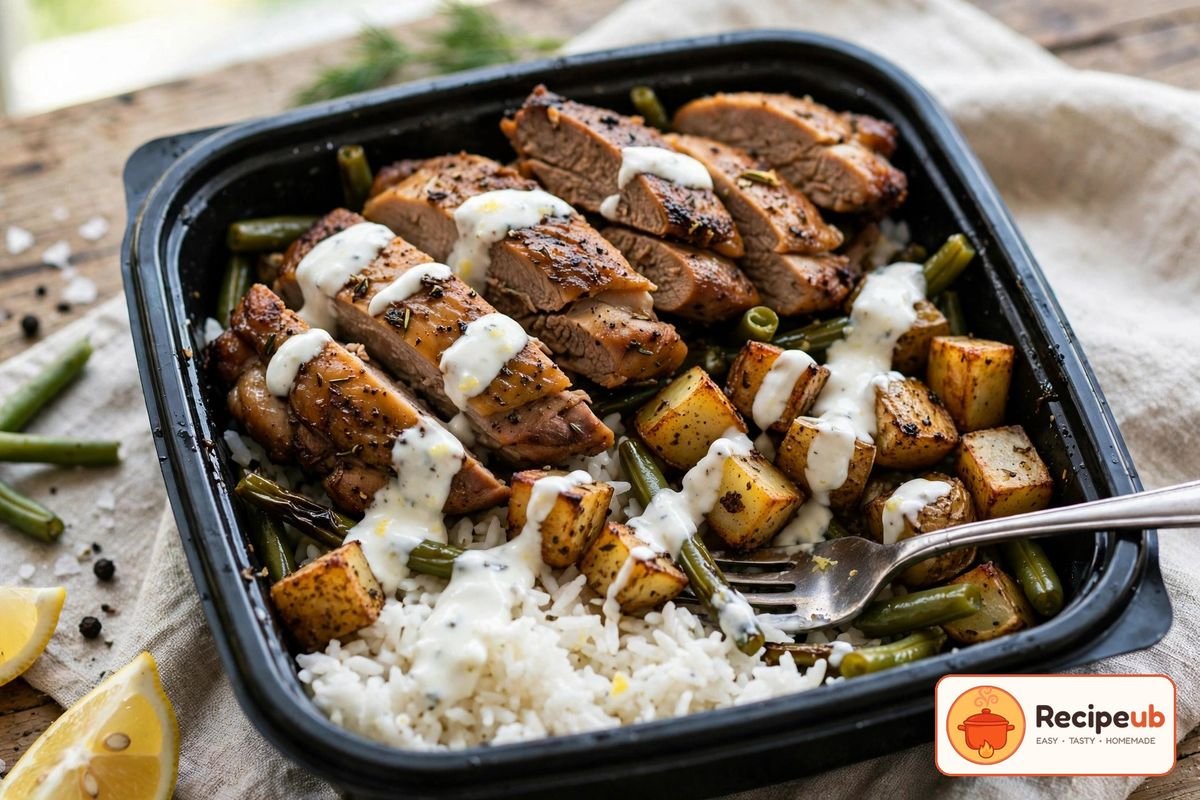
Ingredients
- 1¼ lb boneless, skinless chicken thighs (about 4–5)
- 1 tsp kosher salt, plus a pinch for the sauce
- ½ tsp black pepper
- 1 tsp garlic powder
- 1 tsp smoked paprika
- 1½ lb russet potatoes (about 3 medium), cut in ¾-inch cubes
- 1½ Tbsp olive oil, divided (1 Tbsp for the potatoes, ½ Tbsp for the green beans)
- 1 cup long-grain white rice
- 12 oz frozen green beans (1 bag)
- ½ cup plain nonfat Greek yogurt (one single-serve cup is almost exactly this)
- 1 Tbsp fresh lemon juice (about ½ lemon)
- 1 small clove garlic, grated
- 1 tsp dried dill (or 1 Tbsp fresh dill)
Ingredient notes: The chicken is one standard 1¼ lb tray of boneless skinless thighs — the tray is the batch, on purpose (the Batch Chart above): thighs because a solo meal is a reheated meal and thighs stay moist through reheating, and boneless skinless because the whole point is a batch with no trimming session standing between the store and the pan. The potatoes are russets, bought loose, 3 medium — loose matters for one person, because a 5 lb bag is its own second-half problem; russets because they roast up fluffy-centered at the same 425°F the chicken wants, in the same 25–30 minutes. The green beans are frozen, one 12 oz bag, and frozen is a system choice, not a compromise: they go onto the hot pan straight from the bag for the last 12 minutes, there is no washing, snapping or trimming, and the part of the bag the chart’s smaller rows call for goes back in the freezer instead of wilting in a crisper drawer. The rice is 1 cup dry long-grain white — dry rice is the solo cook’s friend precisely because the rest of the bag keeps; nothing about it spoils while it waits for next week. The yogurt is one single-serve cup of plain nonfat Greek yogurt — almost exactly the ½ cup the sauce needs, so the sauce does not leave a half tub behind either. And the lemon is one: a tablespoon of its juice for the sauce, and the rest is not an ingredient problem, it is a wedge for the reheated meals.

How to Make Meal Prep for One
- Heat the oven and start the rice. Heat the oven to 425°F. Put 1 cup of rice on the stove — 1½ cups of water, a pinch of salt, covered, on low once it simmers — and let it run in parallel with the pan; it will be done and resting inside the pan’s time. While everything heats, mix the kosher salt, black pepper, garlic powder and smoked paprika in a small bowl: one seasoning mix for the whole pan.
- Season the chicken and the potatoes. Pat the thighs dry and rub them with about half the seasoning mix. Toss the potato cubes with 1 Tbsp of the olive oil and the rest of the mix, spread them over a large rimmed sheet pan, and lay the thighs on the same pan in a single layer — everything in one layer, nothing stacked, or it steams instead of roasting.
- Roast, and add the beans at the end. Roast for 25–30 minutes, until the chicken reads 165°F at the thickest point and the potatoes are browned at the edges. With 12 minutes left, toss the frozen green beans with the remaining ½ Tbsp of olive oil and a pinch of salt and scatter them over the pan — straight from the bag, no thawing. They roast in the pan’s last stretch and come out bright instead of tired.
- Whisk the sauce while the pan finishes. Stir the Greek yogurt, lemon juice, grated garlic, dill and a pinch of salt together and divide it between 4 small cups with lids. Two minutes, no cooking — and it is packed separately on purpose, so it goes on after reheating all week (the Tips below say why that matters).
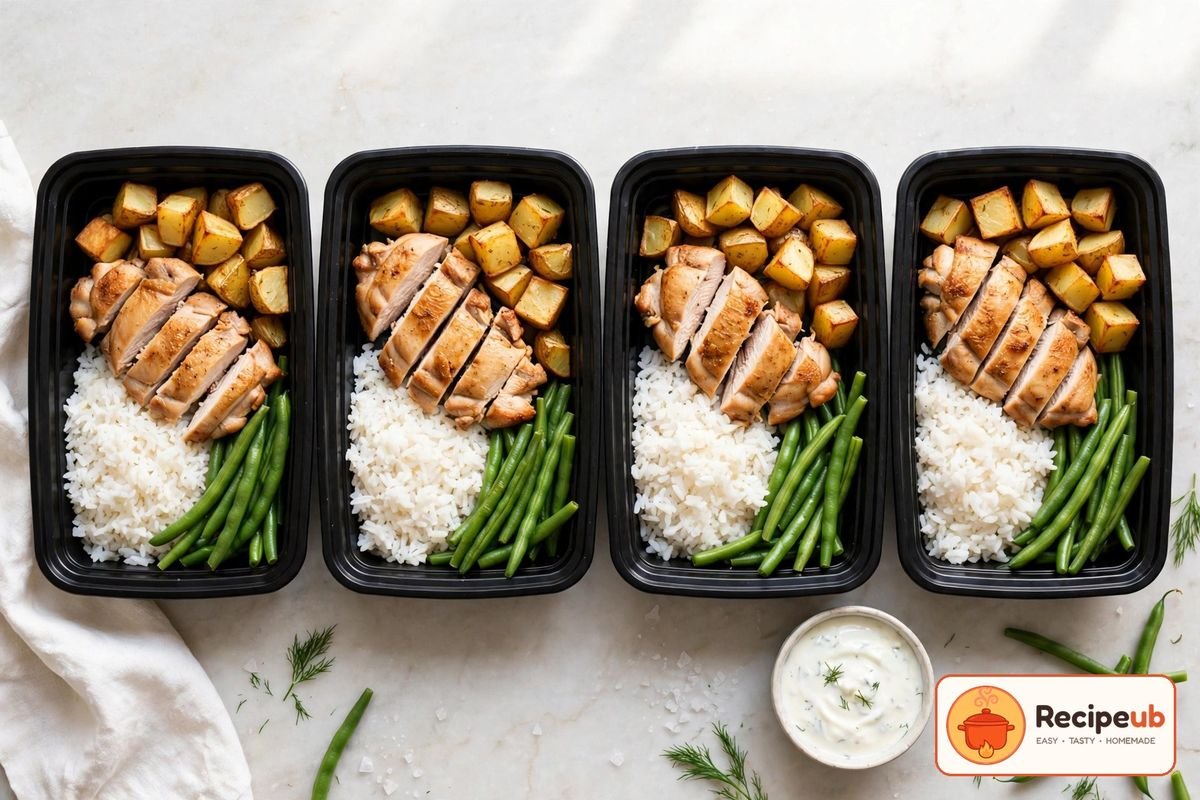
- Rest, slice and pack the four meals. Rest the chicken 5 minutes, then slice it. Divide everything between 4 containers: about ¾ cup of cooked rice, 5 ounces of sliced chicken, a cup of potato cubes and ¾ cup of green beans in each, a sauce cup tucked beside each one. Cool briefly, lid them, and refrigerate within 2 hours of cooking. Day 4 is the last day — that is not a warning, it is the design.

Meal Prep for One (4 Meals, About $1.90 a Meal, 45 Minutes)
Ingredients
Equipment
Method
- Heat the oven to 425°F. Start the rice on the stove (1 cup rice, 1½ cups water, covered, low) so it cooks in parallel. Mix the salt, pepper, garlic powder and smoked paprika.
- Rub the thighs with about half the seasoning. Toss the potato cubes with 1 Tbsp of the olive oil and the rest of the seasoning, spread them on a large rimmed sheet pan, and lay the thighs on the same pan in a single layer.
- Roast 25–30 minutes, to 165°F at the thickest point. With 12 minutes left, toss the frozen green beans with the remaining ½ Tbsp of olive oil and a pinch of salt and scatter them over the pan.
- Whisk the yogurt, lemon juice, grated garlic, dill and a pinch of salt; divide between 4 small lidded cups.
- Rest the chicken 5 minutes and slice it. Pack 4 containers with about ¾ cup of cooked rice, 5 oz of sliced chicken, 1 cup of potato cubes and ¾ cup of green beans each, a sauce cup beside each. Refrigerate within 2 hours; eat within 3 to 4 days.
Notes
- The batch rule: 4 meals is the fridge ceiling. Cooked food keeps 3 to 4 days at 40°F or below (USDA), and a solo eater eats in series — so the batch is sized at 4, and a 5th meal gets frozen on day 0 instead of eaten on day 5.
- The family-pack move: a 3 lb thigh tray is two batches. Freeze half the raw chicken on shopping day and next week’s protein is already bought — the pack never becomes a leftovers problem.
- Reheat to 165°F with a splash of water over the rice, and add the yogurt sauce after reheating, never before — it is a fresh sauce, not a cooking sauce.
- The breast swap, priced: roast 1¼ lb of boneless skinless breast whole on the same pan to 165°F (start checking at 20 minutes). At the BLS October 2026 average of $4.099/lb the same batch costs ≈$2.40 per meal against ≈$1.90 for thighs (a labeled shelf estimate of ~$2.50/lb — BLS publishes no retail thigh average) — and breast reheats drier, which matters in a batch eaten over four days.
What Does the Solo Shop Cost? The Priced Solo Grocery List
Here is the second chart, and it is the one the lane’s own FAQ asks for and never gets: how do I meal prep for one on a budget, answered with a list instead of strategies. One small shop, bought for this batch and nothing else, dated to the October 2026 evidence like the rest of this site’s shelves — the chicken line is a labeled shelf estimate (there is no official retail average for it, and this page will not invent one), and everything else is labeled a shelf estimate, printed as one:
| Line | Amount for the batch | Price basis | Batch cost |
|---|---|---|---|
| Chicken thighs, boneless skinless | 1¼ lb | ~$2.50/lb, labeled shelf estimate (no BLS retail thigh series exists) | ≈$3.15 |
| Long-grain white rice | 1 cup dry (from a 1–2 lb bag) | Shelf estimate, labeled as one | ≈$0.50 |
| Russet potatoes | 1½ lb (3 medium, bought loose) | Shelf estimate, labeled as one | ≈$1.20 |
| Frozen green beans | 12 oz bag | Shelf estimate, labeled as one | ≈$1.10 |
| Greek yogurt, plain nonfat | ½ cup (one single-serve cup is almost exactly this) | Shelf estimate, labeled as one | ≈$0.60 |
| Lemon | 1 | Shelf estimate, labeled as one | ≈$0.60 |
| Olive oil, garlic, dill, salt, pepper, garlic powder, smoked paprika | Pantry amounts | Estimate, labeled as one | ≈$0.50 |
| Batch total | 4 meals | ≈$7.65 → ≈$1.90 per meal |
How to read the table: the list is the recipe — nothing on it is bought for any other purpose, and nothing is left over except pantry staples and the rest of the rice bag, and dry rice keeping is exactly why it was chosen. The breast swap, priced: the same batch built with 1¼ lb of boneless breast at the BLS October 2026 average of $4.099/lb puts the chicken line at $5.12 → batch ≈$9.62 → ≈$2.40 per meal — about 50 cents more per meal for the leaner cut that the lane’s own holders say reheats drier. The comparison is printed because the solo shopper buys one tray, once, and the tray choice is the whole protein budget: there is no family-pack discount quietly subsidizing this list and no second shopper splitting it. Seven dollars and change, four dinners handled, and the most expensive decision in the batch is a $2 tray choice — which is the honest scale of solo budget cooking.
Emma’s Tips for the Best Meal Prep for One
Buy the tray, not the plan. The system works because the shopping is the sizing: one 1¼ lb tray, three loose potatoes, one bag of beans, one cup of rice, one yogurt cup, one lemon. If the cart starts filling with “useful extras,” the second-half problem is back — every extra fresh item is a meal you now owe the fridge. The list above is short enough to memorize, and that is a feature: a solo prep you can shop from memory is a prep that actually happens every week.
Let the sauce carry the variety. Four identical containers is the objection everyone raises to batch cooking, and for one person it is solved in the sauce cup, not in a second recipe. This week’s base takes lemon-dill yogurt; the same base next week takes barbecue sauce, salsa, or hot sauce thinned with a spoon of water — and because the sauce is packed separately and added after reheating, day 3’s meal is not committed to day 1’s flavor. Cook the batch once; season it four times.
Reheat like the meal was planned, not rescued. The splash of water goes over the rice before the microwave, not after — the rice dried a little in the fridge because grains keep absorbing, and the splash hands that moisture back. Heat to a full 165°F, then the sauce, then eat. Skipping the splash is how meal prep gets its gummy reputation; it takes four seconds and it is the difference between a reheated meal and a leftover.
Four containers is the whole equipment list. Glass, about 3 cups each, plus four small lidded cups for the sauce. The 10-pack container set is family-prep equipment; for one person it is four containers in the fridge and six in a cupboard taking up the space the system was supposed to save. Buy the four. If a fifth meal ever joins the batch, it goes in the freezer the day it is cooked — that rule is in the chart, and it is the only upgrade this system needs.
Storage and Reheating
Fridge: The batch keeps 3 to 4 days at 40°F or below — the USDA leftover standard, and the number the whole system is built on. Portion into the containers the day you cook, cool briefly, and refrigerate within 2 hours. Eat the meals in order and treat day 4 as the last day, not the first day to start wondering. The yogurt sauce keeps the same 4 days refrigerated in its cups — it is made fresh each prep, matched to the batch, and it is not a sauce to stretch into a second week.
Reheating: One container at a time: a splash of water over the rice first, then the microwave (or a covered skillet on medium-low) until the meal is steaming hot throughout — 165°F. Stir once halfway so the potatoes and chicken heat at the same pace as the rice. The sauce goes on after reheating, cold from its cup, every time: it is a fresh yogurt sauce, and warming it dulls the lemon and thins it into the rice. A leftover lemon wedge squeezed over the top wakes a day-3 or day-4 meal back up — the acid was a finish on day one and it is a finish again.
Freezer: The cooked meals freeze acceptably for up to 3 months — the chicken, rice and potatoes come back well by the reheating rule above; the green beans soften slightly, which is the honest cost. But the solo-specific freezer move is the other one, and it happens on shopping day, not leftover day: if the store’s tray is the 3 lb family pack, freeze half the raw chicken the day you buy it. Next week’s batch is then already bought, the pack never becomes a second-half problem, and the freezer is working on the system instead of rescuing it. The one planned exception inside the batch itself is the chart’s fifth meal: if you cook five, meal 5 is frozen on day 0, labeled, and eaten within the same 3 months.
FAQs
How many meals should one person meal prep at a time?
Four. Cooked food keeps 3 to 4 days in the fridge at 40°F or below (the USDA window), and a solo eater eats in series — one meal a day — so a batch of four is eaten on days 1 through 4 and never outlives the window. That is the rule the Solo Batch Chart above is built on: 2 and 3 meals are easy fridge batches, 4 is the ceiling, and a 5th meal gets frozen on day 0 instead of eaten on day 5. The standard 8-to-10-box preps assume a family eating in parallel; for one person, they are freezer projects whether they say so or not.
How much chicken do I need for meal prep for one?
5 ounces of raw chicken per meal — so 1¼ lb for the four-meal batch, which is one standard tray of boneless skinless thighs, bought as it comes. The Batch Chart prints the whole scale: 10 oz for 2 meals, about 1 lb for 3, 1¼ lb for 4, about 1½ lb for 5. Each meal ends up with roughly 4 ounces of cooked chicken and about 35 grams of protein across the whole container (estimate). If your store’s tray is a 3 lb family pack, that is two batches — freeze half the raw chicken the day you buy it.
How long does meal prep last in the fridge?
3 to 4 days at 40°F or below, refrigerated within 2 hours of cooking — the USDA leftover standard, and the answer every holder in this lane gives in its own FAQs. This batch is sized to the rule rather than patched around it: cooked on day 0, the fourth meal is eaten on day 4, the last day of the window. The yogurt sauce keeps the same 4 days in its cups. Anything meant for day 5 or later belongs in the freezer from day 0, not in the fridge on a hope.
How much does meal prep for one cost?
This batch: one shop of ≈$7.65 for 4 meals, ≈$1.90 a meal — estimates, itemized line by line in the Priced Solo Grocery List above, with every line’s basis labeled. The chicken is the biggest line at ≈$3.15 (1¼ lb at a labeled shelf estimate of ~$2.50/lb — BLS publishes no retail average for boneless skinless thighs, and this page does not invent one). Built with boneless breast instead, at the verified BLS October 2026 average of $4.099/lb, the same batch runs ≈$2.40 a meal. No plan fees, no special equipment, no second trip.
What should be on a grocery list for meal prep for one person?
Exactly the list that cooks the batch — for this one: 1¼ lb boneless skinless chicken thighs, 3 medium russet potatoes bought loose, one 12 oz bag of frozen green beans, long-grain white rice, one single-serve cup of plain Greek yogurt, and one lemon, over pantry staples (olive oil, garlic, dill, salt, pepper, garlic powder, smoked paprika). The full priced version is Chart 2 above. The solo principle underneath it: buy loose where you can, frozen where it keeps, and dry where it waits — and never buy a fresh item that has no assigned meal, because an unassigned half-pack is where solo budgets actually leak.
Can I freeze meal prep for one?
Yes — two different ways, and the chart marks both. A cooked fifth meal is frozen on day 0 and keeps up to 3 months (the green beans soften slightly on thawing; everything else comes back by the reheating rule). The more useful solo move is freezing raw: half of a 3 lb family tray of thighs, frozen the day you buy it, is next week’s batch already purchased. What does not work is freezing as a rescue on day 4 — by then the meal has spent its fridge window, and the freezer does not hand the days back.
Chicken thighs or chicken breast — which is better for meal prep for one?
Thighs, for a batch — and the reason is reheating. Three of this batch’s four meals are eaten reheated, and thighs stay moist through reheating where breast dries a little more each round; the solo lane’s own recipe holders give the same answer. Breast’s honest wins are leanness and a published price: it is the leaner cut, and at the BLS October 2026 average of $4.099/lb the breast version of this batch costs ≈$2.40 a meal against ≈$1.90 for thighs. The swap is printed on the card with its timing (roast whole on the same pan, start checking at 20 minutes) — it is a fine batch either way, but it is not the same batch.
How do I keep meal prep for one from getting boring?
Change the sauce, not the batch. The base — chicken, rice, potatoes, green beans — is deliberately neutral, and the flavor lives in a sauce that is packed separately and added after reheating, so no meal is committed to day 1’s taste. This week it is lemon-garlic-dill yogurt; the identical base takes barbecue sauce, salsa, or a soy-ginger drizzle next week without a second cook. It is the answer the lane’s holders give in their own FAQs, with the mechanism made structural: the variety is built into the packing, not left to willpower on day 3.
What containers are best for meal prep for one?
Glass containers of about 3 cups — big enough for a full meal with the sauce cup tucked in, small enough that the food fills them instead of drying out in the air space. And the solo number is the point: you need four, plus four small lidded cups for the sauce. Not the 10-pack — that is family-prep equipment, and for one person the extra six containers are just storage debt. Glass earns its place here because these containers are reheated daily; they go from fridge to microwave without staining or holding last week’s sauce flavor.
How do I reheat meal prep bowls safely?
To 165°F throughout, with a splash of water over the rice before heating — the splash hands back the moisture the grains absorbed in the fridge, and it goes on before the heat, not after. Microwave or a covered skillet on medium-low both work; stir once halfway so the chicken and potatoes catch up with the rice. Then the yogurt sauce, cold from its cup, on top. Sauce before reheating is the one order not to swap: warmed yogurt thins and loses the lemon, and it was made to be the fresh part of a reheated meal.
Final Thoughts
Meal prep for one is not a smaller version of family meal prep — it is a different problem, and the problem is sizing. The plans answer it with a week of different dinners and a long grocery list; the guides answer it with portion ranges and no dish; the one recipe card answers it with a chicken and no sides. What this page adds is the paperwork the solo cook actually needs: a batch chart that scales the whole meal by the count that matters — with the fridge rule printed in the right-hand column, where the lane’s only scaler skips the one size that fits — a grocery list with prices and their bases labeled, and a complete meal on one card that a standard 1¼ lb tray cooks exactly, in 45 minutes, for about $1.90 a meal. Four meals, eaten in order, none of them a day past their window, and nothing in the fridge on Friday that nobody assigned on Sunday. That is the whole system — and for a household of one, it is enough.
More Easy Budget Meal Prep
If the solo system fits your kitchen, the rest of this shelf runs on the same rules — every quantity stated, every price labeled, every difference named. When the cook is one but the dish you want is the classic bowl format, my chicken meal prep bowls — the standard-scale chicken, rice and roasted vegetable bowls, portioned into four lunches at regular grocery scale; this post is the solo system, with the sized shopping list and the batch chart the bowls don’t print is the closest relative, and when you would rather cook the protein once and portion it big, my shredded chicken meal prep — the big-batch shredded chicken, 8 portions built for the freezer route; this post is the 4-meal fridge batch that never needs it takes the opposite road on purpose. For the meatless end of the budget shelf, my rice and beans meal prep — the meatless budget prep, beans and rice portioned for the week; this post is the chicken batch, at solo scale proves the same math works without a protein tray at all — and the whole shelf, solo batches and family batches alike, is gathered in my budget meal prep ideas — the full collection of this site’s budget meal prep systems, with the priced lists and batch charts for each, which is where to start when the next system you need is bigger than one person’s fridge. One shelf, one standard — the batch is sized to the eater, the list is priced, and dinner is handled.




Never Run Out of Dinner Ideas
One easy air fryer or slow cooker dinner in your inbox every week. No spam, ever.
You’re on the list — welcome to Recipeub!