
Slow Cooker Minestrone Soup (Pasta That Stays Firm, 6 Hours on LOW)
Slow cooker minestrone soup is the named Italian soup of beans, small pasta and vegetables in a tomato broth — and it is the slow cooker soup with one famous failure mode: pasta that swells, splits and drinks the whole pot. This version is built to beat exactly that. Two cans of beans — kidney for structure, cannellini for cream — a 28-ounce can of tomatoes, 6 cups of broth and a Parmesan rind cook on LOW for 6 hours, the beans go in at hour 5 instead of hour 0, and the ditalini gets its own 30-minute stage on HIGH at the end, timed on a chart by shape. The bowl lands at about 225 calories and about $1.35, eight servings of 1½ cups each — and every component in it is still itself: whole beans, firm pasta, green zucchini.
Read the top recipes for this dish closely and page 1 is two camps that never acknowledge each other. Half the ranking pages cook the pasta in a separate pot and stir it in per bowl; the other half stir dry pasta into the cooker for the last 15 to 30 minutes — and neither camp prints the rule that explains why both exist, which is that pasta in soup never stops absorbing broth. The vegetable timing is just as split: one of the biggest pages puts the zucchini in for the full 6 to 8 hours, where it dissolves, while the brand holder adds hers 40 minutes out — and no page prints the whole order as one system. The beans get the same treatment: one can here, three cans there, four cans somewhere else, a dried-bean build whose 20-minute par-boil is printed with no explanation at all, and freeze answers that freeze the finished soup, pasta and all, without a word about what thawing does to it. This page prints the four systems the decisions actually need: the pasta minutes for your shape by both methods, the hour every ingredient goes in, the bean math canned versus dried with the safety rule attached, and the freezer rule that makes the leftovers work.
It also knows its neighbors on this site, because the slow cooker soup shelf here is deliberate. This post is the Italian bean-and-pasta pot. Its nearest neighbor is my slow cooker vegetable soup — the all-vegetable pot with potatoes, corn and peas and no pasta, for the nights the soup is a general vegetable soup and not the Italian bean-and-pasta one: that one is a general vegetable pot built on whatever the crisper holds, and this one is a named dish with a structure — two beans, a small pasta, a Parmesan finish. And where this post’s tomatoes stay in chunks as the broth the beans and pasta swim in, my slow cooker tomato soup — the smooth, blended tomato soup finished with half-and-half; this minestrone keeps its tomatoes in chunks and fills the bowl with beans and pasta makes the tomato itself the entire soup. Chunky versus blended, composed versus single-ingredient — each post stays in its lane.
The short answer: Load 1 diced onion, 3 carrots, 3 celery stalks, 4 garlic cloves, 2 Tbsp tomato paste, a 28-oz can of diced tomatoes, 6 cups of low-sodium vegetable broth, 1½ tsp Italian seasoning and a Parmesan rind into a 6-quart slow cooker and cook on LOW. At hour 5, add 1 can each of kidney beans and cannellini beans, drained and rinsed. At hour 6, switch to HIGH and add 1 diced zucchini, 2 cups of green beans and 1 cup of dry ditalini for 25–30 minutes; wilt in 3 cups of baby spinach in the last 5 minutes. Eight bowls of about 1½ cups — about 225 calories and $1.35 each.
In This Recipe
The Plan at a Glance
- Base: onion, carrots, celery, garlic, tomato paste, a 28-oz can of diced tomatoes, 6 cups low-sodium vegetable broth, Italian seasoning, bay leaves and a Parmesan rind — in at hour 0
- Beans: 1 (15 oz) can kidney beans + 1 (15 oz) can cannellini beans, drained and rinsed — in at hour 5, not hour 0, because canned beans are already cooked
- Pasta stage: 1 cup dry ditalini (about 4 oz) with the zucchini and green beans, on HIGH for the last 30 minutes — every other shape is timed in the Pasta Timing Chart below
- Finish: 3 cups baby spinach wilted in during the last 5 minutes; ¼ cup grated Parmesan over the bowls
- Time: 20 minutes prep / 6 hours 30 minutes cook / 6 hours 50 minutes total (the all-HIGH path, 3 hours 30 minutes, is in the card notes)
- Yield: 8 servings of about 1½ cups each
- Calories: ~225 per serving (estimate); the Italian sausage variation lands at ~365
- Cost: about $1.35 per serving at October 2026 prices; about $1.20 with the dried-bean swap
- Storage: fridge 3 to 4 days; freeze the base without pasta for up to 3 months — the rule is in the Freeze section below
Why This Recipe Works
The pasta gets its own stage, and its own chart. Mushy pasta is this soup’s number one failure mode — it is the question the ranking pages’ FAQs circle, the founding problem of the freshest challenger on page 1, and the reason the separate-pot camp exists at all. So this build never asks pasta to survive a 6-hour cook: the ditalini goes in dry, on HIGH, for the last 25 to 30 minutes, and the chart below times five shapes by both methods — in the cooker, or boiled separately and stirred in — because which method is right depends on whether the pot is tonight’s dinner or tomorrow’s leftovers too.
Every vegetable has an entry time, not a dump time. A slow cooker soup is four different cooks wearing one lid. The hard vegetables and the tomato broth need all 6 hours; canned beans need one; zucchini and green beans need 30 minutes; spinach needs 5. The Add-Order Chart below assigns each component its hour, and the evidence for it is on page 1 in both directions — the biggest community recipe dissolves its zucchini over a full cook, while the test-kitchen and dietitian pages quietly add their beans, zucchini and pasta at the end and never print the system they are following.
Two beans, on purpose. Kidney beans hold their shape and their bite through the pasta stage; cannellini beans loosen a little of their starch into the broth and body it — the whole-bean version of the thickening the brand holder gets by pureeing a can. One can of one bean (the lightest builds on page 1) makes a thinner soup with about 40 fewer calories a bowl; four cans make a bean stew wearing a minestrone name. Two cans, one of each, is the dish.
The Parmesan rind is the depth, and it is already in your freezer. A rind simmered in the tomato broth for 6 hours gives the soup the savory base that a meatless pot has to earn — it is the move the strongest pages on page 1 share (the brand holder, the fresh challenger, the dump-and-go page all print it), and it costs nothing, because the rind is the part of the wedge you were going to throw away. The grated Parmesan at the table is the finish; the rind is the foundation.
The freezer batch is a different object from tonight’s soup. Every freeze answer on page 1 freezes the finished soup and lets the pasta thaw split and bloated, with the broth drunk into it. This system freezes the soup through the bean stage — no pasta, no spinach — and runs the 30-minute pasta stage fresh on serving day. One stage of work returns a bowl that tastes cooked that day; the rule is printed in full below.
The numbers show their work. This page prints what a bowl costs (about $1.35, on verified bean prices and labeled estimates for the rest) and why its calorie number is 225 when page 1 claims everything from 100 to 335 for the same-named soup: the builds and the bowls differ, and once both are stated, the spread explains itself. A number you can audit beats a number you are asked to trust.
When Does the Pasta Go In? The Pasta Timing Chart
Here is the first chart this post exists to print, and it starts with the rule that explains the whole argument on page 1: pasta in soup never stops drinking. It absorbs broth in the pot after the lid comes off, it absorbs broth in the fridge overnight, and it absorbs twice as fast after a freeze-thaw. That one rule is why half of page 1 cooks pasta in a separate pot and the other half stirs it in at the end — both camps are managing the same absorption, and neither says so. This chart prints both methods, by shape, for a 6-quart cooker of this soup switched to HIGH for the pasta stage. Every shape ends at the same finish: just tender, with a bite left — it keeps cooking in the hot broth after the lid comes off.
| Pasta shape | Dry, into the cooker on HIGH | Cooked separately (boiled), stirred in | In leftovers / after thawing |
|---|---|---|---|
| Ditalini — the recipe (about 4 oz per cup) | 25–30 min | Boil 8–9 min to just shy of done; stir in at serving | The best keeper of the small shapes — still softens; add a splash of broth at reheat |
| Small shells (conchigliette) | 25–30 min | Boil 8–10 min; stir in at serving | The cups hold broth and split first — the weakest leftover shape |
| Elbow macaroni | 20–25 min | Boil 7–8 min; stir in at serving | Bloats the most of the three classics — the separate-pot method earns its keep here |
| Orzo | 15–20 min | Boil 7–9 min; stir in at serving | Drinks the most broth per ounce — the pot needs up to 1 extra cup of broth by day 2 |
| Broken spaghetti (1-inch pieces) | 20–25 min | Boil 8–9 min; stir in at serving | Stays distinct longest — the leftover-friendly swap |
How to read the chart: the in-cooker minutes are the convergent middle of the versions that rank for this dish — the ranking pages print 15 to 30 minutes on HIGH for pasta stirred into the cooker, but always as one flat number for whatever shape that page happened to use. Broken out by shape, the logic shows: orzo is small and drinks fast, so it gets the shortest stage; ditalini and shells are thick-walled tubes, so they get the longest. Which method should you use? The in-cooker method, this recipe’s default, is for a pot that will be eaten tonight — one pot, no extra pan, and the pasta drinks broth that was measured for it. The separate-pot method is for a pot that must hold leftovers: boil the pasta 1 minute shy of done, store it apart from the soup or add it per bowl, and day 2 tastes like day 1. The strictest form of that method is the brand holder’s per-bowl service — ¼ cup of cooked pasta under 1¼ cups of soup, assembled in the bowl — and it is credited here because it works, even though her page never prints the chart that tells you what to do with any other shape. And if a starch timing chart is your kind of furniture, this site’s other one is my slow cooker chicken and rice soup — the other soup on this site with a starch timing chart; rice there, ditalini here: same problem, different grain, same solution.
What Order Do the Vegetables Go In? The Add-Order Chart
Here is the second chart. A slow cooker minestrone is not a dump-and-go soup, whatever the convenience lane on page 1 claims — it is one pot with four entry points, and every component in this recipe is assigned to one of them:
| Entry point | What goes in | Why |
|---|---|---|
| Hour 0 | Onion, carrots, celery, garlic, tomato paste, diced tomatoes, broth, Italian seasoning, bay leaves, Parmesan rind | The hard vegetables need the whole cook; the tomato-herb broth is built by it. (The optional 5-minute soffritto — onion, carrot and celery started in the olive oil first — deepens this layer; the strongest technique pages pay for it, and the base method here skips it) |
| The last hour (hour 5 on LOW) | Kidney beans + cannellini beans | Canned beans are already cooked — they need heating through and broth time, not cooking. Six hours from hour 0 splits their skins and clouds the broth (the dietitian page adds them at the end too — the instinct, formalized) |
| The last 30 minutes (the HIGH pasta stage) | Zucchini, green beans, the ditalini | Zucchini at hour 0 is the failure the biggest community recipe prints — 6 to 8 hours dissolves it into the broth. At 30 minutes it is tender and still itself. Green beans land in the same window (frozen green beans can go in at the last hour with the beans) |
| The last 5 minutes | Baby spinach | Spinach needs only the broth’s residual heat to wilt; an hour in the pot turns it olive-drab and stringy. (Kale or chard are sturdier: they take the last 30 minutes with the zucchini) |
How to read the chart: read it as a clock, not a preference list. Each row exists because one ingredient’s correct cooking time is different from the pot’s total time, and a slow cooker cannot change temperature mid-row — so the cook changes the ingredient’s start instead. The two mistakes this chart prevents are the two page 1 actually commits: zucchini dissolved by an hour-0 start, and canned beans burst by a full cook they never needed. The potato variation, printed with the chart because the searches ask for it: 1 medium russet or Yukon Gold, cut into ½-inch pieces, goes in at hour 0 with the carrots — two of the ranking builds carry it — and it adds about 25 calories per serving (estimate) and makes the soup eat like a stew. It is a variation, not the base: the potato-forward vegetable pot on this site belongs to the vegetable soup linked up top, and this post’s base build stays in the classic Italian lane.
Canned or Dried? The Bean System
Here is the third chart, and it answers the second-loudest question in the searches for this dish — bean type, bean substitute, no beans complete in stem after stem. The build is two beans, on purpose: kidney for structure (it holds its shape and its bite through the pasta stage) and cannellini for cream (its starch loosens into the broth and bodies it). The lanes, with the math printed:
| Lane | Amount for this pot | Cost basis | The rule |
|---|---|---|---|
| Canned — the recipe | 1 (15 oz) can kidney + 1 (15 oz) can cannellini, drained and rinsed (about 3 cups cooked beans) | $0.92/can, Walmart Great Value → $1.84 | Already fully cooked by the canner — safe by default, and the reason they go in at the last hour, not hour 0. Rinsing cuts the canning liquid’s sodium and starch |
| Dried — the swap | ½ lb dried beans total (¼ lb kidney + ¼ lb cannellini, or ½ lb of one) → about 3 cups cooked | $1.68/lb, BLS October 2026 → about $0.84 | Soak overnight, then BOIL in fresh water before the cooker — at least a 20-minute par-boil, and kidney beans get a full hard boil: a slow cooker simmers below the boil that makes dried kidney beans safe (the rule below). Cooked dried beans then enter at hour 0 — unlike canned, they still have texture to spare |
The swap matrix (from the searches): great northern — milder, swaps 1:1 for cannellini · pinto — earthier, swaps 1:1 for kidney · chickpea — firmer and nuttier, the third bean in the slow-cooker specialist site’s build · black beans — they work mechanically, but they take the soup out of Italy and toward my slow cooker chicken tortilla soup — the Mexican-spiced chicken soup with black beans, corn and chipotle; this one is the meatless Italian bean-and-pasta pot, so they are printed as a warning, not a swap · no beans — a real search lane, and an honest one: the soup becomes a vegetable-pasta soup, closer to the general vegetable pot linked in the intro, and the chart says so rather than pretending it is still minestrone. One can of one bean (the lightest ranking builds) is the light version: about 40 fewer calories per serving (estimate) and a thinner broth.
The dried-kidney-bean rule — the safety half of this system, and the rule zero recipe pages print: dried red kidney beans carry a natural lectin (phytohaemagglutinin) that is destroyed by a hard boil and is NOT reliably destroyed by a slow cooker’s simmer — undercooked dried kidney beans are a documented cause of food poisoning, and federal food-safety guidance (the FDA’s Bad Bug Book) is to soak dried beans and then boil them in fresh water before eating. So dried beans for this soup are soaked overnight and boiled in fresh water first — and dried kidney beans in particular never go into the slow cooker raw. The deepest technique page on page 1 quietly performs a 20-minute par-boil of its dried beans without ever saying why; this is why. Canned beans are already fully cooked by the canner — which is why canned is this recipe’s default, not a shortcut to apologize for.
How to read the chart: the canned lane costs about a dollar more per pot and buys safety and tenderness control; the dried lane halves the bean cost and demands the boil. Both numbers are verified prices, not the niche’s usual unsourced “beans are cheap.” One more move from the ranking set, printed as the variation it is: for a thicker, bean-blended pot, puree one of the cans with a cup of the broth before it goes in — the brand holder’s signature thickener. This recipe keeps both cans whole, because the bowl is the point: whole beans, firm pasta, distinct vegetables.
What Does a Pot Cost? The Honest Math
No page that ranks for this dish prints any cost at all. Here is this pot’s math, dated to the October 2026 evidence like the rest of this site’s slow cooker shelf — the bean lines are verified prices, and everything else is labeled a pantry estimate, printed as one:
| Line | Amount for the batch | Price basis | Batch cost |
|---|---|---|---|
| Canned kidney + cannellini beans | 2 × 15 oz cans | $0.92/can, Walmart Great Value (verified) | $1.84 |
| Diced tomatoes | 1 × 28 oz can | Pantry estimate, labeled as one | ≈$1.25 |
| Low-sodium vegetable broth | 6 cups (1½ × 32 oz cartons) | Pantry estimate, labeled as one | ≈$2.60 |
| Ditalini | 1 cup dry (4 oz of a 16 oz box) | Pantry estimate, labeled as one | ≈$0.35 |
| Produce (onion, carrots, celery, zucchini, green beans, spinach, garlic) | The build in the recipe | Pantry estimate, labeled as one | ≈$3.50 |
| Olive oil, tomato paste, Parmesan (rind + grated), spices | Pantry amounts | Estimate, labeled as one | ≈$1.20 |
| Batch total | 8 servings | ≈$10.75 → about $1.35 per serving | |
| Dried-bean swap | ½ lb dried beans | $1.68/lb, BLS Oct 2026 (verified) | $0.84 → batch ≈$9.75 → about $1.20 per serving |
How to read the table: only the bean lines are price-verified; the rest are labeled estimates, printed as estimates. Even so, this is the only cost table on page 1 for this dish — and at about $1.35 a bowl for a bean-and-pasta soup that eats as a meal, it is the budget frame this site’s slow cooker shelf runs on. The dried lane’s math is the honest trade in the Bean System above: about a dollar saved per pot, paid for with an overnight soak and a boil the recipe does not let you skip.
Can You Freeze Minestrone? The Freeze-Without-Pasta Rule
Here is the fourth system, and it starts with the observation that the freeze question for this soup is not “can you” — it is “what, exactly, do you freeze.” The ranking answers freeze the finished soup, pasta in, for up to 3 months, and say nothing else. The pasta’s absorption rule from Chart 1 is what that silence costs: frozen in the soup, pasta thaws split and bloated, and the broth it drank never comes back. So this system freezes a different object:
The rule: freeze the soup through the bean stage. Base and beans cooked, pasta and spinach not yet added. Portion it, cool it, and freeze it for up to 3 months (safe longer at 0°F; quality is the deadline). To serve: thaw overnight in the fridge, bring the base back to a simmer, and run the 30-minute HIGH pasta stage with the zucchini and green beans, then wilt the spinach in at the end — the full method is in the Storage section below. The rule costs one 30-minute stage on serving day and returns a bowl that tastes cooked that day.
How to read the rule: it is the absorption rule wearing a calendar. Everything on this page that manages pasta and broth at once — the two charted methods, the separate-pot advice for leftovers, this freeze rule — is the same physics at three different timescales: tonight, tomorrow, and next month. The pages that print a bare “freeze up to 3 months” are not wrong about the window; they are silent about the object, and the object is the whole game.

Ingredients
- 1 Tbsp olive oil (for the optional soffritto start — see the notes; the base method is load-and-go)
- 1 large yellow onion, diced
- 3 medium carrots, diced (about 1½ cups)
- 3 celery stalks, diced (about 1 cup)
- 4 cloves garlic, minced
- 2 Tbsp tomato paste
- 1 (28 oz) can diced tomatoes, undrained
- 6 cups low-sodium vegetable broth
- 1 Parmesan rind (optional but recommended)
- 1½ tsp Italian seasoning
- 1 tsp kosher salt
- ½ tsp black pepper
- 2 bay leaves
- ¼ tsp red pepper flakes (optional)
- 1 (15 oz) can kidney beans, drained and rinsed
- 1 (15 oz) can cannellini beans, drained and rinsed
- 2 cups fresh green beans, cut into 1-inch pieces (frozen works — see the notes)
- 1 medium zucchini, diced
- 1 cup dry ditalini (about 4 oz)
- 3 cups fresh baby spinach (about 3 oz)
- ¼ cup grated Parmesan, for serving (about 1 Tbsp per bowl)
Ingredient notes: The beans are the system, so buy them like it matters: one can of kidney, one can of cannellini — kidney for the bite, cannellini for the body — drained and rinsed, because rinsing washes off the canning liquid’s extra sodium and starch, and they go in at hour 5, not with everything else; the Bean System above has the dried swap (½ lb total) and the boil rule that comes with it. The pasta is ditalini — short tubes that fit on a spoon with a bean, which is the whole design of the dish; small shells, elbow macaroni, orzo and broken spaghetti all work, each on its own line of the Pasta Timing Chart. The Parmesan rind is the one ingredient to plan around: save rinds in a bag in the freezer whenever you finish a wedge, and drop one in frozen — it gives back its flavor over the 6 hours and comes out before serving. (For a fully vegetarian or vegan bowl, the rind and the grated Parmesan are the ingredients to drop or swap — see the FAQs.) The tomatoes are diced and undrained — the can’s liquid is part of the broth — and the broth is low-sodium because the beans, the rind and the finishing cheese all bring salt of their own; season at the end, not the start. The green beans are fresh in the recipe; frozen green beans work on the same chart, added at the last hour with the beans instead of the last 30 minutes. And the zucchini is one medium, diced not sliced — cubes hold their shape through the 30-minute pasta stage in a way half-moons do not.
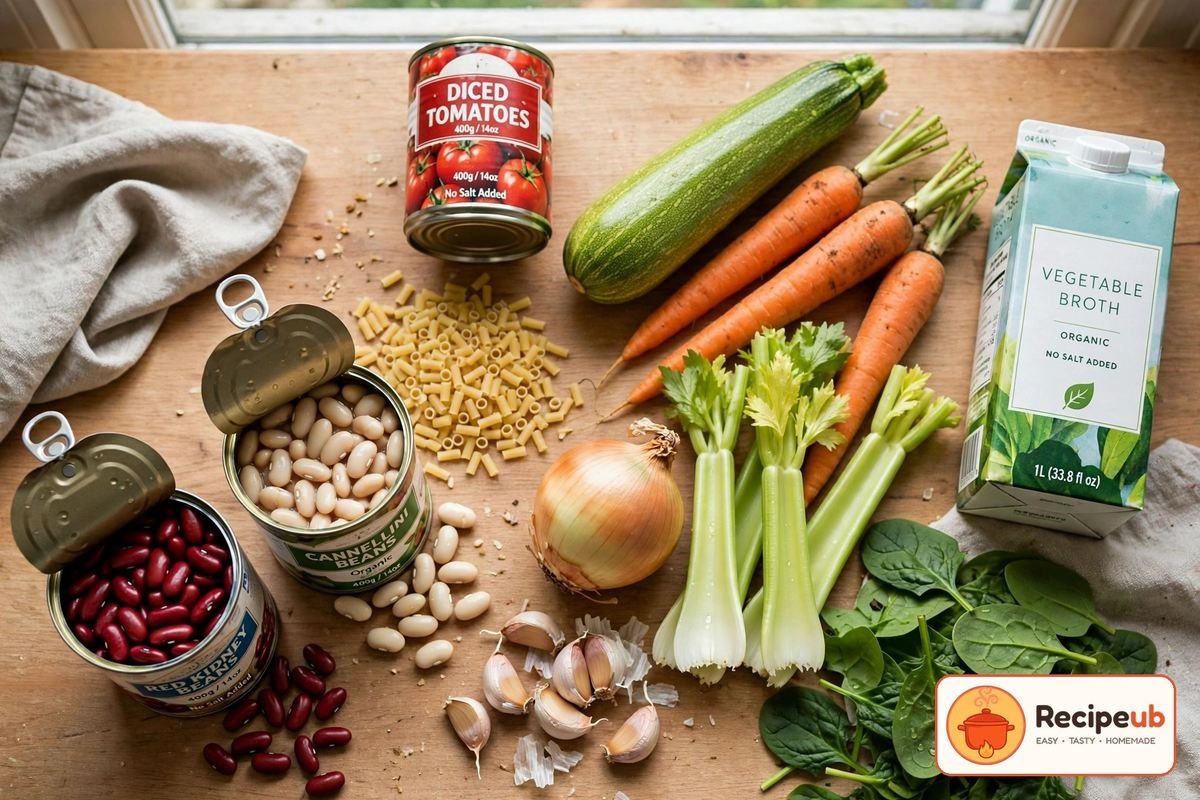
How to Make Slow Cooker Minestrone Soup
- Load the base (hour 0). Add the onion, carrots, celery, garlic, tomato paste, diced tomatoes with their liquid, vegetable broth, Italian seasoning, kosher salt, black pepper, bay leaves and the Parmesan rind to a 6-quart slow cooker, and stir once to settle everything. (Optional depth: first cook the onion, carrot and celery in the olive oil in a skillet for 5 minutes, until softened at the edges, then scrape it all into the cooker — the soffritto start. The base method skips it on purpose.)
- Cook the base on LOW for 5 hours. Cover and walk away. The carrots should be nearly tender and the broth should taste like a soup, not like canned tomatoes — the tomato-herb base is built in this phase.
- Add the beans (hour 5). Stir in the drained, rinsed kidney beans and cannellini beans. Cover and cook on LOW 1 more hour — long enough for the beans to heat through and take on the broth, short enough that their skins stay intact.
- Run the pasta stage (hour 6). Switch the cooker to HIGH. Stir in the zucchini, green beans and the dry ditalini. Cover and cook 25 to 30 minutes, until the pasta is just tender with a bite left — start tasting at 25, because it keeps cooking in the hot broth after the lid comes off.
- Wilt the spinach (the last 5 minutes). Stir in the baby spinach a handful at a time and let it wilt in the broth’s heat, about 5 minutes. It looks like too much spinach for about one minute, and then it is exactly right.
- Finish and serve. Fish out the bay leaves and the Parmesan rind. Taste and add salt if the broth needs it — the rind and the beans decide how much. Ladle into bowls at about 1½ cups each and shower each bowl with about 1 Tbsp of grated Parmesan.


Slow Cooker Minestrone Soup (Pasta That Stays Firm, 6 Hours on LOW)
Ingredients
Equipment
Method
- Add the onion, carrots, celery, garlic, tomato paste, diced tomatoes with their liquid, broth, Italian seasoning, salt, black pepper, bay leaves and Parmesan rind to a 6-quart slow cooker. (Optional: start the onion, carrot and celery in the olive oil in a skillet for 5 minutes first, then add.)
- Cover and cook on LOW for 5 hours, until the carrots are nearly tender.
- Stir in the drained, rinsed kidney beans and cannellini beans. Cover and cook on LOW for 1 more hour.
- Switch to HIGH. Stir in the zucchini, green beans and dry ditalini. Cover and cook 25 to 30 minutes, until the pasta is just tender with a bite left.
- Stir in the spinach and let it wilt in the hot broth, about 5 minutes.
- Remove the bay leaves and the Parmesan rind. Taste for salt, ladle into bowls (about 1½ cups each), and top each bowl with about 1 Tbsp of grated Parmesan.
Notes
- The charts on the page run this recipe: the Pasta Timing Chart (ditalini and small shells 25–30 min dry into the cooker on HIGH; elbow macaroni and broken spaghetti 20–25; orzo 15–20 — or boil any shape separately, 1 minute shy of done, and stir in at serving; pasta in soup keeps absorbing broth in the pot, in the fridge and after thawing, which is why the two methods exist), the Vegetable Add-Order Chart (hour 0: onion, carrots, celery, tomatoes, broth, herbs, rind; last hour: canned beans; last 30 minutes: zucchini, green beans and the pasta stage; last 5 minutes: spinach), the Bean System (canned: 1 can kidney + 1 can cannellini at $0.92 a can, Walmart Great Value, October 2026; dried: ½ lb total for about $0.84 at the BLS October 2026 dried-bean average of $1.68/lb — soaked overnight and BOILED in fresh water before the cooker, never raw into the cooker, kidney beans above all), and the Freeze-Without-Pasta Rule (freeze the soup through the bean stage, without pasta or spinach, up to 3 months; thaw, simmer, and run the pasta stage fresh).
- HIGH path: cook the base on HIGH for 3 hours, add the beans for the last 30 minutes of that base time, then run the same 30-minute HIGH pasta stage — total cook 3 hours 30 minutes.
- Italian sausage variation: brown and crumble 1 lb of mild Italian sausage (casings removed), drain it, and add it with the base at hour 0. It adds about 140 kcal per serving (estimate), taking a bowl to about 365 kcal. Ground beef and ground turkey follow the same brown-first rule.
- Potato variation: 1 medium russet or Yukon Gold, cut into ½-inch pieces, goes in at hour 0 with the carrots; adds about 25 kcal per serving (estimate) and makes the soup eat like a stew.
- Storage: refrigerate within 2 hours; fridge 3 to 4 days at 40°F or below (day-2 pasta is softer — the absorption rule — and the pot wants a splash of broth at reheat); reheat to 165°F. Freeze the base without pasta for up to 3 months.
Emma’s Tips for the Best Slow Cooker Minestrone Soup
Taste the pasta at 25 minutes, not 30. The chart’s range is honest because cookers run at different heats — and because the pasta keeps cooking in the hot broth after the lid comes off and the bowls are ladled. Pull the stage when the ditalini still has a small bite at its center; by the time the bowls reach the table, it will be exactly tender. Thirty seconds of tasting at minute 25 is the whole difference between this soup’s title and the failure mode it is named against.
Keep a bag of Parmesan rinds in the freezer. Every time you finish a wedge of real Parmesan, the rind goes in the bag instead of the trash. A rind simmered for 6 hours in tomato broth is the cheapest depth in Italian cooking — it is what makes a meatless pot taste like it has been cooking all day in a restaurant kitchen — and it comes out of the pot before serving, so nothing is wasted but the bag space.
Rinse the beans, and mean it. The liquid in a can of beans is starchy and salty, and in a soup whose broth you built on purpose, it clouds the pot and salts it before you have had a say. Thirty seconds under the tap is the difference between a broth that tastes like tomatoes and herbs and one that tastes like the can. The one exception is the puree variation in the Bean System — there, the can’s beans and a cup of broth go into the blender on purpose, as a thickener, not by default.
Decide about leftovers before you cook the pasta, not after. If this pot is tonight’s dinner with tomorrow’s lunch riding on it, use the chart’s separate-pot method for the pasta and store the pasta apart from the soup — the absorption rule does not negotiate. If the pot will be eaten tonight, the in-cooker stage is simpler and the pasta drinks broth that was measured for it. The choice takes ten seconds at hour 6; it cannot be made at all on day 2.
Storage and Reheating
Fridge: Leftover minestrone keeps 3 to 4 days at 40°F or below — the careful end of the range the ranking pages print (some say five; this post prints the USDA-aligned line, the same standard as the rest of this site). Refrigerate within 2 hours of cooking. The one honest caveat, straight from Chart 1: pasta sitting in leftover soup keeps absorbing broth overnight and turns bloated, so day-2 bowls are softer than day-1 bowls — expected, not spoiled. If you know on cooking day that leftovers matter, the separate-pot pasta method (or storing the pasta apart from the soup) is how day 2 tastes like day 1.
Freezer: Freeze the soup through the bean stage — base and beans, no pasta, no spinach — for up to 3 months (safe longer at 0°F; quality is the deadline). Portion it flat in containers or bags and thaw overnight in the fridge. The finished soup with the pasta already in it freezes the way the bare answers on page 1 imply it does: the pasta thaws split and bloated and the broth is gone into it. The rule costs one 30-minute stage on serving day and returns a bowl that tastes cooked that day.
Reheating: Bring the refrigerated or thawed base back to a simmer and heat it through to 165°F. If the pasta was frozen out, run the pasta stage fresh at the simmer: zucchini, green beans and ditalini in for 25 to 30 minutes on the stove’s low simmer (or back in the slow cooker on HIGH), spinach wilted in at the end. If the pasta was already in, add a splash of broth to replace what it drank overnight, and heat gently — a hard boil is unkind to pasta that has already given up its structure once.
FAQs
Can you cook minestrone in a slow cooker?
Yes — it is one of the soups the appliance is best at, with one caveat: the pasta cannot take the long cook. The base, the beans and the hard vegetables are made for 6 hours on LOW; the pasta gets its own 30-minute stage on HIGH at the end, timed on the chart above. Cook the whole thing start to finish including the pasta and you get the failure mode this dish is famous for — blown-out pasta and a pot with no broth left. Staged, the slow cooker version is better than the stovetop one for a weeknight, because the 6 hours ask nothing of you but the loading.
When do you add the pasta to slow cooker minestrone — and how do you keep it from getting mushy?
Two honest methods, both on the Pasta Timing Chart. In the cooker: stir the dry pasta in on HIGH for the last 15 to 30 minutes, by shape — ditalini and small shells 25–30, elbow and broken spaghetti 20–25, orzo 15–20 — and serve it soon after. Separately: boil the pasta 1 minute shy of done and stir it in at serving, or portion it per bowl. The mushiness is not really about minutes; it is about absorption. Pasta in soup keeps drinking broth in the pot, in the fridge and after thawing, so the method follows the plan: in-cooker for a pot eaten tonight, separate-pot for a pot that must hold leftovers, and no pasta at all in the freezer batch.
What kind of pasta goes in minestrone?
Ditalini — short, smooth tubes about the size of the beans, designed to land on a spoon with a bean in the same bite. It is the classic shape and the one this recipe is timed on (1 cup dry, about 4 oz). The standard substitutes, each timed on the chart: small shells (conchigliette), elbow macaroni, orzo, and broken spaghetti in 1-inch pieces. What they share matters more than which you pick: small, sturdy, and spoon-size. Long pasta unbroken, and big shapes like rotini or penne, change the dish’s proportions — every spoonful becomes a wrestling match instead of a bite of everything.
What beans go in minestrone — and can I leave them out?
The classic pair, and this recipe’s build: one 15-oz can of kidney beans and one of cannellini beans, about 3 cups of cooked beans to the pot — kidney for structure, cannellini for the cream its starch gives the broth. Swaps that stay in the dish: great northern for the cannellini, pinto for the kidney, chickpeas as a firmer third direction (the full matrix is in the Bean System above). And yes, you can leave the beans out entirely — searchers ask, and the answer is honest: without beans the soup becomes a vegetable-pasta soup, closer to a general vegetable pot than to minestrone, because the beans are half the dish’s definition. It will still be a good soup. It will not be this one.
Can I use dried beans instead of canned?
Yes — ½ lb of dried beans total (¼ lb kidney + ¼ lb cannellini, or ½ lb of one) makes the same ≈3 cups cooked, and at the October 2026 BLS average of $1.68 a pound for dried beans it costs about 84 cents against $1.84 for the two cans. The rule that comes with the savings is not optional: soak the beans overnight, then boil them in fresh water before the slow cooker — at least a 20-minute par-boil, and a full hard boil for kidney beans. Dried kidney beans carry a lectin that a hard boil destroys and a slow cooker’s simmer does not reliably destroy; dried kidney beans never go into a slow cooker raw. Once boiled, dried beans enter at hour 0 — unlike canned, they still have texture to spare.
Can I add meat to slow cooker minestrone?
Yes — it is the loudest variation question in the searches (Italian sausage, ground beef and ground turkey all complete on their own). The measured version on this page: 1 lb of mild Italian sausage, casings removed, browned, crumbled and drained, added with the base at hour 0 — it adds about 140 calories per serving (estimate), taking a bowl from ~225 to about 365 kcal. Ground beef and ground turkey follow the same brown-first rule: browned and drained before the cooker, no extra cook time. The base recipe stays meatless, because that is the classic dish — the variation is printed with its numbers for the nights it is not.
Why did my zucchini dissolve — when do the vegetables go in?
Because it went in at hour 0. Zucchini is a 30-minute vegetable; given a 6-to-8-hour cook it does not soften, it dissolves — the biggest community recipe for this dish cooks it the full time, and its reviews are where the lesson lives. The whole order is the Add-Order Chart: hard vegetables (onion, carrots, celery) at hour 0 with the broth, canned beans at the last hour, zucchini and green beans with the pasta stage in the last 30 minutes, and spinach in the last 5. Every ingredient’s start time is set by its own cooking time, not by the pot’s.
Is slow cooker minestrone vegetarian?
As built here, yes — the base is vegetable broth, beans, vegetables and pasta, with no meat anywhere in the pot. Two honest footnotes. The Parmesan rind and the grated Parmesan are cheese, and Parmesan is made with animal rennet: for a strictly vegetarian bowl, drop the rind and finish with a vegetarian hard cheese or nutritional yeast; for a vegan bowl, the same swap covers both, and the rest of the recipe stands as written. (If you build it on chicken broth instead — some ranking pages do — it stops being vegetarian at the broth, so the broth is the first thing to check.)
Can you freeze minestrone soup?
Yes — up to 3 months — but freeze the right object. Freeze the soup through the bean stage, before the pasta and spinach go in: thaw it overnight, bring it back to a simmer, and run the 30-minute pasta stage fresh. Frozen with the pasta in, the soup thaws the way the absorption rule predicts — pasta split and bloated, broth gone into it. The ranking pages that print a bare “freeze up to 3 months” are right about the window and silent about the object; the object is the whole game, and the full rule is in the Freeze section above.
How many calories are in slow cooker minestrone?
About 225 calories for a 1½-cup home serving of this build (estimate) — two cans of beans, 1 cup of dry ditalini across the pot, the vegetables and broth itemized in the recipe card. The reference bowl in the searches, Olive Garden’s minestrone, is published at 110 calories — for a smaller, cup-size restaurant serving, so the honest comparison is bowl size, not virtue. The ranking recipes run 134 to 313 for their bowls once serving size is accounted for (and one card’s 100 is not credible for any bean-and-pasta serving). This page states its build and its bowl together, which is the only way the number means anything.
Final Thoughts
Slow cooker minestrone soup is not a glamorous recipe either, and it is the January backbone anyway: the meatless pot that eats like a meal, at about $1.35 a bowl, that a family actually finishes. What this page adds is the paperwork the other versions leave out — a pasta chart that times five shapes by both methods and prints the absorption rule that explains the whole argument, an add-order chart that gives every vegetable its hour instead of a dump, a bean system with the prices and the one safety rule the niche never prints, and a freezer rule that respects what pasta does in broth. Two beans, firm pasta, honest numbers — that is the deal.
More Easy Slow Cooker Recipes
If a staged soup with a timing chart is your kind of system, the rest of this shelf runs on the same rules — every ingredient in at its hour, every number showing its work. The Italian shelf is the natural next stop: my slow cooker lasagna soup — the other Italian soup in the slow cooker, built on beef and broken lasagna noodles instead of beans and ditalini is this pot’s rich cousin, all the same pantry — tomatoes, Italian herbs, Parmesan — pointed at a beef dinner instead of a bean one, and my slow cooker lasagna — the layered pasta bake; the same Italian pantry (tomatoes, Italian herbs, Parmesan) in casserole form is what that pantry does when it stands up in layers instead of swimming. And for the nights the bean pot should not be meatless, my slow cooker beef chili — the beef bean pot; this minestrone is the meatless bean pot, with the sausage variation printed for the nights it isn’t runs the same bean math under a pound of beef and a chili spice rack. One shelf, one system — the pot is loaded by the clock, and dinner is handled.




Never Run Out of Dinner Ideas
One easy air fryer or slow cooker dinner in your inbox every week. No spam, ever.
You’re on the list — welcome to Recipeub!