
Slow Cooker Tomato Soup (Creamy Without a Roux, 6 Hours on LOW)
Here is the thing nobody tells you about the most famous slow cooker tomato soup recipes on the internet: two of the biggest ones are not really slow cooker recipes at all. You cook the tomatoes for six hours, yes — and then you stand at the stove whisking butter and flour into a roux in a skillet, warm the milk into it, and pour the whole second project back into the pot. The soup is good. The promise — dump it in the crockpot and walk away — is broken in the last twenty minutes. This recipe keeps the promise. The tomatoes, carrot, onion and celery cook 6 hours on LOW, you blend the pot smooth right in the cooker, and warmed half-and-half and Parmesan go in at the end. Creamy, silky, no roux, no extra pan, no curdling.
And because “which tomatoes?” is the question every tomato soup cook actually asks, this page answers it as a system instead of a shrug: the Tomato Choice Chart below covers whole peeled, fire-roasted, crushed, diced and two kinds of fresh — with the exact broth adjustment for each, including the one number nobody prints, which is how much liquid to cut when fresh tomatoes go in. (Cut it by a full cup. Fresh tomatoes are about 95% water and a closed slow cooker cannot evaporate a drop of it.) It is the pantry-soup sibling of my Slow Cooker Vegetable Soup — that one is the chunky garden bowl, this one is the smooth, creamy classic, and January needs both.
The short answer: Slow cooker tomato soup takes 6 hours on LOW or 3 hours on HIGH for two 28 oz cans of whole peeled tomatoes with 2 cups of broth. Blend the pot smooth, stir in warmed half-and-half and Parmesan, and hold 20 minutes on LOW — creamy with no roux and no extra pan. Using fresh tomatoes instead? Cut the broth to 1 cup and roast or blanch them first; the chart below has every form.
In This Recipe
The Plan at a Glance
- Tomatoes: 2 (28 oz) cans whole peeled tomatoes with their juices — the chart below covers every swap
- Setting and time: LOW for 6 hours (HIGH option: 3 hours), plus a 20-minute finish inside that window’s end
- Creamy method: no roux — blend in the pot, then tempered warmed half-and-half + Parmesan, dairy last, never boiled
- Acidity plan: a cup of carrot built into the base, 1 tsp sugar, and a pinch of baking soda only if a can runs sharp
- Serves: 6 bowls (about 1¾ cups each) in a 6-quart slow cooker
- Cost: about $1.90 a bowl for the soup; the grilled cheese is costed honestly and separately at about $1.25
Why This Recipe Works
No roux, and nothing missing. A roux does two jobs in the skillet versions: it thickens, and it gives the dairy a safe, starchy cushion against the tomato acid. This recipe gets both jobs done inside the pot. Blending the cooked tomatoes with the carrot and onion gives the soup real body — it is a purée, not a broth — and the dairy goes in warmed and tempered, after the blending, at the gentlest heat the cooker has. The result coats a spoon the way the roux versions do. What it does not do is ask you to wash a skillet at the exact moment dinner is supposed to be effortless.
The carrot is the acidity plan, not a vegetable cameo. Tomato soup lives or dies on its acid balance, and the honest fix starts in the base, not at the end. A full cup of diced carrot cooks down sweet over six hours and takes the sharp edge off the tomatoes before you ever reach for the sugar. The ladder after that is short and honest — the carrot, then the teaspoon of sugar already in the pot, then, only if a particular can runs harsh, a pinch of baking soda, which neutralizes acid on contact. The full ladder, with the why for each rung, is in the creamy section below.
Tomato choice is a system, not a guess. Every recipe on page one has an opinion about tomatoes — whole peeled are best, diced go grainy, fire-roasted adds depth — and every one of them states it in a single FAQ line and moves on. But the form you choose changes the liquid, the texture and the finish time, and that deserves a chart, not a sentence. Ours is in the next-but-one section, and it quantifies the thing the other pages only warn about in prose: fresh tomatoes release so much water that the broth has to come down by a cup.
Dairy last, warmed, never boiled — that is the whole curdle secret. Cream curdles in tomato soup for two reasons: it hits hot acid cold, and it boils. Both are avoidable without a grain of flour. The half-and-half gets warmed, a ladle of hot soup gets whisked into it, and only then does it go into the pot, which then holds on LOW — never back up to a simmer — for 20 minutes. One more shared secret, and I will credit it honestly because every big recipe in this cluster uses it: if you keep Parmesan rinds in your freezer, drop one in for the cook. It melts a quiet, salty richness into the base that tastes like the soup simmered in an Italian grandmother’s kitchen. It is their trick. It works. It is in the ingredients as an option because it should be in your soup.
How Long Does Tomato Soup Take in the Slow Cooker?
Six hours on LOW or 3 hours on HIGH — for this build: two cans of whole peeled tomatoes and 2 cups of broth. If you have ever wondered why the internet’s answers scatter from 4 hours to 8 for the same soup, it is not that somebody is lying; it is that the pots are different. Liquid load and tomato form move the finish line:
| The Build | LOW | HIGH |
|---|---|---|
| This recipe — 2 cans whole peeled + 2 cups broth | 6 hours | 3 hours |
| Fresh tomatoes (roasted or blanched first, broth cut to 1 cup) | 6–7 hours | 3–3½ hours |
| Heavy-liquid builds (added tomato sauce + up to 4 cups broth) | 7–8 hours | 3–4 hours |
How to read the chart: a lean two-can pot like this one is done sooner because there is simply less liquid to bring together, and canned whole tomatoes are already cooked once — the slow cooker’s job is melding, not raw-ingredient cooking. Fresh tomatoes take longer because they have to fully break down, which is also why they get the head start of roasting or blanching. The big 7-to-8-hour recipes are carrying a can of tomato sauce and twice the broth; their clock is honest for their pot, it just is not your pot. At the end of the cook here, the soup should look unified and deep red, and a spoonful should taste like one thing, not like tomatoes plus broth. Then blend, add the dairy, and give it its 20 minutes — that finish is inside the total time on the card, not extra.
Which Tomatoes Make the Best Slow Cooker Tomato Soup? The Tomato Choice Chart
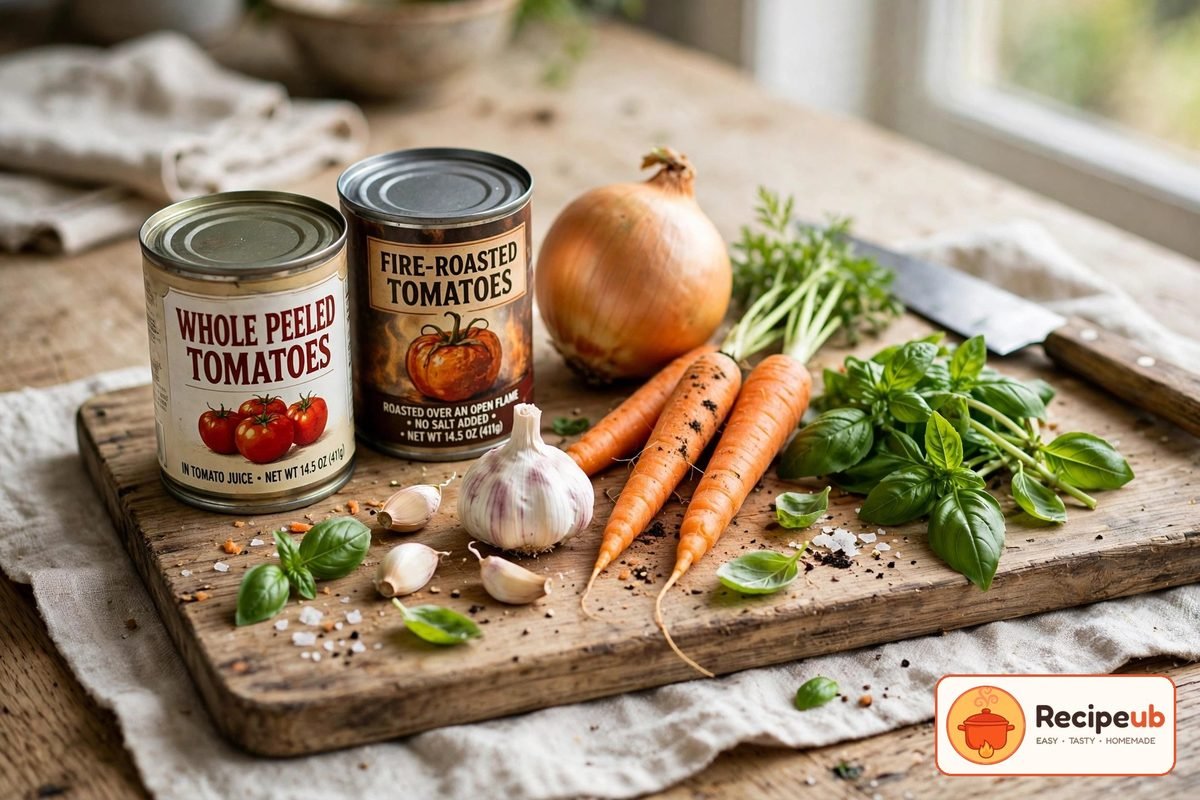
Canned whole peeled tomatoes make the best classic bowl — they blend the silkiest, their flavor is the most balanced, and they are what this recipe is built on. But “best” depends on what is in your pantry and your garden, so here is every form, with the three things that actually change when you swap: how much to use, what happens to the broth, and what you get in the bowl.
| Tomato Form | Amount (to Replace the Base Cans) | Broth Adjustment | Flavor & Texture Result | Approx. Cost | Best For |
|---|---|---|---|---|---|
| Canned whole peeled (the base recipe) | 2 (28 oz) cans, with their juices | 2 cups, as written | Deep, balanced, blends completely silky | ~$5 for both cans | The classic bowl; the default |
| Canned fire-roasted | 2 (28 oz) cans (or one of each) | No change — 2 cups | Smokier and deeper, a touch sweeter; blends just as smooth | ~$5–6 | More depth with zero extra work |
| Canned crushed | 2 (28 oz) cans | No change — 2 cups | Good flavor, slightly thinner body, a little less smooth | ~$4–5 | The cans are already in the pantry |
| Canned diced | 2 (28 oz) cans | No change — 2 cups | Chunkier and can stay faintly grainy even after blending | ~$4–5 | A rustic, textured soup — not the silky classic |
| Fresh Roma/plum, roasted first | About 3½ lb (14–16 Romas) | Cut broth to 1 cup | Bright and sweet; roasting concentrates the flavor and drives off water first | Varies — best in season | A late-summer glut of garden tomatoes |
| Fresh summer tomatoes, blanched & peeled | About 3½ lb ripe tomatoes | Cut broth to 1 cup | Lightest, freshest flavor; thinnest body and a paler red | In-season cost | Peak-season tomatoes too good to can |
The two rules underneath the chart: First, the broth moves only for fresh — canned forms are packed at a consistent liquid level, so the recipe’s 2 cups stands for all of them, but fresh tomatoes are roughly 95% water, they give it all up into a closed pot that cannot evaporate any of it, and the full cup of broth has to come out or you get tomato water instead of tomato soup. Roasting fresh Romas first (425°F, about 25 minutes, until they slump and char at the edges) drives off some of that water before the pot and concentrates what is left — it is the better fresh route. Blanching (a 30-second boil, an ice bath, skins slipped off) is the faster prep, and it works, but the soup will be lighter-bodied. Second, diced tomatoes are the one form with a texture ceiling: most are packed with calcium chloride to keep the cubes firm, and what keeps a cube firm in the can keeps it faintly grainy in your blender. They make a fine rustic soup. They will never make the silky one, and no amount of blending fixes it. This same tomato-base logic is what makes my Slow Cooker Lasagna Soup taste like a Sunday sauce — a good tomato foundation is half of any soup built on it.
How Do You Make Tomato Soup Creamy Without a Roux?
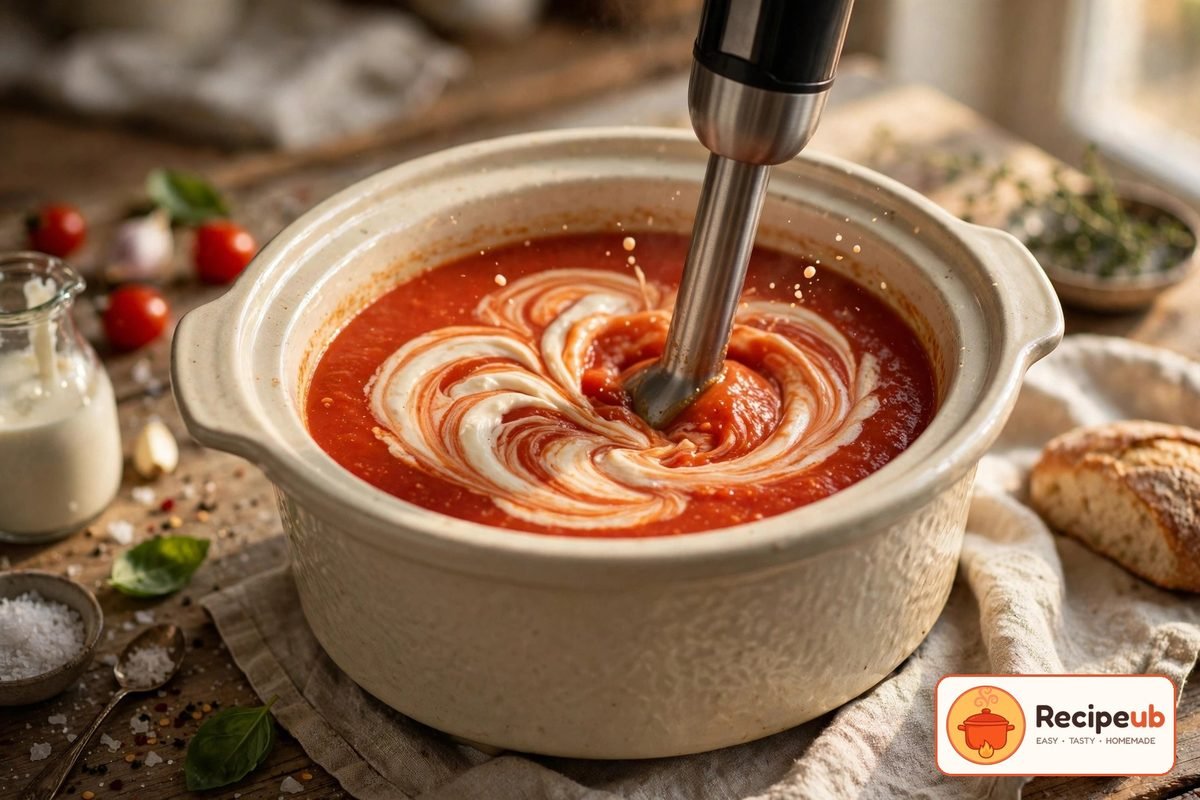
Blend the pot smooth, then stir in warmed, tempered half-and-half and Parmesan, and hold it on LOW for 20 minutes — never let it boil again. That is the entire method, and here is why each part of it matters. The blending is the thickener: two cans of tomatoes puréed with a cup of carrot, an onion and celery is a genuinely thick soup before any dairy touches it, nothing like the thin broth a roux is usually rescuing. The tempering is the insurance: cold dairy hitting hot, acidic soup is the curdle scenario, so the half-and-half gets warmed (30 to 45 seconds in the microwave, or a ladle of hot soup whisked into it in a mug) and arrives at the pot already close to its temperature. And the LOW hold is the finish: 20 gentle minutes for the Parmesan to melt in and the flavors to marry, at a heat that cannot split the dairy. Flour never enters the building.
The acidity ladder, honestly explained. Tomato soup that tastes sharp is an acid problem, and there are three fixes, in the order you should reach for them. Rung one is the carrot — already in this recipe, cooking down sweet for six hours and softening the acid from inside. Rung two is the teaspoon of sugar — also already in the pot; sugar does not remove acid, it balances your perception of it, and a teaspoon is seasoning, not sweetening. Rung three, only if a can runs genuinely harsh, is a pinch of baking soda — an eighth of a teaspoon, stirred in and watched: it will foam briefly as it neutralizes acid for real, which is why it works, and it is also why you use a pinch and taste before ever adding a second one. Too much soda flattens the soup and leaves a soapy, dull taste that no amount of salt repairs. In most pots, rungs one and two are the whole story. This is the opposite end of the soup spectrum from my Slow Cooker Beef Chili, where beef and beans blunt the tomato by sheer bulk — a pure tomato soup has nowhere to hide, so it gets a ladder instead.
What Do You Serve with Tomato Soup? The Grilled Cheese Pairing System
A grilled cheese — and the data says that is not a serving suggestion, it is the meal. Instacart’s Soup Season Report, published in October 2026 from its national order data, found that tomato soup is bought alongside sliced cheese (+224%) and sourdough (+202%) more than almost anything else in the soup aisle — the pairing is literally the purchase. (The pairing is so built into American cooking that Campbell’s built a limited-edition grilled cheese and tomato soup can on it.) Yet most tomato soup recipes treat the sandwich as a photo prop. Here it gets a system: four ways to build it, matched to the table you are feeding.
| Style | Bread | Cheese | Method & Time | Best For |
|---|---|---|---|---|
| Classic skillet sandwich | Sturdy white or sourdough slices | Sharp cheddar (or American for maximum melt) | Butter the outsides; skillet over medium, 3–4 minutes per side, until deep golden | The one-on-one bowl night |
| Sheet-pan batch | Sourdough or country loaf, sliced | Cheddar + mozzarella blend | Butter the outsides; bake at 425°F for 6–8 minutes, flip, 4–6 minutes more | Feeding a family or a crowd all at once |
| Grilled cheese croutons | A day-old sourdough sandwich, cubed | Cheddar | Build one classic sandwich, cut it into 1-inch cubes, toast at 375°F for 8–10 minutes until crisp at the edges | Floating on top of the bowl itself |
| Dippers / strips | Texas toast or thick-cut sourdough | American + cheddar | Skillet exactly as the classic, then slice into 1-inch strips | Kids, dunkers, and soup served in mugs |
How to run it: the soup holds happily on Warm, so the sandwiches are always the last thing made — start them when the soup goes into its 20-minute dairy finish and everything lands together. The croutons deserve one honest note: they are at their best in the first ten minutes, crisp-cheesy on top of the hot soup, so float them at the table, not in the kitchen. Costed separately, because honesty is the house rule: bread, cheddar and butter run about $1.25 a sandwich, which puts the full soup-and-grilled-cheese dinner at roughly $3.15 a person. On soup-night rotation weeks, this is the bowl that alternates with my Slow Cooker Chicken Tortilla Soup — that one brings its own toppings bar, this one brings the sandwich, and nobody at the table feels like January is a punishment.
What This Soup Costs — About $1.90 a Bowl
No big tomato soup recipe prices its pot, so here is this one, at typical US grocery prices in November 2026: the two 28 oz cans of whole peeled tomatoes ≈ $5.00 (mid-range cans run $2 to $4.50 each; value brands less) · vegetable broth ≈ $1.00 · the onion, carrot and celery ≈ $2.00 · olive oil and butter ≈ $0.60 · half-and-half ≈ $0.90 · Parmesan ≈ $1.25 · tomato paste, herbs and sugar ≈ $0.50. Pot ≈ $11.25, divided by 6 bowls = about $1.90 a bowl, and that is a full 1¾-cup dinner bowl, not a cup-sized appetizer portion. The timing is not an accident either: that same Instacart report found tomato soup orders run 76% above their yearly average in January — the #2 January soup in America, in what is literally National Soup Month. This page is published in late November on purpose, the same publish-ahead pattern as the rest of my January soups: indexed and ready weeks before the crest, at a price that makes the crest easy to say yes to.
Ingredients
- 2 (28 oz) cans whole peeled tomatoes, with their juices
- 2 Tbsp tomato paste
- 1 medium yellow onion, diced
- 1 cup diced carrot (about 2 medium carrots)
- ½ cup diced celery (about 2 stalks)
- 4 cloves garlic, minced
- 2 cups low-sodium vegetable broth (chicken broth works if the soup does not need to be vegetarian)
- 1 Tbsp olive oil
- 1 Tbsp butter
- 1 tsp sugar
- 1 tsp dried oregano
- 2 bay leaves
- 1 tsp kosher salt, plus more to taste
- ½ tsp black pepper
- ¾ cup half-and-half, warmed
- ⅓ cup finely grated Parmesan, plus more for serving
- Fresh basil leaves, torn, for serving
- Optional: a Parmesan rind for the pot; a pinch of baking soda if a can runs sharp
Ingredient notes: Whole peeled is the form that matters — see the chart above for why diced will never blend as smooth. The carrot is not filler; it is rung one of the acidity ladder, so do not leave it out and then wonder why the soup tastes sharp. Warm the half-and-half before it goes in — cold dairy into hot acid is the curdle this recipe is designed to avoid, and 30 seconds in the microwave is the whole insurance policy. The Parmesan rind is optional but lovely: fish it out with the bay leaves before blending. Kosher salt note: if you use fine table salt, cut the salt to ¾ teaspoon and adjust at the end. And buy the half-and-half, not heavy cream, unless cream is what you have — cream works 1:1 and makes a richer bowl (and a higher calorie count than the card states); milk is the one swap I would not make, because its low fat is exactly what splits in hot tomato soup.
How to Make Slow Cooker Tomato Soup
- Soften the aromatics (5 minutes, worth it). Melt the butter with the olive oil in a skillet over medium heat and cook the onion, carrot and celery for 4 to 5 minutes, until they soften and the onion turns translucent. Stir in the garlic and tomato paste for the last minute, until the paste darkens a shade. (Honest shortcut: on a true dump-and-go day, skip the skillet and add everything raw — the soup still works; the sauté buys a sweeter, deeper base, and 5 minutes is all it costs.)
- Load the cooker. Scrape the vegetables into a 6-quart slow cooker. Add the tomatoes with all their juices — squeeze each tomato once in your hand over the pot as it goes in, so the pieces start breaking down — then the broth, sugar, oregano, bay leaves, salt and pepper. Drop in the Parmesan rind if you are using one.
- Cook low and slow. Cover and cook on LOW for 6 hours (HIGH: 3 hours). The soup is ready to finish when the carrot is completely tender and the color has deepened to a brick red.
- Blend in the pot. Fish out the bay leaves and the Parmesan rind. Blend with an immersion blender directly in the cooker for 60 to 90 seconds, until completely silky — give it the full time, because tomato skins and carrot fibers surrender slowly. (No immersion blender: blend in batches in a countertop blender, lid vented and covered with a towel, and return the soup to the pot.)
- Temper the dairy. Warm the half-and-half — 30 to 45 seconds in the microwave, or whisk a ladle of the hot soup into it in a mug. Stir the warmed half-and-half and the grated Parmesan into the soup.
- Hold, taste, adjust. Cover and hold on LOW for 20 minutes — do not let it boil. Taste: if a can ran sharp, climb the acidity ladder (a pinch more sugar first; an ⅛ tsp of baking soda only if it is still harsh, stirred in and watched as it foams). Adjust the salt.
- Serve. Ladle into bowls, scatter torn basil and extra Parmesan over the top, and serve with the grilled cheese of your choosing from the pairing system — made last, while the soup held.


Slow Cooker Tomato Soup (Creamy Without a Roux, 6 Hours on LOW)
Ingredients
Equipment
Method
- Soften the aromatics (5 minutes, worth it). Melt the butter with the olive oil in a skillet over medium heat and cook the onion, carrot and celery for 4 to 5 minutes, until they soften and the onion turns translucent. Stir in the garlic and tomato paste for the last minute, until the paste darkens a shade. (Honest shortcut: on a true dump-and-go day, skip the skillet and add everything raw — the soup still works; the sauté buys a sweeter, deeper base, and 5 minutes is all it costs.)
- Load the cooker. Scrape the vegetables into a 6-quart slow cooker. Add the tomatoes with all their juices — squeeze each tomato once in your hand over the pot as it goes in, so the pieces start breaking down — then the broth, sugar, oregano, bay leaves, salt and pepper. Drop in the Parmesan rind if you are using one.
- Cook low and slow. Cover and cook on LOW for 6 hours (HIGH: 3 hours). The soup is ready to finish when the carrot is completely tender and the color has deepened to a brick red.
- Blend in the pot. Fish out the bay leaves and the Parmesan rind. Blend with an immersion blender directly in the cooker for 60 to 90 seconds, until completely silky — give it the full time, because tomato skins and carrot fibers surrender slowly. (No immersion blender: blend in batches in a countertop blender, lid vented and covered with a towel, and return the soup to the pot.)
- Temper the dairy. Warm the half-and-half — 30 to 45 seconds in the microwave, or whisk a ladle of the hot soup into it in a mug. Stir the warmed half-and-half and the grated Parmesan into the soup.
- Hold, taste, adjust. Cover and hold on LOW for 20 minutes — do not let it boil. Taste: if a can ran sharp, climb the acidity ladder (a pinch more sugar first; an 1/8 tsp of baking soda only if it is still harsh, stirred in and watched as it foams). Adjust the salt.
- Serve. Ladle into bowls, scatter torn basil and extra Parmesan over the top, and serve with the grilled cheese of your choosing from the pairing system — made last, while the soup held.
Emma’s Tips for the Best Slow Cooker Tomato Soup
Warm the dairy like it matters, because it does. Every curdled tomato soup I have ever seen traced back to the same thirty seconds: cold cream, straight from the fridge, into a pot of hot acid. Warm the half-and-half, whisk a ladle of soup into it if you want the full tempering treatment, and the finish in this recipe is genuinely foolproof — no flour, no praying.
Blend longer than feels necessary. Sixty seconds gets a tomato soup smooth-ish; ninety gets it silky, and the difference is the whole texture of the bowl. Move the immersion blender slowly up and down and around the edges, where the carrot and tomato skin hide. If a few stubborn flecks survive, another 30 seconds fixes it — a strainer is never the answer here.
Save your Parmesan rinds. I keep a bag of them in the freezer, and one goes into almost every tomato-based pot I make — this soup, marinara, minestrone. It is the trick the big Italian-American recipes all share, and it adds a deep, salty savoriness you cannot quite name in the finished bowl. Fish it out before blending; it will be soft and mostly melted into the base.
Taste for acid at the end, never at the start. A tomato soup at hour one tastes sharper than the same soup at hour six — the long cook mellows it, the carrot sweetens it, and the dairy softens it further. If you “fix” the acid early, you will overshoot and land on a flat, sweet soup. The ladder exists; climb it once, at the end, one rung at a time.
The soup waits; the sandwich does not. Tomato soup is at its best held warm and is honestly better on day two, but a grilled cheese starts losing its crisp the second it leaves the pan. So run the evening backwards: soup into its dairy finish, then sandwiches, then bowls to the table. The pairing system above is built around exactly that order.
Storage and Reheating
Fridge: Cool the finished soup, then refrigerate in airtight containers for up to 4 days. It thickens slightly in the chill — that is the tomato purée setting up, and it loosens again as it warms. The flavor genuinely improves on day two, when the basil-less base has had a night to marry (add fresh basil at serving, never before storing).
Reheating: Warm gently on the stove over medium-low heat, stirring now and then, until steaming — about 10 minutes for a family-size portion — and do not let it boil, for the same curdle reason as the finish. A splash of broth or water restores the exact consistency if it has thickened. The microwave works for single bowls at reduced power; stir halfway.
Freezing: The one rule that matters: freeze the soup before the dairy goes in. The blended tomato base freezes beautifully for up to 3 months in portion-size containers; thaw overnight in the fridge, reheat gently, and stir in the half-and-half and Parmesan fresh at the end, exactly as in step 5. Finished soup that already contains the dairy can be frozen in a pinch, but the texture comes back slightly grainy — edible, not excellent, and this page only prints excellent. Plan the freezer batch dairy-free and it will taste like the day it was made.
FAQs
How long do you cook tomato soup in the slow cooker?
For this recipe, 6 hours on LOW or 3 hours on HIGH, plus a 20-minute hold on LOW after the dairy goes in. The wide scatter of times online — 4 to 8 hours on LOW — comes from different pots: builds with a can of tomato sauce and up to 4 cups of broth honestly need 7 to 8 hours, while this leaner two-can, 2-cup-broth pot is done at 6. Fresh tomatoes take 6 to 7 hours on LOW because they have to break down fully. The timing chart in the article has each build side by side.
Can I use fresh tomatoes instead of canned in slow cooker tomato soup?
Yes — use about 3½ pounds of Roma (plum) tomatoes, roasted at 425°F for about 25 minutes first, or the same weight of ripe summer tomatoes blanched and peeled — and cut the broth from 2 cups to 1 cup. That broth cut is the step most recipes skip: fresh tomatoes are about 95% water, they release all of it into a closed slow cooker that cannot evaporate any, and an unadjusted pot comes out thin and watery. Expect a brighter, lighter-bodied soup than the canned version; the full comparison is in the Tomato Choice Chart above.
Which canned tomatoes are best for tomato soup — whole, crushed, diced or fire-roasted?
Whole peeled, for the classic silky bowl: they blend completely smooth and have the most balanced flavor. Fire-roasted are the best easy variation — same amount, same broth, deeper and smokier. Crushed work fine and blend nearly as smooth, with a slightly thinner body. Diced are the one form with a real drawback: most are packed with calcium chloride to hold their shape, and that firming keeps them faintly grainy even after long blending — fine for a rustic soup, never for the silky one.
How do you make tomato soup creamy without a roux?
Blend first, dairy second, heat never. Blend the cooked tomato base completely smooth in the pot — that purée is the thickener a roux usually provides. Then stir in warmed half-and-half and grated Parmesan and hold the soup on LOW for 20 minutes without boiling. The Parmesan adds body and richness, the warmed dairy cannot shock and split, and the gentle hold marries it all. No skillet, no flour, no second pan to wash.
Will the cream curdle in tomato soup? How do I prevent it?
It curdles when cold, low-fat dairy hits hot acid and boils — and all three causes are avoidable. Use half-and-half or cream (their fat protects them; low-fat milk is the risky one), warm it before it goes in or temper it with a ladle of hot soup, add it at the very end after blending, and never let the soup boil afterward — a LOW hold is as hot as it gets. Follow those four rules and the soup stays silky every time, no roux and no baking-soda insurance required.
Why is my tomato soup too acidic — and how do I fix it?
Tomatoes are acidic, cans vary, and a pure tomato soup has nothing bulky to hide behind. Fix it with the ladder, in order: this recipe builds in a cup of sweet carrot and a teaspoon of sugar from the start, which handles most pots. If a particular can still runs harsh, stir in a pinch — ⅛ teaspoon — of baking soda: it will foam briefly as it neutralizes acid, which is genuinely why it works. Taste before adding any more; too much soda flattens the flavor and leaves a soapy dullness that cannot be undone.
Can I make slow cooker tomato soup without cream — dairy free or vegan?
Yes. The base is already built on vegetable broth and olive oil, so skip the butter (use a second tablespoon of olive oil for the sauté), leave out the Parmesan and rind, and finish with a swirl of good olive oil and the basil — a bright, clean tomato soup that stands on its own. For a creamy vegan version, stir in ½ cup of full-fat coconut milk or a cashew cream at the end, using the same warmed, last-minute, no-boil rules as the dairy version.
What do you serve with tomato soup?
A grilled cheese — Instacart’s order data shows tomato soup is bought with sliced cheese (+224%) and sourdough (+202%), so the pairing is the meal, not a garnish. The article’s Pairing System covers the classic skillet sandwich (3–4 minutes per side), a sheet-pan batch at 425°F for a family, grilled cheese croutons floated on the bowl, and cut dippers for kids. Beyond the sandwich: a simple green salad, or nothing at all — soup and grilled cheese is a complete dinner at about $3.15 a person here.
Can you freeze slow cooker tomato soup?
Yes — but freeze it before the dairy. The blended tomato base keeps up to 3 months in the freezer in portion-size containers; thaw it overnight in the fridge, reheat it gently, and stir in the half-and-half and Parmesan fresh at the end, and it tastes like the day it was made. Soup frozen with the dairy already in it comes back slightly grainy. That freeze-before-the-dairy rule is the one every experienced tomato soup maker in this recipe’s research agreed on.
How long do leftovers keep, and how do I reheat them?
Finished soup keeps up to 4 days in the fridge in an airtight container, and the flavor honestly improves on day two. Reheat it gently on the stove over medium-low heat until steaming — about 10 minutes — stirring now and then and never letting it boil, so the dairy stays smooth. Add a splash of broth if it has thickened in the chill, and put the fresh basil on at serving, not in the storage container.
Final Thoughts
Tomato soup does not need a second pan, a flour paste, or a prayer over the dairy. It needs the right tomato, an honest clock, and a finish that respects the acid. Two cans of whole peeled tomatoes, six quiet hours, a blender, and warmed half-and-half stirred in at the end — that is the whole recipe, and it produces the bowl the skillet versions promise: silky, deep red, balanced, with a grilled cheese built like it matters, because the data says it does. Make it in January when the whole country is craving it, or make it in November like I do, ahead of the wave — either way, this is the tomato soup that finally keeps the slow cooker’s promise.
More Easy Slow Cooker Dinners
If this bowl joins your winter rotation, the rest of the slow cooker shelf is built with the same honesty about time and cost. The 13 Slow Cooker Dinners for Busy Weeknights collection gathers the whole dump-and-go family in one place, this soup included. For the other great top-it-yourself bowl, my Slow Cooker Loaded Baked Potato Soup runs a full toppings bar the way this page runs its pairing system — two soups, two systems, endless January dinners. And when the craving swings back to tomato in a heartier direction, the Slow Cooker Lasagna Soup takes the same tomato foundation and turns it into a full meal, while the Slow Cooker Vegetable Soup keeps the chunky, garden-style bowl covered — between the four of them, the soup season is handled.





Never Run Out of Dinner Ideas
One easy air fryer or slow cooker dinner in your inbox every week. No spam, ever.
You’re on the list — welcome to Recipeub!