
Cheesy Ground Beef and Rice Skillet (One Pot, 40 Minutes)
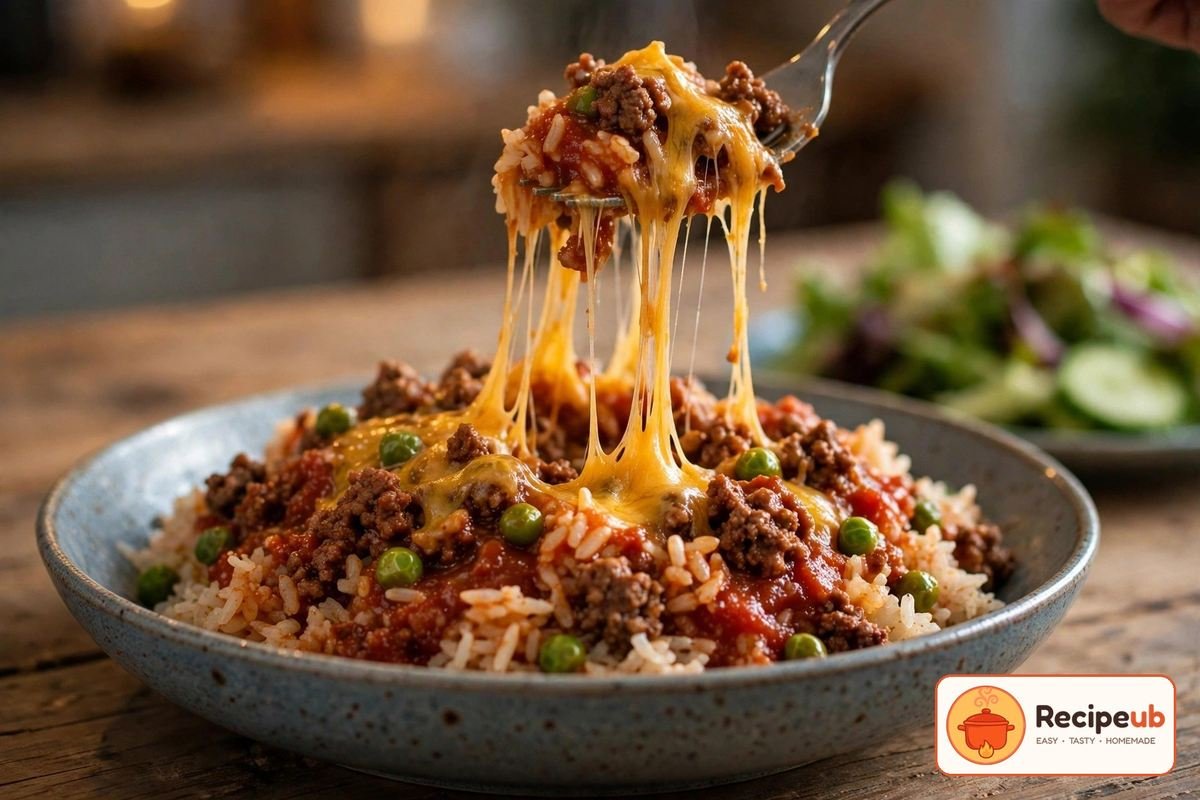
Cheesy ground beef and rice skillet is the one-pot dinner where the rice actually cooks in the pot: real long-grain rice, rinsed and toasted in the beef drippings, then simmered right in the broth and tomatoes with the browned beef, and finished with sharp cheddar melted through it — not sprinkled over it. One pound of beef, a can of tomatoes and a bag of frozen peas, and dinner for six comes out of one skillet in 40 minutes.
Read the top recipes for this dish closely and the page splits into two quiet shortcuts. Half of the biggest versions never cook rice in the pan at all — they reach for instant rice, a Minute rice pouch or a packaged rice-side packet, or they start from rice that was cooked yesterday. And the versions that do cook real rice each hand you exactly one rice, one liquid amount and one cheese, with no help for the three decisions the searches prove people are stuck on: which rice, how much liquid, and which cheese — melted how, so it stays smooth. This page prints both charts, with the numbers, and keeps the whole build on real rice where it belongs.
It also takes its own lane on this site. When the cupboard is nearly bare, there is the 5-ingredient ground beef skillet — same beef-and-cheddar pan with no rice, for the nights the cupboard is nearly bare, done in 25 minutes. And the method itself has a sibling here: my one-pot chicken and rice — the same rice-cooked-in-the-pot method, with chicken. This one is the beef build of that method — rice as the main event, cheddar melted through it, tonight, from the pan.
The short answer: Brown 1 lb of ground beef in a 12-inch deep skillet and drain it. Toast 1½ cups of rinsed long-grain white rice in the pan, add 2½ cups of beef broth + one 14.5 oz can of diced tomatoes, cover and simmer 18 minutes. Off the heat, stir in 1 cup of frozen peas and half of 2 cups of shredded sharp cheddar, rest 5 minutes, then melt the rest of the cheddar on top under the lid. Six servings, about 530 calories each, 40 minutes total, one pot.
In This Recipe
The Plan at a Glance
- Pan: one 12-inch deep skillet with a tight-fitting lid — deep enough that the rice simmers submerged
- Build: 1 lb 85% lean ground beef + 1½ cups long-grain white rice + 2½ cups beef broth + one 14.5 oz can diced tomatoes + 1 cup frozen peas
- Cheese system: 2 cups (8 oz) sharp cheddar, shredded from a block — half stirred through off the heat, half melted on top under the lid (the full system is printed below)
- Time: 10 minutes prep / 30 minutes cook / 40 minutes total — an 18-minute covered simmer, lid on, no peeking
- Yield: 6 servings, about 1⅓ cups each
- Calories: ~530 per serving (estimate, basis printed in full below); about 29 g protein; the lighter cheese route is in the cheese table
- Cost angle: 1 lb of beef across 6 servings, at a moment when ground beef averaged $6.76 a pound (BLS, October 2026) — the math is in its own section below
- Storage: refrigerate within 2 hours, in shallow containers; fridge 3 to 4 days; freeze up to 3 months; reheat to 165°F
Why This Recipe Works
The rice cooks in the pan, and the liquid is measured for it. Real rice is not a shortcut that happens to work — it drinks the broth as it simmers, and the broth has to be portioned for the drinking, with the tomato juice from the can counted as part of the liquid. The ranking versions prove how unsettled this number is: for the same dish, one prints 1½ cups of stock per cup of rice, another 2 cups, another 2½ — a full cup of spread. The Rice Liquid Chart below settles it per rice type, so the ratio survives any bag in your pantry.
The cheese goes in off the heat, in two stages, on purpose. Cheddar stirred into a boiling pan breaks — the emulsion splits and the sauce turns grainy and oily, which is this dish’s number-one failure mode and one no ranking page explains. Here the pan comes off the burner first: half the cheddar stirs through the steaming rice and melts into the body of the dish, and the other half goes over the top and melts under the lid into the blanket. The Cheese Melt System below prints the four rules in order, with the rescue for when it does go wrong.
One pound of beef feeds six, on purpose. The shortcut builds bulk the pan with a second pound of beef, a jar of queso or a soup can. This one browns 1 pound and lets the rice and cheese carry the skillet — a design choice that mattered less in 2019 than it does in November 2026, with ground beef at record prices (the sourced numbers are in the beef section below). Six real servings from a single pound is the recipe’s whole economic argument.
The cheese question gets a table, not a shrug. “What cheese works best if I don’t have cheddar?” is a literal FAQ question on a ranking recipe for this dish — and every top recipe just picks its one cheese and moves on. The table below prints five, per cup: melt behavior, flavor, and calories, including the swap that melts best (Monterey Jack) and the one that lightens the pan (half mozzarella).
It is a January dinner published in November on purpose. This is back-to-routine weeknight food — the searches carry no season at all, just method and variation questions — and on this site’s own trend research, weeknight comfort dinners peak in mid-January, when the post-holiday routine comes back. A 40-minute, one-pot beef and rice skillet that is already indexed when that wave arrives is the same publish-ahead play as the rest of this month’s posts.
How Much Liquid Does the Rice Need? The Rice Liquid Chart
This is the first chart this post exists to print. Every recipe for this dish gives you the liquid for its own batch and stops there; the ratio underneath — the thing you actually need when the bag in your pantry is jasmine, basmati or brown — is nowhere on page 1. Here it is, per 1 cup of dry rice, in this skillet build, where a 14.5 oz can of diced tomatoes is already in the pan.
| Rice (1 cup dry) | Added liquid | Covered simmer | Note |
|---|---|---|---|
| Long-grain white — the recipe | 1¾ cups | 18 minutes | Rinse first; rest 5 minutes off the heat |
| Jasmine | 1⅔ cups | 15–18 minutes | Softer finish; check at 15 |
| Basmati | 1¾ cups | 18 minutes | The most separate grains of the three whites |
| Brown long-grain | 2¼ cups | 40–45 minutes | The +½-cup, +25-minute swap |
| Instant / Minute | 1½ cups | 5 minutes + 5 minutes rest | The shortcut row — printed for honesty; the recipe’s default is real rice |
How to read the chart: “added liquid” is the broth or water you pour in — the juice from the can of tomatoes is already in the pan doing the rest of the work, which is why these numbers look lower than the broth-only builds elsewhere. This recipe’s 1½ cups of long-grain rice takes 2½ cups of broth plus the can — the chart’s long-grain row, scaled up and rounded to a measure you can pour. The basis is the cluster of real builds underneath the famous versions: 1¾ cups of broth plus tomatoes per cup on one page, 1½ cups of stock plus tomatoes on another, 2 cups of broth with no tomatoes on a third, and the 2½-cups-plus-tomatoes build whose own FAQ has to defend its rice against mush — the wet outlier. Brown rice is the one row that changes the clock as well as the cup: half a cup more liquid and a 40-to-45-minute simmer, which is why it is a planned swap and not a same-night one. And the instant row is printed because the searches ask for it — it works, in 5 minutes, and it is still not this recipe’s method; real rice is the dish.
Why Does the Cheese Go In Off the Heat? The Cheese Melt System
This is the second system this post exists to print. Grainy, oily cheese is the failure mode of every cheesy skillet ever made, and it is almost never the cheese’s fault — it is the order of operations. Four rules, in the order they happen:
- Shred it yourself. Bagged shredded cheese is coated in anti-caking starch and cellulose, and that coating resists melting — the shreds hold their shape and weep oil instead of flowing. A block of cheddar and a box grater is the whole fix, and it takes two minutes.
- Heat off before cheese goes in. Cheddar stirred into a boiling pan breaks: the emulsion splits, the proteins seize, and the sauce goes grainy. Off the heat, the pan is still steaming hot — more than enough to melt cheese — but nothing is bubbling, so the emulsion holds and the melt stays smooth.
- Half through, half on top. Half the cheese stirred through the hot rice becomes the creamy body of the dish; half scattered over the top and lid-melted for 2 to 3 minutes becomes the blanket and the pull. One stage alone gives you either a cheesy rice with a bare top or a cheese lid over plain rice.
- The rescue. If the cheese ever does clump or look oily — the pan was too hot, the cheese went in early — stir in 2 to 3 tablespoons of warm broth or milk, off the heat, and keep stirring gently. Liquid plus gentle heat re-forms the emulsion, and the pan recovers.
Which cheese? The choice table. Per 1 cup shredded, from USDA standard reference values (rounded, so read them as approximate):
| Cheese | Melt behavior | Flavor | ≈ kcal/cup |
|---|---|---|---|
| Sharp cheddar — the recipe | Very good off-heat; can oil if boiled | Strongest — carries the beef | ≈440 |
| Monterey Jack | The best melter of the group | Mild, creamy | ≈420 |
| Colby Jack | Excellent | Mild-medium, kid-friendly | ≈430 |
| Pepper Jack | Excellent | Jack + heat | ≈420 |
| Low-moisture mozzarella | Stretchiest, least saucy | Mildest — blend 50/50 with cheddar | ≈300 |
How to read the table: cheddar is the default because this dish needs a cheese that can stand up to beef, tomatoes and smoked paprika — a mild cheese disappears. Monterey Jack is the swap when melt is the priority: it flows smoother than anything else on the list and never grains, at the cost of a quieter flavor. Pepper Jack is the one-move heat upgrade, no extra peppers to chop. And mozzarella is the lightener — half cheddar, half mozzarella keeps the pull, softens the flavor and trims the pan, which is the honest lighter route alongside simply using 1½ cups of cheese instead of 2.
How Does 1 Pound of Beef Feed Six? The Honest Math
Because the rice and cheese do the filling, and because November 2026 is the wrong month to be casual about beef. The number, sourced: ground beef, 100% beef, averaged $6.76 a pound in October 2026, in the Bureau of Labor Statistics average price data released November 10, 2026 — just under the all-time record of about $6.92 set in August 2026, with the U.S. cattle herd at its smallest since 1951 and prices expected to stay tight through 2027. Plenty of builds for this dish start with 1½ or 2 pounds of that beef. This pan uses 1 pound, browned and drained, and stretches it across 6 servings with 1½ cups of rice, a can of tomatoes and 2 cups of cheddar — and the stretcher went the other way on price: white long-grain rice averaged $1.10 a pound in the same October 2026 BLS data, about one-sixth the price of the beef it is replacing. The beef becomes the seasoning-rich backbone instead of the bulk. That is also the difference between tonight’s dinner and a system: when you want the whole week handled instead of tonight, my ground beef meal prep — three pounds cooked once and split three ways, when you want the whole week handled instead of tonight is that post. This skillet is one dinner, eaten from the pan, and the swaps hold the same 1-pound line — ground turkey or half beef and half Italian sausage, both in the FAQs and the card notes.
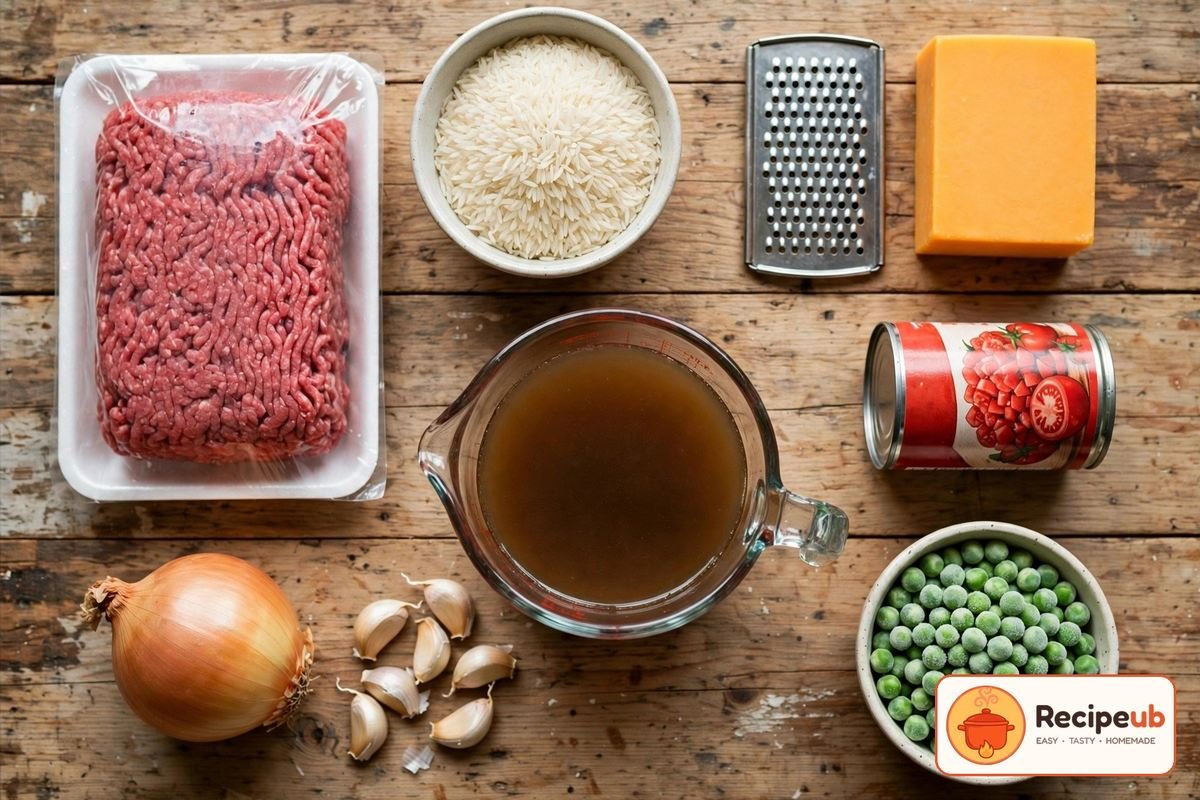
Ingredients
- 1 Tbsp olive oil
- 1 lb 85% lean ground beef
- 1 medium yellow onion, diced
- 1 bell pepper (any color), diced
- 3 garlic cloves, minced
- 1 tsp smoked paprika
- 1 tsp garlic powder
- ½ tsp kosher salt, plus more to taste
- ¼ tsp black pepper
- 1 Tbsp Worcestershire sauce
- 1½ cups long-grain white rice, rinsed
- 2½ cups low-sodium beef broth
- 1 (14.5 oz) can diced tomatoes, undrained
- 1 cup frozen peas
- 2 cups (8 oz) sharp cheddar, shredded from a block, divided
Ingredient notes: The rice is ordinary long-grain white on purpose — the pantry standard, the cheapest bag in the BLS series, and the rice the chart above is built on. Rinse it: thirty seconds in a sieve washes off the surface starch that turns a one-pot rice gummy, and it is the cheapest texture insurance in the recipe. The beef is 85% lean because the pan wants some fat for the toasting step and the draining removes the excess — the drained weight is what the calorie basis uses. The cheddar is a block, not a bag, and that is rule 1 of the melt system above, not a preference: the anti-caking coating on bagged shreds is the grainy-cheese problem before the pan is even hot. The tomatoes go in undrained — their juice is measured liquid in this build, and draining them means adding broth to replace it. Low-sodium broth, because the cheese and the Worcestershire bring their own salt and you can add more at the end but never take it back. And the peas go in frozen, at the very end, with the cheese — five minutes of residual heat is all they need, and any longer turns them dull and army-green.
How to Make Cheesy Ground Beef and Rice Skillet
- Brown the beef. Heat the olive oil in a 12-inch deep skillet over medium-high heat. Add the ground beef and cook 6 to 8 minutes, breaking it into small crumbles, until well browned with no pink left. Drain the fat and return the beef to the pan.
- Soften the vegetables. Add the diced onion and bell pepper to the beef and cook 3 to 4 minutes, until softened at the edges.
- Bloom the spices. Stir in the garlic, smoked paprika, garlic powder, kosher salt, black pepper and Worcestershire sauce and cook 30 seconds, until fragrant.
- Toast the rice. Add the rinsed rice and stir it through the beef for 1 to 2 minutes, until the grains are glossy and coated. This is the step that keeps the grains separate later — do not skip it.
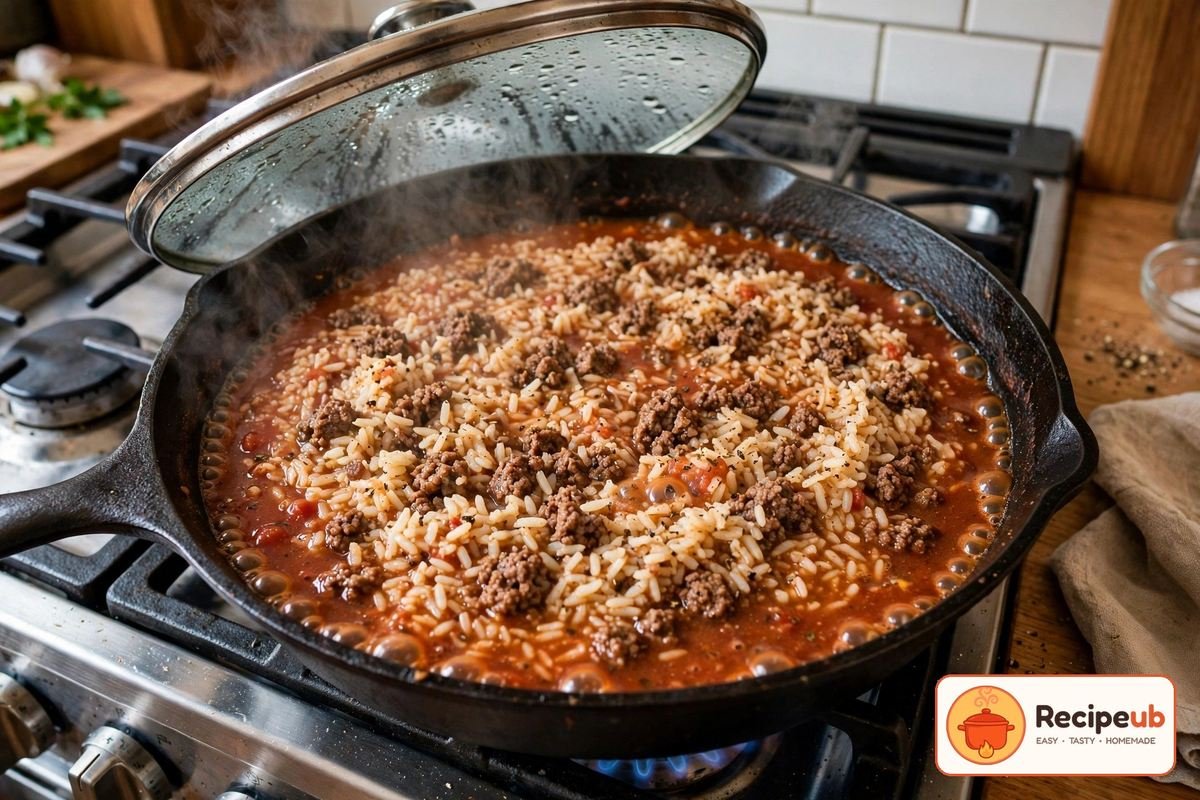
- Add the liquid. Pour in the beef broth and the can of diced tomatoes with all their juice and stir to combine. Bring the pan to a boil.
- Cover and simmer. Drop the heat to low, cover with the tight lid, and simmer 18 minutes. The lid stays on the whole time — every peek is steam the rice was counting on.
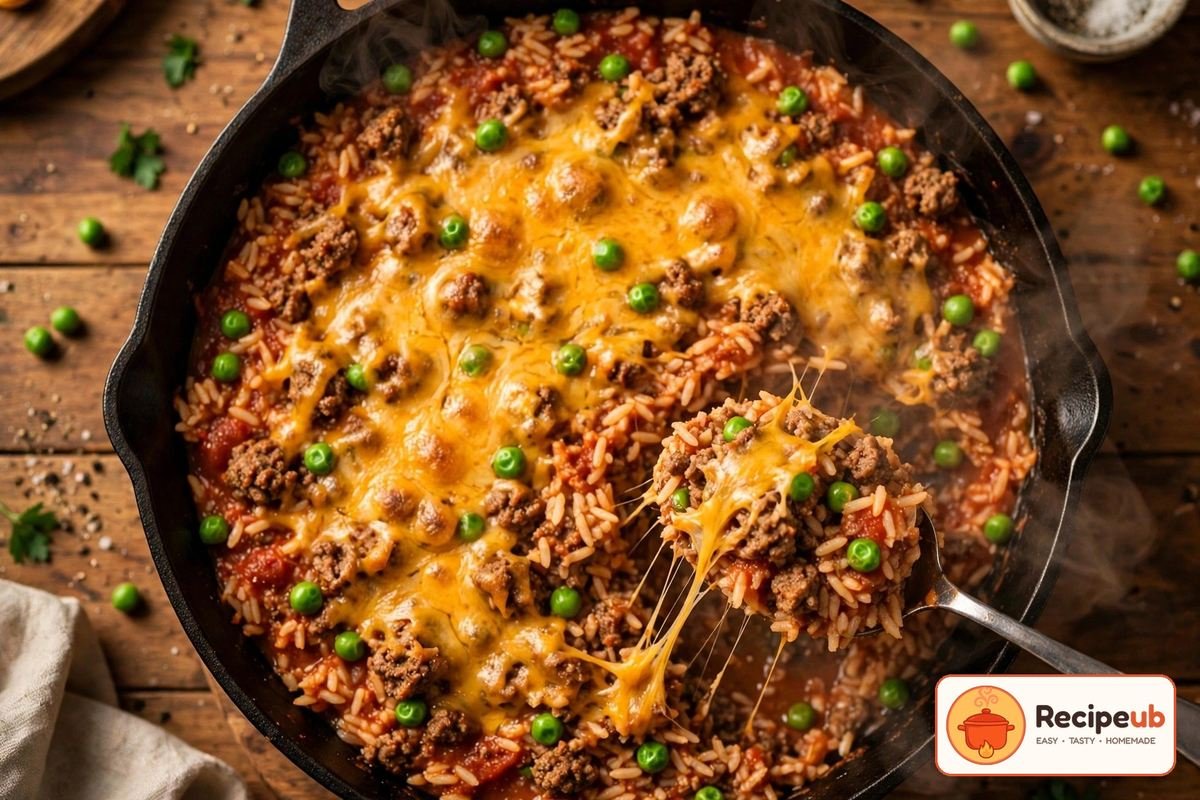
- Cheese, off the heat. Take the pan off the burner. Stir in the frozen peas and half the shredded cheddar until the cheese melts through the rice. Cover and rest 5 minutes.
- Blanket and scoop. Scatter the remaining cheddar over the top, cover for 2 to 3 minutes until it melts into a blanket, and scoop straight from the skillet.
Cheesy Ground Beef and Rice Skillet (One Pot, 40 Minutes)
Ingredients
Equipment
Method
- Heat the olive oil in a 12-inch deep skillet over medium-high heat. Brown the ground beef 6 to 8 minutes, breaking it into small crumbles, until no pink remains. Drain the fat.
- Add the diced onion and bell pepper and cook 3 to 4 minutes, until softened.
- Stir in the garlic, smoked paprika, garlic powder, salt, black pepper and Worcestershire sauce; cook 30 seconds.
- Add the rinsed rice and stir through the beef 1 to 2 minutes, until the grains are glossy and coated.
- Pour in the beef broth and the diced tomatoes with their juice; stir and bring to a boil.
- Cover with a tight lid and simmer on low for 18 minutes, without lifting the lid.
- Off the heat, stir in the frozen peas and half the cheddar until melted through. Cover and rest 5 minutes.
- Scatter the remaining cheddar over the top, cover 2 to 3 minutes until melted, and scoop to serve.
Notes
- The two systems on the page run this recipe: the Rice Liquid Chart (per 1 cup of dry rice, with the can of tomatoes in the pan — long-grain white 1¾ cups added liquid, 18 min; jasmine 1⅔ cups, 15–18 min; basmati 1¾ cups, 18 min; brown 2¼ cups, 40–45 min; instant 1½ cups, 5 min + 5 min rest) and the Cheese Melt System (shred from a block; heat OFF before the cheese goes in; half stirred through, half on top under the lid; rescue a grainy melt with 2–3 Tbsp warm broth or milk).
- Cheese swaps, same 2 cups: Monterey Jack for the smoothest melt, Colby Jack for a milder kid-friendly pan, pepper jack for heat, or half cheddar and half low-moisture mozzarella for the lightest version (per cup: cheddar about 440 kcal, mozzarella about 300).
- Taco variation: swap the smoked paprika and garlic powder for 2 Tbsp taco seasoning and use pepper jack — a variation of this pan, printed here as one; the classic build above is the recipe.
- Storage (USDA): refrigerate within 2 hours, in shallow containers rather than the deep skillet; fridge 3 to 4 days at 40°F or below; freeze up to 3 months (the cheese can separate slightly — it reheats as a softer, creamier scoop). Reheat to 165°F with 1–2 Tbsp broth or water per portion.
Emma’s Tips for the Best Cheesy Ground Beef and Rice Skillet
Rinse and toast — the two rice steps are the whole texture. Rinsing washes off the surface starch that glues grains together, and the 1-to-2-minute toast in the beef drippings coats each grain so it simmers up separate instead of clumping. Skip the rinse and the pan is gummy; skip the toast and it is merely fine. Do both and the rice eats like it was cooked on its own — which is the entire claim of this recipe.
The lid is an ingredient. Eighteen minutes, covered, low heat, no peeking. Every lift of the lid dumps the steam the rice is cooking in and drops the pan’s temperature, and the bottom layer pays for it with a chalky core. If your lid fits loosely, lay a sheet of foil under it. Set a timer and trust it.
Drain the beef, keep the flavor. Browning 85% lean beef leaves a spoonful or two of fat in the pan, and that fat carries grease into the rice if it stays — the finished skillet reads heavy and the cheese swims. Drain it off after browning. The flavor is in the browned bits on the beef and the pan, not in the puddle, and the olive oil and spices rebuild the base in the next step.
Make it yours, in the directions the searches ask for. The taco direction is the loud one: 2 tablespoons of taco seasoning in place of the paprika and garlic powder, pepper jack on top, corn in with the peas — a real variation of this pan, and if that is the dinner your table wants most nights, my one-pot taco pasta takes the same flavors into pasta form. The broccoli direction swaps the peas for 2 cups of small broccoli florets added in the last 5 minutes of the simmer. The Cajun direction trades the paprika for 2 teaspoons of Cajun seasoning and the bell pepper stays right where it is. One base, three directions — the rice chart and the melt system do not change for any of them.
Storage and Reheating
Fridge: Leftovers keep 3 to 4 days at 40°F or below — the USDA window for cooked leftovers, and the number this recipe prints. This is a cooked-rice dish, so the rice rule applies in full: refrigerate within 2 hours of cooking, and portion the leftovers into shallow containers instead of storing the whole deep skillet — a deep pan of rice and beef holds heat in the middle for hours, and rice that sat warm is the one leftover that reheating cannot rescue. The shallow transfer is what gets it cold fast.
Freezer: Freeze portions for up to 3 months, thawed overnight in the fridge. One honest note: the cheese can separate slightly in the freeze, so a thawed portion reheats as a softer, creamier scoop rather than a distinct-grain one. It is still good — plan it as a cozy lunch, not a dinner-party serve.
Reheating: Heat to 165°F, and add 1 to 2 tablespoons of broth or water per portion before you start — the rice drank the liquid once and will drink again, and the splash is what re-steams it instead of drying the edges. A drizzle of up to ¼ cup of broth over a whole pan of leftovers does the same job for a family reheat. Microwave in short bursts, stirring once, or cover a portion in a small skillet over medium-low. A small handful of fresh cheddar over a reheated portion brings the blanket back.
FAQs
Can I use brown rice instead of white rice in this skillet?
Yes — it is the most-asked swap for this dish, and it changes exactly two numbers. Use 2¼ cups of added liquid per cup of brown rice instead of 1¾ (so about 3⅜ cups of broth for this recipe’s 1½ cups of rice — call it 3⅓), and give it a covered simmer of 40 to 45 minutes instead of 18. Everything else — the toast, the off-heat cheese, the peas at the end — stays the same. It is a planned swap, not a same-night one, because the clock nearly triples; the full set of rice swaps is in the Rice Liquid Chart above.
What cheese works best in a beef and rice skillet? Can I swap the cheddar?
Sharp cheddar is the default because it is the strongest flavor on the list and this pan needs a cheese that can stand up to beef and tomatoes. The swaps, by what they do: Monterey Jack melts the smoothest of any cheese here and never grains — the choice when melt matters more than punch. Colby Jack is the mild, kid-friendly middle. Pepper Jack adds heat without another ingredient. Mozzarella is the stretchiest and the lightest per cup (about 300 kcal against cheddar’s 440), but it is mild — blend it 50/50 with cheddar rather than swapping it outright. Whatever you choose, shred it from a block and add it off the heat; those two rules matter more than the cheese itself.
How do I keep the rice from getting mushy?
Mushy rice in this dish is a liquid problem or a lid problem, almost never a rice problem. Measure to the chart — 1¾ cups of added liquid per cup of long-grain rice, with the tomato juice counted as part of the pan’s liquid, not added on top of a full measure of broth. Rinse the rice and toast it, so the grains start separate. Then keep the simmer low and the lid on for the full 18 minutes, and rest the pan off the heat before the cheese goes in — the rest is when the grains finish firming. The wettest builds for this dish pour in 2½ cups of broth plus the tomatoes per cup of rice, and their own FAQs end up defending the mush; this chart exists so yours does not have to.
Why did my cheese go grainy — and how do I fix it?
Grainy cheese means the emulsion broke, and it breaks for one of three reasons: the cheese went into a pan that was still bubbling, it was bagged shredded cheese with its anti-caking coating, or both. Cheddar stirred into boiling liquid seizes — the proteins tighten and squeeze out the fat, and the sauce turns gritty and oily. The fix, if it has already happened: take the pan off the heat and stir in 2 to 3 tablespoons of warm broth or milk, gently, until it comes back together. The prevention is the Cheese Melt System above — block cheese, heat off, half through and half on top.
Do I have to drain the ground beef?
Yes, for this build. A pound of 85% lean beef leaves enough fat in the pan to grease the rice as it simmers, and greasy rice reads heavy and makes the cheese swim instead of melting into the grains. Draining costs you nothing in flavor — the browned bits stay on the beef and the pan, and the spices bloom in the next step. The one exception: if you are using very lean beef (93% or leaner) and the pan looks nearly dry after browning, skip the drain and go straight to the vegetables.
Can I make this with instant (Minute) rice?
You can, and the chart prints its row: 1½ cups of added liquid per cup of instant rice, a 5-minute simmer and a 5-minute rest. Half the biggest recipes for this dish are built exactly that way, and it does make a faster pan. It is not this recipe’s method, on purpose — instant rice eats softer and less distinct, and the grains never quite separate the way toasted long-grain does. If instant is what the night allows, the rest of the build — the beef, the tomatoes, the melt system — works exactly as written.
Can I make cheesy beef and rice ahead for meal prep?
It keeps well enough that the question is really about storage, and the answer is yes with the rice rules attached: cool it fast, portion it into shallow containers, refrigerate within 2 hours, and eat it inside 3 to 4 days, reheated to 165°F with a splash of broth. The cheese softens into the rice over the days, so a prepped portion eats creamier than the fresh pan — most people here count that a feature. What this post is not is a batch system; it is one dinner that happens to portion well.
Can I use ground turkey instead of ground beef?
Yes — same pound, same method, and brown it the same way. Turkey is leaner, so keep the olive oil, do not skip the Worcestershire (it is doing the beefy-depth work), and season a touch more assertively at the end; the smoked paprika matters more, not less. The rice chart and the melt system do not change. If turkey skillets are a lane your table likes, my ground turkey skillet is the dedicated build — sweet potato and black beans, no rice — and this pan is the one to reach for when it is rice night.
Can I make it without cheese?
Yes — a small but real group of searchers asks for exactly that, and the pan holds up: the beef, rice and tomato base is a complete dinner on its own. Two adjustments keep it from eating plain. Stir a spoonful of tomato paste in with the spices for depth, and finish each serving with something fresh and sharp — sliced green onions, a spoonful of salsa, or a squeeze of lime — to replace the contrast the cheese was providing. The rice chart does not change; just skip the melt steps and rest the pan 5 minutes before scooping.
How long does it keep in the fridge? Can I freeze it?
In the fridge, 3 to 4 days at 40°F or below — the USDA window for cooked leftovers — as long as it was refrigerated within 2 hours of cooking and moved into shallow containers rather than stored in the deep skillet. Frozen, it keeps up to 3 months at best quality; thaw overnight in the fridge, knowing the cheese may separate slightly and reheat as a softer scoop. Either way, reheat to 165°F with a tablespoon or two of broth or water per portion so the rice re-steams instead of drying out. The full handling notes are in Storage and Reheating above.
Final Thoughts
Cheesy ground beef and rice skillet is the weeknight dinner that asks the least and gives the most: one pan, one pound of beef, real rice cooked where it will be eaten, and cheddar melted through it like it means it. What this page adds is the paperwork the other versions leave out — a liquid chart that survives whichever rice is in the pantry, the four melt rules that keep the cheese smooth instead of grainy, and the beef math printed with its source. One pound of beef, six servings, forty minutes, one pot to wash: that is the whole argument, and it holds up every time the skillet hits the stove.
More Easy One-Pot & Skillet Dinners
If one-pan weeknight dinners are your kind of system, the rest of my skillet shelf runs on the same rules — real times, the deciding charts printed, dinner out of one pan. The newest sibling is my skillet lasagna — broken noodles simmered in marinara with the same lid-melted cheese finish and its own set of charts for the pan, the liquid and the cheese. When the beef wants a sauce instead of a skillet of rice, there is the beef stroganoff skillet — the creamy mushroom one, with pasta instead of rice, thirty minutes and five ingredients. And the two posts this dinner sits between are already linked up top — the five-ingredient, no-rice beef skillet for the bare-cupboard nights, and the one-pot chicken and rice for the nights the protein changes. One shelf, one pan, no sink full of pots — that is the deal.



Never Run Out of Dinner Ideas
One easy air fryer or slow cooker dinner in your inbox every week. No spam, ever.
You’re on the list — welcome to Recipeub!