
Slow Cooker Pot Roast (Fork-Tender, With Real Gravy From the Drippings)
Pot roast has a reputation problem, and it is not the roast’s fault. Ask ten recipes how long a 3-pound chuck roast takes in the slow cooker and you will get answers from 6 hours to 10 — for the same cut, at the same setting. Ask how much liquid to add and the answers run from 1 cup to 2½, usually with no explanation at all. No wonder so many Sunday roasts come out either boiled gray or still chewing at dinnertime. This is the pot roast I make: one whole 3½-pound chuck roast, seared, set on a bed of onions and carrots, and cooked 8 hours on LOW in just 1½ cups of broth — then sliced against the grain and served with a real gravy you make from the drippings in about five minutes. And because the guessing is the problem, this page prints the numbers: a chart that times the roast by its weight, one liquid rule that works for every size, and a gravy method with actual ratios.
One thing to be clear about, because this site keeps its beef dinners honest: this is the whole roast, cooked in one piece and sliced at the table — a carving dinner. If you want this same beef-and-gravy comfort in spoonable form, that is my Slow Cooker Beef Stew, where the chuck is cubed before it cooks. And my Slow Cooker Beef and Potatoes is the cubed weeknight version with the potatoes built in. This page owns the roast itself: one piece, one long cook, one sharp knife at the end.
The short answer: A 3½-pound chuck roast takes 8 hours on LOW (or 4½ to 5 hours on HIGH) in the slow cooker, and it is done when a fork twists in the thickest part with no resistance — about 195 to 205°F inside. Use 1½ cups of liquid for a roast this size, never more than halfway up the meat. A roast that is still tough at hour 6 is not ruined — it is undercooked. Give it another hour.
In This Recipe
The Plan at a Glance
- Cut: one whole 3½ lb boneless chuck roast, cooked in one piece
- Setting and time: LOW for 8 hours (HIGH option: 4½ to 5 hours)
- The liquid rule: 1½ cups of broth for a 3 to 4 lb roast — the pot braises, it never swims
- Vegetables, in 3 stages: onions and carrots under the roast from the start, potatoes at the halfway point, mushrooms in the last 30 to 45 minutes
- The gravy: strained, defatted drippings + a simple flour roux, 2 tablespoons of flour per cup of liquid
- Serves: 8 plates (about 4 oz sliced roast, potatoes, carrots and gravy each)
Why This Recipe Works
The time is keyed to the weight, not to a guess. A roast is a solid piece of meat, and heat moves through it at a pace set by its size — a 2-pound roast and a 5-pound roast cannot share one cook time, yet most recipes hand them exactly that. This recipe is built on a 3½-pound roast at 8 hours on LOW, and the chart in the next section gives you the honest window for every other weight, all anchored to the same doneness test: a fork that twists with no resistance.
The liquid is measured like a braise, because that is what this is. The single most common pot roast mistake is drowning it. Cover a roast in broth and you have not made pot roast, you have boiled beef — the meat comes out gray and stringy, and the “gravy” is flavored water. A 3½-pound roast and its vegetables release roughly 2 cups of their own liquid as they cook, so the pot only needs 1½ cups to start: enough to braise and to become gravy, not enough to swim in.
The vegetables follow the roast’s clock, in three stages. Onions and carrots go under the roast at the start — they become its rack, lifting it out of the deepest liquid, and they melt into the gravy’s base. Potatoes wait until the halfway point, because a potato that cooks for the full 8 hours in a small slow cooker can disintegrate at the edges. Mushrooms go in for only the last 30 to 45 minutes, so they stay meaty instead of going spongy. Three additions, each tied to a stage of the roast’s own cook — load, halfway, finish.
The gravy is a method, not an afterthought. Most pot roast recipes end with “thicken the juices if you like,” which is how you get lumpy, greasy sauce. Here the drippings are strained, defatted and measured, then thickened with a proper roux at a printed ratio. Five minutes, no packets, no canned soup — and the gravy tastes like the roast because it is the roast.
How Long Does a Pot Roast Take in the Slow Cooker?
Here is the question behind almost every search for this recipe, answered the way the informational guides answer it — by weight — but on a recipe page, keyed to one tested method. Every row ends at the same finish line: fork-tender, which means a fork inserted into the thickest part twists with no resistance, at 195 to 205°F internal. (A roast is merely safe at 145°F — safe and tender are two very different dinners, and pot roast is about tender.)
| Roast Weight (boneless chuck) | LOW | HIGH |
|---|---|---|
| 2 lb | 6–7 hours | 3½–4 hours |
| 3 lb | 7½–8½ hours | 4–5 hours |
| 3½ lb (this recipe) | 8 hours | 4½–5 hours |
| 4 lb | 8½–10 hours | 5–6 hours |
| 5 lb | 10–11 hours | 6–7 hours |
How to read the chart: find your roast’s weight, cook to the early end of its window, then test with the fork — not the clock. If the fork meets resistance, the roast is not done, whatever the timer says; close the lid and give it another hour. That one fact explains most “tough pot roast” stories: collagen, the connective tissue that makes chuck tough, only melts into gelatin after sustained time above about 180°F, so a tough roast at hour 6 is undercooked, not overcooked, and the fix is more time, not less. This weight-keyed logic is the same approach I use for my Whole Chicken in the Slow Cooker — the site’s other whole-piece, cooked-in-one-piece dinner — because a whole piece of anything cooks by its size, not by a recipe’s habits.
The Liquid Rule: A Roast Braises, It Does Not Swim
If the time question is the first thing people ask about pot roast, the liquid question is the second — the searches literally include both “pot roast with no liquid” and “slow cooker pot roast too much liquid,” which tells you how confusing the advice has been. Here is the whole rule, and it is the only one you need:
- 2 to 3 lb roast: 1 cup of liquid
- 3 to 4 lb roast: 1½ cups of liquid (this recipe)
- 5 lb roast: 2 cups of liquid, maximum
And one visual check that overrides the measuring cup: the liquid should never come more than halfway up the side of the roast. The reason the numbers stay this low is the roast itself — a 3½-pound chuck and a pot of vegetables will release roughly 2 more cups of liquid as they cook, so a pot that starts at 1½ cups finishes with about 3½ cups of rich, concentrated drippings: exactly what the gravy needs. Start with 3 or 4 cups of broth and you finish with a watery soup that no amount of flour quite rescues, wrapped around meat that steamed instead of braised. If your roast is on the small side for your cooker and the liquid looks sparse at the start, trust the rule anyway — by hour three, the pot will show you where the liquid was hiding.
To Sear or Not to Sear: The Honest Verdict
My verdict: sear it — 10 minutes, recommended but not mandatory. Here is the honest reasoning, including the part most recipes get wrong. Searing does not seal in juices; that is a myth, and a seared roast loses just as much moisture as an unseared one. What searing actually does is flavor: browning is the Maillard reaction, and it needs temperatures of 285°F and up. A slow cooker, working gently in liquid, never gets the surface of the meat anywhere near that — so the deep, roasted, almost nutty flavor of a browned crust can only come from a hot pan before the roast goes in. In this recipe the sear does double duty, because the browned bits left in the skillet get scraped up into the broth, and that fond becomes the backbone of the gravy.
The skip path, printed without shame: some days there is no 10 minutes. If you skip the sear, put the roast straight in and stir 2 tablespoons of tomato paste and the Worcestershire into the broth before pouring it over — the paste’s concentrated umami replaces part (not all) of what the crust would have given you. The roast will still be tender. It will simply taste a little less like Sunday.
What a Real Pot Roast Costs in November 2026
Beef is expensive, and I am not going to pretend otherwise — but there is genuinely good news in the newest numbers. In the Bureau of Labor Statistics’ October 2026 average price data, boneless USDA Choice chuck roast averaged $9.08 a pound — the lowest since March 2026, down from a July peak of $9.63. So the 3½-pound roast in this recipe runs about $32, the whole pot about $37 to $38 with the vegetables and gravy, and that works out to roughly $4.75 a plate for 8 people — meat, potatoes, carrots and real gravy for less per person than one fast-food combo. Two more honest notes: the USDA’s food price outlook still forecasts beef rising about 8.7% across 2026, so a sale-priced roast in the freezer is money saved, not money spent. And if chuck is priced out of reach the week you shop, a round roast averaged $8.37 a pound in the same data — it works in this recipe with one trade-off: it is leaner, so slice it, never shred it, and serve it with plenty of gravy.
How to Make Real Gravy From the Drippings
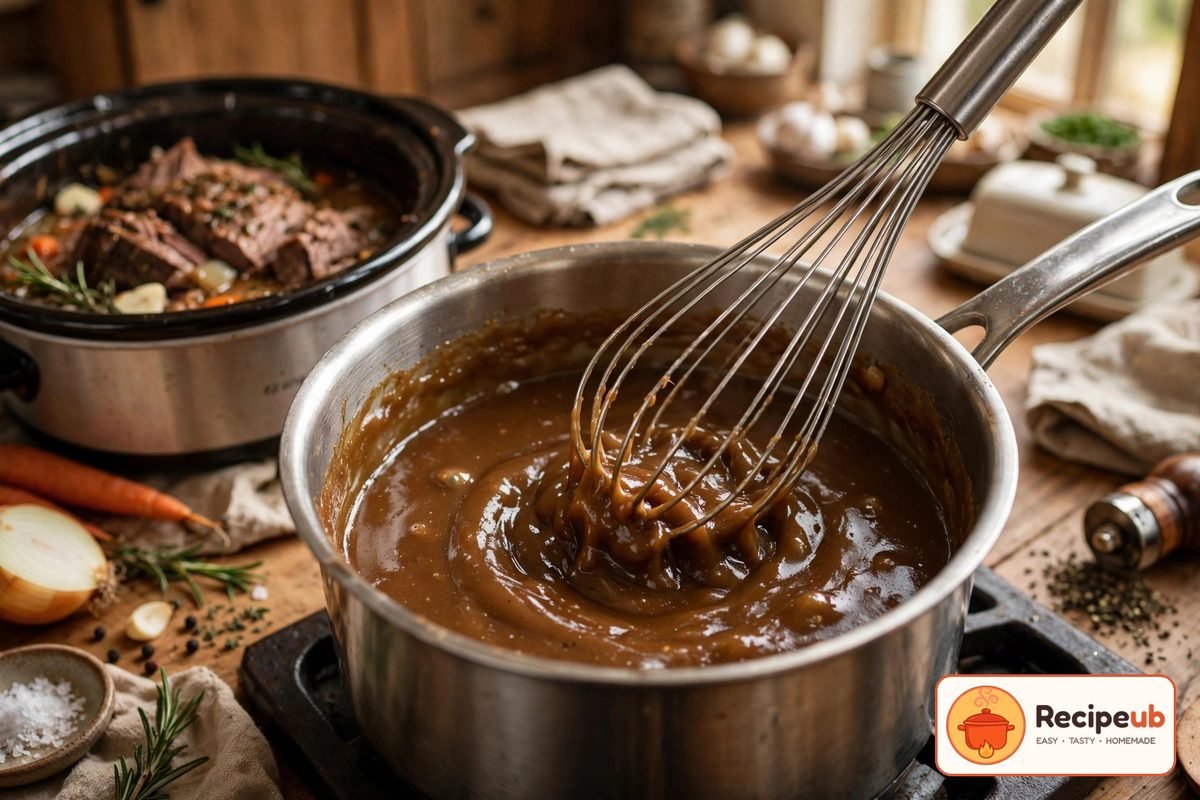
This is the step most pot roast recipes wave at — “thicken the juices” — and it is the step that decides whether the plate tastes finished. Here is the full method, with the ratios, because gravy is not hard; it is just specific.
- Strain. Pour the cooking liquid through a sieve into a fat separator or a large measuring jug. You should have about 2½ to 3 cups from a 3½-pound roast (the 1½ cups you added, plus roughly 2 cups the roast and vegetables released, minus what the pot kept).
- Defat. Let the liquid sit 5 minutes so the fat rises, then pour the drippings out from under the fat (a fat separator does this in one motion) or skim the fat off the top with a spoon. Greasy gravy is almost always just un-defatted gravy.
- Build the roux. Melt 2 tablespoons of butter in a saucepan over medium heat. Whisk in flour at the ratio of 2 tablespoons of flour per cup of drippings — about 6 tablespoons for 3 cups — and cook, whisking, for 1 minute, until it turns pale gold and smells faintly nutty.
- Whisk the drippings in gradually. Add the drippings a splash at a time at first, whisking smooth after each addition, then pour in the rest. (Adding it all at once to a hot roux is how lumps happen; the gradual start is the whole trick.)
- Simmer to finish. Bring the gravy to a gentle simmer and cook 1 to 2 minutes, until it is glossy and coats the back of a spoon. It thickens a little more as it sits. Taste before you salt — the drippings are already seasoned.
The cornstarch shortcut, honestly: if you want gravy without a roux, whisk 1 tablespoon of cornstarch per cup of drippings into a slurry with cold water, stir it into the simmering drippings, and cook 1 minute. It works and it is gluten-free — but the roux version has the deeper, rounder flavor, and it is the one this recipe is built on. Either way, you will have about 2½ to 3 cups of gravy, which is a generous ⅓ cup per plate with some left for the leftovers — and leftovers, with gravy, are half the point of a pot roast.
Ingredients
- 3½ lb boneless beef chuck roast
- 2 tsp kosher salt
- 1 tsp black pepper
- 1 tsp garlic powder
- 1 tsp onion powder
- 1 tsp smoked paprika
- 2 Tbsp olive oil
- 2 medium yellow onions, sliced thick
- 1 lb carrots, cut into 2-inch chunks
- 2 Tbsp tomato paste
- 1½ cups low-sodium beef broth
- 1 Tbsp Worcestershire sauce
- 1 tsp dried thyme
- 2 bay leaves
- 1½ lb baby potatoes, halved if large
- 8 oz mushrooms, halved (quartered if large)
- 2 Tbsp unsalted butter
- 6 Tbsp all-purpose flour (about 2 Tbsp per cup of drippings, for the gravy)
- Fresh parsley, chopped, for serving
Ingredient notes: Chuck is the cut, and it is not close: its marbling and collagen are exactly what an 8-hour braise rewards, melting into meat you can slice or pull apart with a spoon’s edge. Keep the roast whole — the moment you cube it, you are making stew, which is a different (also wonderful) dinner. The thick-sliced onions are structural, not just flavor: they form the bed the roast sits on. Baby potatoes hold their shape better than cubed russets, and going in at the halfway point keeps their edges honest. Kosher salt note: if you use fine table salt, cut it to 1½ teaspoons. The flour and butter are for the gravy at the end — 6 tablespoons of flour is the right amount for the roughly 3 cups of drippings this pot makes, but measure your drippings and use the ratio in the gravy section. And one honest nod to the shortcut crowd: yes, a packet of onion soup mix stirred into the broth is the version a lot of families grew up on, and it works. This recipe is the from-scratch one — same comfort, no packet, and a gravy that needs no mix to taste like something.
How to Make Slow Cooker Pot Roast
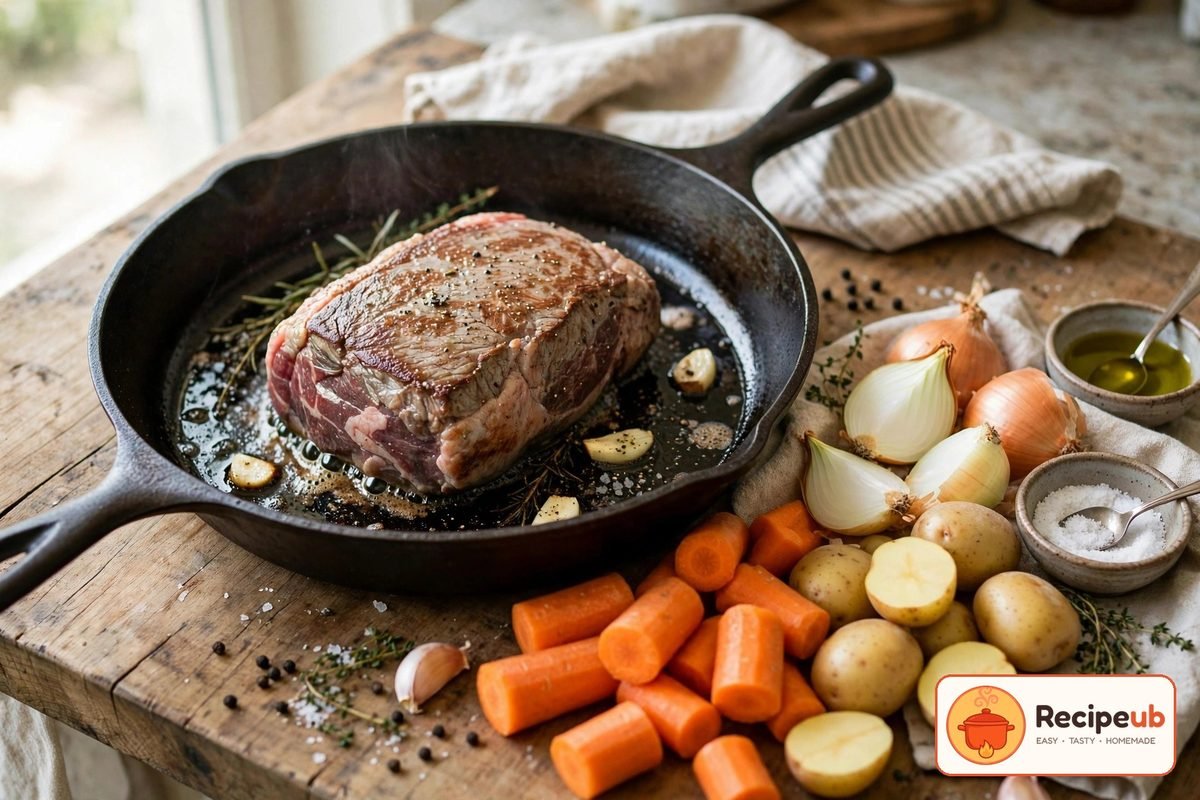
- Season the roast. Pat the chuck roast dry with paper towels — dry meat browns, wet meat steams. Rub it all over with the salt, pepper, garlic powder, onion powder and smoked paprika.
- Sear. Heat the olive oil in a large skillet over medium-high heat until it shimmers. Sear the roast 4 to 5 minutes per side, until every side has a deep brown crust. Move the roast to a plate. (Skipping the sear? See the verdict section above, and add the tomato paste and Worcestershire straight to the broth.)
- Build the braising liquid. In the same skillet over medium heat, stir the tomato paste into the drippings for 1 minute, until it darkens a shade. Pour in the beef broth and scrape up every browned bit — that fond is gravy flavor. Stir in the Worcestershire and thyme and take the pan off the heat.
- Load the cooker in order. Spread the sliced onions and carrot chunks across the bottom of a 6-quart slow cooker — this is the roast’s rack. Set the roast on top of them. Pour the hot broth mixture over everything and tuck in the bay leaves. The liquid should sit no more than halfway up the roast.
- Cook low and slow. Cover and cook on LOW for 8 hours (HIGH: 4½ to 5 hours). At the halfway point — hour 4 on LOW — lift the lid once, quickly tuck the potatoes in around the roast, and close it again. One lid-lift, budgeted on purpose.
- Add the mushrooms at the finish. In the last 30 to 45 minutes, stir the mushrooms into the liquid around the roast. Test the roast with a fork: it should twist with no resistance. If it resists, give it another hour and test again.
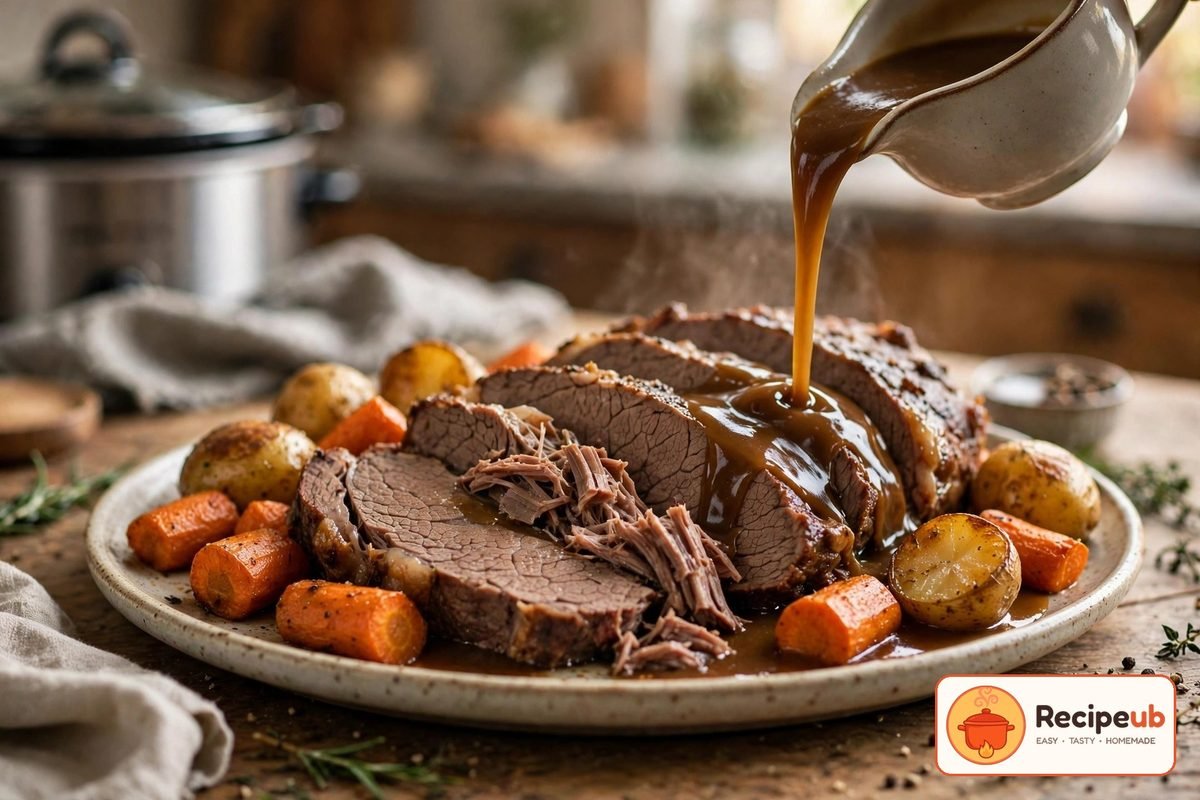
- Rest and slice. Lift the roast onto a cutting board and tent it loosely with foil for 15 minutes. Slice it against the grain into ½-inch slices, or pull it into large chunks with two forks — the same whole-muscle, low-and-slow logic as my Slow Cooker Pulled Pork, just beef and sliced instead of pork and shredded. Arrange the vegetables around it and keep everything warm while you make the gravy.
- Make the gravy. While the roast rests, strain and defat the drippings and make the gravy exactly as in the gravy section above — butter and flour roux, 2 tablespoons of flour per cup of drippings, simmered 1 to 2 minutes until glossy. Pour it over the sliced roast, scatter the parsley, and serve.

Slow Cooker Pot Roast (Fork-Tender, With Real Gravy From the Drippings)
Ingredients
Equipment
Method
- Pat the roast dry and rub it all over with the salt, pepper, garlic powder, onion powder and smoked paprika.
- Sear in the olive oil in a large skillet over medium-high heat, 4 to 5 minutes per side, until deeply browned. Transfer to a plate.
- In the same skillet, cook the tomato paste in the drippings for 1 minute. Pour in the broth, scrape up all the browned bits, and stir in the Worcestershire and thyme.
- Spread the onions and carrots in the bottom of a 6-quart slow cooker. Set the roast on top, pour the broth mixture over, and add the bay leaves. Liquid should come no more than halfway up the roast.
- Cover and cook on LOW for 8 hours (HIGH: 4½ to 5 hours). At the halfway point, quickly tuck the potatoes in around the roast.
- Stir in the mushrooms for the last 30 to 45 minutes. The roast is done when a fork twists in the thickest part with no resistance (195 to 205°F).
- Rest the roast, tented, for 15 minutes. Slice against the grain into ½-inch slices (or pull into large chunks) and arrange the vegetables around it.
- Strain and defat the drippings (about 2½ to 3 cups). Melt the butter in a saucepan, whisk in the flour (2 Tbsp per cup of drippings), cook 1 minute, then whisk the drippings in gradually and simmer 1 to 2 minutes, until glossy. Pour over the roast, scatter the parsley, and serve.
Notes
- Time by weight (boneless chuck, fork-tender at 195–205°F): 2 lb = LOW 6–7 hours / HIGH 3½–4 hours; 3 lb = LOW 7½–8½ hours / HIGH 4–5 hours; 3½ lb (this recipe) = LOW 8 hours / HIGH 4½–5 hours; 4 lb = LOW 8½–10 hours / HIGH 5–6 hours; 5 lb = LOW 10–11 hours / HIGH 6–7 hours. A tough roast is an UNDERcooked roast — give it another hour.
- The Liquid Rule: 1 cup for a 2–3 lb roast, 1½ cups for 3–4 lb, 2 cups maximum for 5 lb — never more than halfway up the roast. The roast and vegetables release about 2 more cups as they cook.
- Vegetable stages: onions and carrots under the roast from the start; potatoes at the halfway point; mushrooms in the last 30–45 minutes.
- Gravy ratio: 2 Tbsp flour per cup of defatted drippings, whisked into an equal start of butter (2 Tbsp butter for a full batch); or 1 Tbsp cornstarch slurry per cup for a gluten-free shortcut. Yield about 2½–3 cups.
Emma’s Tips for the Best Slow Cooker Pot Roast
Trust the fork, not the clock. Every slow cooker runs a little different, and every roast is shaped a little different. The chart gets you to the right neighborhood; the fork-twist test tells you you are home. Start testing at the early end of your weight’s window, and remember the golden rule of chuck: tough means not yet.
Do not skip the rest. Fifteen tented minutes on the cutting board lets the roast’s juices settle back into the meat instead of flooding the board at the first slice. Slice too soon and the gravy has to do the work the rest would have done — and there is never quite enough gravy for that.
Slice against the grain, always. Look for the direction the muscle fibers run and cut across them, not along them. A fork-tender roast is forgiving, but a with-the-grain slice can still chew like a rope; against the grain, the same meat eats like a steakhouse carve. If you prefer, pull the roast into large, rustic chunks instead — just keep them big, so every piece still feels like roast, not stew.
Make the full batch of gravy, even for a small table. Gravy is the leftover’s best friend: it reheats without breaking, it keeps sliced roast moist in the fridge, and a spoonful over tomorrow’s reheated plate makes day two taste like day one. Freeze any extra in a small container — future you, standing in front of a plain weeknight chicken, will be grateful.
One lid-lift, budgeted. Every peek costs the cooker 15 to 20 minutes of recovered heat. This recipe spends exactly one, at the halfway point, to add the potatoes — and that is it. If your schedule means you truly cannot be there at halfway, the potatoes can go in at the start in large halves; they will be softer at the edges, and dinner will still be very good. Just do not open the lid to check — the fork test at the end is the only check that counts.
Storage and Reheating
Fridge: Cool the roast, then store the sliced meat in its gravy in an airtight container for up to 4 days — the gravy is a moisture blanket, and slices stored in it reheat juicier than slices stored dry. Store the vegetables alongside or in the same container; they keep the same 4 days.
Reheating: Warm slices gently in their gravy on the stove over low heat, covered, until steaming — about 10 minutes. Low and covered is the whole method: a hard, fast reheat is how a tender roast turns tough after the fact. The microwave works for a single plate; cover it, use 50% power, and spoon gravy over the top first.
Freezing: Pot roast freezes beautifully for up to 3 months — slice it, pack it in its gravy in portion-size containers with a little headspace, and freeze. The gravy protects the meat from freezer dryness in a way plain wrapping never does. Thaw overnight in the fridge and reheat as above. It is the same make-once-eat-twice thinking as my Slow Cooker Ham and Potato Soup: one quiet cooking day that pays you back on the busiest night of some future week.
FAQs
How long do you cook a pot roast in the slow cooker?
It depends on the roast’s weight. For boneless chuck: a 2 lb roast takes 6 to 7 hours on LOW, a 3 lb roast 7½ to 8½ hours, this recipe’s 3½ lb roast 8 hours, a 4 lb roast 8½ to 10 hours, and a 5 lb roast 10 to 11 hours. On HIGH, roughly halve those times. The clock only gets you close — the roast is done when a fork twists in the thickest part with no resistance, at 195 to 205°F. The full chart is in the timing section above.
How much liquid does a pot roast need in the slow cooker?
Far less than most people pour in: 1 cup for a 2 to 3 lb roast, 1½ cups for a 3 to 4 lb roast, and 2 cups maximum for a 5 lb roast. The roast and vegetables release about 2 more cups of liquid as they cook, so the pot finishes with plenty. The visual rule that never fails: the liquid should never come more than halfway up the side of the roast.
Should pot roast be covered with liquid in a slow cooker?
No. Pot roast is a braise, not a boil — the meat should sit in liquid, not under it. Covered completely, the roast steams and boils at the surface, the meat comes out gray and stringy, and the drippings are too diluted to make a proper gravy. Halfway up the roast at the very most, and for the sizes in this recipe, the measured cups in the liquid rule will land you well under that line.
Do you have to sear a roast before the slow cooker?
No — the roast will cook safely and tenderly without it. But you give up flavor: browning needs 285°F and up, a temperature a slow cooker never reaches at the meat’s surface, so the deep roasted crust flavor can only come from a hot pan first. Searing does not seal in juices (that part is a myth), and an unseared roast is still a good dinner — stir tomato paste and Worcestershire into the broth to replace some of the lost depth. Ten minutes, better roast: in this kitchen, the sear is worth it.
Why is my pot roast tough?
Because it is undercooked — this is the most misunderstood moment in all of slow cooking. Chuck is loaded with collagen, and collagen only melts into gelatin after sustained time above about 180°F. A roast pulled at the point where it is merely done (safe, sliceable, 145–160°F) will chew like a shoe. A roast given its full time, until a fork twists freely at 195 to 205°F, falls apart. If yours is tough, close the lid, give it another hour, and test again before you change anything else.
Can you overcook a pot roast in the slow cooker?
Yes — eventually. A slow cooker is forgiving, but a roast left hours past its fork-tender window goes the other way: the meat dries out, shreds into strings, and the vegetables dissolve. The fork test is your protection in both directions. If your day runs long, let the cooker drop to Warm once the roast tests tender rather than stretching the LOW cook, and plan to slice and sauce it when you get home.
What is the best cut of meat for pot roast?
Chuck roast, first and by a distance — its marbling and collagen are built for a long braise, and it is the cut this recipe and its chart are written for. Brisket is the runner-up: it slices beautifully and holds together for a carve-at-the-table presentation. Round roast is the honest budget swap (it averaged $8.37 a pound in the BLS October 2026 data, against chuck’s $9.08) — it works, but it is lean, so slice it thin against the grain, never shred it, and be generous with the gravy.
Can you cook a frozen roast in the slow cooker?
No — thaw it first. The USDA advises against cooking frozen meat in a slow cooker, because a solid roast can spend too long in the temperature range where bacteria grow before the cooker brings it through. A 3 to 4 lb roast needs about 24 hours in the fridge to thaw. Forgot? A cold-water thaw, water changed every 30 minutes, gets a roast there in a few hours — then season, sear and cook exactly as written.
Do vegetables go under or over the roast — and when do the potatoes go in?
Both, on a schedule — this recipe’s Three-Stage Plan. Onions and carrots go under the roast from the start, where they act as its rack and melt into the gravy’s base. Potatoes go in at the halfway point, around and partly over the roast, because a full 8 hours can disintegrate their edges. Mushrooms go in last, for the final 30 to 45 minutes only. Under, halfway, finish — three stages, all keyed to the roast’s clock.
How do you make gravy from pot roast drippings?
Strain the drippings and let the fat rise, then skim it or pour the liquid out from under it — defatting is the step that keeps gravy silky instead of greasy. For every cup of drippings, whisk 2 tablespoons of flour into melted butter (2 tablespoons of butter for a full batch), cook the roux 1 minute, then whisk the drippings in gradually and simmer 1 to 2 minutes until glossy. From this roast you will get about 2½ to 3 cups of gravy. The full numbered method, plus the cornstarch shortcut, is in the gravy section above.
Final Thoughts
Pot roast was never a hard recipe — it was an unspecified one, and there is a difference. The meat is forgiving, the cooker is patient, and the vegetables want to help. What the dish needed was somebody to write down the numbers: how long for the roast you actually bought, how much liquid is actually enough, and how the drippings in the pot become the gravy on the plate. Now they are written. Buy the chuck while it is at its cheapest since March, give it its 8 quiet hours, and slice it at the table like the Sunday dinner it has always wanted to be.
More Easy Slow Cooker Beef Dinners
If this roast earns a place in your winter rotation, the rest of the slow cooker beef shelf is built with the same measure-first honesty. My Slow Cooker Beef Stew is this roast’s spoonable sibling — same chuck, same patience, but cubed, with its own vegetable-timing chart for the nights you want dinner in a bowl. The Slow Cooker Beef and Potatoes is the simplest version of these flavors on the site, the weeknight cubed-beef dinner that asks almost nothing of you, and my Slow Cooker Beef Chili takes the same low-and-slow beef logic in a thicker, spicier, three-bean direction for game day. And when you want the whole family of them in one place — the roasts, the stews, the soups and the set-it-and-forget-it classics — they are all gathered in my 13 Slow Cooker Dinners for Busy Weeknights, where this pot roast now has its seat at the table.



Never Run Out of Dinner Ideas
One easy air fryer or slow cooker dinner in your inbox every week. No spam, ever.
You’re on the list — welcome to Recipeub!