
Air Fryer Chicken Tenders (Crispy, 400°F, 12 Minutes — Breading That Stays On)
Every fast-food chain in America launched chicken tenders this year — McDonald’s, Taco Bell, Popeyes, all of them — and a three-piece combo now runs $9.69 to $12.19 depending on whose drive-thru you pick. Meanwhile a 1½-pound pack of chicken tenderloins costs about six dollars. So this is the homemade answer, and it solves the one problem that ruins homemade tenders: the breading falling off. You know the scene — half the crust left in the basket, bare patches where the panko slid away, a tender that looks like it lost a fight. That is not a luck problem. It is a sequence problem, and this recipe fixes it with a named, ordered system: five rules, in order, that keep the crust exactly where you put it. The tenders themselves are the classic — real tenderloin strips, a seasoned flour-egg-panko breading, 400°F for 12 minutes — with a chart that finally answers how long tenders take based on how thick they actually are.
One cut note before we start, because this site keeps its chicken honest: this post is about whole tenderloin strips. If you want bite-size pieces instead, my Air Fryer Chicken Bites are the cubed version, cut into 1-inch pieces for snacking and salads. Strips and cubes cook differently and get their own charts — this page owns the strips.
The short answer: Chicken tenders take 10 to 12 minutes at 400°F in the air fryer for standard ½- to ¾-inch-thick tenderloins — this recipe cooks 12 minutes, flipped at 6 — and they are done at 165°F in the thickest part. Thin tenders take 8 to 10 minutes, thick ones 12 to 14, and the full thickness chart is below.
In This Recipe
The Plan at a Glance
- Cut: 1½ lb chicken tenderloins (about 12 tenders) — whole strips, not cubes, not breasts
- Breading: flour, egg wash, seasoned panko — in that order, every time
- The system: pat dry → thin flour → egg glue → press → rest 10 minutes → no flip before minute 5–6
- Setting and time: 400°F for 12 minutes, flip at 6 (standard ½- to ¾-inch tenders)
- The finish line: 165°F in the thickest tender, checked with a thermometer
- Serves: 4 (about 3 tenders each), about 360 calories and roughly $1.60 a serving
Why This Recipe Works
The breading is a system, not a hope. Every tender that sheds its crust fails at one of five points: the surface was wet, the flour was skipped or caked, the egg wash was thin, the crumbs were sprinkled instead of pressed, or the tender was flipped before the crust set. This recipe treats those five failure points as five rules, done in order — the Breading-Stays-On System, spelled out in its own section below. Follow the order and the crust survives the basket, the flip and the plate.
The time is keyed to thickness, not vibes. Look at the top recipes for this dish and you will find the same food at the same temperature quoted at 7 to 10 minutes on one page and 17 to 18 on another. Both can be right — for different tenders. A thin ¼-inch strip and a plump 1-inch tenderloin are different dinners wearing the same name, so this recipe measures the tender, not the clock’s mood: the chart below gives you the time for the tender actually in your hand.
The egg wash is real glue. Some recipes dip tenders in oil or butter instead of egg to save a step, and the crust pays for it. Egg is protein; as it heats, it sets into the bond between flour and crumb. That bond is the whole architecture of a breading that stays on. The flour underneath matters just as much — it gives the egg something dry to grip instead of sliding over wet chicken.
The price is the quiet headline. Boneless chicken averaged $4.099 a pound in the Bureau of Labor Statistics’ October 2026 data, so the tenderloins in this recipe cost about $6.15 — roughly one fast-food three-piece combo — and they feed four people. With tenders on 40% of restaurant menus this year, the chains have made the case for the dish; this page just makes it at home, for about $1.60 a serving, with more protein and a fraction of the sodium of the frozen bag.
How Long Do Chicken Tenders Take in the Air Fryer?
Here is the question behind almost every search for this recipe, answered the way it should be: by how thick your tenders are and what state they start in. Every row is anchored to the same finish line — 165°F in the thickest part of the thickest tender, checked with a thermometer. Tenderness is not the test here the way it is in a stew; temperature is.
| Tender | Temp | Time | Flip At |
|---|---|---|---|
| Fresh breaded, thin (¼–½″ thick) | 400°F | 8–10 min | 4–5 min |
| Fresh breaded, standard tenderloin (½–¾″) — this recipe | 400°F | 10–12 min | 5–6 min |
| Fresh breaded, thick (¾–1″) | 400°F | 12–14 min | 6–7 min |
| Fresh unbreaded (seasoned, no coating) | 390°F | 8–10 min | 4–5 min |
| Frozen store-bought breaded, precooked | 400°F | 10–12 min | 5–6 min |
| Frozen breaded, raw inside (including homemade make-ahead) | 390°F | 14–16 min | 7–8 min |
| Reheat leftovers | 375°F | 3–5 min | Halfway |
How to read the chart: measure your thickest tender at its thickest point and find its row — that one tender sets the time for the batch, because the thin ones forgive a minute and the thick one does not forgive being undercooked. Two frozen rows, on purpose: most store-bought frozen tenders are precooked inside their breading and only need to crisp and heat through, while raw-inside tenders — including the homemade ones you bread and freeze yourself — need genuinely longer. They are different foods and they get different rows; check your bag, because it will say which one you bought. The frozen rows stay a chart and a paragraph here, not a whole method — for the site’s full from-frozen treatment, my Air Fryer Frozen Chicken Wings show how I handle frozen chicken in depth. And if you cook air fryer chicken often enough to want every chart in one place, the tenders chart joins the rest in my 11 Easy Air Fryer Recipes with Exact Times & Temperatures.
The Breading-Stays-On System: 5 Rules, In Order
This is the section this recipe exists for. Breading falls off for mechanical reasons, and each rule below removes one of them. Skip a rule and you have not ruined dinner, but you have reopened the exact door the crust walks out of.
Rule 1 — Pat the tenders bone-dry. Moisture is the enemy at the surface: flour slides on wet chicken, and steam building under a coating during cooking pushes it off from inside. Blot every tender with paper towels until the surface looks matte, not shiny. Thirty seconds, non-negotiable.
Rule 2 — Flour first, thin, excess shaken off. Dredge each dry tender in the seasoned flour and shake off everything loose, so what remains is a whisper-thin, even coat. The flour gives the egg something dry and starchy to grip. Thick, caked flour is its own failure — it turns gummy and peels away in sheets, taking the crumb with it.
Rule 3 — Egg wash is the glue. Dip the floured tender in beaten egg (with a spoonful of milk or water to thin it) and let the excess drip off for a few seconds. The egg’s protein is the adhesive layer of the whole structure; it is what sets in the heat and locks flour to crumb. No egg in the house? Buttermilk or a thin smear of mayonnaise binds respectably — both show up in the FAQs — but egg is the strongest bond, and it is what this recipe is built on.
Rule 4 — Press the crumbs, then rest 10 minutes. Roll the tender in the panko mixture and press — palm down, firmly, both sides — so the crumbs bite into the egg layer instead of resting on it. Then set the breaded tenders on a rack and rest them for 10 minutes before cooking (the fridge is ideal). That rest is the step almost nobody prints and everybody needs: the flour and egg hydrate into a paste that grips the chicken, and the crust goes into the basket already set instead of still loose.
Rule 5 — Space them, spray them, and do not flip early. Cook in a single layer with about ½ inch between tenders — crowded tenders steam, and steam loosens crust. Spray the tops with oil until no dry white flour spots show; dry spots stay pale and powdery. And once the basket closes, hands off until minute 5 or 6: the crust needs those first minutes of heat to set before anything touches it. Flip once, gently, with tongs on the chicken — never by shaking the basket.
It is the same flour-egg-crumb discipline that keeps the coating on my Air Fryer Chicken Parmesan, where the crust then has to survive sauce and cheese on top. If it can survive Chicken Parmesan, it can survive a flip.
Six Dipping Sauces Worth the Two Minutes
Tenders are a dipping food — it is an entire restaurant chain’s business model — and this November the internet is arguing about Raising Cane’s versus Chick-fil-A all over again. Here is the whole argument, settled at home: all six sauces, each about two minutes, each with the job it does best. Stir each one up while the tenders rest and you lose no time at all.
| Sauce | Flavor | The 2-Minute Version | Best For |
|---|---|---|---|
| Cane’s-style sauce | Tangy, peppery, savory | Mayo + ketchup + Worcestershire + garlic powder + lots of black pepper | The classic tender experience — the one everyone asks about |
| Honey mustard | Sweet heat, gentle | Equal parts Dijon and honey, spoonful of mayo | Kids, and anyone who finds buffalo too loud |
| Ranch | Cool, herby | Ranch seasoning stirred into sour cream or Greek yogurt | Hot tenders, game-day spreads, cooling the buffalo |
| BBQ | Smoky, sweet | Your favorite bottled sauce + a pinch of smoked paprika and brown sugar | The unbreaded tenders especially |
| Buffalo | Hot, buttery | Hot sauce melted into butter, 2-to-1 | Game day — toss the tenders or dip, both work |
| Chick-fil-A-style sauce | Smoky-sweet, mustardy | Honey mustard + BBQ sauce + mayo | The compromise sauce — the one that disappears first |
How to use the chart: make two, not six — one cool (ranch or honey mustard) and one with a personality (Cane’s-style or buffalo) covers a family table. On game day, when these share a spread with my Air Fryer Chicken Wings, I put the buffalo on the wings and keep the tenders on Cane’s-style and ranch, so the two trays do not taste like the same party. One trend worth stealing: hot honey — honey warmed with a pinch of chili flakes — is one of the fastest-growing tender flavors on restaurant menus right now; drizzle it over the finished tenders instead of a dip and the whole plate tastes current.

The Honest Calorie Count: Fresh vs. Frozen, Same Weight
Here is a trick the frozen bag plays, and it is worth seeing once: the leading frozen tenders print 170 to 190 calories on the label, which sounds lighter than this recipe’s 360 — until you read the serving size. Their serving is 3 ounces. Ours is about 6 ounces of actual dinner. Compared at the same weight, the story flips on everything except the calorie line itself.
| Per ~6 oz cooked serving | Calories | Protein | Sodium |
|---|---|---|---|
| These fresh breaded tenders | ~360 | ~42 g | Moderate — you salt them yourself |
| Fresh unbreaded tenders (seasoned only) | ~190 | ~40 g | Low — seasoning only |
| Frozen store-bought tenders (label math, doubled from 3 oz) | ~350–380 | ~24 g | 1,100–2,080 mg (the label prints 550–1,040 mg per 3 oz) |
How to read the table: on calories, fresh and frozen are a genuine wash — breaded chicken is breaded chicken, and I am not going to pretend otherwise. The honest differences are protein and sodium: the homemade serving carries close to double the protein, because more of its weight is chicken rather than coating and water, and the frozen bag’s sodium — up to a full day’s worth in a doubled serving — is the number that should actually make the decision. If calories are the whole point, the middle row is your recipe: skip the breading, season the tenders directly, and cook them on the chart’s unbreaded row for a 190-calorie serving that keeps nearly all the protein.
Ingredients
- 1½ lb chicken tenderloins (about 12 tenders)
- ½ cup all-purpose flour
- 1 tsp kosher salt, divided
- 1 tsp paprika
- 1 tsp garlic powder
- ½ tsp onion powder
- ½ tsp black pepper
- 2 large eggs
- 1 Tbsp milk or water
- ¾ cup panko breadcrumbs
- ½ cup fine breadcrumbs
- 2 Tbsp grated Parmesan
- Olive oil spray
Ingredient notes: Tenderloins are the strip of meat that sits under the breast — naturally tender, evenly sized, and shaped for dipping. If your store is out, slice boneless chicken breasts lengthwise into ¾-inch strips and you are in the same place; that slicing is exactly how the strips relate to my Air Fryer Chicken Breast, which owns the whole-breast version with its own thickness chart. The panko-and-fine-crumb mix is deliberate: panko brings the big crunch, the fine crumbs fill the gaps panko leaves, and together they make a coat with no bare patches. Season the flour, not just the crumb — flavor that starts at the first layer survives to the last bite. And a small thing that matters: pull the white tendon from each tenderloin with a paper towel grip before breading; it does not soften in 12 minutes and it is the one chewy bite in an otherwise tender strip.
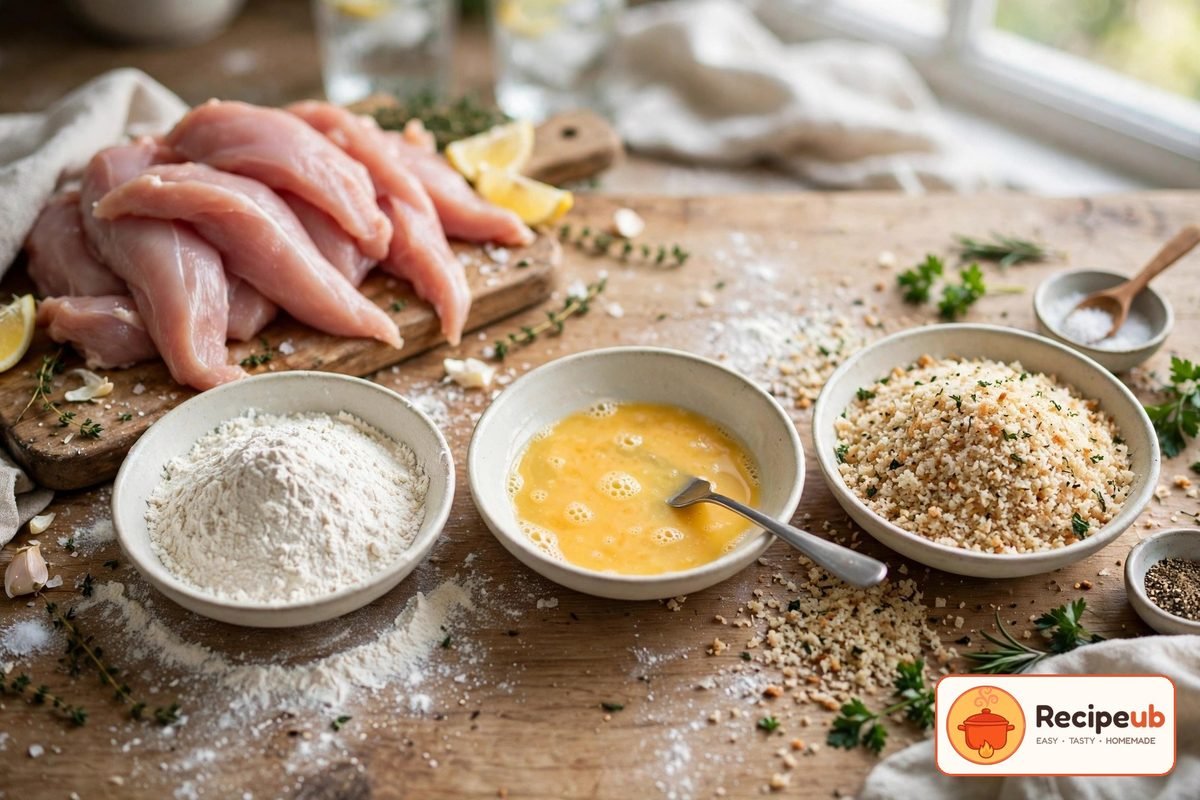
How to Make Air Fryer Chicken Tenders
- Dry and set up. Pat the tenderloins completely dry with paper towels (Rule 1). Set up three shallow bowls: the flour mixed with half the salt, the paprika, garlic powder, onion powder and black pepper in the first; the eggs beaten with the milk and remaining salt in the second; the panko, fine breadcrumbs and Parmesan in the third.
- Flour. Dredge each tender in the seasoned flour, coating all sides, then shake off every bit of excess (Rule 2). Lay the floured tenders on a plate as you go.
- Egg. Dip each floured tender in the egg wash, turning to coat, and let the excess drip back into the bowl for a few seconds (Rule 3).
- Crumb and press. Roll each tender in the panko mixture, pressing firmly with your palm on both sides so the crumbs bite in (Rule 4). No bare spots — patch any with a pinch of crumb and another press.
- Rest 10 minutes. Set the breaded tenders on a rack or a parchment-lined plate and rest them 10 minutes (the fridge if there is room). This is the step that keeps the crust on — do not skip it to save time, because it is the time that saves the crust.
- Preheat and load. Preheat the air fryer to 400°F for 3 to 5 minutes. Arrange the tenders in a single layer with about ½ inch of space between them (Rule 5) — cook in two batches rather than crowding. Spray the tops with oil until no dry white spots show.
- Cook, flip once. Cook at 400°F for 6 minutes, until the crust has set and started to color. Flip each tender gently with tongs, spray the second side, and cook 6 minutes more — 12 minutes total — until deeply golden and the thickest tender reads 165°F on a thermometer.
- Rest and serve. Rest the tenders 2 to 3 minutes (the crust firms up and the juices settle), then serve hot with two dipping sauces from the chart above.


Air Fryer Chicken Tenders (Crispy, 400°F, 12 Minutes — Breading That Stays On)
Ingredients
Equipment
Method
- Pat the tenderloins completely dry. Set up three bowls: flour with half the salt and all the spices; eggs beaten with the milk and remaining salt; panko, fine breadcrumbs and Parmesan.
- Dredge each tender in the seasoned flour and shake off all excess.
- Dip in the egg wash, letting the excess drip off.
- Roll in the panko mixture, pressing firmly with your palm on both sides. Rest the breaded tenders on a rack for 10 minutes.
- Preheat the air fryer to 400°F. Arrange the tenders in a single layer with ½ inch of space (cook in batches if needed) and spray until no dry spots show.
- Cook at 400°F for 6 minutes. Flip gently with tongs, spray the second side, and cook 6 minutes more, until golden and the thickest tender reads 165°F.
- Rest 2 to 3 minutes and serve hot with dipping sauces.
Notes
- Time by thickness at 400°F (165°F finish): thin ¼–½″ tenders = 8–10 min; standard ½–¾″ = 10–12 min; thick ¾–1″ = 12–14 min. Flip at the halfway point of your row.
- Unbreaded variation: skip the coating, season the tenders directly, cook at 390°F for 8–10 minutes — about 190 calories per serving.
- Frozen rows: store-bought precooked breaded tenders = 400°F, 10–12 min; raw-inside frozen (including homemade make-ahead) = 390°F, 14–16 min. Reheat leftovers at 375°F for 3–5 min.
- The breading rules that matter: pat dry, flour thin, egg as glue, press the crumbs, rest 10 minutes, and never flip before minute 5–6.
Emma’s Tips for the Best Air Fryer Chicken Tenders
Measure the thickest tender, not the average one. A batch of tenderloins is mostly uniform, but there is always one plump outlier, and that one sets your time. Find it, cook to its row of the chart, and check its temperature. The thin tenders will be fine — chicken strips forgive a minute over far better than a thick one forgives a minute under.
Bread everything, then cook — never bread as you go. If you bread the first tenders and cook them while you bread the rest, the first batch gets no rest and the last batch gets twenty minutes of it, and they will not match. The whole batch breaded, the whole batch rested, the whole batch cooked: that rhythm is why the crust is consistent from the first tender to the twelfth.
Spray like you mean it. The oil spray is not a garnish; it is what turns pale, powdery crumb into golden crust. Spray until you cannot see a dry white spot, especially at the edges where the crumb is thinnest. Missed spots stay floury no matter how long you cook them.
Tongs, not the basket shake. Shaking an air fryer basket is fine for fries and a disaster for fresh breading — the tenders tumble, knock against each other and shed crust at every contact point. Flip each tender once, gently, gripping the chicken itself. It takes twenty seconds longer and saves the entire coating.
Sauce while they rest. The 10-minute breading rest and the 2-minute sauce chart were made for each other. Stir up the Cane’s-style and the ranch while the tenders sit, and everything — chicken rested, crust set, sauces ready — lands on the table in one motion.
Storage and Reheating
Fridge: Cool the tenders, then refrigerate in an airtight container for up to 3 days. Line the container with a paper towel if you have one — it catches the condensation that would otherwise soften the crust overnight.
Reheating: The air fryer is the only reheating method that gives the crust back: 375°F for 3 to 5 minutes, flipping halfway, straight from the fridge. The microwave makes them safe and sad — hot, but steamed soft. If the microwave is the only option, a minute on a paper towel is the least-bad version.
Freezing: Freeze cooked tenders in a single layer on a tray until solid, then bag them for up to 2 months; reheat from frozen at 390°F for about 10 to 12 minutes, checking for 165°F. To freeze them raw and breaded — the true make-ahead move — bread them, rest them, freeze them solid on the tray, and cook from frozen on the chart’s raw-inside row: 390°F for 14 to 16 minutes. Either way, a frozen tender of your own beats the bag, the way everything on this shelf beats its shortcut version — my Air Fryer Boneless Skinless Chicken Thighs exist for exactly that reason too, for the nights a whole different cut is what the fridge holds.
FAQs
How long do you cook chicken tenders in the air fryer?
For standard tenderloins, ½ to ¾ inch thick: 10 to 12 minutes at 400°F, flipped halfway — this recipe uses 12 minutes, flipped at 6. Thickness changes the answer more than anything else: thin ¼- to ½-inch tenders take 8 to 10 minutes, and thick ¾- to 1-inch tenders take 12 to 14. The thickness chart above has every row, including unbreaded and frozen.
What temperature do you cook chicken tenders at in the air fryer?
400°F for breaded tenders — it sets the crust fast enough to lock it on and browns the panko before the chicken overcooks. Unbreaded tenders do better a touch lower, at 390°F, where the surface seasons and firms without a coating to protect it. Lower temperatures like 370°F work but take nearly twice as long and give a paler crust; 400°F is the standard for a reason.
Can you cook frozen chicken tenders in the air fryer?
Yes — but check which kind your bag holds, because they cook differently. Store-bought tenders that are precooked inside the breading need only 10 to 12 minutes at 400°F to crisp and heat through. Tenders that are raw inside — including homemade ones you breaded and froze — need 14 to 16 minutes at 390°F, and a thermometer check for 165°F is not optional on those. The bag will say which one you bought.
How do you keep breading from falling off chicken tenders in the air fryer?
With the system, in order: pat the chicken completely dry, dredge in a thin layer of flour with the excess shaken off, dip in egg wash (the glue layer), press the panko on firmly, and rest the breaded tenders 10 minutes before cooking so the coating sets. Then cook in a single layer and do not flip before minute 5 or 6. No egg for the wash? Buttermilk or a thin smear of mayonnaise both bind in its place — egg is strongest, but either beats oil or butter as an adhesive.
Can you air fry chicken tenders without breading?
Yes, and it is a genuinely good version, not a compromise. Season the tenderloins directly — the same spice blend from this recipe works — and cook at 390°F for 8 to 10 minutes, flipping halfway, to 165°F. Without the coating, the serving drops to about 190 calories while keeping roughly 40 grams of protein, which is why “no breading” and “calories” travel together in search. The BBQ sauce from the dip chart was made for this version.
How do you reheat chicken tenders in the air fryer?
At 375°F for 3 to 5 minutes, flipping halfway. That short, hot pass re-crisps the crust and heats the chicken through without drying it, and it is the reason the air fryer beats every other leftover method for this dish. From frozen, give leftovers about 10 to 12 minutes at 390°F and check the temperature.
Do you need to flip chicken tenders in the air fryer?
Yes — once, at the halfway point, and not before minute 5 or 6. The flip evens the browning and crisps the underside, which sits against the basket and steams without it. But flipping early, while the crust is still unset, is the single most common way breading gets torn off. Set crust first, one gentle flip with tongs, done.
How do you know when chicken tenders are done?
By temperature, not by color: 165°F in the thickest part of the thickest tender, read on an instant-read thermometer. Golden breading can hide an underdone center in a thick tender, and a pale tender can be fully cooked. Color tells you about the crust; only the thermometer tells you about the chicken.
Can you stack chicken tenders in the air fryer?
No — they need a single layer with about ½ inch of space between them. Stacked or touching tenders steam where they meet, the crust softens and sticks to its neighbor, and the touching spots tear the breading off when you separate them. If your batch does not fit, cook it in two batches; the first batch holds fine in a low oven for the five minutes the second one takes.
Why are my chicken tenders dry or rubbery?
Usually one of two reasons: they cooked past their row of the chart (a thin tender given a thick tender’s 14 minutes will dry out every time), or the thermometer never came out and “a few extra minutes to be safe” did the damage. Tenderloins are lean and small, so their margin is minutes, not tens of minutes. Measure the thickness, cook to its row, pull at 165°F, and rest them — the dry-tender problem mostly solves itself.
Final Thoughts
The chains can keep their combos. A tender is a simple food — a strip of chicken, a crust, a sauce — and everything that goes wrong with it at home goes wrong for fixable reasons: a wet surface, a skipped flour, a crust flipped before its time, a clock that never asked how thick the chicken was. This recipe is just those fixes, written down in order: five rules for the breading, one chart for the timing, six sauces for the table, and an honest label for what a serving really is. Make them once by the system and you will not need the system again — it will just be how you make tenders.
More Easy Air Fryer Chicken Dinners
If tenders earn a spot in your rotation, the rest of the air fryer chicken shelf is built with the same measure-first honesty. My Air Fryer Chicken Bites are the cubed cousins of these strips — same crispy logic, bite-size pieces, made for snacking and salads — while the Air Fryer Chicken Breast takes the whole breast, pounded even, with a thickness chart of its own for the nights you want a full cutlet on the plate. And when the week needs the original weeknight hero, the Air Fryer Boneless Skinless Chicken Thighs are still the juiciest shortcut on the site — three cuts, three charts, three different dinners, and not one of them asking you to guess a time again.




Never Run Out of Dinner Ideas
One easy air fryer or slow cooker dinner in your inbox every week. No spam, ever.
You’re on the list — welcome to Recipeub!