Why One Tray of These Lemon Cheesecake Bars Was Not Enough


These lemon cheesecake bars with lemon curd come from years of baking across different kitchens and learning how citrus behaves in each one. I stopped rushing the curd, stopped overmixing the filling, and this version finally held. It’s the one that finally matched what I had been trying to recreate for years.
Jump to:
There’s a family photo somewhere of me sitting on a picnic blanket, holding half a melted lemon dessert bar while everyone else faces the camera, and I’m turned toward the cooler because I knew there was another one hidden under the drinks.
I don’t remember whose picnic it was or even which country it belonged to. Whether it was a park in Israel with citrus trees close by, a crowded afternoon in Montreal, or one of those long Mother’s Day gatherings where desserts appeared late and disappeared quickly. If I’m being honest, it was probably Shavuot, the Jewish holiday of all things dairy, when cheesecakes rule the day. But I digress.
What I remember most is the cold bite of lemon against the heat, the creamy center, the crust breaking apart in my hands, and that quiet urgency to reach for another before the tray emptied.
And now in my own kitchen with the kids pulling at my sleeves and F slicing fruit at the counter, I keep returning to that same feeling through the lemon desserts that have shaped this space, from the soft layers of my lemon tiramisu to the quiet reliability of almond flour lemon bread and the slices of gluten-free lemon poppy seed loaf cake that travel with us to playgrounds and long drives.

This recipe came together somewhere between all of those, built slowly through years of baking across the cultures that raised me. Each batch teaching me something new until I stopped measuring so closely and started trusting the way the curd thickens under the whisk. The way the filling smooths when the cream cheese is ready, the way the swirl settles into the surface before baking
Now these bars sit cold in the fridge, bright, creamy, sharp enough to wake up your whole mouth, the kind of dessert that still makes me glance toward the refrigerator, half expecting someone else to reach in first.
Ingredients

Fresh lemons carry this entire recipe. I use both the zest and juice because they bring two different layers of flavor. I always reach for heavy, thin-skinned lemons with a deeper yellow color because they usually give more juice and stronger aroma. Meyer lemons can work when they are in season, though they bring a softer citrus note and a little less sharpness.
The center of these cheesecake bars is cream cheese. I always use full-fat blocks rather than whipped or spreadable tubs because they bake with better structure and hold that creamy texture once chilled. I have tried lighter versions before, and they tend to release extra moisture and soften too much after slicing. Mascarpone can step in if you want something slightly softer and richer, though it brings a milder tang.
The other crucial filling component is lemon curd. You can use store-bought lemon curd, or make your own – I have a vegan lemon curd version I love.
With citrus already layered in, lemon sandwich cookies build the crust. I started using gluten-free lemon sandwich cookies after one batch with plain graham crackers felt flat next to the lemon curd. If you cannot find lemon cookies, vanilla sandwich cookies or graham crackers with extra lemon zest work well.
Vanilla rounds out the sharper edges of the citrus and cream cheese. It does not stand out on its own, though you notice when it is missing. I prefer pure vanilla extract because it settles more naturally into baked cheesecakes, though vanilla bean paste works beautifully when I want those tiny flecks running through the filling.
See the recipe card for full list and exact quantities.

Top Tips
Chill the lemon curd before swirling it into the filling – I learned this after one batch where I rushed the curd straight from the stove. Warm curd sinks into the cheesecake batter and loses those clean yellow ribbons on top. Fully chilled curd stays where you place it, giving you that marbled finish in every slice.
Tap the pan before baking – once the filling is in the pan, tap it firmly against the counter two or three times. Small air bubbles rise to the surface, which helps the bars bake more evenly and keeps little pockets or cracks from showing up after chilling. I started doing this after noticing tiny holes in the center of earlier batches.
Use a water-dampened knife for the cleanest cuts – a dry knife tends to drag through the chilled curd and pull the filling at the edges. I run the blade under hot water, wipe it lightly, and clean it between every cut. It takes an extra minute, though the layers stay sharp and bakery-clean.
How to Make Lemon Cheesecake Bars with Lemon Curd

These lemon creamy cheesecake bars come together in layers, and each one builds the texture of the final slice. The curd needs patience, the crust needs pressure, and the filling needs a gentle hand. If you love lemon then here’s how to make this recipe:
Cook and Finish the Lemon Curd
- Whisk egg yolks, sugar, lemon zest, juice, and salt over simmering water.
- It starts thin, then thickens and lightens, coating the back of a spoon. A line should hold when you run your finger through it. If it stays runny, keep going. If it turns grainy, lower the heat and whisk steadily.
- Remove from heat and stir in butter until smooth and glossy. If it doesn’t fully blend, the curd may have cooled too much.
- Press plastic wrap directly on the surface before chilling to prevent a skin. refrigerating. This step matters more than it seems. Without it, a thin skin forms on top that can create lumps later when you try to use it.
Prepare the Pan and Oven
- Line your pan with parchment paper, letting some hang over the sides for easy lifting later. This makes removing the bars much cleaner once they’ve set.
- Preheat the oven to 325°F. A steady, moderate temperature helps the filling cook evenly without cracking or over-setting at the edges.
Build the Crust with the Right Texture


- If it feels too dry, it won’t press together properly. If it feels overly greasy, the crust can become dense after baking. You’re looking for a mixture that holds its shape when pressed between your fingers.
Press and Bake the Crust Until Set

- After baking, the crust should look slightly deeper in color and feel firm to the touch. It may puff a little in the oven but will settle as it cools.
- If it still feels soft or crumbly, give it another minute or two. A fully set crust keeps the layers above from shifting later.
Mix the Cheesecake Filling Until Smooth


- The mixture should look thick, creamy, and uniform. This will bring the mixture to a silky, pourable consistency.
Assemble and Swirl the Layers


- When you swirl it with a knife, move lightly. The goal is soft streaks, not fully mixing it in.
- If you swirl too much, the curd blends into the filling and loses that contrast. If you don’t swirl enough, it stays in thick patches that can sink unevenly.
Bake Until Set with a Gentle Center Movement

- When you gently shake the pan, the middle should move a little, like a soft ripple.
- If the entire surface moves, it needs more time. If the center feels firm and no longer shifts, it may be overbaked and turn dense after chilling.
- The top should look matte rather than glossy when it’s ready. Watch closely in the final minutes, as the difference between set and overdone happens quickly.
Cool Slowly Before Chilling

- This gradual cooling helps prevent cracks and keeps the texture even.
- If moved too quickly into the fridge, the sudden temperature change can cause the surface to pull slightly.
Chill Until Fully Set
- Refrigerate for at least four hours. During this time, the filling firms up and the layers settle into place.
- When ready, the bars should feel firm when sliced, with clean edges and distinct layers. If they still feel soft or stick to the knife, they need more time.
Slice and Serve

- Wiping the knife between cuts helps keep the edges neat.
- You’ll see the contrast clearly here. A firm crust, a smooth center, and streaks of curd running through the top.
Storage

Store lemon cheesecake bars with lemon curd in an airtight container in the refrigerator for up to three days. Keep them in the pan until fully chilled, then slice and layer with parchment if stacking to prevent sticking and keep the crust firm. Serve straight from the fridge or let them sit briefly before slicing for cleaner edges.

For longer storage, freeze fully chilled bars cut into squares and wrapped tightly. Place in a freezer-safe container and freeze for up to one month. Thaw overnight in the refrigerator to keep the texture smooth. Avoid refreezing, as the curd can lose structure and the crust may soften.
FAQs
This usually happens when the heat is too high or the mixture is not whisked constantly over the simmering water. The egg yolks can start to cook too quickly and form tiny bits. If this happens early, lower the heat and keep whisking. If small bits already formed, strain the curd through a fine mesh sieve while it is still warm to bring it back to a smooth texture.
Cracks often come from overbaking or too much air mixed into the batter. The center should still have a slight jiggle when it comes out of the oven. If the surface is fully firm, it has gone too far. Another cause is overmixing after adding the eggs, which introduces air that expands and collapses during baking. Gentle mixing once the eggs go in helps prevent this.
A soft crust usually means the cookie crumbs were not pressed firmly enough or the butter ratio was off. The crust should feel compact before baking, almost like packed damp sand. If it is too loose, it will not set properly and can soften once the filling is added. Letting the crust cool fully before pouring in the batter also helps it stay firm.
Fresh lemon juice works best for this recipe. Bottled juice tends to have a flatter, slightly muted flavor that does not balance well with the cream cheese. Fresh zest is also important because it carries the oils that give the bars their brightness and aroma. If needed, bottled juice can be used in a pinch, though the final flavor will be less layered.
Recipe
Tried and loved this recipe? Please leave a 5-star review below! Your reviews mean a lot to me, so if you’ve got any questions, please let me know in a comment.
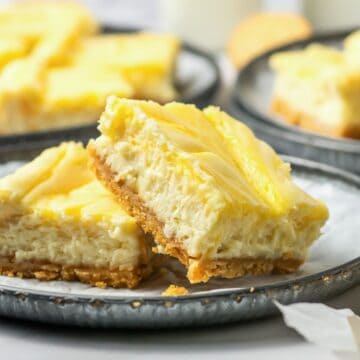
Lemon Cheesecake Bars with Lemon Curd
Lemon cheesecake bars with lemon curd, creamy and bright with a firm crust and smooth citrus layers.
Prevent your screen from going to sleep
Ingredients
For the Lemon Curd
- 4 egg yolks
- ⅔ cup sugar
- 1 tablespoon lemon zest
- ⅓ cup lemon juice
- ⅛ teaspoon salt
- 6 tablespoon unsalted butter
For the Cheesecake Filling
- ¾ cup sugar
- 1 tablespoon lemon zest
- 16 oz cream cheese softened
- 2 eggs
- ¼ cup lemon juice
- 1 teaspoon vanilla
- ½ cup lemon curd
Instructions
-
Combine egg yolks, sugar, zest, juice, and salt in a heatproof bowl over simmering water. Whisk constantly for 10 minutes until pale and thickened.
-
Remove from heat and stir in butter until melted. Cover with plastic wrap touching surface. Refrigerate.
-
Line an 8×8 pan with parchment paper. Preheat oven to 325°F.
-
Pulse Oreos in food processor until fine crumbs. Mix with zest and melted butter until wet sand consistency.
-
Press mixture into bottom of prepared pan. Bake for 10 minutes. Cool to room temperature.
-
Beat cream cheese, sugar, and zest until smooth. Add eggs and mix well. Stir in vanilla and lemon juice.
-
Pour filling into crust. Dollop curd over filling and swirl with knife.
-
Bake 45-50 minutes until edges are set with slight jiggle in center. Cool to room temperature.
-
Refrigerate 4 hours until completely set.
-
Serve.
Nutrition
Calories: 474kcalCarbohydrates: 43gProtein: 6gFat: 32gSaturated Fat: 18gPolyunsaturated Fat: 2gMonounsaturated Fat: 8gTrans Fat: 0.4gCholesterol: 200mgSodium: 248mgPotassium: 112mgFiber: 0.2gSugar: 41gVitamin A: 1158IUVitamin C: 8mgCalcium: 71mgIron: 0.5mg
Electric mixer or hand mixer

Post Comment