
Chicken Bog (Chicken, Sausage and Rice, 65 Minutes)
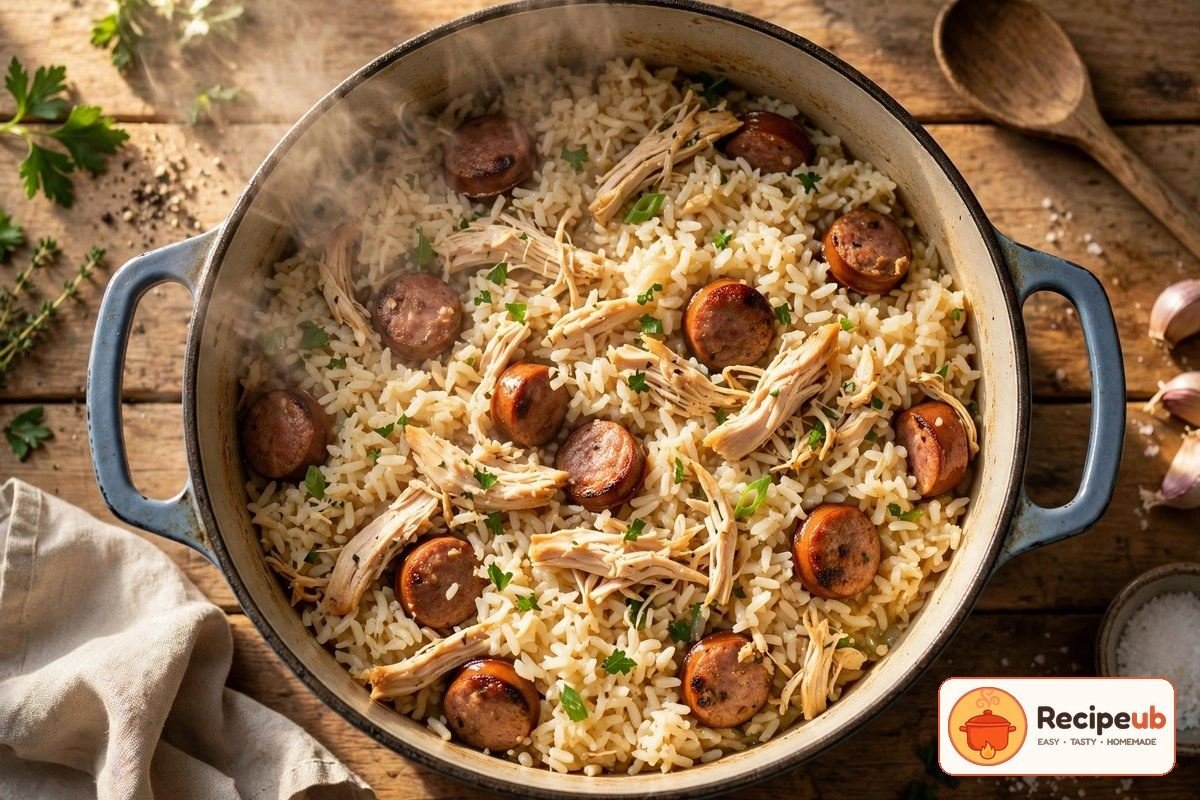
Chicken bog is the dinner the search box describes in its own completions: chicken bog, chicken bog recipe, chicken bog south carolina, chicken bog recipe with chicken thighs, chicken bog recipe with rotisserie chicken, chicken bog recipe with chicken breast — and, typed whole onto the rice stem, chicken bog rice to water ratio. Read those completions together and the searcher is carrying two unanswered questions into the results page: which chicken does this dish actually need — and how wet is the rice supposed to be? Page 1 answers neither with an object. The #1 seat on the dish is a tourism board — the South Carolina site explaining the dish, carrying a festival recipe from the Loris Chamber of Commerce. The two platform recipes both simmer a whole chicken for over an hour and card totals of 2 hours 10 and 2 hours 15; the classic one’s method ends by telling the cook to stir “until thickened to desired consistency” — the dish’s defining variable, handed back to the reader as a shrug. The prestige explainer’s own recipe adds wine and tomatoes and serves the chicken over separately cooked rice, which is not a bog by its own text’s admission. One blog simmers its whole chicken 60 to 90 minutes and suggests cooking it two days ahead to route around the clock. And the ratio — the one number the dish is named for — appears exactly once on the whole page, as a single line inside one blog’s tips block, never converted, never mapped to what it eats like. This page prints the three systems the cluster leaves out: the Bog Chart — every named holder’s broth-to-rice ratio converted to one column and mapped to the finished texture, from fluffy perloo at 1½ cups to soup at 4; the Chicken Chart — the four chicken lanes priced in the currency this lane actually charges, which is time; and the Priced Pot — the whole batch costed at November 2026 prices, for a crowd dish the lane calls “economical” and never prices. The build itself keeps the dish’s one-pot logic intact: 12 ounces of smoked kielbasa browned first so its drippings season the pot, 1½ pounds of boneless skinless chicken thighs poached about 14 minutes to 165°F in the same pot — which is what makes the broth — and 2 cups of long-grain white rice simmered in 5 cups of that broth, the chicken and sausage returned, at 2½ cups of broth per cup of rice. Six servings at about 560 calories and ≈$1.20 a serving (both estimates, itemized on this page), in 65 minutes — about half of the classic clock, with nothing opened from a carton and nothing cooked on a previous day.
It also knows its nearest neighbor on this site, because this shelf already runs a chicken-and-rice pot. If plain chicken and rice is the weeknight you already know, that is my one-pot chicken and rice — the plain weeknight build, chicken and rice in one pot with a budget frame and no second protein; this post is its Lowcountry cousin, where smoked sausage joins the pot and the rice is supposed to come out wet. The market already treats them as two dishes — chicken bog vs chicken and rice is a comparison searchers type into the box themselves — and the difference is not a garnish: post 6’s rice finishes as a pilaf-style pot, and this one’s rice finishes deliberately wet, by a printed number, with a second protein in it. Same shelf, same two headline ingredients, opposite finish — and the finish is the dish.
The short answer: Slice 12 oz of smoked kielbasa into rounds and brown them 4 minutes in a Dutch oven; set them aside. Add 1½ lb of boneless skinless chicken thighs to the same pot with 5½ cups of water, half an onion in wedges, a celery stalk, a bay leaf, salt and black pepper, and poach about 14 minutes, until the thickest thigh reads 165°F. Pull the chicken into bite-size pieces. Measure 5 cups of the broth back (top up with water if it runs short). Soften the diced onion in 1 Tbsp of butter and the drippings 3 minutes, add 3 minced garlic cloves for 1 minute, toast 2 cups of long-grain white rice for 1 minute, then pour in the broth, return the chicken and sausage with a second bay leaf and a heavy grinding of black pepper, cover and simmer 18 minutes. Rest 10 minutes off the heat, stir once, gently — six servings at about 560 calories and ≈$1.20 each, in 65 minutes.
In This Recipe
What Is Chicken Bog?
Chicken bog is a South Carolina Lowcountry one-pot dish: chicken, smoked sausage and long-grain white rice cooked together in the chicken’s own broth until the rice is deliberately wet — moist, cohesive and spoonable, the grains swollen and leaning into each other instead of standing separate. It comes from the rice country of the Pee Dee and the Waccamaw — the dish’s home ground is Loris, South Carolina, which has called itself the capital of the chicken bog world since its Bog-Off festival began in 1979, and which searchers type into the box alongside Florence as a place, not just a recipe. The name is the texture: the rice is finished boggy, likened by the dish’s own writers to the wetlands of the Lowcountry it comes from — a wetter rice than a pilaf, on purpose, by design, and (this is the part page 1 leaves unprinted) by a measurable amount of broth.
The purist core is short enough to state in one sentence, and the state’s own tourism page states it: chicken, smoked sausage, rice, salt and black pepper, and perhaps onion — purists insist those are the only ingredients. Everything else is a variation, and variations are fine as long as they are named as variations. This build cooks on the purist core and names its own two additions in the open: celery in the poach (it flavors the broth and comes out before the rice — it is a broth ingredient, not a bog ingredient) and butter at the onion (one tablespoon, working with the sausage drippings). What this build does not add is the furniture other pages quietly install: no mushrooms, no Parmesan rind, no wine, no cream-of-anything soup — the broth is made in the pot, not opened from a can, because the broth is the dish. Stated as one citable line: chicken bog is a South Carolina Lowcountry one-pot dish of chicken, smoked sausage and rice cooked in the chicken’s own broth until the rice is deliberately wet — 2½ cups of broth for every cup of rice — and it differs from jambalaya in having no tomato and no Cajun seasoning, and from perloo in its wetter finish. The two charts below are that sentence, printed as systems.
The Plan at a Glance
- The ratio: 2½ cups of broth for every cup of long-grain white rice — 5 cups measured back for this pot’s 2 cups of rice; that is the bog line on the Bog Chart below, with perloo below it and soup above it (the ratio rule in the card notes)
- The chicken: 1½ lb boneless skinless thighs, poached about 14 minutes to 165°F in the pot the sausage just browned in — the chicken still makes the broth, the traditional way; it just does not take an hour to do it (the chicken rule in the card notes)
- The sausage: smoked kielbasa, sliced into rounds and browned FIRST — its drippings season the poaching liquid before the chicken ever goes in; smoked is the South Carolina choice, and andouille pulls the pot toward jambalaya (the sausage rule in the card notes)
- The rice: long-grain white, not rinsed — the surface starch is part of the body that makes this a bog and not a pilaf
- What is NOT in it: no tomato, no Cajun seasoning, no shrimp — those belong to the Louisiana pot on this shelf, and the fence is named in Why This Version Works below
- The clock: the chicken is pulled with two forks WHILE the onion softens and the rice toasts — the pulling runs inside the cook time, stated openly, which is part of how the total is 65 minutes and not 80
- Time: 15 minutes prep / 50 minutes cook (sausage 4 + poach 14 + onion 3 + garlic 1 + toast 1 + simmer 18 + rest 9 to 10, stated openly) / 65 minutes total
- Yield: 6 servings (about 1½ cups each)
- Calories: ≈560 per serving (estimate); protein ≈32 g per serving (estimate)
- Cost: ≈$1.20 per serving (estimate) at November 2026 prices — the rice line is a BLS-verified anchor; the chicken and sausage lines are labeled shelf estimates; the full line-by-line table is The Priced Pot below
- Storage: fridge 3 to 4 days; freezer up to 3 months — this dish was born as a batch dish and freezes like one; the rules are in the Storage section below
Why This Version Works
The sausage browns first, so the fast chicken lane does not cost the broth. The honest trade in this build is printed on the Chicken Chart below and not hidden: a whole chicken simmered for an hour makes the richest broth, and boneless thighs poached in 14 minutes make a lighter one. What closes most of that gap is the order of operations. The kielbasa goes into the dry Dutch oven first and browns in its own fat; when it comes out, its drippings — smoked, salty, pork-rich — stay in the pot, and the thighs poach in water that those drippings are already seasoning, along with the onion, celery, bay, salt and pepper. The broth a thigh poach makes in a sausage-seasoned pot is not the broth a whole chicken makes, and this page does not pretend otherwise — but it is a real broth, made in the pot, in the dish’s own logic: the proteins season the liquid, and the liquid cooks the rice. Nothing is opened from a carton, and no shortcut lane that skips the poach can say that.
The rice is not rinsed, and the reason is the dish’s name. Every instinct from pilaf cooking says to rinse rice until the water runs clear — and for a pilaf that instinct is right, because a pilaf wants separate grains. A bog wants the opposite: grains that swell, soften at the edges and lean together into a cohesive, spoonable mass. The surface starch on unrinsed long-grain rice is part of that body — it is, in a real sense, an ingredient, and rinsing it down the sink is removing the thing that makes the finish a bog instead of a moist pilaf. So the rice goes in as it comes from the bag, gets one minute of toasting in the butter and drippings to coat each grain, and then meets a measured amount of broth. Which amount is the whole dish — the Bog Chart below is this paragraph as a table.
It knows exactly which pot it is not. This shelf runs the other chicken-sausage-rice pot too, and the search box asks the two against each other by name — chicken bog vs jambalaya is a typed search. The answer this page gives is the ingredient list: my one pot jambalaya — the Louisiana build, chicken, sausage and shrimp with Cajun seasoning and tomato, its rice finished as separate grains; this post is the South Carolina pot, where there is no tomato, no Cajun seasoning and no shrimp, and the rice lets go and leans together is a fine dinner, and it is not this one. Jambalaya is Louisiana: Cajun seasoning, tomato, the trinity cooked as a base, shrimp in this site’s build, grains that stay distinct. Chicken bog is South Carolina: black pepper does the seasoning work, the sausage is smoked rather than spiced, and the rice is finished wet on purpose. Same three headline ingredients, opposite regional logic — a reader choosing between them deserves the fence named, and here it is named in the open, not discovered at the table.
The clock is cut at the poach, not at the principle. Read page 1’s clocks again: 2 hours 10, 2 hours 15, an hour and a half of cooking behind a rotisserie chicken, 80 to 90 minutes for the festival pot, and the freshest blog routing around its own 60-to-90-minute chicken by telling you to cook it two days ahead. Every one of those clocks is the same shape — an hour-plus chicken, then a rice pot. The active work in any of them is under half an hour; the rest is a whole bird simmering. This build keeps every step of the dish’s logic — sausage browned, chicken poached in the same pot, broth measured, rice cooked in the broth — and changes only the cut of chicken, from a 3½-pound bird to boneless thighs that poach in about 14 minutes. The saving is real and it is stated where it comes from: the poach, never the broth. A weeknight bog is not a different dish; it is the same dish whose chicken fits a Tuesday.
Ingredients
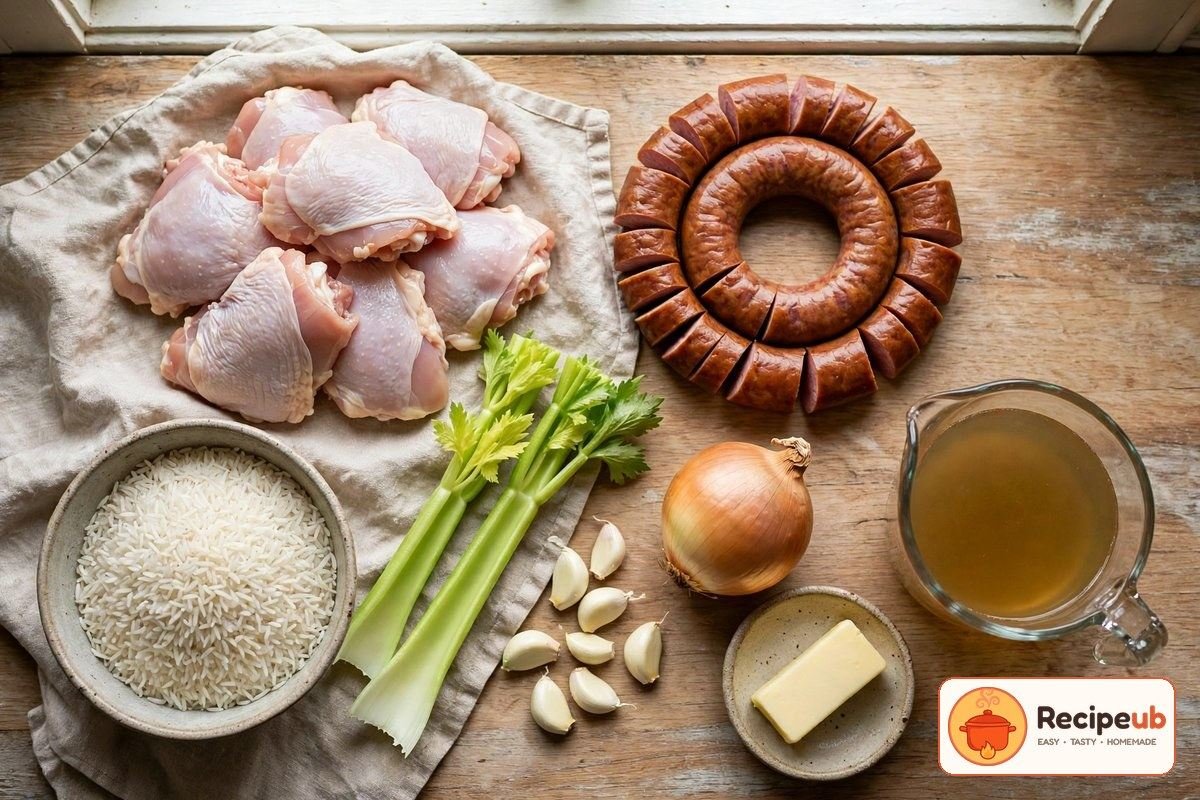
- 12 oz smoked kielbasa, sliced into ½-inch rounds
- 1 Tbsp butter
- 1½ lb boneless skinless chicken thighs
- 5½ cups water, for poaching
- 1 medium yellow onion, half cut in wedges and half diced
- 1 celery stalk, cut into chunks
- 2 bay leaves, divided
- 1½ tsp kosher salt, divided
- 1 tsp black pepper, plus more for finishing
- 3 cloves garlic, minced
- 2 cups long-grain white rice
- Sliced green onions and hot sauce, for serving
Ingredient notes: The sausage is smoked kielbasa, 12 ounces, sliced into ½-inch rounds — smoked sausage is the South Carolina tradition (the purist line in What Is Chicken Bog above), and the rounds brown at the edges in a way crumbled sausage never does. Andouille is the swap the biggest blog on page 1 builds on, and it is named here as a swap rather than used silently: andouille is Louisiana’s sausage, spiced and hot, and it pulls the pot toward jambalaya with every bite — the kielbasa-vs-andouille line is the sausage rule in the card notes. Ground sausage and breakfast sausage are typed variants on the search stem, and both are declined for the same reason: a bog’s sausage is a smoked rope, sliced, not a fresh crumble. The same smoked sausage does completely different work elsewhere on this shelf — my one-pot sausage and potatoes — the skillet build, smoked sausage roasted into a pan of potatoes; this post slices the same sausage into rice and broth instead — there it crisps against potatoes; here it seasons a poach and then rides in rice. One dated check belongs in this note, because this build cooks kielbasa: FSIS Recall 026-2026 (Kayem Foods Inc., announced October 17, 2026, Class I) covers ready-to-eat products — including kielbasa — sold under the Kayem, Al Fresco, McKenzie, Triple M, Deutschmacher, Jordan’s, Essem and Winnisimmet St. Butchery brands, identified by the establishment numbers EST. M/P 7839, EST. P 20935A and EST. M 9520 inside the USDA mark of inspection; check the EST. number on your package — a kielbasa from any other maker is not in this recall. The chicken is boneless skinless thighs, 1½ pounds — the Chicken Chart’s lanes live below, but the short version is that thighs poach in about 14 minutes, stay moist through the rice’s second heat, and make a lighter broth that the sausage-first order answers; boneless breast is the chart’s caution row, because it dries in the simmer. The rice is long-grain white rice, 2 cups, not rinsed — long-grain is the Lowcountry grain (the festival pots cook it, and the heritage builds cook its Carolina Gold cousin), and the no-rinse rule is the dish’s body, explained in Why This Version Works. The water is 5½ cups for the poach, of which 5 cups are measured back for the rice — the poach is deliberately a half cup generous, because thighs, onion and celery drink a little and foam takes a little, and the ratio that matters is the measured 5 cups that meet the rice, not the 5½ that started the poach; if the measure still runs short, top it up with water and say so at the pot — the ratio is the recipe. The onion does double duty by design: half in rough wedges flavors the poach and comes out with the celery; half diced goes into the rice. The black pepper is 1 teaspoon in the build and a heavy extra grinding to finish — in a dish whose purist seasoning is salt and pepper, the pepper is not a background note; it is the signature, and the finish is where it reads.
How to Make Chicken Bog
The method is one pot in one order, and the order is the recipe: sausage first for its drippings, thighs poached in the seasoned pot to make the broth, broth measured — actually measured, with a measuring cup, not eyeballed — and the rice cooked in exactly 2½ cups of it per cup of rice. The one piece of choreography is the chicken-pulling, which runs while the onion softens and the rice toasts; the clock statement in The Plan says so in the open, and the steps below are written so the overlap is easy to take. A large Dutch oven is the vessel — the typed stem itself asks for one (chicken bog in dutch oven) — because it holds the poach and the rice in the same heavy pot with a lid that seals.
- Brown the sausage first. Set a large Dutch oven over medium-high heat. Add the kielbasa rounds in a single layer and cook 4 minutes, turning once, until the edges are browned and the pot holds a slick of smoked drippings. Lift the sausage out to a plate and leave every drop of the drippings in the pot — they are the broth’s first seasoning, and the thighs are about to poach in them.
- Poach the thighs — this is the broth being made. Add the 5½ cups of water, the onion wedges, the celery chunks, 1 bay leaf, 1 tsp of the salt and ½ tsp of the black pepper to the pot and bring it to a gentle simmer. Slide in the chicken thighs, keep the liquid at a bare simmer — a poach, not a boil; a hard boil toughens thighs and clouds the broth — and cook about 14 minutes, until the thickest thigh reads 165°F on an instant-read thermometer. The temperature is the rule, not the minutes: thighs vary, and 165°F is the number every lane on the Chicken Chart ends at.
- Pull the chicken; measure the broth. Lift the thighs out to a board and pull them into bite-size pieces with two forks — about 4 minutes of work, and it runs while steps 4 and 5 happen, so start the onion and come back to the forks between stirs. Strain or lift out the onion wedges, celery and bay leaf and discard them; their work is done. Now measure the broth: pour 5 cups back into the pot (a measuring cup, honestly used) and top up with water if the poach left you short. This measure is the recipe’s whole point — 5 cups for 2 cups of rice is the 2½:1 line on the Bog Chart, and it is decided here, at the measuring cup, not at the table.
- Soften the onion in butter and drippings. Return the pot to medium heat and melt the butter in whatever drippings remain. Add the diced onion and cook 3 minutes, until softened and translucent at the edges. (This is the window where the chicken gets pulled, if it is not already.)
- Garlic, then toast the rice. Add the minced garlic and cook 1 minute, until fragrant. Add the dry, unrinsed rice and stir it through the butter and onion for 1 minute, until the grains are glossy and coated — the toast is brief and it is not about color; it is about each grain going into the broth already dressed in fat, which helps the finished bog spoon up cohesive instead of starchy-loose.
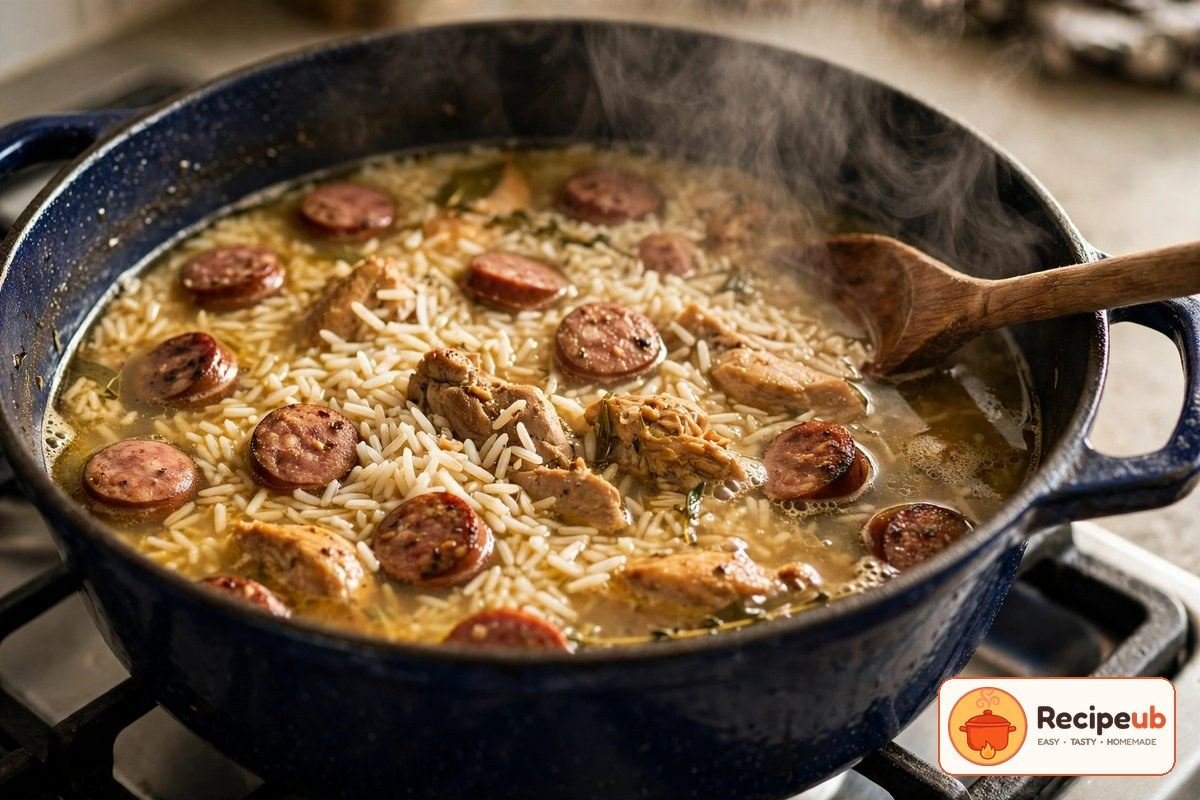
- Everything back, at the ratio. Pour in the 5 cups of measured broth and stir in the remaining ½ tsp salt, the second bay leaf and a heavy grinding of black pepper. Return the pulled chicken and the browned kielbasa to the pot and stir once to settle everything under the liquid. Bring it just to a simmer.
- Simmer, covered, and do not stir. Cover the pot, drop the heat to low, and simmer 18 minutes without lifting the lid and without stirring — stirring a bog mid-simmer breaks grains and turns the finish gummy, and the lid is doing the steaming the top layer of rice needs. At 18 minutes the liquid should be absorbed and the rice tender and visibly moist, with a sheen on top.
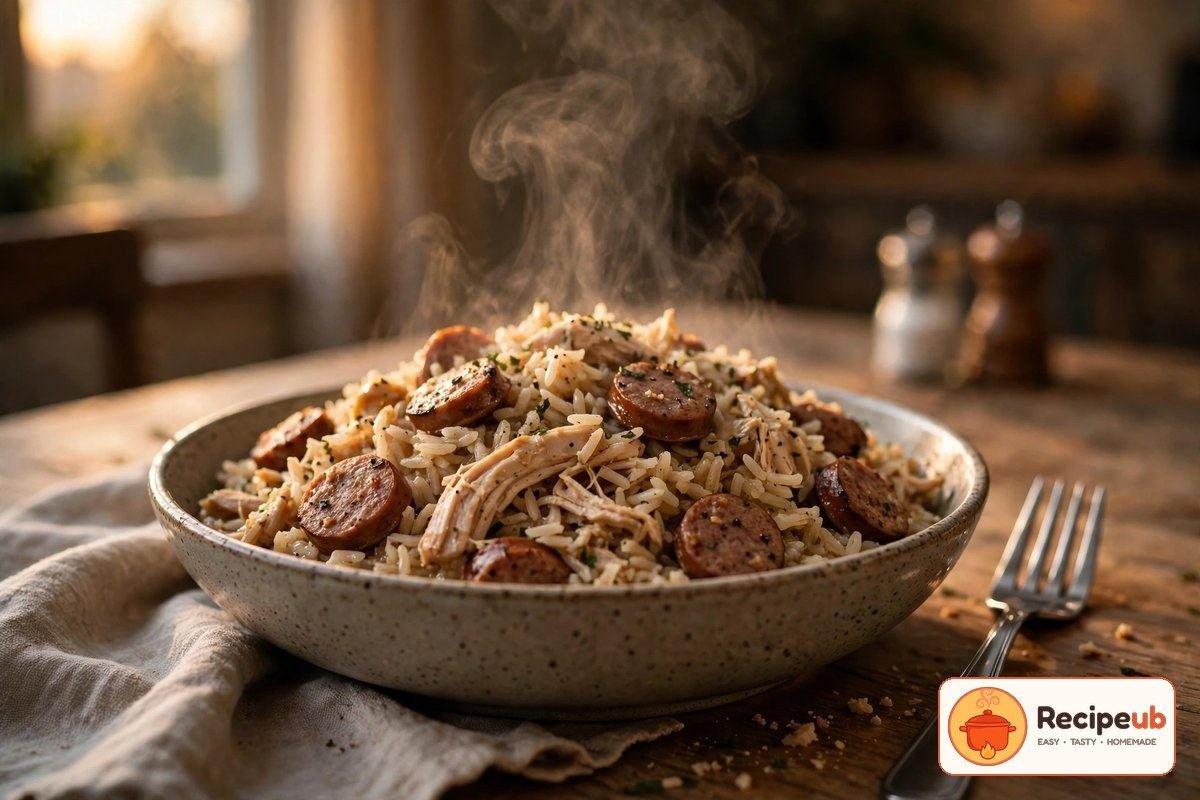
- Rest, then stir once. Take the pot off the heat and let it rest, still covered, 9 to 10 minutes — the rest is a cooking step, not a pause: the rice finishes steaming, the moisture evens out from the wet bottom to the top layer, and the bog sets into its spoonable body. Then lift the lid, remove the bay leaf, and stir once, gently, folding the bottom up through the top. Taste for salt and finish with another grinding of black pepper. Serve straight from the pot, with sliced green onions over the top and hot sauce on the table.
Chicken Bog (Chicken, Sausage and Rice, 65 Minutes)
Ingredients
Equipment
Method
- Brown the kielbasa rounds in a large Dutch oven over medium-high heat for 4 minutes, turning once. Remove to a plate, leaving the drippings in the pot.
- Add 5½ cups of water, the onion wedges, celery, 1 bay leaf, 1 tsp of the salt and ½ tsp of the pepper. Bring to a gentle simmer, add the chicken thighs and poach about 14 minutes, until the thickest thigh reads 165°F.
- Pull the chicken into bite-size pieces with two forks. Discard the poach vegetables and bay leaf. Measure 5 cups of the broth back into the pot, topping up with water if it runs short.
- Melt the butter in the pot and soften the diced onion for 3 minutes. Add the garlic for 1 minute, then the unrinsed rice, toasted 1 minute until glossy.
- Pour in the 5 cups of broth; add the remaining ½ tsp salt, the second bay leaf and a heavy grinding of black pepper. Return the chicken and kielbasa and stir once.
- Cover and simmer on low for 18 minutes without stirring. Rest, covered, off the heat for 9 to 10 minutes. Remove the bay leaf, stir once gently, and serve with sliced green onions and hot sauce.
Notes
- The ratio rule: 2½ cups of broth for every cup of long-grain white rice is the bog — moist, cohesive, a spoon stands in it. Drier than that and you have cooked a perloo (pilau); wetter, served as-is, and you have chicken and rice soup. The Bog Chart on the page carries the whole map, with every classic pot’s number on it — and the broth is measured at the pot, with a measuring cup, because the ratio is decided there and nowhere else.
- The chicken rule: boneless skinless thighs poach in about 14 minutes to 165°F and make the broth in the same pot. A whole chicken works too — 60 to 90 minutes of simmering, and it makes a richer broth — and the Chicken Chart on the page prices every lane in time, so the trade is a decision, not a discovery. Boneless breast is the caution lane: it dries in the rice’s second heat.
- The sausage rule: smoked kielbasa is the South Carolina choice — a smoked rope, sliced into rounds and browned first so its drippings season the poach. Andouille is Louisiana’s sausage, and it pulls the pot toward jambalaya; ground and breakfast sausage are not the form this dish uses.
- The leftovers rule: refrigerate within 2 hours and e
How Much Broth Per Cup of Rice? The Bog Chart
Here is the first chart this post exists to print, and it answers the question the search box types verbatim onto this dish’s rice stem — chicken bog rice to water ratio, the second completion on that stem. A bog is defined by how wet the rice finishes, and how wet the rice finishes is a number: cups of broth per cup of rice. Page 1’s relationship to that number is one blog’s single tips line (“a good starting point is 2.5 cups of chicken broth for every cup of long-grain rice” — a number with no map around it), one prestige build that runs about 2.7:1 and never divides its own ingredients, and the classic platform recipe ending its method with “until thickened to desired consistency.” Here is the number printed as a system instead: every named holder’s ratio converted to the same unit, mapped to what actually lands on the spoon. This recipe uses the bold row.
| Broth per 1 cup of rice | The finish | Who cooks there |
|---|---|---|
| 1.5 cups | Fluffy, separate grains — a perloo (pilau), the bog’s dry cousin | The Wikibooks heritage batch (6 cups : 4 cups, soaked rice) |
| 2 cups | Moist pilaf — grains distinct, no sheen; the bog’s dry edge | — |
| 2.5 cups | A proper bog — cohesive, wet sheen, a spoon stands in it | The Forked Spoon’s printed tip and method; THIS RECIPE (5 cups : 2 cups) |
| ≈2.7 cups | A wetter bog — looser, glossier | The Kitchn (4 cups : 1½ cups — her build, never numbered on her page) |
| 3.5 cups, cooked down | The festival pot — starts loose, cooks down to bog in company | The Loris Chamber recipe (3½ cups measured back : 1 cup) |
| 4+ cups, served as-is | Soup — rice in broth, not broth in rice | A different dish — see the note below the chart |
How to read the chart: the rows are one dial, and both ends of it are failures with names. Turn it down — toward 2 cups, toward 1½ — and the pot gets drier and more separate until it crosses into perloo: a good dish, an honored dish, and not this one, because a bog’s whole identity is the wet finish. Turn it up — toward 3½, toward 4 — and the rice starts swimming; the Loris festival pot can start at 3.5:1 because it cooks down in a huge pot with constant attention until it lands on the bog line, but a covered weeknight pot served as-is at 4:1 has crossed the chart’s top fence into soup — which is a dish this site already cooks, on purpose, in a different vessel: my slow cooker chicken and rice soup — the soup build, rice swimming in broth across 6¼ hours in the slow cooker; this post stops one row earlier on the same chart, where the broth is in the rice instead of the rice in the broth. The middle row is the target, and it is worth saying plainly what “proper bog” looks like so a first-time cook has a picture and not just a number: the surface shines, the grains are swollen and soft-edged, a spoonful holds together on the spoon, and the pot stirs as one mass rather than as grains in liquid. That is 2½ cups per cup — and it is also why the broth in this recipe is measured back at the poach instead of poured by feel: the dial is set at the measuring cup, and a cook who eyeballs the liquid has set it somewhere on this chart without knowing where.
Which Chicken? The Chicken Chart
Here is the second chart, and it answers the question the search box asks three separate ways on this dish’s own stem — chicken bog recipe with chicken thighs, chicken bog recipe with chicken breast, chicken bog recipe with rotisserie chicken are all typed completions, and “what type of chicken should I use” is a printed section header on the brand holder’s page. Every holder picks a lane silently and pays its price without printing it. The price is time, and here it is, lane by lane, with what each lane does to the broth — because in this dish the chicken is not just an ingredient, it is the cooking liquid’s author. This recipe uses the bold row.
| Chicken | The clock | The broth | The catch |
|---|---|---|---|
| Whole chicken (3–4 lb) | 60–90 min simmer + picking | The richest — the traditional pot | A two-hour dinner (both platform builds; the Chamber pot) |
| Bone-in thighs | ~25–30 min poach | Nearly as rich, a third of the wait | Picking bones; skin to discard |
| Boneless skinless thighs — THIS BUILD | ~14 min poach, to 165°F | Lighter — and the sausage’s drippings carry the difference, because the sausage browns first | The chart says the broth is lighter; it does not pretend otherwise |
| Rotisserie chicken | 0 min to shred | None — unless the bones simmer an hour, or a carton opens | The shortcut that isn’t, done properly |
| (caution row) Boneless breast | ~12 min poach | Lean | Dries in the rice’s second heat — the holders’ one agreed warning; if used, pull it at 160°F and let carryover finish it to 165°F in the rest |
How to read the chart: start from the broth column, because that is what the lane actually buys. The whole chicken buys the richest broth and pays for it with the whole evening — an hour to an hour and a half of simmering before the rice is even measured, which is why the freshest blog on page 1 tells its readers to cook the chicken two days ahead: the lane’s own holder routes around her chicken instead of defending it. Bone-in thighs are the honest middle — most of the richness at a third of the wait, paid for in bone-picking. This build’s lane pays the least time and gets the lightest broth, and the recipe spends its one structural trick on closing that gap: the sausage browns first, in the same pot, so the thigh poach happens in drippings, onion, celery and bay rather than in plain water. What the trick cannot do is make a 14-minute poach taste like a 90-minute one, and the chart does not claim it — it claims the broth is good, made in the pot, in the dish’s logic, on a weeknight. The rotisserie lane is priced last and priced honestly: the chicken is free of cooking, and the broth is the bill — the brand holder who takes this lane simmers the picked bones for a full hour to make her stock, which means her “shortcut” build cards 1 hour 30 to 1 hour 45 of cooking, longer at the stove than this build’s total time. The other way out of the rotisserie lane is a carton of broth, which works and is named here as what it is: the one lane where the dish’s defining step — the chicken makes the broth — is outsourced. And if the whole-bird lane is the one your table loves, taken all the way on its own terms, this site cooks it as its own dinner: my whole chicken in the slow cooker — the whole-bird build, a chicken poached low and slow until it falls apart; this post takes the chart’s fast lane instead, thighs poached in the bog pot itself. Every lane ends at the same safety number — 165°F — and the chart prints it in the build’s row rather than assuming it.
What Does the Pot Cost? The Priced Pot
Here is the third thing this post prints that page 1 does not: the whole pot, priced line by line, at November 2026 prices — with one line read directly from the Bureau of Labor Statistics, every other line labeled a shelf estimate, printed as one, because this page names its sources instead of rounding a receipt it never saw. It also reconciles: the method serves 6, and the table divides by the same 6. Chicken bog is a dish born to feed crowds — church suppers, festival pots, a town that built a Bog-Off around it — and the lane’s entire cost vocabulary is two phrases: “economical” and “a few ingredients make a lot.” Both are true. Neither is a price.
| Line | Amount for the batch | Price basis | Batch cost |
|---|---|---|---|
| Long-grain white rice | 2 cups (≈0.82 lb dry) | BLS October 2026 average, $1.101/lb (verified, series APU0000701312 — white long-grain rice, an exact item match for this build) | ≈$0.90 |
| Smoked kielbasa | 12 oz | Shelf estimate for a national-brand smoked sausage rope, labeled as one — no BLS average-price series exists for smoked sausage that this page can claim | ≈$3.50 |
| Boneless skinless chicken thighs | 1½ lb | Shelf estimate at ≈$1.30/lb, labeled as one — no BLS average-price series exists for boneless thighs that this page can claim | ≈$1.95 |
| Butter, onion, celery, garlic, bay, salt, pepper | Pantry amounts | Estimates, labeled as one | ≈$0.85 |
| Batch total | 6 servings | ≈$7.20 → ≈$1.20 per serving |
How to read the table: the shape of this receipt is the dish’s whole biography. The rice — the ingredient the dish is named for, the one that fills the pot — is the cheapest line on it at about 90 cents, on a verified federal average for the exact item, because long-grain white rice is one of the least expensive calories in an American grocery store and a bog is mostly rice. The protein lines run the other way: the kielbasa is the pot’s most expensive line at about $3.50, and the thighs — the fast lane’s whole bargain — come in under two dollars for a pound and a half. That is how a festival dish feeds a crowd for about $1.20 a serving: a cheap grain, cooked in a broth the chicken makes for free, carrying two modestly priced proteins a long way. The holders call it economical and stop; this page shows the arithmetic, with the one verified anchor named and every estimate labeled, so the claim is a table instead of an adjective.
Emma’s Tips for the Best Chicken Bog
Set the table the Lowcountry way: hot sauce out, green onions on, pickled okra if you have it. A bog is seasoned at the pot with salt and black pepper, and finished at the table by each eater — that is the traditional service the platform builds gesture at in a garnish line and this page prints as a rule. Sliced green onions go over each bowl. Hot sauce sits on the table, not in the pot: the dish is pepper-forward, not chile-hot, and the heat is a personal adjustment, not a recipe decision. Pickled okra is the traditional third — briny, crisp, the bite that cuts a rich, wet rice — and a bowl of it beside the pot is the most authentic thing you can add without touching the recipe.
Poach at a bare simmer, never a boil. The thighs want water that shivers, not water that rolls. A hard boil does two kinds of damage at once: it toughens the thigh meat at the surface before the center is done, and it churns the drippings and proteins into a cloudy, greasy broth — and the broth is about to become the rice’s cooking liquid, so its clarity is the finished dish’s sheen. If the pot comes up too hot, pull it off the heat for a moment and let it settle back to a shimmer. Fourteen calm minutes beat ten violent ones.
Do not stir the rice — once, at the end, gently. This is the discipline pilaf cooks and bog cooks share. Mid-simmer stirring breaks the grains, releases their starch into the liquid as paste instead of body, and turns the finish gummy — the difference between a bog and a porridge is mostly a spoon left alone. The lid stays on for the same reason: the top layer of rice cooks in the steam the lid traps, and every peek lets that steam — and a few degrees — out of the pot. Simmer it covered, rest it covered, and let your single gentle stir happen after the rest, when it folds the pot together instead of tearing it apart.
Measure the broth like it matters, because it is the recipe. Every other quantity in this dish tolerates a cook’s judgment — the onion can be generous, the pepper heavier, the sausage a link longer. The broth cannot, because the broth is the finish: a cup too much is a row up the Bog Chart toward soup, a cup too little is a row down toward perloo. Pour the poach liquid through a measuring cup and put back exactly 5 cups for this batch. If the poach ran short, water tops it up without apology — the ratio counts liquid, and the liquid is already seasoned. The measuring cup is not a fussy extra in this recipe; it is the instrument the dish is played on.
Leftover bog has a second life, and it has a name: bog balls. Searchers type it into the box (chicken bog balls is a completion on the dish’s own stem), and it is a real Lowcountry leftover form: chill the leftover bog until it is firm, roll it into balls, crumb them, and fry until crisp outside and steaming inside — the wet rice that defines the bog is exactly what makes the chilled ball hold together. It is the rare leftover transformation that is not a compromise but a tradition, and a pot built for six makes it easy to plan: cook the batch, eat the bowls, and fry what is left on night two.
Storage and Reheating
Fridge: Leftovers keep 3 to 4 days at 40°F or below — the USDA window for cooked chicken and rice, and the window the lane’s own holders print. Refrigerate within 2 hours of cooking, in shallow containers so the dense rice cools promptly all the way through — a deep pot of bog left to cool on the counter is the one storage move this dish does not forgive, because wet rice at warm temperatures is exactly the medium nothing should sit in. The texture note, printed honestly: the bog thickens in the fridge, because the rice keeps drinking what moisture it can reach even cold. Day-two bog is a firmer bog. That is expected, it is not spoilage, and the reheat below is built for it.
Reheating: With a splash of broth or water — a tablespoon or two per portion — covered, until steaming hot throughout and back to 165°F. The splash hands back the moisture the fridge drank, and the covered heat turns it to steam inside the portion, loosening the grains back toward the bog line on the chart. In the microwave: covered, at full power in short bursts with one stir. On the stove: a pot, a splash, low heat and the lid, with one gentle stir at the end. Reheat once and eat it hot; a bog reheated twice has been dried and rescued past what the rice can repay.
Freezer: The bog freezes up to 3 months — the holders agree, and this page adds only the framing: this dish was born as a batch dish, cooked in festival quantities to feed crowds, and it freezes like one. Freeze it in portions, in containers with the surface pressed flat, and thaw in the fridge before reheating with the splash, as above. The rice softens a degree across a freeze and a thaw — a frozen-and-reheated bog eats a touch softer than the fresh pot — and for a dish whose finish is deliberately soft and wet, that is the smallest freezer tax any rice dish on this shelf pays. Freezing is a first-class lane here, not a rescue: a double batch on a Sunday is a legitimate way to run this recipe.
The batch habit: A bog is a batch dish by birth — the same poach-and-pull chicken, portioned for the week, is a system this site already runs on its own: my shredded chicken meal prep — the batch system, poached chicken pulled and portioned with its broth for a week of meals; this post is the same chicken logic spent in one pot, with the rice cooked in the broth instead of beside it. The difference is where the broth goes: there it is saved as an ingredient, here it is spent on the rice in the same hour. Either way, the poach is the skill, and it is a 14-minute one.
FAQs
What is chicken bog?
Chicken bog is a South Carolina Lowcountry one-pot dish of chicken, smoked sausage and long-grain white rice, cooked together in the chicken’s own broth until the rice is deliberately wet — moist, cohesive and spoonable rather than fluffy. It comes from the rice country around the Pee Dee and the Waccamaw; its home ground is Loris, South Carolina, which has run a Bog-Off festival since 1979 and calls itself the capital of the chicken bog world. The name describes the finish: the rice is cooked boggy, likened to the Lowcountry wetlands, at a measured 2½ cups of broth per cup of rice (the Bog Chart above). The purist ingredient list, per the state’s own tourism page, is chicken, smoked sausage, rice, salt and black pepper, and perhaps onion — everything beyond that is a variation, and this page names its own two (celery in the poach, butter at the onion) in the open.
What is the rice-to-water ratio for chicken bog?
2½ cups of broth for every cup of long-grain white rice — in this build, 5 cups of the measured poaching broth for 2 cups of rice. The number is the dish: it is the second completion on the search stem for this dish’s rice, and page 1 answers it with one blog’s single tips line and a classic recipe that ends “until thickened to desired consistency.” The Bog Chart above prints the whole map around the number — at about 1½ cups per cup the rice finishes fluffy and separate, which is a perloo; at 2½ it finishes as a proper bog, cohesive with a wet sheen; at 4 cups or more, served as-is, it is chicken and rice soup. Note that the liquid is broth, not plain water: the chicken poaches first and makes it, and the ratio is measured at the pot when the broth goes back in.
What is the difference between chicken bog and perloo (pilau)?
The finish — which is to say, the ratio. Perloo (also spelled perlo, and called pilau or pilaf further from the Lowcountry) and chicken bog are the same family: chicken and rice cooked together in the chicken’s broth, from the same West African rice-kitchen roots the Lowcountry inherited. The difference is how wet the rice is cooked. A perloo cooks at pilaf liquid levels — about 1½ cups of broth per cup of rice — and finishes fluffy, with grains that stand separate. A bog cooks wetter on purpose, at about 2½ cups per cup, and finishes cohesive and spoonable. The lane’s best-known answer to this question is two sentences of prose on one blog (“chicken bog is wetter, pilau is drier”); the Bog Chart above prints the two numbers side by side as adjacent rows of one table, which is what the difference actually is. Sausage, incidentally, belongs to the bog’s purist core; a plain chicken perloo often carries none.
Is chicken bog the same as jambalaya?
No — they are cousins from different states, and the search box asks the question by name. Jambalaya is Louisiana: Cajun or Creole seasoning, tomato in the red builds, the onion-celery-bell-pepper trinity cooked as a base, often shrimp alongside the chicken and sausage — and its rice finishes as distinct grains. Chicken bog is South Carolina: no tomato, no Cajun seasoning, no shrimp, black pepper doing the seasoning work, smoked sausage rather than spiced andouille — and its rice finishes deliberately wet, the grains leaning together. The protein pair (chicken and sausage over rice) is genuinely shared, which is why the two get compared; everything that defines each dish — the seasoning, the tomato, the finish — runs opposite. This site cooks both, and names the fence from both sides.
Can I make chicken bog with chicken thighs instead of a whole chicken?
Yes — that is this build, and the Chicken Chart above is the full answer. Boneless skinless thighs poach in about 14 minutes to 165°F, against a whole chicken’s 60 to 90 minutes of simmering plus picking, and they stay moist through the rice’s second heat in a way boneless breast does not. The honest trade is the broth: a whole bird makes the richest broth, and a thigh poach makes a lighter one. This recipe closes most of that gap structurally — the kielbasa browns first in the same pot, so the thighs poach in sausage drippings, onion, celery and bay rather than plain water — and the chart states what the trick cannot do, rather than pretending the two broths are the same. Bone-in thighs are the middle lane: about 25 to 30 minutes, nearly the whole chicken’s richness, paid for in bone-picking.
What sausage goes in chicken bog — kielbasa or andouille?
Smoked sausage — kielbasa is this build’s — is the South Carolina tradition. The purist line printed by the state’s own page says smoked sausage, and the form is a smoked rope sliced into rounds, browned so the edges catch. Andouille is Louisiana’s sausage: spiced, hot, and — in a pot seasoned only with salt and black pepper — loud enough to pull the whole dish toward jambalaya, which is the fence this page names. The biggest blog on page 1 builds on andouille and offers kielbasa as the substitute; this page reads the tradition the other way, with the traditional choice as the build and andouille as the named swap. Ground sausage and breakfast sausage, both typed variants on the search stem, are declined for a simpler reason: the dish’s sausage is smoked and sliced, not fresh and crumbled.
Why is my chicken bog dry — or soupy?
Because the ratio moved — it is a number problem in both directions, and the Bog Chart is the troubleshooting table. Dry bog (tight, separate, pilaf-like) means the liquid ran low: the broth was eyeballed instead of measured, the poach ran short and was not topped up, or the rice got more than its share of an unmeasured pot. The fix this time is a splash of hot broth or water stirred in at the rest; the fix next time is the measuring cup — 5 cups back for 2 cups of rice, topped up honestly if the poach drank some. Soupy bog (rice swimming, grains in liquid) means the liquid ran high or the pot was served before the rest let the rice finish drinking. The fix this time is the rest itself — 10 covered minutes off the heat absorbs more than a first look suggests — and a few uncovered minutes at a bare simmer if it is still loose. What neither failure needs is the classic recipe’s instruction to stir “until thickened to desired consistency”: the consistency is a ratio, set before the lid goes on, and the chart states the target.
Do I rinse the rice for chicken bog?
No — the rice goes in unrinsed, on purpose. The surface starch on long-grain rice is part of the body that makes the finish a bog: it is what lets the grains swell, soften at the edges and lean together into a cohesive, spoonable mass. Rinsed rice cooks cleaner and more separate — which is exactly right for a pilaf and exactly wrong here. The rice-stem variants, answered in one line each: brown rice needs more liquid and considerably more simmer time, and its bran keeps the grains separate — a different finish, not a bog by this chart; instant rice cannot hold the finish at all, collapsing before the broth is absorbed; parboiled (converted) rice is the festival-pot tradition in parts of the Lowcountry and works at the same 2½:1 ratio, finishing a shade firmer — the one variant this page blesses.
Can I use rotisserie chicken?
Yes, with the lane’s true cost stated, which is what the Chicken Chart’s rotisserie row is for. The chicken itself is free — picked and shredded in minutes — and the bill arrives as the broth: a bog’s rice cooks in the chicken’s own broth, and a rotisserie chicken has already spent its. Done properly, the lane costs what the brand holder pays — the picked bones simmered about an hour into stock, which makes her “shortcut” build longer at the stove than this recipe’s total time. The other way out is a carton of chicken broth, which works, keeps the sausage-first order unchanged, and is named here as what it is: the one lane where the dish’s defining step is outsourced. If the carton is your lane on a given night, season the rice’s liquid a little more assertively with salt and pepper, because carton broth arrives pre-salted to somebody else’s taste.
How long do leftovers keep, and can I freeze chicken bog?
Fridge: 3 to 4 days at 40°F or below, refrigerated within 2 hours of cooking — the USDA window, and the one the lane’s holders print. The bog thickens as it sits, because the rice keeps drinking; reheat portions to 165°F with a splash of broth or water, covered, and the splash loosens it back to the bog line. Freezer: up to 3 months, in portions — the dish was born as a festival batch and freezes like one; thaw in the fridge and reheat with the splash. The full rules, including why shallow containers matter for a dense wet rice, are in the Storage section above. And the leftover form with its own name and its own search stem: chilled bog, rolled into balls, crumbed and fried — bog balls, in the Tips above.
Final Thoughts
Chicken bog is not a complicated dinner, and it is an oddly unexamined one anyway — because the recipe was never the problem. It is a pound and a half of chicken, twelve ounces of sausage and two cups of rice in one pot. The problem is that page 1 prints it as a museum of long clocks and unnumbered claims: two platform builds past two hours, a tourism board holding the explainer seat, a heritage recipe spread over two days, a “shortcut” build whose stock takes an hour, the dish’s defining ratio appearing once as a tips line and once as “desired consistency,” and not one price on a dish whose entire reputation is feeding a crowd cheaply. What this page adds is the paperwork the other versions leave out: a bog chart that converts every classic pot’s ratio into one column with the texture map and both failure ends named, a chicken chart that prices the four lanes in the time they actually cost, a priced pot with a verified anchor and every estimate labeled, and a weeknight build that cuts the poach instead of the principle — the chicken still makes the broth, in the same pot the sausage browned in, and the broth still cooks the rice. Ratio at 2½, chicken at 165°F, pepper heavy at the finish: that is the deal — a 65-minute bog that a Loris traditionalist would recognize, at about $1.20 a serving.
More Easy One-Pot Dinners
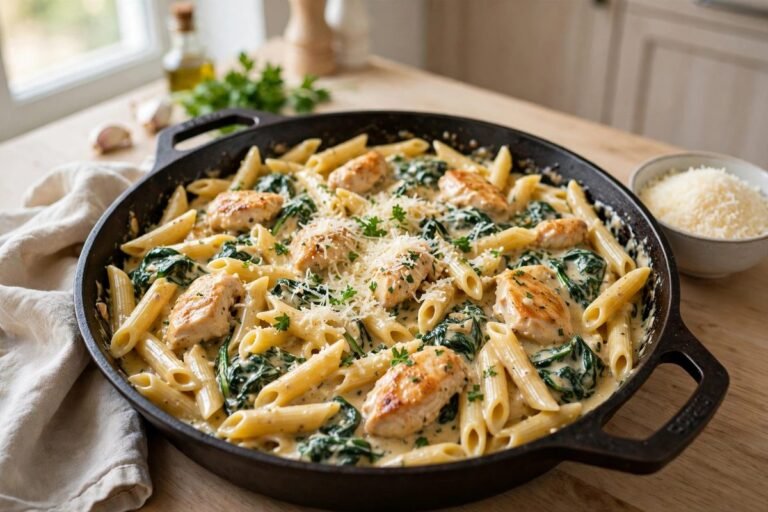
If a measured one-pot system is your kind of cooking, the rest of this shelf runs on the same rules — every ratio printed, every difference named. For the shelf’s creamy weeknight chicken pot, my creamy Tuscan chicken — the cream-sauce skillet, chicken in a garlic-Parmesan cream sauce with spinach; this post is the broth pot, where the chicken makes its own cooking liquid and rice is the second half of the dinner shows the same protein run through a sauce instead of a poach, and for the roasted end of the shelf, my one-pan chicken and potatoes — the roasted pan dinner, chicken and potatoes cooked together in a hot oven; this post never turns the oven on, and its chicken is poached, not roasted proves the one-vessel idea works at both ends of the stove. One shelf, one standard — the chicken makes the broth, the broth is measured, the ratio is printed, and dinner is handled.


Never Run Out of Dinner Ideas
One easy air fryer or slow cooker dinner in your inbox every week. No spam, ever.
You’re on the list — welcome to Recipeub!