
Slow Cooker Chicken Stew (With Potatoes, Thick Without Cream, 6 Hours on LOW)
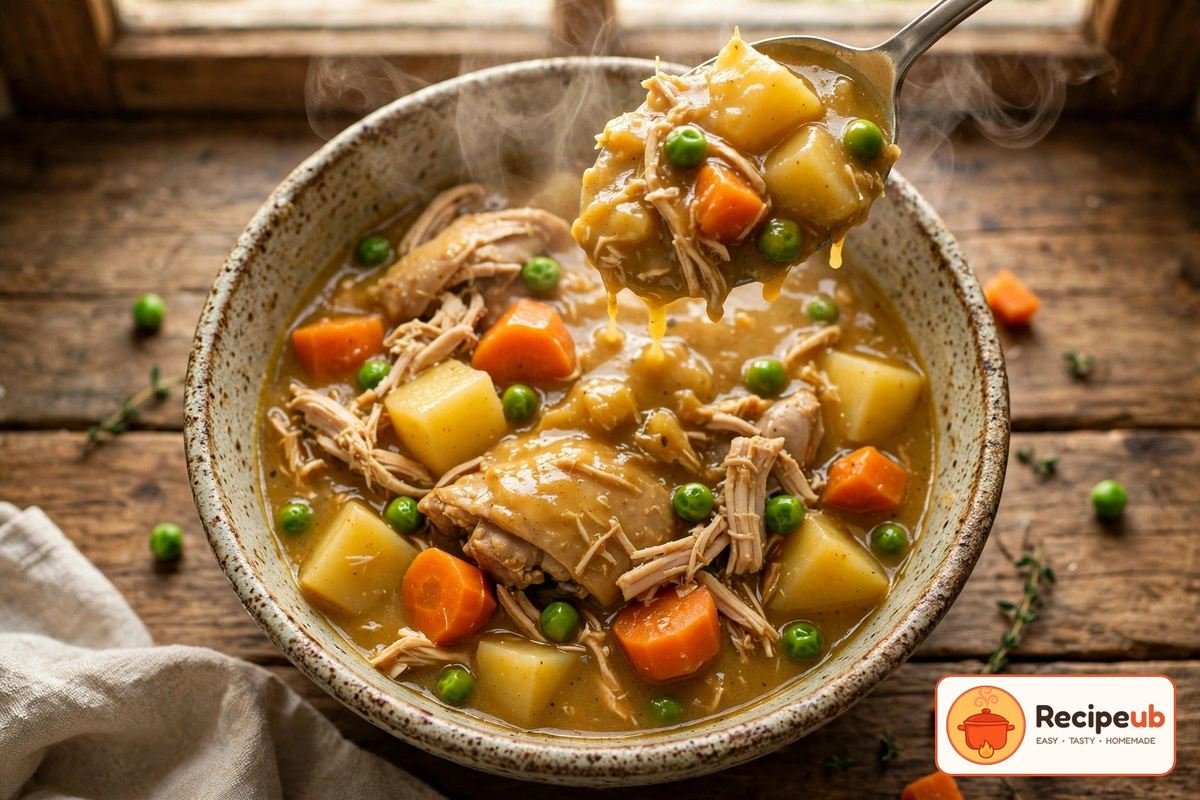
Slow cooker chicken stew is the winter pot the searcher is actually describing when the completions are read honestly: with potatoes, with potatoes and carrots, with chicken thighs, with chicken breasts, without cream, how long on low. A stew — not a soup — with potatoes as the starch, a broth with real body, and a straight answer on which cut survives six hours. This version is built to answer exactly that. The chicken is 2 pounds of boneless skinless thighs, left whole, laid over 1½ pounds of Yukon Gold potatoes cut in 1-inch chunks, 1 pound of carrots cut smaller at ½ inch, celery, onion, garlic and tomato paste, under 4 cups of low-sodium chicken broth with thyme and bay. It cooks 6 hours on LOW, the chicken comes out and shreds, and a cornstarch slurry — 3 tablespoons plus 3 tablespoons of cold water — goes in with the peas for a final 30 minutes on HIGH. No cream anywhere in the pot. Six bowls at about 360 calories and ≈$2.10 a serving (both estimates, itemized on this page), and the broth coats a spoon instead of pooling under it.
Read page 1 for this dish closely and every recipe is a thickener argument with only one side printed. One holder swears by the cornstarch slurry, one builds a stovetop roux and calls it the step she would not skip, one whisks flour into the broth before the cooker is even switched on, one finishes with cream and prints the order like a warning — cooker off first. Each method works; none of the pages tells the reader what the other four do, when they go in, or how each one fails. The same silence covers the two questions the searches keep asking next to the thickener one: whether the vegetables go under the chicken or on top of it (page 1 splits, and the split is never explained), and whether thighs or breasts belong in a six-hour pot (both cuts complete on the head search; only one page answers, in a single ingredient note). This page prints the three systems the decisions actually need: the five-thickener chart, the vegetable timing chart with the placement verdict, and the cut verdict with the prices attached.
It also knows its neighbors on this site, because this shelf already holds three pots a searcher could confuse with this one, and each is a different dish. This post is a brothy-thick chicken stew with potatoes as the starch, eaten as a finished bowl — nothing is ladled over anything, and nothing steams on top. If the stew you want is the one crowned with biscuits, that is my slow cooker chicken and dumplings — the version with biscuit dumplings steamed on top of a creamy canned-soup base; this stew has no dumplings and no canned soup, and its starch is potatoes. And if the pot you want is a filling waiting for its biscuit, that is my slow cooker chicken pot pie filling — a flour-thickened, cream-finished filling made to be ladled over separately baked biscuits; this stew is the complete bowl, eaten as-is. Three pots, three jobs — this one is the bowl you serve straight from the cooker.
The short answer: Load 1½ lb of Yukon Gold potatoes (1-inch chunks), 1 lb of carrots (½-inch), 3 celery stalks, a diced onion, garlic and 1 Tbsp of tomato paste into the bottom of a 6-quart slow cooker. Pour over 4 cups of low-sodium chicken broth with 1 tsp dried thyme, 2 bay leaves, 1 tsp kosher salt and ½ tsp black pepper, and lay 2 lb of boneless skinless chicken thighs (whole, thawed) on top. Cook 6 hours on LOW, lift the chicken out and shred it, then whisk 3 Tbsp of cornstarch with 3 Tbsp of cold water, stir it in with 1 cup of frozen peas, and cook 30 minutes on HIGH until the broth coats a spoon. Chicken and parsley back in — six servings at about 360 calories and ≈$2.10 each, in 6 hours 50 minutes total.
In This Recipe
The Plan at a Glance
- Chicken: 2 lb boneless skinless chicken thighs, whole and thawed — never frozen (the USDA line is FAQ 1) — shredded or chunked at the end
- Vegetables: 1½ lb Yukon Gold potatoes in 1-inch chunks; 1 lb carrots and 3 celery stalks in ½-inch pieces; 1 medium yellow onion, diced — the density-matched cuts from the Timing Chart below
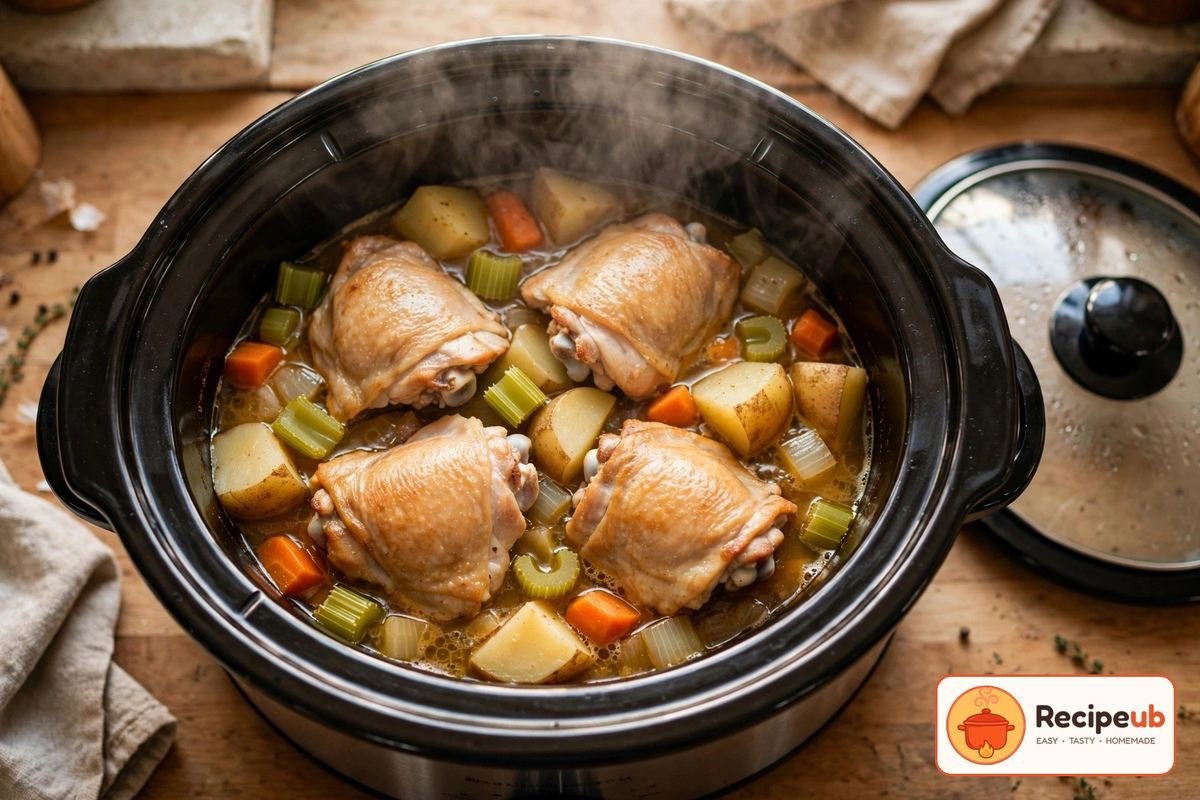
- The load order: vegetables on the bottom, in the broth; thighs on top — the placement verdict, defended in the Timing Chart
- The liquid: 4 cups low-sodium chicken broth (a stew’s measure — half the liquid of this shelf’s soups), 1 Tbsp tomato paste, 1 tsp dried thyme, 2 bay leaves, 1 tsp kosher salt, ½ tsp black pepper
- The thickener: cornstarch slurry — 3 Tbsp cornstarch whisked smooth with 3 Tbsp cold water — in at the end with the peas, 30 minutes on HIGH. No cream in the pot, at any point
- Time: 20 minutes prep / 6 hours 30 minutes cook (6 hours on LOW + the 30-minute HIGH thickening finish, stated openly) / 6 hours 50 minutes total. The HIGH path is 3½ hours + the same finish
- Yield: 6 servings, about 2 cups each
- Calories: ~360 per serving (estimate)
- Cost: ≈$2.10 per serving (estimate) at October 2026 prices — the chicken line is a labeled shelf estimate, the rest labeled estimates; the BLS-verified breast comparison is in the Cut Verdict
- Storage: fridge 3 to 4 days; freezes up to 3 months with no cream to separate — the rules are in the Storage section below
Why This Recipe Works
The thickener goes in at the end, because a slow cooker cannot set a slurry at the start. Six hours of gentle heat breaks a cornstarch slurry down before it ever thickens, and flour whisked in cold at minute one is a different dish’s method — the filling lane, linked in the intro. The slurry works here because it meets a hot pot for exactly the window it needs: 30 minutes on HIGH, long enough to turn glossy and spoon-coating, short enough that it never boils itself thin again. That timing is the whole recipe in one move, and the Thickener Chart below prints what the other four methods do instead — including the two honest cases where a different row beats this one.
The carrots are cut smaller than the potatoes, because they are denser. This is the one genuine system page 1 already half-knows — printed there as a prose paragraph, printed here as a chart. A carrot is denser than a potato, so a ½-inch carrot piece and a 1-inch potato chunk finish on the same six-hour schedule: both tender, neither mush. Cut them the same size and one of them is wrong at hour six — the carrots still firm or the potatoes blown apart. The cut sizes are not a style choice; they are the timing mechanism, which is why they are in the Timing Chart with every other vegetable’s row.
The vegetables go on the bottom and the chicken goes on top. Page 1 splits on this — one holder layers her potatoes over everything and does not stir; the rest put the vegetables under the chicken — and the split is never explained on either side. It tracks cook time and method: the on-top layer belongs to a shorter, seared build. For a six-hour raw build, the vegetables belong in the liquid at the base, where they cook in the broth the whole time and season it as they go, and the thighs belong on top, where they baste down into the pot instead of boiling apart in it. The verdict is printed with its reasoning in the Timing Chart, not as a bare instruction.
Thighs, because six hours is a dark-meat cook. The cluster’s center of gravity is thighs, and the one breast-led page on page 1 takes the short path — cubed breast, four hours on HIGH — which is the evidence in recipe form: breast in a slow cooker is a short-cook meat. Left whole for six hours on LOW, thighs shred into soft, juicy strands; the same cook leaves breast edges dry and stringy. The Cut Verdict below prints the full comparison — shred behavior, the path each cut needs, and the October 2026 prices — including the honest line in breast’s favor: it is leaner per cup.
Four cups of broth, not eight — this is a stew, and the liquid is the difference. This shelf’s soups run 8 cups of broth, and they are soups: my slow cooker chicken and rice soup — the 8-cup soup whose starch is rice, stirred in at the end; this stew runs half the liquid and its starch is potatoes, in from the start is built that way on purpose. A stew at 8 cups would need twice the thickener to stand up, and it would still read as soup with ambitions. Four cups, reduced by nothing and thickened at the end, is what makes the broth a sauce for the potatoes instead of a bath for them.
No cream, because cream is a finish and this bowl does not need one. The searches split on this — creamy completes on the head term, and without cream completes on its own stem — and page 1 mostly serves the first half. But cream in a stew is doing garnish work: it pales and enriches a broth that the slurry has already given body, at roughly 50 calories a serving, and it is the ingredient that separates in the freezer. This build leaves it out of the pot and prints it in the chart as what it is — a finish, added off the heat, for the cook who wants it — so both searchers get a true answer on the same page.
How Do You Thicken Slow Cooker Chicken Stew? The Thickener Chart
Here is the first chart this post exists to print, and it starts with the argument page 1 is having without knowing it: there are five ways to give this stew body, every ranking recipe champions exactly one of them, and no page prints them side by side. Here they are — when each goes in, the body it gives, and how each one fails. This recipe uses row 1.
| Thickener | When it goes in | The body it gives | How it fails |
|---|---|---|---|
| Cornstarch slurry (3 Tbsp + 3 Tbsp cold water) — the recipe | Last 20–30 min, on HIGH | Glossy, spoon-coating, keeps the broth’s color; gluten-free | Lumps if the water isn’t cold or it isn’t whisked smooth first; thins back out if boiled hard for an hour or more; firms up extra in the fridge |
| Flour slurry (3 Tbsp flour + cold water) | Last 30 min, on HIGH | Opaque, matte, classic stew body | Raw-flour taste if it doesn’t get its full hot 30 minutes; can go pasty if over-dosed |
| Stovetop roux (4 Tbsp butter + ⅓ cup flour, + 1 cup cooker liquid) | Built in a pan at the end, stirred back in | The richest, gravy-like body of the five | Needs a second pan at serving time; adds ~70 kcal/serving of butter; breaks the dump-and-go promise |
| Mashed potato (mash 1 cup of the cooked potatoes back in) | At the end, no added starch | Light natural body, slightly rustic texture | Only lightly thickens — will not fix a truly watery pot on its own; over-mashing turns gluey |
| Cream finish (½ cup heavy cream) | After the cooker is OFF | Silky, pale, rich — a finisher, not a thickener | Curdles or separates if boiled; separates further after freezing; adds ~50 kcal/serving |
How to read the chart: the rows are ordered the way the cluster uses them — the slurry is the center of gravity (four of the full reads land there), and each row after it is a real lane with a real cost attached. The roux row is the one to choose when gravy is the point and a second pan is no hardship; it is also the row that quietly adds 70 calories a serving of butter, which is why its holder’s card reads 455 against this build’s ~360. The cream row is printed last on purpose: it is the only entry that is not a thickener at all, and it carries the chart’s strictest handling rule — the cooker goes off before the cream goes in, every time, because boiled cream separates. And the mashed-potato row is the emergency row: it will rescue a mildly thin pot with nothing but a fork, and it will not rescue a watery one — the chart says so rather than letting a reader find out at the table.
When Do the Vegetables Go In? The Vegetable Timing Chart
Here is the second chart. A slow cooker stew is two cooks running at once — the six-hour cook and the thirty-minute cook — and every ingredient in this pot belongs to one of them. The chart prints both, with the cut each hour-0 vegetable needs and the reason for it.
| Goes in at hour 0 (LOW) | Cut | Why this cut |
|---|---|---|
| Yukon Gold potatoes | 1-inch chunks | Waxy flesh holds a chunk through 6 hours; the ½-inch cuts on page 1 pair with their shorter 4–5 hour cooks |
| Carrots | ½-inch pieces | Denser than potato — cut smaller so they finish on the same schedule |
| Celery | ½-inch pieces | Softens fully; smaller pieces melt into the base |
| Onion | Diced | Melts into the broth |
| Garlic + tomato paste + thyme + bay | — | Need the full cook to season the broth |
| Goes in for the last 20–30 min (HIGH) | ||
| Cornstarch slurry | — | Needs the heat spike to set (the Thickener Chart above) |
| Frozen peas, straight from frozen | — | The cluster’s one unanimous rule: peas at the end stay bright green; 6 hours turns them olive and mushy |
| Shredded chicken (returns) | — | Shredded off the heat, returned to warm through — not cooked twice |
| Parsley + final salt | — | A fresh herb dies in a 6-hour cook |
How to read the chart: the cut column is a timing column in disguise. Cut size and cook time are one decision, not two — page 1’s ½-inch potatoes belong to 4–5 hour cooks (one of them seared and short, one a dump build with small baby golds), and the 1-inch chunk is what a full six hours asks for. Match the wrong pair and the chart cannot save the pot: ½-inch potatoes at six hours dissolve into the broth (which thickens it, after a fashion, while ruining the stew), and 1-inch carrots at six hours are still firm at the center. The placement verdict, settled here because the chart is where it belongs: the vegetables go on the bottom, the chicken on top. Three of the four full reads load the vegetables into the liquid at the base, where they cook in the broth for the whole six hours; the one on-top build pairs its layer with a pre-sear and the cluster’s shortest LOW cook. For this recipe — raw, whole thighs, six hours — bottom placement is the call, and the thighs resting on top baste down over the vegetables instead of being boiled apart among them.

Chicken Thighs or Breasts? The Cut Verdict
Here is the third chart, and it answers the question both halves of the autocomplete set are asking — with chicken thighs and with chicken breasts complete side by side on the head search. Over a long cook, the two cuts are not interchangeable, and the chart prints what each one does, the path each one needs, and what each one costs in October 2026.
| Boneless skinless thighs — the recipe | Boneless skinless breasts | |
|---|---|---|
| After 6h on LOW | Shred into soft strands, still juicy (dark meat + more fat) | Edges dry and stringy — the thigh holder’s own note: breasts “tend to be a bit drier” |
| The path that works | LOW 6h / HIGH 3½h, whole, shred or chunk at the end | The SHORT path only: cubed, HIGH ~4h (the breast-led page-1 build) |
| Shred behavior | Pulls apart cleanly with two forks | Cubes hold shape but chew dry; shredding makes it drier |
| Price (Oct 2026) | ~$2.50/lb shelf estimate (labeled — BLS publishes no retail thigh series) | $4.099/lb (BLS) — the same stew costs ≈$3.20 more per pot |
| Calories | ~360 kcal/serving (this build, itemized on this page) | Leaner per cup (the breast build’s card: 180 kcal/cup) — the honest trade, stated |
How to read the chart: the verdict is thighs for any cook over four hours, and it is not close — but the chart prints the breast’s one winning row in full, because it is real: breast is leaner per cup, and a cook counting calories above everything else gets a true number here (180 kcal a cup on the breast build’s own card, against this bowl’s ~360 for a two-cup serving of the thigh build — the same landing zone per bowl, reached with more fat and more flavor in the meat itself). What the chart refuses is the swap-without-warning: breasts dropped whole into this recipe’s six-hour LOW cook is the one combination page 1’s evidence rules out. Breast has a path — cubed, HIGH, four hours — and it is printed in its row, as a different recipe’s shape rather than a substitution in this one. And the comparison has a third leg, off this chart: the same long-cook system built on a different protein is my slow cooker beef stew — the same system, built on chuck: flour-dredged beef, eight hours on LOW; this chart is what the chicken version of that shelf looks like, which is why the price row below it matters. The price row is the quiet argument underneath: in October 2026, boneless breast fell 2.5% to $4.099/lb and still costs ≈$3.20 more per pot than the thigh build, whose line is a labeled shelf estimate because the Bureau of Labor Statistics publishes no retail average for boneless skinless thighs — breast, legs ($1.75/lb) and whole chicken ($2.03/lb) are the chicken lines it prints.
What Does the Pot Cost? The Honest Math
No page that ranks for this dish prints a full cost for the pot. Here is this build’s math, dated to the October 2026 evidence like the rest of this site’s shelves — the chicken line is a labeled shelf estimate (there is no official retail average for it, and this page will not invent one), the breast comparison beside it is the verified BLS figure, and everything else is labeled a shelf estimate, printed as one:
| Line | Amount for the batch | Price basis | Batch cost |
|---|---|---|---|
| Chicken thighs, boneless skinless | 2 lb | ~$2.50/lb, labeled shelf estimate (no BLS retail thigh series exists) | ≈$5.00 |
| Yukon Gold potatoes | 1½ lb | Shelf estimate, labeled as one | ≈$1.50 |
| Carrots | 1 lb | Shelf estimate, labeled as one | ≈$1.00 |
| Yellow onion | 1 medium | Shelf estimate, labeled as one | ≈$0.75 |
| Celery | 3 stalks | Shelf estimate, labeled as one | ≈$0.60 |
| Frozen peas | 1 cup | Shelf estimate, labeled as one | ≈$0.80 |
| Chicken broth | One 32-oz carton (4 cups) | Shelf estimate, labeled as one | ≈$2.50 |
| Cornstarch, tomato paste, dried herbs | Pantry amounts | Estimate, labeled as one | ≈$0.50 |
| Batch total | 6 servings | ≈$12.65 → ≈$2.10 per serving |
How to read the table: the comparison the table exists for is the protein swap, because October 2026 made it a live question — the month’s grocery coverage leads with chicken against beef (ground beef at the BLS $6.755/lb against boneless breast at $4.099/lb), and this pot is where that math lands on a plate. Built on thighs at the labeled estimate, the stew runs ≈$2.10 a serving; built on breast at the verified BLS price, the same pot costs ≈$3.20 more (≈$2.65 a serving); and the beef version of this dinner — the chuck build linked in the Cut Verdict above — cooks against that $6.755 backdrop. Chicken stew is the cheapest stew on this site, and the claim is printed with its sources showing, not asserted.
Ingredients
- 2 lb boneless, skinless chicken thighs, thawed, left whole
- 1½ lb Yukon Gold potatoes, cut into 1-inch chunks
- 1 lb carrots, cut into ½-inch pieces
- 3 celery stalks, cut into ½-inch pieces
- 1 medium yellow onion, diced
- 3 cloves garlic, minced
- 1 Tbsp tomato paste
- 4 cups low-sodium chicken broth
- 1 tsp dried thyme
- 2 bay leaves
- 1 tsp kosher salt, plus more to finish
- ½ tsp black pepper
- 3 Tbsp cornstarch
- 3 Tbsp cold water
- 1 cup frozen peas
- Chopped fresh parsley, for serving
Ingredient notes: The cut is thighs, whole and thawed — whole because a thigh shredded at the end gives the stew its strands, and thawed because frozen chicken in a slow cooker is the one safety line this page does not bend (the USDA position, in full, is FAQ 1). The potatoes are Yukon Golds in 1-inch chunks, unpeeled: a waxy potato holds its chunk through six hours where a russet slumps, and the size is the timing mechanism from the Timing Chart — ½-inch potatoes belong to shorter cooks. The carrots are cut smaller than the potatoes on purpose (½ inch), because carrots are denser and need the head start in surface area to finish on the same schedule. The broth is 4 cups, low-sodium — a stew’s measure, half the liquid of a soup, and low-sodium because the pot reduces its seasoning into one place: the final salt, added after the slurry, when the broth’s body is set and its salt level can actually be judged. The thickener is cornstarch, whisked with cold water — cold, because warm water starts the starch swelling in the bowl and delivers it to the pot in lumps (the Thickener Chart’s failure row). And the peas go in frozen, at the end — that is not a shortcut, it is the cluster’s one unanimous rule.

How to Make Slow Cooker Chicken Stew
- Load the vegetables first. Put the potatoes, carrots, celery, onion and garlic in the bottom of a 6-quart slow cooker. Stir the tomato paste through them, then pour the broth over and add the thyme, bay leaves, kosher salt and black pepper. The vegetables sit in the liquid for the whole cook — that placement is the Timing Chart’s verdict, not a packing preference.
- Lay the thighs on top. Set the whole thighs in a single layer over the vegetables. Do not stir them down into the broth; they cook resting on top and baste down into the pot. Put the lid on.
- Cook 6 hours on LOW. (The HIGH path: 3½ hours.) Leave the lid closed — every lift drops the temperature the chart’s times are built on. The chicken is ready when it pulls apart cleanly with two forks; if it resists, it needs more time, not more force.
- Shred the chicken. Lift the thighs out onto a board and shred or cut them into chunks — shreds for the classic bowl, chunks if you like a bigger bite. Fish out and discard the bay leaves. The chicken waits off the heat while the broth is finished; it is not cooked twice.
- Thicken, with the peas. Whisk the cornstarch and the cold water together in a small bowl until completely smooth — no white streaks. Stir the slurry into the hot stew along with the frozen peas, straight from the bag. Switch the cooker to HIGH, lid back on, and cook 20–30 minutes, until the broth turns glossy and coats the back of a spoon.
- Return the chicken and serve. Stir the shredded chicken and the parsley back in and let it warm through for a few minutes. Taste and add the final salt now. Serve straight from the cooker, in bowls, with the broth spooned over the top.
Slow Cooker Chicken Stew (With Potatoes, Thick Without Cream, 6 Hours on LOW)
Ingredients
Equipment
Method
- Load the potatoes, carrots, celery, onion and garlic into the bottom of a 6-quart slow cooker; stir in the tomato paste, pour the broth over, and add the thyme, bay leaves, salt and pepper. Lay the whole thighs on top in a single layer; do not stir.
- Cook on LOW for 6 hours (HIGH: 3½ hours), until the chicken pulls apart cleanly with two forks.
- Lift the chicken out, shred or chunk it, and discard the bay leaves. Whisk the cornstarch with the cold water until smooth, stir it into the stew with the frozen peas, and cook on HIGH for 20–30 minutes, until the broth is glossy and coats a spoon.
- Return the chicken and parsley, warm through, salt to taste, and serve.
Notes
- The charts on the page run this recipe: the Thickener Chart (cornstarch slurry — this recipe — glossy and spoon-coating, last 20–30 min on HIGH; flour slurry, opaque and matte, needs its full hot 30 minutes; stovetop roux, the richest body, at the cost of a second pan and ~70 kcal/serving of butter; mashed potato, a light natural fix that will not rescue a watery pot; cream, a finisher and not a thickener, added only after the cooker is OFF, ~50 kcal/serving), the Vegetable Timing Chart (potatoes 1-inch and carrots ½-inch at hour 0 because density sets the cut; peas, slurry, shredded chicken and parsley in the last 20–30 minutes; vegetables on the bottom, chicken on top), and the Cut Verdict (thighs for any cook over 4 hours; breast only on the short path — cubed, HIGH ~4 hours; breast at the BLS October 2026 average of $4.099/lb costs ≈$3.20 more per pot).
- Frozen chicken: do not start this stew from frozen. USDA guidance is to thaw meat and poultry before slow cooking — a slow cooker can hold frozen chicken in the 40–140°F danger zone for hours. Thaw overnight in the fridge.
- Cost: ≈$2.10 per serving (estimate) — thighs 2 lb at ~$2.50/lb is a labeled shelf estimate (BLS publishes no retail average for boneless skinless thighs); produce, broth and pantry lines are labeled shelf estimates bringing the pot to ≈$12.65. The verified comparison: boneless breast at $4.099/lb (BLS, October 2026) builds the same pot for ≈$2.65 per serving.
- Storage: refrigerate within 2 hours; fridge 3 to 4 days at 40°F or below (the stew sets thicker cold — loosen with a splash of broth when reheating). Freeze up to 3 months; there is no cream in the base to separate, but the potatoes soften — reheat gently and do not re-boil.
Emma’s Tips for the Best Slow Cooker Chicken Stew
Cut by density, not by habit. The single most useful habit this recipe teaches: dense vegetables get the smaller cut. Carrots at ½ inch against potatoes at 1 inch looks backwards the first time you do it, and it is the reason both are tender at the same hour. Any vegetable you swap in gets the same question — denser than a potato, or less? — and its cut follows from the answer.
Whisk the slurry like you mean it. The slurry is three tablespoons of cornstarch and three tablespoons of cold water, whisked until there is not one white streak left, then stirred into a hot pot. Every lump a chicken stew ever had was born in that bowl: warm water swells the starch early, a half-whisked slurry clumps on contact, and neither mistake can be stirred out afterward. Twenty seconds of whisking is the cheapest insurance in the recipe.
Test the chicken with forks, not the clock. Six hours is the chart’s number, but cookers run hot and cold, and the chicken itself is the reliable instrument: it is ready when it pulls apart cleanly with two forks. If it resists, it is not being stubborn — it needs more time, and thirty more minutes costs the stew nothing. Shredding undercooked thigh is how a stew ends up with rubbery strings in a perfect broth.
Keep the lid on, and season at the end. A slow cooker’s heat is a bank balance: every lid lift spends it, and the chart’s times assume the lid stayed shut. The same discipline applies to the salt — the broth’s final level is only knowable once the slurry has set its body, so the finishing salt goes in after the thickening, a little at a time, tasting as you go.
Storage and Reheating
Fridge: Leftover stew keeps 3 to 4 days at 40°F or below — the standard every recipe on this site prints. Refrigerate within 2 hours, in a shallow covered container. One expected change, printed because it worries people: the stew will look thicker cold than it did hot. That is the cornstarch firming up plus the potatoes absorbing broth overnight — it is not spoilage and it is not a mistake. A splash of broth stirred in as it reheats brings the bowl back to serving body.
Reheating: Gently, on the stove over medium-low or in the microwave at half power, stirring now and then, until steaming hot throughout. What reheating must not do is re-boil the pot hard and long: a slurry-thickened broth boiled for an extended stretch starts to thin back out — the Thickener Chart’s failure row, arriving a day late. Warm it through, loosen it with broth if it set firm, and stop there.
Freezer: This stew freezes better than its creamy neighbours, because there is no cream in the base to separate — up to 3 months, in portions, thawed overnight in the fridge and reheated by the rule above. The one honest cost is the potatoes: like every potato in every frozen stew on this shelf, they come back softer than they went in. If a batch is being cooked for the freezer on purpose, that softness is the trade to accept; the chicken, carrots and broth freeze and return exactly as they were.
FAQs
Can you put frozen chicken in a slow cooker for stew?
No — thaw it first. The USDA position is that meat and poultry should be thawed before slow cooking, because a slow cooker warms slowly enough that frozen chicken can sit in the 40–140°F danger zone — the range where bacteria multiply — for hours before it ever reaches a safe temperature. Overnight in the fridge is the thaw this recipe assumes: the thighs go in whole and thawed, and the six-hour clock is timed from there. It is the one step in this recipe that is a rule rather than a preference.
How long does chicken stew take in a slow cooker on LOW and HIGH?
6 hours on LOW, plus the 30-minute HIGH thickening finish — 6 hours 50 minutes total with the 20 minutes of prep. On HIGH, the same stew takes 3½ hours plus the same finish. The finish is not optional padding in either path: the cornstarch slurry needs its hot window at the end to set, whichever road the pot took to get there. The thighs are the doneness test at either setting — they pull apart cleanly with two forks when they are ready, and if they resist, they need more time.
Are chicken thighs or breasts better for slow cooker stew?
Thighs, for any cook over about four hours — that is the Cut Verdict above in one line. Dark meat with more fat shreds into soft, juicy strands after six hours on LOW; breast edges dry and turn stringy over the same cook, which is why the one breast-led build on page 1 takes the short path instead (cubed, HIGH, about 4 hours). Breast’s honest win is calories — leaner per cup, 180 kcal on its own card — and its honest cost is price: at the BLS October 2026 average of $4.099/lb, the breast version of this pot runs ≈$3.20 more than the thigh build.
How do you thicken chicken stew in a slow cooker?
With a slurry, at the end, on HIGH. Whisk 3 tablespoons of cornstarch with 3 tablespoons of cold water until completely smooth, stir it into the hot stew, and give it 20–30 minutes on HIGH until the broth turns glossy and coats a spoon. The two rules that make it work are timing and temperature: a slurry added at the start gets broken down by six hours of heat before it can thicken anything, and a slurry whisked with warm water lumps before it reaches the pot. The other four methods — flour slurry, roux, mashed potato, cream — are compared in the Thickener Chart above.
Why is my slow cooker chicken stew watery?
One of three real causes, in the order they usually happen. The thickener never got set — a slurry added too early, or never switched to HIGH for its 20–30 minute window, so it never reached the heat it needs. Lid condensation — a slow cooker traps its own steam, and that water rains back into the pot for six hours; it is why this recipe starts at a stew’s 4 cups of broth instead of a soup’s 8, and why lifting the lid “to check” makes it worse, not better. Or cream went in too early and broke instead of enriching. The fix for a finished watery pot is the chart’s emergency row plus the real one: mash a cup of the cooked potatoes back in for light body, and if that is not enough, a second half-slurry, whisked smooth and given its full hot window.
When do you add peas to slow cooker chicken stew?
At the end — straight from frozen, with the slurry, for the last 20–30 minutes on HIGH. It is the one rule every recipe in the cluster agrees on, because the alternative is visible in any pot that got it wrong: peas cooked for six hours turn olive-drab and mushy and lose the sweetness they were added for. In at the finish, they stay bright green and just-tender, and they thaw and heat through in the same window the broth needs to set. No thawing, no separate pan.
Can you make slow cooker chicken stew without cream?
Yes — this recipe is the proof, and it is built that way on purpose. The body comes from the cornstarch slurry, not from dairy: the broth ends glossy and spoon-coating with no cream in the pot at any point. Cream’s actual job in a stew is a finish — silkiness and pale richness, added after the cooker is off so it cannot curdle — at about 50 calories a serving. If you want it, the Thickener Chart prints it as a row with its rule attached. If you do not, nothing in this bowl is missing it.
Do potatoes go on the top or bottom of the slow cooker?
On the bottom, in the liquid — for this cook. Page 1 genuinely splits on this: one holder layers her potatoes over the top and does not stir, and the rest load the vegetables underneath. The split tracks the method: the on-top layer belongs to a pre-seared build with the cluster’s shortest LOW cook, where the potatoes steam gently above the liquid. In a six-hour raw build, the bottom is where potatoes cook in the broth the whole time and season it as they go — and the thighs rest on top, basting down over them. The full reasoning is in the Vegetable Timing Chart.
Can you leave chicken stew on LOW for 8 hours?
The thighs can take it; the finish cannot be moved. Whole thighs on LOW tolerate 8 hours better than any other cut in the chart — they get softer, not drier — so a workday that runs long does not ruin this pot. But the peas and the slurry still go in at the end, whenever the end is: eight hours of peas is the olive-and-mushy outcome the Timing Chart exists to prevent, and a slurry added at hour zero will not survive to thicken anything. Breast, for the record, does not tolerate the 8-hour version at all — cubed and HIGH for about 4 hours is its only path.
How long does slow cooker chicken stew keep, and can you freeze it?
3 to 4 days in the fridge at 40°F or below, refrigerated within 2 hours — and expect it to set thicker cold, because the cornstarch firms and the potatoes drink broth overnight; a splash of broth on reheating fixes it. It freezes for up to 3 months, and cleaner than the creamy versions on this shelf, because there is no cream in the base to separate. The one cost is texture: the potatoes come back softer after freezing. Thaw overnight in the fridge and reheat gently, without a long hard boil.
Final Thoughts
Slow cooker chicken stew is not a complicated recipe, and it is an argued-about one anyway — because the argument was never about loading the pot. It is twenty minutes of cutting and a lid. The argument is about the five thickeners nobody prints side by side, the carrot that has to be cut smaller than the potato and the reason why, the layer order two camps defend without explaining, and the cut question both halves of the search are asking at once. What this page adds is the paperwork the other versions leave out — a thickener chart with the failure modes printed next to the promises, a timing chart that treats cut size as the timing mechanism it is, a placement verdict with its reasoning showing, and a cut verdict priced in the month chicken got cheaper while beef did not. A thick bowl, tender thighs, bright peas, honest numbers — that is the deal.
More Easy Slow Cooker Recipes
If a chart-driven stew is your kind of system, the rest of this shelf runs on the same rules — every timing stated, every difference named. For the same winter night pointed at a different pot, my slow cooker vegetable soup — the tomato-broth soup with beans and no chicken at all; this stew is the chicken version of that evening is the meatless lane, and my slow cooker chicken noodle soup — the 8-cup noodle soup, thin broth and all; this post is what that shelf does when the bowl has to be a stew instead is the soup the stew is most often confused with, separated by nothing more than liquid and a thickener. And when the next pot has not been chosen yet, the slow cooker dinners collection — every slow cooker dinner on this site in one place, this stew included is where this shelf keeps all of it, charts and all. One shelf, one system — the pot is loaded in the right order, the thickener goes in at the right hour, and dinner is handled.


Never Run Out of Dinner Ideas
One easy air fryer or slow cooker dinner in your inbox every week. No spam, ever.
You’re on the list — welcome to Recipeub!