
Air Fryer Salmon (Crispy Skin, 400°F, 8 Minutes)
Air fryer salmon is the dinner I make when I want the evening to feel handled: four fillets, a five-minute rub, eight minutes in the basket, and out comes fish with shatter-crisp skin and a center that flakes into big, moist sheets. No oven heating the kitchen, no pan of spitting oil, no hovering. It is also, not for nothing, the right fish at the right moment — farmed salmon prices slid for three straight weeks last January as the holiday peak faded, and a 6-ounce fillet at home runs about $3.40 to $4.00 against the $20-plus a restaurant charges for the same plate. This is the January healthy-eating dinner that does not taste like a resolution.
The short answer: Cook air fryer salmon at 400°F for 7 to 10 minutes for a 1-inch skin-on fillet, skin-side down, no flipping. It is done when the thickest part reaches 145°F and the flesh flakes. Like yours medium or medium-rare instead? The Doneness Chart below gives the pull temperatures for that — and no other recipe on page 1 prints them.
In This Recipe
The Plan at a Glance
- Dish: whole salmon fillets, skin-on, cooked intact in the air fryer
- Fillets: 4 fillets, 6 oz each, about 1 inch thick
- Time: 5 minutes prep / 8 minutes cook / 13 minutes total
- Method: 400°F, skin-side down, no flipping, 2-minute rest
- Cost: about $3.40 to $4.00 a fillet at home (fresh skin-on Atlantic runs about $8.97 a pound at Walmart) vs. $20-plus for a restaurant salmon entrée
- Calories: about 310 a serving, about 34 g protein
- The charts: Thickness × Skin timing (with a real from-frozen row) and a Doneness Chart with pull temperatures
Why This Recipe Works
The skin is the cooking surface. Skin-side down is not a preference in this recipe, it is the method. The skin sits against the hot basket and crisps in the fillet’s own fat, while it shields the flesh above it from the direct blast of heat — the top of the fillet cooks gently, almost steamed in its own juices, while the bottom turns to a cracker. Flip the fillet and you tear the skin, lose the crisp, and overcook the delicate top. So: down, the whole time, no flip. (The full ruling, including the skinless case, is in the skin-side section below.)
Dry fish, hot basket. Crispy skin is made before the fillet ever goes in. I pat the fillets completely dry with paper towels — surface water steams instead of crisping — and I preheat the air fryer for 3 to 5 minutes, because a fillet that lands in a cold basket sits in its own juices for the first two minutes. Some recipes skip the preheat and still work; they just do not get this skin. The rub goes on the flesh side only: smoked paprika and garlic powder for a savory crust, and nothing wet — no glaze, no marinade — because a dry surface is the whole game.
The rub is its own identity. The two big recipes for this dish go lemon-Dijon and lemon-garlic. Mine is a garlic-butter-free, pantry-dry rub — smoked paprika, garlic powder, salt and black pepper — that browns into a dark, savory crust and lets the salmon taste like salmon. It takes thirty seconds to mix, it is already in your spice drawer, and it works on skinless fillets and frozen ones too (the frozen method is a full row of the chart below, not a footnote).
Doneness is a number you choose, not a number you are handed. Every page-1 recipe gives one endpoint: 145°F. That is the USDA’s number and it is a perfectly good one — but a great many of us like salmon at medium, glossy and deep pink in the center, and “cook to 145” answers a question we did not ask. So this page prints a Doneness Chart: the temperature to pull the fillet at for medium-rare, medium, medium-well and well done, and what it will read after its 2-minute rest. Pick your row before you start, temp the thickest part, and the fish comes out your way on purpose.
How Long Do You Cook Salmon in the Air Fryer? The Thickness × Skin Chart
Salmon timing is thickness timing — the clock follows the thickest part of the fillet, not its weight. Every row below is at 400°F, skin-side down, no flip, and every row ends the same way: check the thickest part with a thermometer and pull at the temperature your Doneness Chart row says. The frozen fillet is a full method row here, not an afterthought, because “air fryer salmon from frozen” is one of the most-searched versions of this dish and no page-1 recipe covers it.
| Fillet | Time at 400°F | Notes |
|---|---|---|
| ½–¾ inch, skinless | 6–8 minutes | The thin tail-end cuts; check at 6 |
| ½–¾ inch, skin-on | 7–9 minutes | Skin adds a minute of insulation |
| 1 inch, skinless | 7–9 minutes | Same time, no crisp-skin payoff |
| 1 inch, skin-on (the recipe) | 7–10 minutes (8 is the standard) | The benchmark row — crispy skin, flaky center |
| 1½ inch, skin-on | 10–13 minutes | Thick center-cut and king salmon fillets |
| Frozen, 1 inch, skin-on | 12–15 minutes at 390°F | Cook 5 minutes, THEN season (rub slides off a frozen surface), finish to temperature |
How to read the chart: the times are windows, and your thermometer is the referee — start checking at the low end of your row. Two adjustments worth knowing: at 375°F, add about 2 minutes (the rule of thumb is roughly 9 minutes per inch at 400°F, 10 to 11 minutes per inch at 375°F). And wild, lean fillets — sockeye especially — cook a little faster than farmed Atlantic, so check them a minute early. This chart is the salmon page of the same system that runs my full air fryer recipes with times and temperatures hub: one temperature, honest windows, and the thermometer call at the end.
The frozen method, in full: put the frozen fillets in the basket skin-side down at 390°F, plain — no oil, no rub, it will not stick to an icy surface. After 5 minutes the surface has thawed enough to hold seasoning: pull the basket, brush the tops with the oil and press on the full rub, then send them back for 7 to 10 more minutes, until the thickest part temps at your number. The skin will not be quite as crisp as a fresh fillet’s — that is the honest trade — but the flesh cooks evenly and nobody at the table will know the fish was frozen an hour ago.
What Temperature Is Salmon Done At? The Doneness Chart
Here is the chart I wish every air fryer salmon recipe printed. One page-1 recipe mentions pulling the fish early and letting carryover heat finish it — as a sentence, with one number. This is the whole system: the temperature to pull the fillet out of the basket, and the temperature it will actually be served at after its 2-minute rest, because a hot fillet keeps cooking on the plate and gains about 5 degrees as it sits.
| Doneness | Pull the fillet at | After the 2-minute rest | What you get |
|---|---|---|---|
| Medium-rare | 120°F | ~125°F | Deep pink, glossy, silky center |
| Medium | 125°F | ~130°F | Pink and moist, flakes in large sheets |
| Medium-well | 135°F | ~140°F | Light pink, just firm, still juicy |
| Well done / USDA | 145°F | 145°F | Fully opaque, firm, the food-safety standard |
The honest line, printed plainly: the USDA’s number for fish is 145°F, and if you are cooking for anyone pregnant, elderly, very young or immunocompromised, that is the row to use. The lower rows are a cook’s preference, pulled early on purpose — restaurants serve salmon at medium every night of the week — and this chart exists so that choosing them is a decision with numbers, not a guess with crossed fingers. Temp the thickest part of the fillet, away from the skin, and remember the rest is part of the cooking: pull at your row’s first number, never the second.
Does Salmon Go in the Air Fryer Skin Side Up or Down?
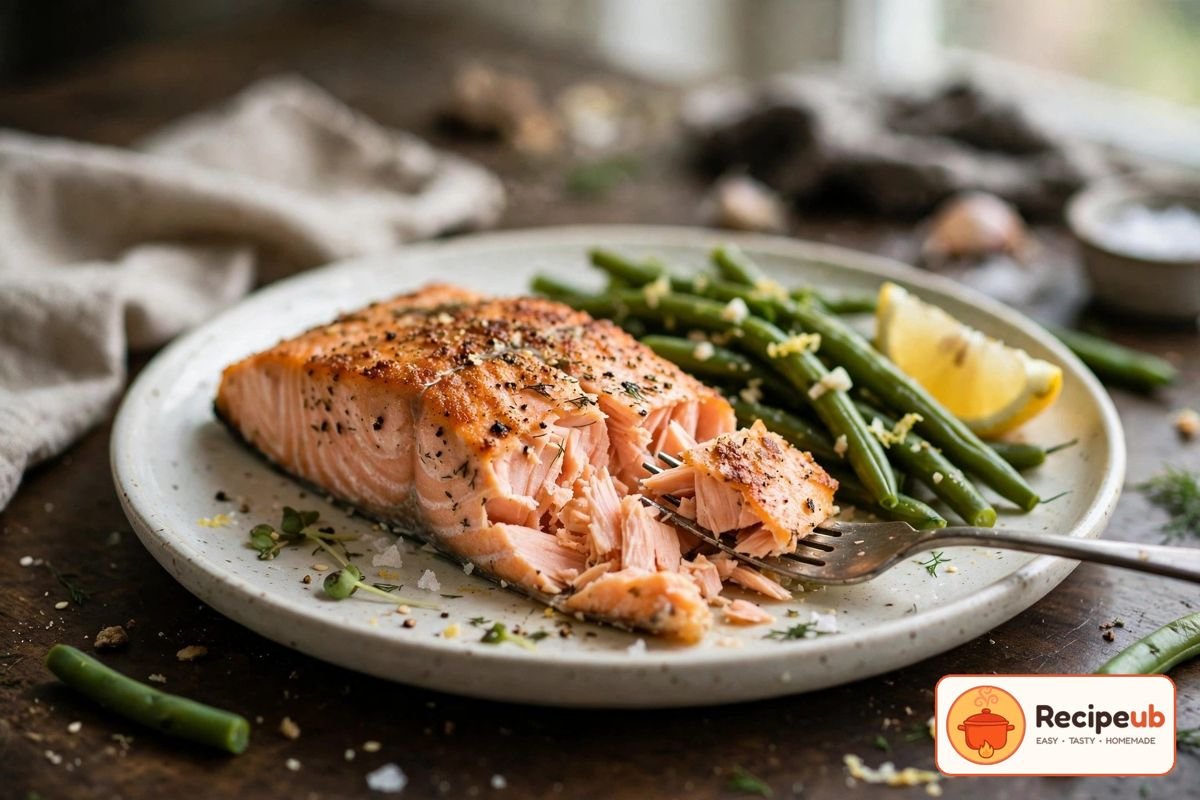
Down. Settled, in one word, because this question appears in search in three different forms and gets answered in passing almost everywhere: skin side down, for the entire cook, no flipping. The skin crisps against the basket, it insulates the flesh from the harshest heat, and the fillet lifts out cleanly once the skin has set and crisped — fish that sticks in minute two releases in minute eight, so do not pry at it early.
The one exception is a skinless fillet: with no skin to protect it, lay it down on a small piece of parchment or a lightly oiled basket so the seasoned top does not weld itself to the grates, and use the skinless rows of the timing chart. And if you plan to remove the skin before serving, still cook it skin-side down — the skin peels away in one piece after cooking, taking none of the flesh with it. Cook with it, crisp it, then decide.
Ingredients
- 4 skin-on salmon fillets (6 oz each, about 1 inch thick)
- 1 Tbsp olive oil
- 2 tsp smoked paprika
- 2 tsp garlic powder
- 1 tsp kosher salt
- ½ tsp black pepper
- Lemon wedges, to serve (optional)
- Chopped parsley, to serve (optional)
Ingredient notes: Buy fillets of even thickness — a tapered tail piece and a thick center-cut in the same basket will never finish together; if the shop’s fillets taper, fold the thin tail under itself so the piece cooks at one thickness. Skin-on is the recipe as written, and center-cut fillets give you the most even 1-inch row of the chart. Farmed Atlantic is the forgiving choice (its fat buys you a wider timing window); wild sockeye is leaner, cooks a minute or so faster, and runs about 30 to 40 fewer calories a fillet. The rub makes slightly more than you need if your fillets are small — press on a generous, even coat and let the rest go; a thin, patchy rub gives you a patchy crust.
How to Make Air Fryer Salmon
- Preheat the air fryer. Run it empty at 400°F for 3 to 5 minutes. A hot basket is half the crispy-skin equation.
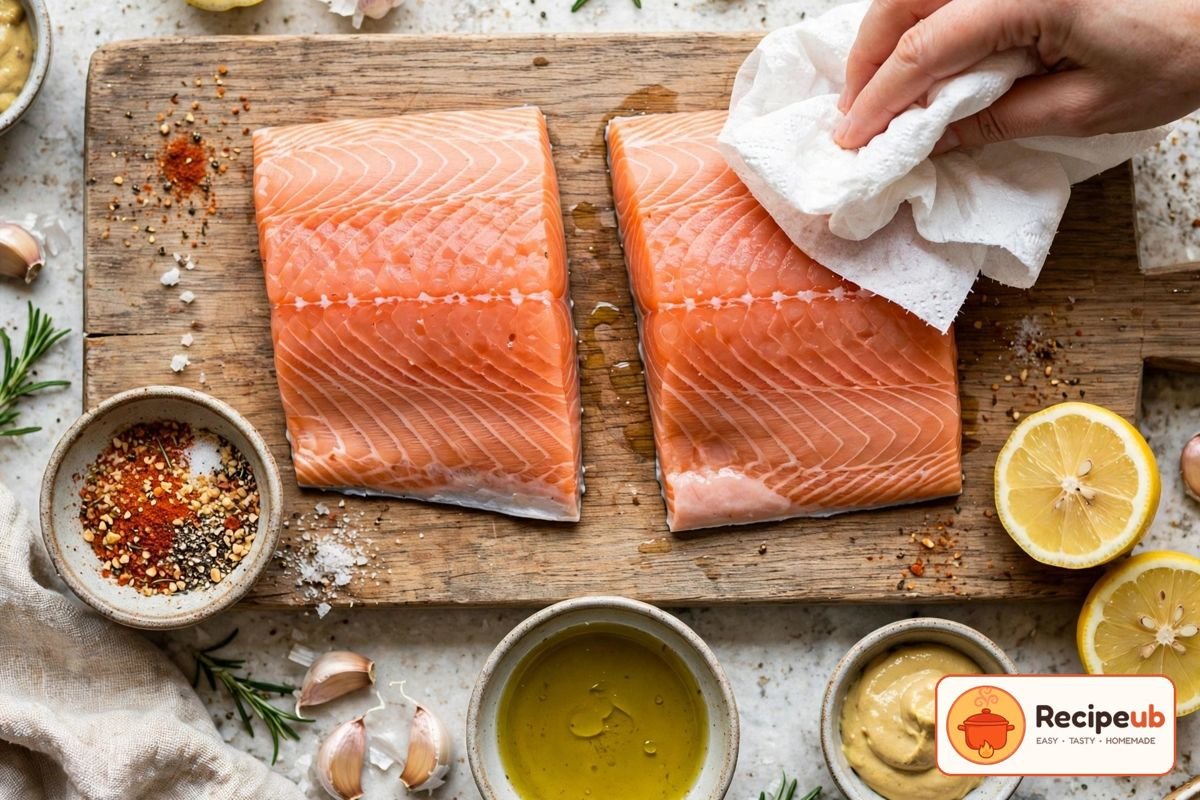
- Dry the fillets. Pat every surface — top, sides and especially the skin — completely dry with paper towels. This is the step that decides whether the skin crisps or steams, and it takes twenty seconds.
- Mix the rub. Stir the smoked paprika, garlic powder, kosher salt and black pepper together in a small bowl.
- Oil and season. Brush the flesh side and sides of each fillet with the olive oil (about ¼ tablespoon per fillet), then press the rub on in an even coat. A light brush of oil on the skin helps it crisp and release; the rub itself stays off the skin — it would scorch against the basket.
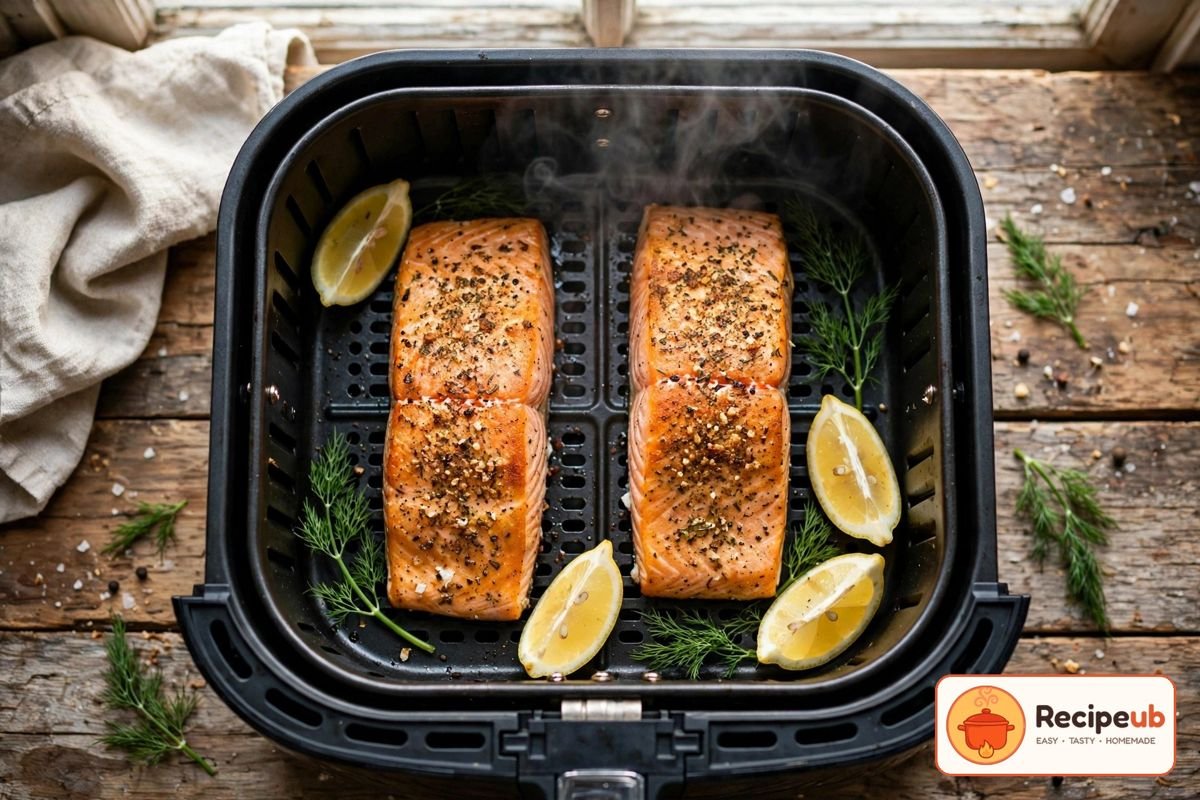
- Load the basket, skin-side down. Set the fillets in a single layer, skin down, with a little air space between them. Crowded fillets steam each other; cook in two batches rather than stack.
- Air fry at 400°F. Cook 7 to 10 minutes — 8 minutes is the standard for a 1-inch fillet — with no flipping, until the thickest part of the thickest fillet reaches the pull temperature for your doneness (see the Doneness Chart; 145°F for well done, 125°F pulled for medium).
- Rest 2 minutes, then serve. Slide the fillets onto plates skin-side down and leave them alone for 2 minutes while carryover heat finishes the center. Serve with lemon wedges and parsley if you like, and eat the skin like the prize it is.

Air Fryer Salmon (Crispy Skin, 400°F, 8 Minutes)
Ingredients
Equipment
Method
- Preheat the air fryer to 400°F for 3 to 5 minutes.
- Pat the fillets completely dry on all sides with paper towels.
- Stir the smoked paprika, garlic powder, salt and black pepper together. Brush the flesh and sides of each fillet with olive oil and press the rub on in an even coat.
- Place the fillets in the basket in a single layer, skin-side down, with space between them.
- Air fry at 400°F for 7 to 10 minutes (8 minutes for a 1-inch fillet), no flipping, until the thickest part reaches your pull temperature — 145°F for well done, or see the doneness chart on the page.
- Rest 2 minutes so carryover heat finishes the center, then serve.
Notes
- Doneness pull temperatures (read at the thickest part; the fillet gains about 5°F as it rests 2 minutes): medium-rare pull 120°F, medium pull 125°F, medium-well pull 135°F, well done / USDA 145°F. The USDA standard is 145°F; the lower pulls are a cook’s preference.
- Skin side down for the whole cook, no flipping — the skin crisps against the basket and protects the flesh.
- From frozen (1-inch skin-on fillet): 390°F for 12 to 15 minutes; cook plain for the first 5 minutes, then brush with oil, press on the rub, and finish to temperature.
- Skinless fillets: ½–¾ inch 6–8 minutes, 1 inch 7–9 minutes at 400°F, on parchment or a lightly oiled basket.
- Storage: fridge 3 to 4 days. Reheat in the air fryer at 350°F for 3 to 4 minutes — never the microwave, which turns salmon rubbery.
Emma’s Tips for the Best Air Fryer Salmon
Pat it dry like you mean it. Every crispy-skin failure I have ever had traced back to a wet fillet. Water on the skin has to boil off before the skin can crisp, and by the time it does, the flesh above has overcooked. Two paper towels, every surface, no shortcuts — and if your fillets came out of a vacuum pack, give them 10 uncovered minutes in the fridge after drying; the cold air takes the last of the surface moisture.
Do not move the fillet early. In minute two, the skin is still soft and will tear if you poke it. By minute eight it has crisped and set, and a thin spatula slides under it cleanly. The fish tells you when it is ready to move: it releases. Until then, hands off.
Temp the thickest part, not the middle of the basket. Fillets taper, baskets have hot spots, and the only reading that matters is the thickest part of the thickest fillet, probed from the side so the thermometer does not touch skin or basket. One fillet at 145°F does not clear a thicker neighbor at 130°F — unless 130°F is your medium row and you meant it.
Variations — skinless, frozen and other cuts. The skinless rows and the full frozen method are both in the Thickness × Skin Chart above, and they use this same rub and this same no-flavor-lost logic. For a flavor change, the rub is the lever: swap the smoked paprika for regular paprika and add ½ teaspoon of brown sugar for a sweeter crust, or add ¼ teaspoon of cayenne for heat. And one boundary worth naming, because the searches blur it: this recipe is for whole fillets, cooked intact. If tonight’s plan is bowls or salads and you are making bite-size pieces instead? Use the Air Fryer Salmon Bites recipe — that post owns the cubed method, with its own timing. Whole fillets live here; bite-size pieces live there; each page does its one job properly.
Storage and Reheating
Fridge: Cooked salmon keeps 3 to 4 days in a covered container. Leftover fillets are genuinely good cold — flaked over a salad or a grain bowl the next day, the medium center you cooked on purpose eats like a deli fish.
Freezer: Cooked salmon freezes for up to 2 months, wrapped tightly; thaw overnight in the fridge. The skin will not re-crisp to its first-night glory, so frozen leftovers are better flaked into pasta, cakes or bowls than served as a proud whole fillet.
Reheating: The air fryer, and only the air fryer: 350°F for 3 to 4 minutes brings a fillet back hot with some of its skin crisp restored. The microwave is the enemy here — it heats unevenly, turns the flesh rubbery, and perfumes the whole kitchen. Gentle and short is the rule, and stop as soon as the center is warm, because a reheated fillet is a fillet cooking twice.
FAQs
How long do you cook salmon in the air fryer?
At 400°F: 7 to 10 minutes for a 1-inch skin-on fillet, with 8 minutes the standard. Thickness rules everything — thin ½–¾ inch fillets take 6 to 9 minutes depending on skin, and a thick 1½ inch fillet takes 10 to 13. At 375°F, add about 2 minutes. The full Thickness × Skin Chart is above, and your thermometer makes the final call: pull at the temperature for your doneness, from 120°F for medium-rare to 145°F for well done.
What temperature is salmon done at?
The USDA standard is 145°F at the thickest part, and that is the number to use for anyone who needs the conservative call. But salmon is at its best for many of us below that: pull at 120°F for medium-rare (serves about 125°F after resting), 125°F for medium (serves about 130°F), or 135°F for medium-well (serves about 140°F). The Doneness Chart above prints every pull temperature and its rested result — the chart no other recipe on page 1 gives you.
Do you flip salmon in the air fryer?
No. Skin-side down for the entire cook. The skin needs uninterrupted contact with the hot basket to crisp, it insulates the flesh while it cooks, and flipping mid-cook tears both the skin and the delicate top of the fillet. Set it down, close the basket, and do not touch it until the time is up — the fillet releases cleanly once the skin has crisped.
Does salmon go in the air fryer skin side up or down?
Down — for the whole cook, with no flipping. Skin down means the skin crisps against the basket in the fillet’s own fat while the flesh above cooks gently and stays moist. Skin up gives you a steamed, pale skin and a drier top. If your fillet is skinless, it goes on parchment or a lightly oiled basket instead, and cooks to the skinless rows of the timing chart.
Can you cook frozen salmon in the air fryer?
Yes — it is a full method on this page, not a workaround. Put the frozen 1-inch skin-on fillet in at 390°F, plain, for 5 minutes; then pull the basket, brush the thawed surface with oil, press on the full rub (seasoning slides off a frozen surface, which is why it waits), and cook 7 to 10 minutes more, 12 to 15 minutes total, until the thickest part reaches your temperature. The flesh cooks evenly; only the skin gives up a little crispness compared to fresh.
Do you need to preheat the air fryer for salmon?
For this recipe, yes — 3 to 5 minutes at 400°F. Recipes disagree on this (some big ones skip it), and salmon cooked in a cold-start basket still comes out fine; it just does not get the same skin. A preheated basket starts the skin crisping on contact instead of steaming the fillet in its own juices for the first two minutes. If crispy skin is the point — and the title of this recipe says it is — preheat.
How do you get crispy skin on air fryer salmon?
Four things, in order: pat the fillet completely dry, skin included; preheat the basket; cook skin-side down with no flipping; and leave space between fillets so steam can escape instead of softening the skin. A light brush of oil on the skin helps it crisp and release. What works against you: wet fish, a cold basket, crowding, and any wet marinade or glaze on the skin side. The rub in this recipe goes on the flesh only for exactly that reason.
Why is there white stuff on my salmon?
That is albumin — a natural protein in salmon that gets squeezed out of the flesh as it cooks and sets white on the surface. It is completely harmless and safe to eat. You see more of it the hotter and longer the fish cooks, which is one more argument for pulling at your doneness temperature instead of blasting past it: a fillet pulled at medium shows barely a trace, while an overcooked one wears a white coat.
How do you reheat salmon in the air fryer?
350°F for 3 to 4 minutes, skin-side down, just until the center is warm. It is the only reheat that gives you any of the skin’s crisp back. Stop early rather than late — the fillet is cooking a second time, and every extra minute dries it. And skip the microwave entirely: it reheats unevenly, turns salmon rubbery, and leaves the kitchen smelling of fish for hours.
Is air fryer salmon healthy?
It is one of the strongest weeknight dinners going: about 310 calories and 34 grams of protein a fillet, with the omega-3 fats salmon is famous for, cooked in its own fat with a teaspoon of oil across four servings and no breading, no deep frying, no butter bath. Wild sockeye runs even leaner, about 30 to 40 fewer calories a fillet. It is exactly why this dish owns January in my kitchen — the healthy-eating dinner that arrives with crispy skin and a 13-minute total time, so the resolution survives contact with a Tuesday.
Final Thoughts
Air fryer salmon does not need much — a dry fillet, a hot basket, a thirty-second rub — but it rewards precision about the two things the other recipes leave vague: how long for your fillet’s thickness and skin, and how hot for your doneness. Those two charts are the recipe as much as the ingredient list is. Learn your row, pull at your number, rest it two minutes, and a $3.50 fillet eats like the $20 restaurant plate — crispy skin, flaky center, thirteen minutes, in the middle of January or any night of the year.
More Easy Air Fryer Recipes
If a 13-minute protein is your kind of weeknight anchor, the rest of my air fryer shelf builds the plate around it. The classic pairing at my table is air fryer Brussels sprouts with bacon, crisped in the same basket while the salmon rests, and on the nights the family wants a fuller plate, air fryer cabbage wedges go in sweet and charred at the edges, or a batch of frozen French fries in the air fryer turns it into fish-shop night. And when chicken is the protein instead, my air fryer chicken breast runs on the same chart logic as this page — one honest temperature, a timing chart by thickness, and a thermometer call at the end.





Never Run Out of Dinner Ideas
One easy air fryer or slow cooker dinner in your inbox every week. No spam, ever.
You’re on the list — welcome to Recipeub!