
Air Fryer Baked Potato (Crispy Skin, 40 Minutes at 400°F)
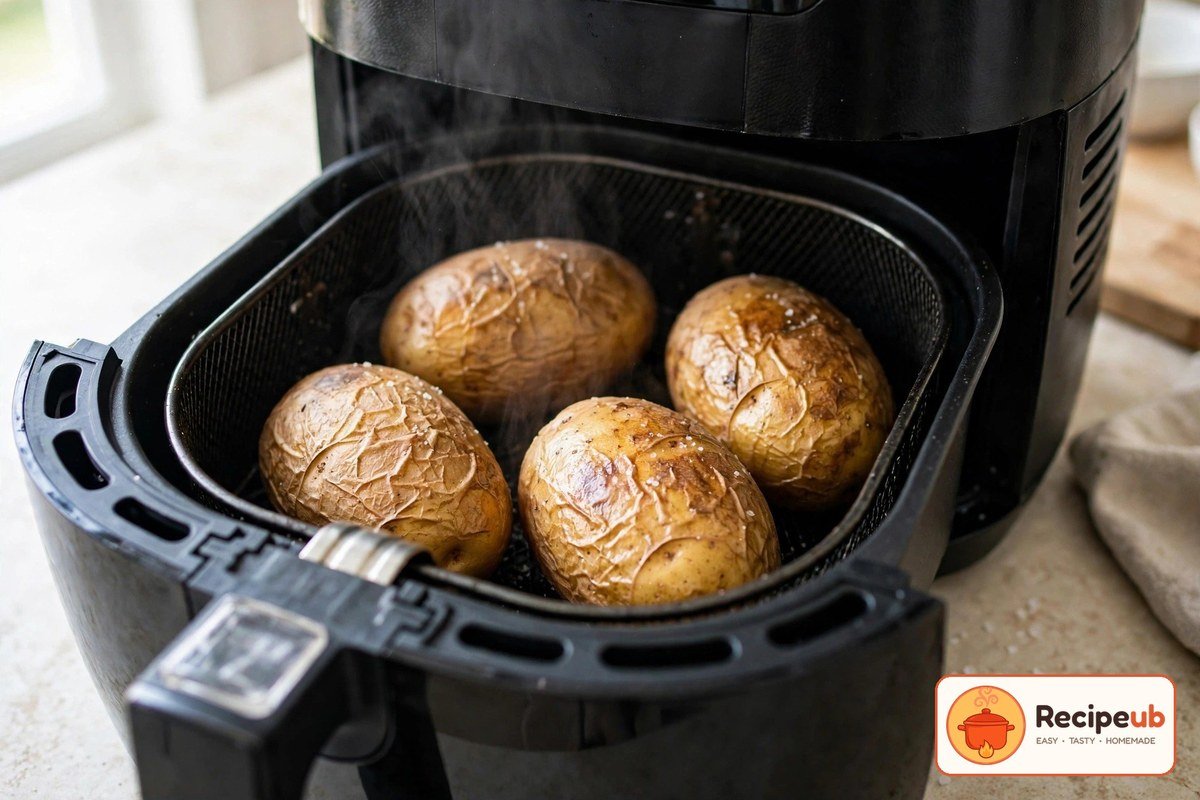
An air fryer baked potato is the side dish the whole appliance was quietly built for: a whole russet, rubbed with oil and salt, cooked in dry circulating heat until the skin goes crisp and salty and the center turns to fluff — no oven heating the kitchen for an hour, no microwave’s leathery skin. This version cooks four russet potatoes, about 8 ounces each, at 400°F for 40 minutes, flipped once, and calls them done the way the best pages on the internet do: when the center reads 205–210°F. Plain, each potato lands at about 225 calories and about $1.02 at this fall’s prices — and what you build on top of it is printed, with the calories, further down this page.
Read the top recipes for this dish closely and every one of them times exactly one potato and gestures at the rest. One builds on a 7-ounce potato, another on an 8-ounce, a third on 10-to-12-ounce steakhouse potatoes — three different “standard” potatoes, three different clocks. Put them side by side and page 1 runs the same 8-ounce potato anywhere from 35 to 45 minutes, each page stating its own number as settled fact. The foil question — which searchers ask in stem after stem — gets one line everywhere (“it makes the skin soggy”) and never the second half of the answer, the storage safety rule. And every page names toppings without ever saying what a topping costs you in calories. This page prints the four things the decisions actually need: the minutes for your potato’s weight, the thermometer rule that settles the argument, the complete foil verdict, and a topping chart with the numbers on it.
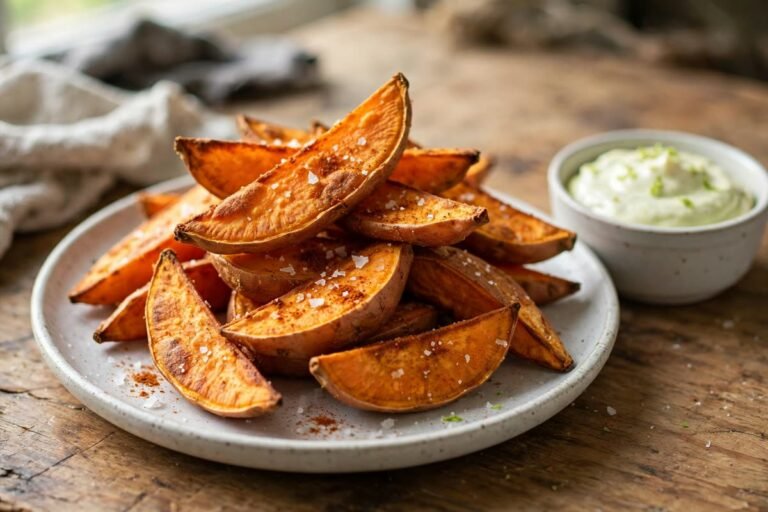
It also knows its neighbors on this site, because the potato shelf here is deliberate. This post is the dish itself — a whole russet baked in its skin. Its closest cousin is my slow cooker loaded baked potato soup — the same loaded flavors as a thick, creamy soup, for the nights you want the bowl instead of the skin: that one simmers diced potatoes into a soup and borrows this dish’s toppings as a garnish, and this one is the potato the soup imitates. And where this post bakes a russet whole, my air fryer sweet potato wedges — the sweet potato version, cut into wedges so it cooks in 20 minutes instead of 40 is the other potato in the other form: cut faces cook fast and sweet, a whole russet cooks slow to a center. Whole versus cut, russet versus sweet — each post stays in its lane.
The short answer: Scrub and dry 4 russet potatoes (about 8 oz each), prick each one 8–10 times with a fork, rub with 1 Tbsp olive oil and 1 tsp kosher salt across all four, and air fry in a single layer at 400°F for 40 minutes, flipping halfway (375°F for toaster-oven-style models). Done when the center reads 205–210°F. Rest 2–3 minutes, split, squeeze, fluff — about 225 calories and $1.02 per plain potato.
In This Recipe
The Plan at a Glance
- Potatoes: 4 russet potatoes, about 8 oz each (2 lb total), scrubbed and dried completely — same-size potatoes, so one clock times them all
- Rub: 1 Tbsp olive oil + 1 tsp kosher salt across the four potatoes (¾ tsp oil each — the measured middle of the ranking builds)
- Method: basket-style air fryer at 400°F, single layer with space between, flip halfway; toaster-oven-style models run at 375°F
- Time: 5 minutes prep / 40 minutes cook / 45 minutes total for the 8-ounce build — every other size is timed in the Size × Time Chart below
- The decider: the center reads 205–210°F, or a thin knife slides to the middle with no resistance — brown skin alone does not prove a cooked middle
- Calories: ~225 per plain potato (estimate); the topping builds run ~390 (classic) to ~550 (loaded) in the Topping System below
- Cost: about $1.02 per plain potato at October 2026 BLS prices; about $1.65 to $1.85 finished as a classic
- Storage: refrigerate leftovers within 2 hours, unwrapped (never in foil — the safety rule is in the Foil Verdict below); fridge 3 to 4 days; reheat in the air fryer at 350°F to a 165°F center
Why This Recipe Works
The chart bands by weight, because weight is what the cook can actually check. Nobody’s potato is “medium.” It is 6 ounces or 11, and those two potatoes are 15 minutes apart. Every ranking page times the one size its author bought and leaves the reader to guess the rest; the loudest signal in the searches for this dish — time, time and temp, at 400 — is readers asking how many minutes for the potato in their hand. So the chart below prints five weight bands, and it prints them honestly: page 1 itself disagrees about the same potato, and the chart says so instead of pretending one page’s clock is the truth.
The thermometer is the decider, not the timer. Underneath all five bands sits one rule that the careful pages on page 1 agree on word for word: a baked potato is done when its center reads 205–210°F. Timers disagree because baskets, models and potato shapes disagree; the center temperature does not. Start checking five minutes before your band’s low end, pull at temperature, and the argument every other page starts is over before it begins.
Dry skin is the whole crispness game. The two clearest lines in the competitor reading are about water: surface water left on a scrubbed potato “has to evaporate before the skin can brown,” and “dry skin crisps; damp skin steams.” So this recipe dries the potatoes completely before the oil goes on, cooks them bare — no foil, ever, for cooking — and leaves space between them so the air that does the crisping can actually circulate. The crisp skin in the title is not a hope; it is those three rules.
The oil is measured, not sprayed and not drowned. The ranking builds run from oil spray (the lightest skin on the page, and the least crisp by design) through ½ tsp a potato to a full 1½ tsp. This build rubs ¾ tsp per potato — enough oil for the salt to cling and the skin to fry properly, counted honestly in the calorie math at about 30 kcal a potato. It is the middle of the cluster, chosen on purpose, and it is why this page’s calorie number can show its work.
The foil answer is printed whole — all three uses. Searchers ask about foil constantly, and the entire first page answers only the cooking question. But foil has three separate uses with three separate answers: never for cooking (steam kills the crisp), allowed briefly for holding (and the skin pays for every minute), and never for storage — a foil-wrapped baked potato left at room temperature is a documented food-safety hazard, per Iowa State University Extension, and leftovers should be refrigerated unwrapped, per Ohio State University Extension. The third answer is the one that can hurt someone, and it appears on zero recipe pages. It is printed in full below.
The toppings are priced in calories, so the potato is a decision, not a surprise. A plain air fryer baked potato is a ~225-calorie side. The same potato with butter and sour cream is a ~390-calorie classic; fully built, it is a ~550-calorie dinner. None of that is hidden and none of it is a warning — it is a chart, so the reader builds the potato they actually want on purpose, including the Greek-yogurt swap that lightens any build by about 40 calories.
How Long Do You Cook a Baked Potato in the Air Fryer? The Potato Size × Time Chart
Here is the first chart this post exists to print. Whole russets at 400°F (375°F for toaster-oven-style air fryers), oiled and salted, flipped halfway — and every band ends at the same decider: the center reads 205–210°F.
| Potato size | Weight each | Time at 400°F | Center temp |
|---|---|---|---|
| Small | 5–6 oz | 30–35 min | 205–210°F |
| Medium — the recipe | 7–8 oz | 35–40 min | 205–210°F |
| Large | 9–10 oz | 40–45 min | 205–210°F |
| Extra large | 11–12 oz | 45–50 min | 205–210°F |
| Steakhouse | 13–14 oz | 50–60 min | 205–210°F |
How to read the chart — including the disagreement nobody prints: these bands are the convergent middle of the versions that rank for this dish, and the honest note is that page 1 does not agree with itself. For the same 8-ounce potato, one top page prints 35–40 minutes, another prints a flat 40, and a third runs it a full 45 minutes — a 10-minute spread for one potato, each stated as fact. The small-site charts that do band by weight land where this chart lands (5–6 oz at 30–35, up through 12–14 oz at 50–60), which is why the bands above are trustworthy as a starting clock — and why the chart’s real headline is the last column. Start checking 5 minutes before your band’s low end, and pull at temperature, not at the timer. The best single line in the competitor reading belongs under this chart: brown skin doesn’t guarantee a cooked middle — check the thickest part of each potato separately, because no two potatoes in a basket are the same potato. Two more notes the searches ask for. Toaster-style models: run the same bands at 375°F — the oven-style chamber holds heat differently, and the chart’s times assume the basket-style 400°F. Cut in half: a potato halved lengthwise, cut face oiled, cooks at 400°F in roughly 20–25 minutes with a crisper cut face — the faster format the searches keep completing for, printed here as a note; the recipe below is the whole potato. And for the site’s other potato clock, the cut-and-frozen lane has its own chart in my air fryer frozen french fries — the other potato time-and-temp chart on this site, for the cut and frozen lane.
Should You Wrap a Baked Potato in Foil? The Complete Foil Verdict
Here is the second chart, and it starts with the observation that the foil question is not one question. Searchers complete for it constantly — in foil, with foil, wrapped in foil — and every ranking page answers it as a one-line texture tip. Foil actually has three uses around a baked potato, and the three answers are different:
| Use | Verdict | Why |
|---|---|---|
| Wrapping during cooking | Never | Foil traps the potato’s own steam against the skin — the skin steams soft and wrinkly instead of crisping, and the foil blocks the circulating air that is the air fryer’s whole mechanism. Unanimous across every top recipe for this dish |
| Wrapping to hold warm after cooking | Allowed, briefly — the skin pays | Foil after cooking holds heat for serving, but every minute wrapped is steam against the skin you just crisped. Hold uncovered in the turned-off air fryer instead when you can |
| Wrapping for storage | Never at room temperature; unwrap before the fridge | The safety rule: potatoes carry botulism spores from the soil, and a foil wrap seals out the oxygen those bacteria want. Iowa State University Extension: dangerous bacteria, including the botulism type, can grow in foil-wrapped baked potatoes left out of the refrigerator more than 2 hours — remove the foil right after baking and refrigerate leftovers unwrapped. Ohio State University Extension: do not refrigerate a cooked potato with the foil on it |
How to read the table: the niche answers the foil question as a texture tip. It is actually a texture answer for cooking, a trade-off for holding, and a safety rule for storing — and the third row is the one that matters most, which is why this post prints all three. The air fryer method already cooks bare, so the rule that protects people is the storage one: if a potato was wrapped at any point — at a steakhouse, at a cookout, in a restaurant takeout bag — unwrap it before it goes in the fridge, and never leave a foil-wrapped baked potato sitting out. Leftovers go in the refrigerator unwrapped, within 2 hours, per the Storage section below.
Can You Microwave a Baked Potato First? The Microwave-Start Combo Chart
Here is the third chart, for the nights 40 minutes is too long. The shortcut is real search demand — microwave first and after microwave complete in stem after stem — and exactly one ranking page prints it, for exactly one potato, without ever saying what it costs. Prick first, microwave on a plate, then oil and salt, then air fry at 400°F:
| Potato size | Microwave first | Then air fry at 400°F | Total | vs straight |
|---|---|---|---|---|
| Medium 7–8 oz — the recipe’s size | 5 min | 8–12 min | ~15–18 min | Saves ~20–25 min |
| Large 9–12 oz | 6–7 min | 12–18 min | ~20–25 min | Saves ~20 min |
How to read the chart — including the trade-off, stated plainly: the medium row is anchored on the one printed combo in the ranking set (5 minutes of microwave, then 8 minutes of air fry for a 7½–8 oz potato), and the large row is the cluster’s scaled middle; both rows end at the same 205–210°F center check as everything else on this page. Now the cost, because the shortcut is not free: the microwave sets the flesh before the skin ever sees dry heat, so the skin crisps thinner and less shattering than the straight cook, and the center runs slightly denser. That is the right trade on a Tuesday, when the potato is a vehicle for toppings and dinner is late. It is the wrong trade when the crisp, salty, shattering skin is the whole point — which, on this page, it usually is. The chart prints both rows and the price of both, and lets the night decide.
What Should You Put on It? The Topping System (With Calories)
Here is the fourth chart. Every competitor for this dish lists topping names — butter, loaded, chili — and not one prints what a topping adds, so the reader cannot build the potato they actually want to eat. This system is built on the base potato (~225 kcal with its oil, basis in the header note), with measured amounts per potato and the running total for each build. Calories are USDA-standard-value estimates, labeled as such:
| Build | Toppings (per potato) | Added kcal | Per finished potato |
|---|---|---|---|
| Plain, as cooked | Flaky salt on the flesh | +~0 | ~225 kcal |
| Classic | 1 Tbsp butter (~102) + 2 Tbsp sour cream (~60) + chives (~2) | +~165 | ~390 kcal |
| Broccoli Cheddar | ½ Tbsp butter (~51) + ½ cup steamed broccoli (~27) + 1 oz shredded cheddar (~115) | +~195 | ~420 kcal |
| Chili Cheese | ½ cup beef chili (~175) + ½ oz cheddar (~57) + 1 Tbsp sour cream (~30) | +~260 | ~485 kcal |
| Loaded | 1 Tbsp butter (~102) + 2 Tbsp sour cream (~60) + 1 oz cheddar (~115) + 1 slice bacon, crumbled (~45) + green onions (~2) | +~325 | ~550 kcal |
How to read the chart: the toppings, not the potato, decide what the meal is — the plain potato is a side, the loaded one is a dinner, and now the choice is made with the numbers showing. Two of the builds are standing invitations to this site’s slow cooker shelf: the chili cheese row is built for a half cup of my slow cooker beef chili — a half cup ladled over the split potato is the chili-cheese build in the chart above, and the BBQ direction the ranking pages name without measuring is a split potato under a scoop of my slow cooker pulled pork — the BBQ loaded potato: pork, cheddar and green onions over the split potato — pork, cheddar and green onions, roughly the loaded row’s numbers with the bacon swapped for the pork. The light swap, printed with the chart: 2 Tbsp of nonfat Greek yogurt (about 18 kcal) in place of the sour cream (about 60) saves roughly 40 kcal on any build and eats like sour cream once the potato is topped — the one light move in the competitor set worth keeping. Top while the potato is steaming hot, in order — butter first so it melts into the fluff, then cheese so the heat takes it, then the cool toppings last.

What Does a Baked Potato Cost This Fall? The Honest Math
Every page in this niche calls the baked potato practically free. Here is this recipe’s math, from the Bureau of Labor Statistics average price data for October 2026: white potatoes averaged $1.962 a pound — and the honest context is that fall 2026 is not a cheap-potato moment. The same BLS series swung from $1.471 in August to $1.636 in September to $1.962 in October, and USDA’s November 10, 2026 forecast puts the U.S. potato crop at 387.8 million cwt, down 7.1% from 2025, with Idaho down 13.3%. This post dates its number instead of reaching for the cliché:
| Line | Amount for the batch | Price basis | Batch cost |
|---|---|---|---|
| Russet potatoes (in the BLS white-potato average) | 2 lb (4 × ~8 oz) | $1.962/lb, BLS Oct 2026 | $3.92 |
| Olive oil | 1 Tbsp | Pantry estimate, labeled as one | ≈$0.15 |
| Kosher salt | 1 tsp | Pantry estimate, labeled as one | ≈$0.02 |
| Batch total | 4 potatoes | ≈$4.10 → about $1.02 per potato | |
| Classic toppings | Per potato | Butter + sour cream + chives, pantry estimate | +≈$0.60–0.80 → about $1.65–1.85 finished |
How to read the table: the ~$1.02 is a plain potato price at the October 2026 average — a side that eats like a meal for about a dollar even in an expensive potato fall, and under two dollars finished as a classic. The number carries its date on purpose: a series that moves 47¢ to 54¢ a pound in a month gets refreshed when BLS publishes new averages, rather than a stale “cheapest dinner ever” claim sitting on the page.
Ingredients
- 4 russet potatoes, about 8 oz each (2 lb total)
- 1 Tbsp olive oil
- 1 tsp kosher salt
- Toppings of your choice — measured amounts and calories in the Topping System above
Ingredient notes: The potato is the recipe, so buy it like it matters: russets, because their low moisture and starchy flesh are what bake up fluffy — a waxy red or a yellow potato cooks up dense and gummy by comparison, and no chart on this page is written for them. Buy four of the same size (about 8 oz each is the size the cluster times best and the size a US shopper actually brings home), because one clock has to time them all; a mixed basket is how one potato is perfect and the next is hard in the middle. The oil is a full tablespoon across the four — ¾ tsp per potato, rubbed on, not sprayed — because the oil is what fries the skin crisp and gives the salt something to cling to; the spray builds on page 1 are lighter and their skins show it. The salt is kosher, rubbed over the oiled skin before cooking, not sprinkled after: salt that cooks on the skin is the flavor of the skin itself. And dry the potatoes completely after scrubbing — this is an ingredient note and a method rule at once, because surface water has to evaporate before skin can brown, and a damp potato spends its first minutes steaming instead of crisping.

How to Make Air Fryer Baked Potato
- Scrub and dry completely. Scrub the potatoes under running water, then dry them thoroughly with a clean towel — bone dry, not mostly dry. Damp skin steams; dry skin crisps.
- Prick each potato 8–10 times. Stab all over with a fork, evenly spaced. The holes vent the steam the potato makes as it cooks — this is the step that keeps a potato from bursting in the basket, and every top recipe for this dish prints it.
- Rub with oil and salt. Rub the olive oil over every skin until each potato shines, then rub the kosher salt over the oiled skins so it clings. Work quickly and cook right away — salt left sitting on a raw skin draws out moisture.
- Load the basket in a single layer. Set the potatoes in the air fryer basket with space between them — touching skins don’t crisp, and a crowded basket cooks unevenly. Four 8-ounce potatoes fit a standard basket; if yours is small, cook in two batches rather than stacking.
- Air fry at 400°F, flipping halfway. Cook for 40 minutes total for the 8-ounce build (375°F for toaster-oven-style models), turning each potato over at the 20-minute mark so both sides of the skin crisp evenly. Start checking at 35 minutes — your band’s low end in the Size × Time Chart.
- Check the center, not the skin. The potatoes are done when the center of the thickest one reads 205–210°F on an instant-read thermometer, or a thin knife slides to the middle with no resistance. Brown skin alone does not prove a cooked middle — if the center is short, give the potatoes 5 more minutes and check again.
- Rest, split and fluff. Rest 2–3 minutes. Cut a lengthwise slit in the top of each potato, squeeze the ends toward the middle so the flesh pushes up, and fluff the inside with a fork. Top while steaming hot, from the Topping System above.

Air Fryer Baked Potato (Crispy Skin, 40 Minutes at 400°F)
Ingredients
Equipment
Method
- Scrub the potatoes and dry them completely — dry skin crisps, damp skin steams. Prick each potato 8 to 10 times with a fork to vent steam.
- Rub the olive oil over every skin, then rub the kosher salt over the oiled skins so it clings. Cook right away.
- Set the potatoes in the air fryer basket in a single layer with space between them. Air fry at 400°F (375°F for toaster-oven-style models).
- Cook 40 minutes for 8-ounce potatoes, flipping each one halfway, until the center of the thickest potato reads 205–210°F or a thin knife slides to the middle with no resistance. (Other sizes: 5–6 oz, 30–35 min; 9–10 oz, 40–45 min; 11–12 oz, 45–50 min; 13–14 oz, 50–60 min.)
- Rest 2 to 3 minutes. Split each potato lengthwise, squeeze the ends toward the middle, fluff the flesh with a fork, and top while steaming hot.
Notes
- The charts on the page run this recipe: the Size × Time Chart (five weight bands at 400°F, all ending at a 205–210°F center — page 1 runs the same 8-oz potato anywhere from 35 to 45 minutes, so start checking 5 minutes before your band’s low end and pull at temperature, not at the timer), the Foil Verdict (never wrap to cook — steam kills the crisp; wrapping to hold is allowed briefly and the skin pays; never wrap for storage — Iowa State University Extension: dangerous bacteria, including botulism, can grow in foil-wrapped baked potatoes left out more than 2 hours, so unwrap leftovers and refrigerate them; Ohio State University Extension: do not refrigerate a cooked potato with the foil on), the Microwave-Start Combo (7–8 oz: microwave 5 min, then air fry 8–12 min, about 15–18 min total — faster, with a thinner, less crisp skin and a slightly denser center), and the Topping System (plain ~225 kcal; classic ~390; broccoli cheddar ~420; chili cheese ~485; loaded ~550; swap 2 Tbsp nonfat Greek yogurt, ~18 kcal, for the sour cream, ~60, to save about 40 kcal on any build).
- Halves: a potato cut in half lengthwise, cut face oiled, cooks at 400°F in about 20–25 minutes with a crisper cut face.
- Cost: about $1.02 per plain potato — 2 lb of russets at $1.962/lb (BLS average price for white potatoes, October 2026) = $3.92, plus oil and salt ≈ $0.17, across 4 potatoes. Classic toppings add about $0.60 to $0.80 a potato (pantry estimate).
- Storage: refrigerate leftovers unwrapped within 2 hours; fridge 3 to 4 days at 40°F or below; reheat in the air fryer at 350°F for 5 to 10 minutes, to a 165°F center, and the skin re-crisps. Freeze wrapped potatoes up to 3 months; thawed flesh is best scooped into soups or crisped as home fries.
Emma’s Tips for the Best Air Fryer Baked Potato
Weigh one potato before you set the timer. The whole system on this page runs on the potato’s weight, and “medium” is not a weight. One trip across a kitchen scale — or a glance at the bag’s count and total weight — tells you which band of the chart you are in, and it is the difference between a potato pulled fluffy at 40 minutes and one pulled hard at the same clock. If your four potatoes are not the same size, set the timer for the biggest one and start checking the smallest first.
Believe the thermometer over the skin. The most useful warning in all the research for this post is that brown skin doesn’t guarantee a cooked middle. A potato can look perfect — dark, crisp, salted — and still be firm at the center, especially in a crowded basket. An instant-read thermometer in the thickest part settles it in three seconds: 205–210°F and it is done, whatever the skin is claiming.
Salt immediately, cook immediately. Rub the oil on, rub the salt on, and get the potatoes into the basket. Salt sitting on a raw, oiled skin starts pulling moisture to the surface, and surface moisture is the enemy this recipe keeps fighting. The same logic runs the other way at the end: split, fluff and top while the potato is steaming, because the butter and cheese need that heat to melt into the flesh instead of sitting on top of it.
Do not turn the heat up to save time. The instinct with a big potato is 425°F and a shorter clock. The clearest method note in the competitor reading says why that fails: higher heat just darkens the skin before the center catches up — you get a scorched jacket on a raw middle. Keep it at 400°F and let the chart’s minutes do the work; the only honest shortcut on this page is the microwave start, and it prints its trade-off.
Storage and Reheating
Fridge: Leftover baked potatoes keep 3 to 4 days at 40°F or below. Two rules carry the whole section: refrigerate within 2 hours of cooking (1 hour if the kitchen is above 90°F), and refrigerate them unwrapped — if a potato was wrapped in foil to hold or to travel, the foil comes off before the fridge, every time, per the Iowa State and Ohio State Extension guidance in the Foil Verdict above. Some pages print “up to 5 days” for leftovers; this post prints the careful 3-to-4-day line, the same standard as the rest of this site.
Reheating: Back in the air fryer at 350°F for 5 to 10 minutes, until the center reaches 165°F — the skin re-crisps as it reheats, which is the whole advantage over the microwave. The microwave works and is faster; it also leaves the skin soft, which is sometimes fine (a potato destined to be scooped into a bowl) and sometimes the whole loss. Never reheat a potato that sat out wrapped in foil at room temperature — that is the one leftover this page will not rescue; when in doubt, it goes out.
Freezer: Baked potatoes freeze wrapped individually for up to 3 months (safe longer at 0°F; quality is the deadline). Be honest about what a thawed baked potato is: the flesh turns a little grainy and wet, so it is at its best scooped into soups or crisped in a skillet as home fries rather than re-served whole in its skin.
FAQs
How long do you cook a baked potato in the air fryer?
By weight, at 400°F: a small 5–6 oz potato takes 30–35 minutes, a medium 7–8 oz potato takes 35–40 minutes (this recipe’s 8-ounce build is 40), a large 9–10 oz takes 40–45, an extra-large 11–12 oz takes 45–50, and a 13–14 oz steakhouse potato takes 50–60. Every band ends at the same decider — the center reads 205–210°F — because the ranking pages themselves run the same 8-ounce potato from 35 to 45 minutes, and the thermometer is the rule that settles which clock your basket agrees with.
What temperature should the air fryer be for baked potatoes?
400°F for a basket-style air fryer, and 375°F for a toaster-oven-style model, whose chamber holds heat differently. Do not go higher to save time: hotter air just darkens the skin before the center catches up, so a 425°F potato comes out scorched outside and firm in the middle. The time lives in the Size × Time Chart above; the temperature stays put.
Do you have to poke holes in a potato before air frying?
Yes. Prick each potato 8–10 times with a fork before it goes in. A baking potato makes steam inside its skin as it cooks, and the holes are the vents that let that steam escape in a controlled way instead of building pressure until the skin splits or the potato bursts. It takes ten seconds, it is printed by every top recipe for this dish, and it is the cheapest insurance in the recipe.
Should I wrap my baked potato in foil in the air fryer?
Not to cook — foil traps the potato’s steam against the skin, so the skin steams soft and wrinkly instead of crisping, and the foil blocks the circulating air the air fryer cooks with. Wrapping a cooked potato briefly to hold it warm is allowed, and the skin softens a little for every minute it sits wrapped. And never wrap one for storage: Iowa State University Extension warns that dangerous bacteria, including the botulism type, can grow in foil-wrapped baked potatoes left out of the refrigerator for more than 2 hours — unwrap leftovers and refrigerate them, and per Ohio State University Extension, do not refrigerate a cooked potato with the foil still on it.
How do you know when a baked potato is done?
The center reads 205–210°F on an instant-read thermometer — the range the careful pages for this dish agree on — or a thin knife or skewer slides to the middle with no resistance. Use the temperature as the decider, because the squeeze test and the skin can both lie: brown, crisp skin does not guarantee a cooked middle, especially with mixed-size potatoes in one basket. Check the thickest part of the largest potato.
Can you microwave a baked potato before air frying to save time?
Yes — it is the shortcut in the Combo Chart above. For a 7–8 oz potato: prick it, microwave 5 minutes, then oil and salt it and air fry at 400°F for 8–12 minutes, for a total of about 15–18 minutes instead of 35–40. The trade-off is stated with the chart: the microwave sets the flesh before the skin sees dry heat, so the skin crisps thinner and less shattering and the center runs slightly denser. Right trade on a weeknight, wrong trade when the skin is the point.
Why is my baked potato still hard in the middle?
Three usual causes, in order. Size mismatch: the potato was bigger than the time assumed — an 11-ounce potato on an 8-ounce clock is the most common hard middle there is, and it is why this page bands its chart by weight. Crowding: potatoes touching each other, or stacked, block the circulating air and cook unevenly. Trusting the skin: the outside browned and looked done while the center lagged — check the thickest part of each potato with a thermometer (205–210°F) instead of judging by color. The fix in the moment is simple: 5 more minutes, then check again.
Can I cook baked potatoes cut in half in the air fryer?
Yes — halve the potato lengthwise, oil the cut face as well as the skin, salt it, and air fry at 400°F cut-side up for about 20–25 minutes, until the center reads 205–210°F. The cut face crisps and browns in a way a whole potato’s flesh never does, and the format runs about 15 minutes faster than the whole potato, which is why the searches keep asking for it. The whole potato in the recipe is the classic build; the halves are the weeknight variation, printed here rather than pretending it is the same dish.
How long do leftover baked potatoes last — and how do I reheat them?
Three to four days in the fridge at 40°F or below, refrigerated within 2 hours of cooking and stored unwrapped — if the potato was wrapped in foil at any point, the foil comes off before the fridge (the storage rule in the Foil Verdict above). Reheat in the air fryer at 350°F for 5 to 10 minutes, until the center reaches 165°F, and the skin re-crisps; the microwave is faster and leaves the skin soft. Frozen, a wrapped baked potato keeps about 3 months, and its thawed flesh is best scooped into soups or crisped as home fries.
How many calories are in an air fryer baked potato?
About 225 calories for a plain 8-ounce russet with its oil (estimate — about 195 for the potato itself plus roughly 30 for its share of the oil rub, with about 5 g of protein). The builds climb from there: about 390 as a classic (butter, sour cream, chives), about 420 as broccoli cheddar, about 485 as chili cheese, and about 550 fully loaded. The ranking cards for this dish spread from 157 to 256 calories for the plain potato because they are quietly timing three different builds — a 7-ounce potato with oil spray at the low end, a full 1½ tsp of oil per serving at the high end — which is why this page names its size and its oil in the answer.
Final Thoughts
An air fryer baked potato is not a glamorous recipe either, and it is the backbone of a hundred dinners anyway: the side that turns into the meal the moment anything lands on top of it. What this page adds is the paperwork the other versions leave out — a time chart that bands by the weight of the potato in your hand and admits the internet disagrees about the minutes, a thermometer rule that ends the argument, a foil verdict that prints the safety half everyone else skips, and a topping chart that lets you choose between a 225-calorie side and a 550-calorie dinner with your eyes open. Crisp skin, fluffy center, honest numbers — that is the deal.
More Easy Air Fryer Recipes
If a whole potato timed by weight is your kind of chart, the rest of this shelf runs on the same rules — real times, real temperatures, no guessing. The dinners that want this potato beside them are already here: my one-pan chicken and potatoes — the chicken dinner where cut potatoes roast in the pan juices is the night the potato shares the pan instead of the basket, and when the potato is headed for lunches instead of a plate, my sheet pan chicken meal prep — five assembled lunches with roasted potato pieces, when the potato is one part of a full prep shows the same vegetable cut up and roasted as one component of a full week. One potato, three honest ways to run it — whole in the basket, cut in the pan, or portioned across the week.



Never Run Out of Dinner Ideas
One easy air fryer or slow cooker dinner in your inbox every week. No spam, ever.
You’re on the list — welcome to Recipeub!