
Creamy Tuscan Chicken (One Pan, 30 Minutes, No Pasta)
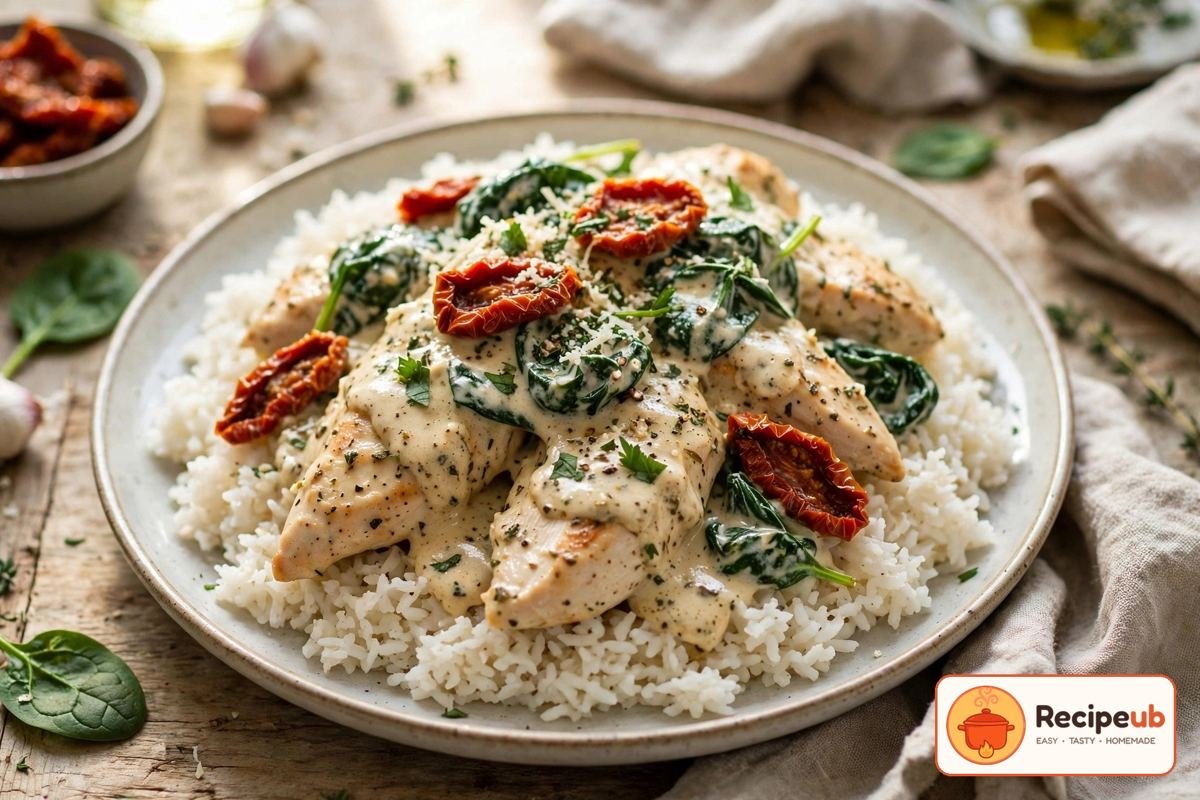
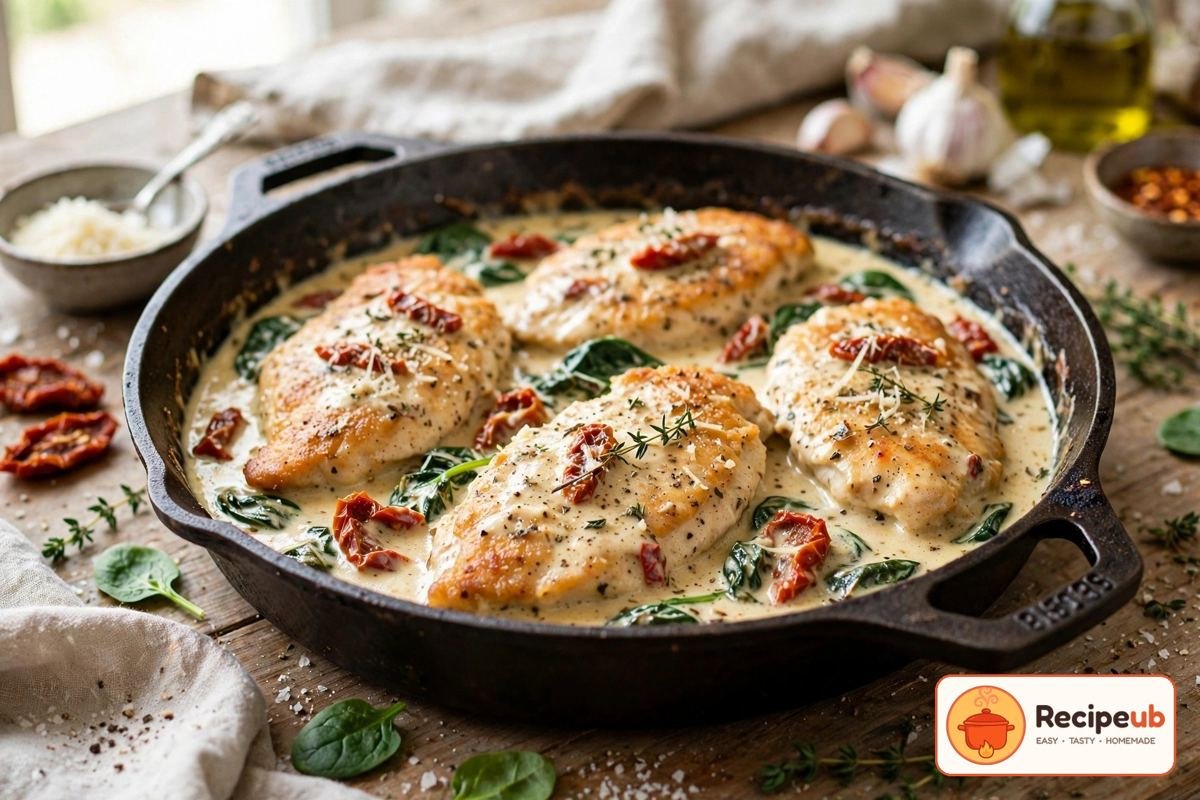
Creamy Tuscan chicken is chicken cutlets simmered in a garlic-Parmesan cream sauce with sun-dried tomatoes and spinach — no pasta in the pan. That last clause matters more than it sounds. Search this dish and most of what comes back is the pasta version, the soup version or the crockpot version, and the plain skillet original gets blurred into all of them. This page is the original: two chicken breasts butterflied into cutlets, seared in the oil from the sun-dried tomato jar, and finished in a cream sauce that takes twenty minutes from the moment the pan gets hot. Thirty minutes, one pan, dinner.
What makes this version different is that it prints the three things page 1 leaves you to guess. A spinach rule with an amount, a moment and a number of seconds — because spinach is where this sauce goes thin and gray. A sun-dried tomato verdict with the exact swap between oil-packed and dry-packed — because the recipes split on it and nobody converts it for you. And a sauce fix chart, because a cream sauce that lands too thin, too thick or grainy deserves better than a shrug. The dish itself is simple. The details are the recipe.
One boundary, stated plainly before we start, because the internet keeps blurring it: Want the sun-dried tomato cream sauce with the pasta cooked right in it? That’s my Marry Me Chicken Pasta — this Tuscan version skips the pasta and adds spinach. Same flavor family, two different pans. If pasta is in the pan, it is the Marry Me post. If spinach is in the sauce and pasta never touches the skillet, you are in the right place.
The short answer: Butterfly 2 large chicken breasts (1½ lb) into 4 cutlets, sear them in 1 tablespoon of the oil from the sun-dried tomato jar plus 1 tablespoon olive oil, then build the sauce in the same pan: garlic, ½ cup oil-packed sun-dried tomatoes, ½ cup broth, 1 cup heavy cream and ½ cup Parmesan, kept at a bare simmer. Return the chicken until it reaches 165°F, then add 5 oz baby spinach in 3 handfuls for 90 seconds to 2 minutes, heat off. One pan, 30 minutes, no pasta.
In This Recipe
The Plan at a Glance
- Chicken: 2 large boneless skinless breasts, 1½ lb total, butterflied into 4 cutlets
- Searing fat: 1 Tbsp oil reserved from the sun-dried tomato jar + 1 Tbsp olive oil
- Sauce: garlic, ½ cup oil-packed sun-dried tomatoes, ½ cup chicken broth, 1 cup heavy cream, ½ cup freshly grated Parmesan
- Spinach: 5 oz baby spinach (one clamshell), added last by the Spinach Rule below
- Time: 10 minutes prep / 20 minutes cook / 30 minutes total
- Cost: about $6.15 of chicken for the dish at the October 2026 BLS average of $4.099 a pound for boneless breast — roughly $1.55 a serving before the sauce
- Serve over: rice, mashed potatoes, cauliflower rice or crusty bread — the base is chosen at the table, never cooked in the sauce
- The charts: the Sun-Dried Tomato Swap, the Spinach Rule and the Sauce Fix Chart
Why This Recipe Works
Cutlets, not whole breasts. A whole chicken breast is a wedge — thick at one end, thin at the other — and in a sauce that means one end overcooks while the other waits. Butterflied into cutlets, every piece is the same thickness, sears in the same minutes, and finishes at 165°F at the same moment. Cutlets are also the majority method on page 1 for a reason: more flat surface against the pan means more golden sear, and sear is flavor the sauce gets built on.
The jar oil is the first ingredient, not a byproduct. Every recipe that uses oil-packed sun-dried tomatoes tells you to drain them — and most tell you to throw the oil away. That oil has been sitting with tomatoes, garlic and herbs for weeks; it is the most flavorful fat in the building. One tablespoon of it, with a tablespoon of plain olive oil, is the searing fat here, and the chicken picks up a tomato-garlic base note before the sauce even starts. It costs nothing — it was already in the jar.
The cream never boils. A cream sauce has one hard rule and this is it: bare simmer, never a rolling boil. Boiling is what breaks a sauce into grainy curds and a slick of oil, and it is the failure behind most “why did my Tuscan sauce split” questions. This sauce comes up to the gentlest simmer, the Parmesan goes in gradually off the boil, and the spinach wilts in the residual heat with the burner off.
The spinach has a rule, not a guess. Page 1 uses anywhere from 1 cup of spinach to a full 5-ounce clamshell in this dish, added anywhere from before the cream to covered with the chicken for 13 to 15 minutes — which is how spinach turns gray and weeps water into a sauce that was thick a minute earlier. The rule below fixes the amount to the sauce volume, the moment to after the chicken returns, and the time to under two minutes.
No flour dredge. Several good recipes dredge the cutlets in flour to thicken the sauce, and it works — but the sauce’s body then depends on a coating that softens as it sits. This version skips the dredge: the sauce thickens by reduction and Parmesan, the cutlets stay gluten-free by default, and if your sauce still lands off-target, the Sauce Fix Chart below corrects it with numbers instead of hope.
Oil-Packed or Dry-Packed? The Sun-Dried Tomato Verdict
This is the question the ingredient itself asks, because the jar and the bag are not the same product. Oil-packed sun-dried tomatoes are soft, deep red and ready to slice; dry-packed are leathery, darker and need liquid before they behave. Page 1 splits between them — most recipes use oil-packed, one very big one uses dry with no explanation — and nobody prints the conversion. Here it is, both ways:
| Form | Amount for this recipe | What to do with it |
|---|---|---|
| Oil-packed (the pick) | ½ cup, drained and sliced | Reserve 1 Tbsp of the jar oil before draining — it is the searing fat |
| Dry-packed (the swap) | ⅓ cup | Soak 10 minutes in hot chicken broth, drain, then slice |
The verdict: oil-packed wins, and it is not close. The texture is right out of the jar, the flavor is rounder, and the jar oil does double duty as the searing fat — an ingredient the dry-packed version does not give you. But the swap matters, because ½ cup oil-packed and ⅓ cup dry-packed look like different amounts of tomato and are actually the same: dry tomatoes are concentrated, and once they have taken up broth for 10 minutes they land at roughly the same yield. That is the conversion — and it explains why the dry-packed recipes on page 1 cluster around ⅓ cup while the oil-packed ones cluster around ½.
One caution that belongs to this section: the acid in sun-dried tomatoes can react with a reactive pan, so a stainless or enameled skillet is the safe choice; in cast iron, keep the tomatoes’ time in the bare pan short and get the broth in promptly — the sauce should taste like tomatoes, not like the pan.
When Do You Add the Spinach? The Spinach Rule
Here is the rule this whole page exists to print, stated once, completely:
The Spinach Rule: 5 oz of baby spinach — one standard clamshell — per 1 to 1¼ cups of cream, added in 3 handfuls after the chicken has returned to the sauce, stirred for 90 seconds to 2 minutes until just wilted, then the heat goes off.
| Part of the rule | The number | Why |
|---|---|---|
| Amount | 5 oz (one clamshell) per 1 to 1¼ cups cream | Matched to the sauce volume — enough to be a real ingredient, not so much it floods the pan |
| Moment | After the chicken returns to the sauce | The chicken needs its simmer time; the spinach needs almost none |
| Method | 3 handfuls, one at a time | Each handful wilts down before the next goes in, so the pan never overflows or steams |
| Time | 90 seconds to 2 minutes | Spinach is done the moment it wilts — past that it goes from green to gray |
| Heat | Off as soon as it wilts | Residual heat finishes it; the burner is what overcooks it |
Why the rule works: spinach is mostly water held in leaves, and heat breaks the leaves down and lets that water out. Add spinach early and it does two kinds of damage at once — it cooks past wilted into the gray, stringy state nobody wants, and it releases its water into your sauce a spoonful at a time, thinning a sauce you just reduced. Add it last, in handfuls, for under two minutes, and the leaves stay green and give up only a little water into a sauce that is about to be served anyway. The covered 13-to-15-minute spinach cook in one famous version of this dish is the cautionary tale: that is not wilting, that is stewing, and the sauce pays for it.
What If the Sauce Goes Wrong? The Sauce Fix Chart
Cream sauces are forgiving right up until they are not, and every failure mode has a specific cause and a specific fix. This is the chart to screenshot — four problems, each with the correction, in the order to try them:
| Problem | Why it happens | The fix |
|---|---|---|
| Too thin | Spinach water, a short simmer, or cream that never reduced | 1) Simmer gently 2 to 3 more minutes. 2) Stir in 2 more Tbsp Parmesan. 3) Whisk 1 tsp cornstarch into 1 Tbsp cold broth and stir it in |
| Too thick | Reduced too far, or too much Parmesan too fast | Add chicken broth 1 Tbsp at a time, stirring, until the sauce coats the back of a spoon |
| Grainy or broken | The sauce boiled, or the Parmesan was pre-grated and added all at once | Take the pan off the heat and whisk in 1 to 2 Tbsp cold cream. Next time: bare simmer only, Parmesan fresh-grated and added gradually |
| Too salty | The sun-dried tomatoes and the Parmesan are both salt — the dish salts itself | Taste before you add any salt of your own; if it is already over, a splash of cream or broth dilutes it back |
And the swap the chart makes possible: you can build this sauce on half-and-half instead of heavy cream — page 1’s most common answer to that question is “not recommended,” full stop, with no fix offered. Here is the fix. Whisk 1 teaspoon of cornstarch into each cup of half-and-half before it goes in the pan, and hold the sauce at a bare simmer, never a boil. The cornstarch gives the lighter dairy the stability cream has naturally, and the no-boil rule protects it. The sauce lands a little lighter and a touch less rich — the honest trade — but it holds together, which is what the “not recommended” answers never tell you how to do.
Ingredients
- 2 large boneless skinless chicken breasts (1½ lb total), butterflied into 4 cutlets
- Kosher salt and black pepper, to taste
- ½ tsp garlic powder
- 1 Tbsp oil reserved from the sun-dried tomato jar
- 1 Tbsp olive oil
- 2 cloves garlic, minced
- ½ cup oil-packed sun-dried tomatoes, drained and sliced
- ½ cup low-sodium chicken broth
- 1 cup heavy cream
- 1 tsp Italian seasoning
- ¼ tsp red pepper flakes (optional, for a gentle heat)
- ½ cup freshly grated Parmesan, plus more for serving
- 5 oz baby spinach (one standard clamshell)
Ingredient notes: The chicken is cutlets, and the cut matters more than the brand: two large breasts butterflied open and halved give you four even pieces that sear and finish together. If your breasts are small, use three and make six smaller cutlets — the sauce amounts do not change. On doneness, the discipline here is the same one I use everywhere: the thickest part of the cutlet is the only reading that counts, and it is the same timing logic I lay out in my slow cooker chicken breast post, where the whole method turns on cooking chicken breast to temperature instead of to a guess. The sun-dried tomatoes are oil-packed — the verdict section above has the reasoning and the dry-packed swap (⅓ cup, soaked 10 minutes in hot broth). Reserve the jar oil before you drain the tomatoes; once it is down the sink, the free searing fat is gone. The Parmesan should be freshly grated: pre-grated cheese is coated with anti-caking starch, melts reluctantly and is the leading cause of the grainy row in the Sauce Fix Chart. And the spinach is a full 5-ounce clamshell — it looks like a mountain raw and cooks down to almost nothing, which is why the amount is keyed to the cream in the Spinach Rule rather than measured in cups.

How to Make Creamy Tuscan Chicken
- Butterfly and season the chicken. Slice each breast open horizontally and cut it into 2 cutlets, 4 in total, as even in thickness as you can make them. Pat dry, then season both sides with salt, black pepper and the garlic powder.
- Sear in the jar oil. Heat the reserved sun-dried tomato oil and the olive oil in a large skillet over medium-high heat until it shimmers. Lay the cutlets in a single layer — work in two batches if your pan is crowded — and sear about 3 to 4 minutes per side, until deeply golden. The chicken does not need to be cooked through yet; it finishes in the sauce. Move it to a plate.
- Bloom the garlic and tomatoes. Lower the heat to medium. Add the minced garlic and the sliced sun-dried tomatoes to the same pan and stir for about 1 minute, until the garlic is fragrant and the tomato oil turns a deeper red.
- Deglaze with the broth. Pour in the chicken broth and scrape up every browned bit from the bottom of the pan — those bits are concentrated sear flavor and they belong in the sauce. Let it simmer 1 to 2 minutes.
- Build the cream sauce. Pour in the heavy cream, add the Italian seasoning and the red pepper flakes if you are using them, and bring the sauce to a bare simmer — small lazy bubbles at the edges, never a rolling boil. Simmer gently for 2 to 3 minutes, until it just begins to thicken.
- Add the Parmesan gradually. Sprinkle in the Parmesan a small handful at a time, stirring after each addition until it melts before adding more. Off the boil, added gradually — that is the whole technique for a smooth sauce.
- Return the chicken and finish it. Slide the cutlets and any juices from the plate back into the sauce. Simmer gently for 3 to 5 minutes, turning once, until the thickest part of the largest cutlet reads 165°F on an instant-read thermometer. That number is the finish line — pull the pan’s heat down the moment you reach it, because cutlets left simmering past 165°F dry out even in a cream sauce.
- Wilt the spinach by the rule. Add the spinach in 3 handfuls, stirring each handful in until it just wilts before adding the next — 90 seconds to 2 minutes total. Turn the heat off. Taste and adjust salt and pepper now, remembering the tomatoes and Parmesan brought salt with them. Serve straight from the pan with extra Parmesan over the top.

Creamy Tuscan Chicken (One Pan, 30 Minutes, No Pasta)
Ingredients
Equipment
Method
- Butterfly the breasts into 4 cutlets of even thickness. Pat dry and season both sides with salt, black pepper and the garlic powder.
- Heat the jar oil and olive oil in a large skillet over medium-high heat. Sear the cutlets 3 to 4 minutes per side until deeply golden; they finish in the sauce. Set aside on a plate.
- Lower the heat to medium. Stir the garlic and sun-dried tomatoes in the same pan for about 1 minute, until fragrant.
- Pour in the broth and scrape up the browned bits. Simmer 1 to 2 minutes.
- Add the cream, Italian seasoning and red pepper flakes. Bring to a bare simmer — never a hard boil — and simmer gently 2 to 3 minutes.
- Stir in the Parmesan gradually, a handful at a time, until melted and smooth.
- Return the chicken and its juices to the sauce. Simmer gently 3 to 5 minutes, until the thickest part of the largest cutlet reads 165°F.
- Add the spinach in 3 handfuls, stirring until just wilted, 90 seconds to 2 minutes total. Turn the heat off, taste, adjust salt and pepper, and serve with extra Parmesan.
Notes
- The Spinach Rule: 5 oz baby spinach per 1 to 1¼ cups cream, added in 3 handfuls after the chicken returns, 90 seconds to 2 minutes, heat off. Spinach releases its water as it cooks — late and fast keeps the sauce thick and the leaves green.
- Sun-dried tomato swap: ½ cup oil-packed, drained = ⅓ cup dry-packed soaked 10 minutes in hot broth, drained. Oil-packed is the pick — and 1 Tbsp of its jar oil is the searing fat in this recipe.
- Half-and-half swap: whisk 1 tsp cornstarch into each cup of half-and-half before adding, and hold the sauce at a bare simmer, never a boil.
- Chicken thighs: boneless skinless thighs work — sear the same way and simmer to 175°F, about 2 to 3 minutes longer than the cutlets.
- Storage: 3 to 4 days in the fridge. Freeze the chicken in its sauce for up to 2 months and add fresh spinach when you reheat; the frozen spinach is the part that suffers.
Emma’s Tips for the Best Creamy Tuscan Chicken
- Dry chicken sears, wet chicken steams. Pat the cutlets genuinely dry with paper towels before they meet the pan. Surface moisture is the enemy of the golden crust, and the crust is not decoration — the browned bits it leaves behind are what the broth scrapes up into the sauce.
- Save the jar oil before you drain anything. The first move of the recipe happens at the jar, not the stove: spoon out a tablespoon of the sun-dried tomato oil before the tomatoes go into the strainer. I learned this the annoying way, standing over a sink with a drained jar and a recipe that wanted the oil. Jar first, drain second.
- Fresh-grated Parmesan is a sauce ingredient, not a garnish choice. The pre-grated kind is dusted with anti-caking starch, and that coating is what turns a smooth cream sauce grainy. Grating ½ cup from a wedge takes about a minute, melts like it wants to, and is the cheapest insurance in the whole recipe. The grainy row of the Sauce Fix Chart exists almost entirely because of the bagged cheese.
- Season at the end, not the beginning. Between the sun-dried tomatoes, the Parmesan and the broth, this sauce arrives pre-salted by its own ingredients. Salt the chicken directly — that part is safe — but do not salt the sauce until it is finished and you have tasted it. You can always add the last quarter-teaspoon. You cannot take it back out.
- Rest the cutlets in the sauce, off the heat. Once the spinach wilts and the burner goes off, give the pan two or three undisturbed minutes before serving. The chicken settles and the sauce clings instead of pooling. It is a small pause that makes the dish taste finished rather than assembled.
What Do You Serve With Creamy Tuscan Chicken?
The sauce is the point of the dish, so the base underneath it has one job: carry sauce to your mouth without competing with it. Nothing is cooked in the pan — the base is chosen at the table — and these are the four routes that work, with what each one changes:
| Base | What changes |
|---|---|
| White or jasmine rice | The neutral carrier. The sauce soaks in and every bite is balanced — the weeknight default |
| Mashed potatoes | The richest route. The cream sauce becomes the gravy and the dish turns into full comfort food |
| Cauliflower rice | The lightest route. The sauce supplies all the richness, so the base can afford to be lean |
| Crusty bread | No cooking at all. Built for sopping — tear, drag through the pan, repeat |
A note on the rice route, because the two dishes get confused: serving this chicken over rice is a plating choice, and the rice cooks in its own pot. Serving it over rice tonight? My One-Pot Chicken and Rice cooks the rice in the pot when you want it all in one go. Different method, different post — here, the skillet holds chicken and sauce only. And for meal-prep weeks, these cutlets portion over any base above exactly as they are; for the same cut in a completely different treatment, my air fryer chicken breast is the same cutlets, crisped instead of sauced.
Storage and Reheating
| Fridge | 3 to 4 days | The USDA window for cooked chicken — store the cutlets in their sauce, airtight |
| Freezer | Up to 2 months | Freeze the chicken in the sauce; add fresh spinach when you reheat — frozen spinach comes back limp and dark |
| Reheating | Gentle, to 165°F | Covered skillet over low heat or the microwave at reduced power, with a splash of broth or cream; never re-boil the sauce |
Fridge: Leftovers keep 3 to 4 days refrigerated, stored in the sauce so the chicken stays moist. This is one of the rare cream sauces that reheats gracefully, because it was never boiled in the first place.
Freezer: The honest verdict is “yes, with one adjustment.” The chicken in its sauce freezes well for up to 2 months, and the sauce comes back with a gentle reheat and a good stir. The spinach is the casualty — it thaws limp and dark and gives up its water into the sauce. So freeze the chicken and sauce, and wilt a fresh handful of spinach into the pan as it reheats.
Reheating: Warm the leftovers gently — a covered skillet over low heat, or the microwave at half power in short bursts — with a splash of broth or cream if the sauce has tightened in the fridge. Bring the chicken back to 165°F and stop there. The one thing not to do is re-boil the sauce to “make sure it is hot”: boiling is what breaks it, on day one or day three alike.
FAQs
What’s the difference between Tuscan chicken and Marry Me chicken?
The structure of the pan. Marry Me chicken cooks pasta in the sun-dried tomato cream sauce — the pasta is an ingredient, cooked in the pan. Creamy Tuscan chicken has no pasta in the pan at all, and spinach is a defining ingredient in its sauce; it is served over a base you choose at the table. Same flavor family, different dish. If pasta is in the sauce, it is the Marry Me version; if spinach is in the sauce and pasta never touches the skillet, it is this one.
Can I use half-and-half instead of heavy cream?
Yes — with one stabilizer and one rule. Whisk 1 teaspoon of cornstarch into each cup of half-and-half before it goes into the pan, and hold the finished sauce at a bare simmer, never a boil. The cornstarch gives the lighter dairy the stability that heavy cream has on its own. The sauce will be a little lighter and slightly less rich, which is the honest trade, but it will hold together instead of breaking.
Can I use chicken thighs instead of breasts?
Yes. Boneless skinless thighs sear exactly the same way in the jar oil, then simmer in the sauce about 2 to 3 minutes longer than the cutlets, until the thickest thigh reads 175°F — thighs are at their most tender a little past the breast’s 165°F, and they forgive an extra minute in a way breasts never do. The sauce, the tomatoes and the Spinach Rule do not change at all.
Should sun-dried tomatoes be oil-packed or dry-packed?
Oil-packed, for this recipe — softer texture, rounder flavor, and the jar gives you the tomato oil that becomes the searing fat. If dry-packed is what you have, use ⅓ cup instead of ½, and soak it 10 minutes in hot chicken broth before slicing. The two amounts are the same quantity of tomato in different states, which is the conversion page 1 never prints.
Why is my sauce thin — and how do I thicken it?
Usually one of three causes: the spinach went in early and released its water, the cream never got its 2 to 3 minutes of simmer, or the Parmesan went in too fast to melt and thicken. Fix it in order — simmer gently 2 to 3 more minutes, stir in 2 more tablespoons of Parmesan, or whisk 1 teaspoon of cornstarch into 1 tablespoon of cold broth and stir that in. The Sauce Fix Chart above covers the too-thick, grainy and too-salty versions too.
When do you add the spinach so it doesn’t overcook?
Last, and fast. The Spinach Rule: 5 oz of baby spinach per 1 to 1¼ cups of cream, added in 3 handfuls after the chicken has returned to the sauce, stirred for 90 seconds to 2 minutes until it just wilts, then the heat goes off. Spinach added early cooks gray and releases its water into the sauce; spinach added at the end stays green and the sauce stays thick.
What do you serve with creamy Tuscan chicken?
A base that carries the sauce: white or jasmine rice for the balanced weeknight plate, mashed potatoes when you want the sauce to be the gravy, cauliflower rice for the lightest version, or crusty bread for sopping straight from the pan. What does not happen is pasta cooked in the sauce — that is a different recipe on this site.
Can I make creamy Tuscan chicken ahead — and how long do leftovers keep?
Yes, and it reheats well for a cream sauce. Cook it fully, cool it, and refrigerate it in its sauce for 3 to 4 days, the USDA window for cooked chicken. Reheat gently — covered, low heat, a splash of broth or cream — back to 165°F, and never re-boil the sauce. Made ahead for guests, it is actually a kindness to yourself: the dish holds warm far better than it tolerates being rushed.
Can I freeze creamy Tuscan chicken?
Yes, with one adjustment. The chicken in its cream sauce freezes well for up to 2 months, and the sauce comes back together with a gentle reheat and a stir. The spinach does not survive the freezer gracefully — it thaws limp and dark and waters the sauce — so freeze the chicken and sauce, and wilt fresh spinach in during the reheat. That two-minute swap is the difference between leftovers that taste frozen and leftovers that taste made.
Final Thoughts
Creamy Tuscan chicken is a 30-minute skillet dinner that page 1 somehow turned into a guessing game — how much spinach, which tomatoes, why did the sauce split. The answers turned out to be small and printable: one clamshell of spinach keyed to the cream and added last by the rule, oil-packed tomatoes with their jar oil in the pan and the dry-packed swap written down, and a cream sauce that is never allowed to boil and can be fixed by chart when it strays. Make it once by the numbers and it stops being a recipe you follow and becomes a dinner you just know.
More Easy One-Pot & Skillet Dinners
If the one-pan, sauce-built-in-the-skillet way of cooking is your weeknight language, the rest of my skillet shelf speaks it fluently. For the garlic-first version with pasta in the pot, see my One-Pot Creamy Garlic Chicken Pasta — same one-pot logic, garlic as the headline and the pasta cooked right in the sauce. And when the same creamy Italian flavors sound good but the evening does not, my Slow Cooker Creamy Italian Chicken takes them into the crockpot instead — same creamy Italian flavors, hours instead of minutes, and dinner waiting when you get home. Between the three pans, the creamy chicken dinner is covered from every angle a week can throw at it.






Never Run Out of Dinner Ideas
One easy air fryer or slow cooker dinner in your inbox every week. No spam, ever.
You’re on the list — welcome to Recipeub!