
Slow Cooker Chicken and Dumplings with Biscuits (Fluffy, Never Gummy)
There is a specific disappointment every chicken and dumplings cook knows: you lift the lid at the end of a long, patient cook, the stew underneath is perfect — and the dumplings are raw in the middle. Gummy, shiny, doughy little lumps sitting on top of a dinner you waited five hours for. Look up how long the dumplings are supposed to take and you will get no help at all: the top recipes for this dish say 30 minutes, one hour, an hour and a quarter and an hour and a half, all for what looks like the same biscuit dough. They are all describing real pots. The times disagree because the dough, the piece size and the pot setting differ — and nobody prints the chart that sorts it out. This recipe does. It is the classic creamy version: shredded chicken, carrots, celery and peas in a cream of chicken base, topped with refrigerated biscuit dumplings that finish fluffy, never gummy — because they go onto a simmering stew, on HIGH, with the lid shut, for exactly as long as the chart below says.
It is the same creamy chicken family as my Slow Cooker Chicken Pot Pie Filling — same cozy base, but here the dumplings do the job the crust does there, right in the pot. Twenty minutes of prep in the morning, and by dinner you have the South’s most-searched winter comfort food at about $2.50 a bowl, in the season when chicken is the one protein that is actually cheaper than it was last year.
The short answer: The stew cooks 4 hours on LOW, then you shred the chicken, switch the pot to HIGH, lay the biscuit quarters on top of the simmering stew and cook 1 more hour with the lid shut — 5 hours of cooking total. The chicken is done at 165°F; the dumplings are done when a toothpick pushed into the center of the biggest one comes out clean, with no wet dough.
In This Recipe
The Plan at a Glance
- Chicken: 1½ lb boneless, skinless chicken breasts (thighs work too — see the chicken chart)
- Setting and time: stew 4 hours on LOW, then dumplings 1 hour on HIGH (all-HIGH option: stew 2 hours, dumplings still 1 hour)
- Dumplings: one can of refrigerated buttermilk biscuits, cut in quarters (a 5-minute from-scratch dough is inside, too)
- The three dumpling rules: simmering stew, pot on HIGH, lid shut — no stirring, no peeking
- Cost: about $2.50 a bowl at fall 2026 chicken prices
- Serves: 6 bowls (about 1¾ cups each) in a 6-quart slow cooker
Why This Recipe Works
The chart ends the timing argument. Dumpling finish times on the internet range from 30 minutes to 3 hours, and the spread is not error — it is five different doughs being timed as if they were one. A biscuit quarter, a biscuit strip, a Bisquick drop, a from-scratch drop and a frozen flat dumpling are five different recipes wearing one name. This page prints all five in one chart, with the doneness test that matters more than any clock.
Hot base, HIGH heat, lid shut — that is the whole never-gummy secret. Dumplings do not boil in this pot; they steam. Dough dropped onto lukewarm stew absorbs broth before it can set, and that is where gummy comes from. Dough dropped onto a stew that is already simmering, in a pot switched to HIGH, under a lid that stays closed, sets on the outside first and puffs up light. Every anti-gummy rule here — simmering base, HIGH, no stirring, no peeking, even pieces — is that one piece of physics, applied five ways.
Both dumpling lanes live on one page. The big sites make you choose a lane before you cook — sometimes two separate URLs from the same brand. This recipe runs the easy biscuit version as the main road, because it is what most of us are making on a Tuesday, and gives the 5-minute scratch dough as a real, timed alternative, with a head-to-head table so you can pick with your eyes open.
It is built for the chicken you already have. Fresh breasts, thighs, a frozen-brick emergency, or the shredded meat left over from a Sunday whole chicken — every starting point has a row in the chicken chart and a finish line of 165°F, and the leftover version gets its own fast lane below.
How Long to Cook Chicken and Dumplings in the Slow Cooker
The stew and the dumplings are two separate cooks with two separate clocks, and most failed pots come from treating them as one. The stew cooks low and slow until the chicken shreds; the dumplings are a short, hot finish at the end. For the chicken phase, every road ends at the same place — 165°F and meat that pulls apart with two forks:
| Chicken You Put In | LOW | HIGH | Notes |
|---|---|---|---|
| Boneless, skinless breasts (this recipe) | 4–5 hours | 2–3 hours | Shred, then stir back in before the dumplings |
| Boneless, skinless thighs | 4–6 hours | 2–3 hours | Darker, richer, more forgiving if the pot runs long |
| Frozen chicken breasts | 5–6 hours | Not recommended | Thawing first is the better path — see the note below |
| Already-cooked shredded chicken (leftover or rotisserie) | No separate cook | No separate cook | Stir in before the dumplings; it heats through during the dumpling hour |
How to read the chart: this recipe uses the breast row at its early end — 4 hours on LOW — because the vegetables are cut small and the chicken goes back in shredded. The frozen row needs an honest word: a slow cooker warms frozen chicken slowly, so in my kitchen the rule is thaw first, overnight in the fridge. The row exists because life happens; if you use it, keep the breasts in a single layer, do not shorten the time, and confirm 165°F in the thickest breast before you shred. Once the chicken is shredded and back in, the stew can hold on LOW while you ready the dumplings — it is the dumpling clock, not the stew clock, that cannot stretch.
How Long Do the Dumplings Take in the Slow Cooker?
This is the chart I wish every chicken and dumplings recipe printed. It assumes the three rules from the plan: the stew underneath is at a simmer when the dough goes on, the pot is switched to HIGH, and the lid stays shut the whole time — every peek dumps the steam the dumplings are cooking in and adds minutes you cannot see. The LOW column is there because people ask, but HIGH is the reliable finish; on LOW the tops stay pale and the gummy risk climbs.
| Dumpling Dough | When to Add | HIGH | LOW | Done When |
|---|---|---|---|---|
| Refrigerated biscuit quarters (this recipe) | On the simmering stew, for the final hour | 1–1¼ hours | ~2 hours | Toothpick in the center comes out clean; split one open — the middle looks like bread, not dough |
| Refrigerated biscuit eighths or strips | Final stretch, single layer | 1–1½ hours | 1½–2 hours | Same toothpick test; strips should be tender all the way through |
| Bisquick drop dumplings | Final stretch, dropped by the spoonful | 30–45 minutes | 1½–2 hours | Toothpick clean; tops dry and matte, not shiny |
| From-scratch drop dumplings (heaping tablespoon) | Final stretch, dropped by the spoonful | 1–1½ hours | 2–3 hours | Split the biggest one — center is set and bready, no wet streak |
| Frozen flat dumplings (Mary B’s style) | Earlier — they simmer in the stew itself | 1–2 hours | 2–3 hours | Tender and noodle-like, with no chewy, raw center |
How to read the chart: piece size is the hidden variable in every dumpling argument online. A biscuit cut in quarters is roughly four times the dough of one cut in eighths, so of course their times differ — the famous 30-minute biscuit recipes quietly assume small, flattened pieces, and cooks who follow them with big quarters get raw middles. Cut small and even, and when the clock and the toothpick disagree, believe the toothpick: test the biggest dumpling in the pot, because when that one is done, all of them are. One honest limit: cooked dumplings hold about 2 to 3 hours on LOW or Warm. Past that they keep drinking broth and start to dissolve — a thickening strategy, not a serving plan.
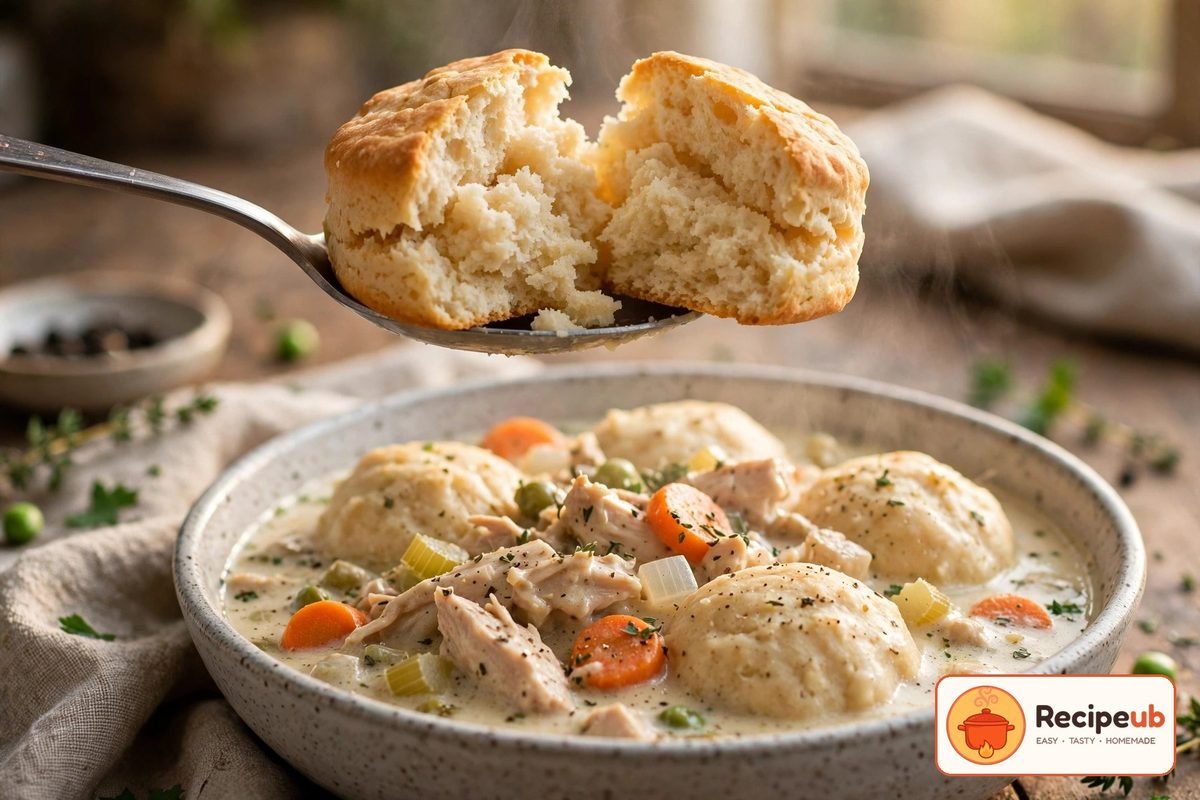
Biscuits or Homemade Dumplings — Which Is Better?
It is the topic’s central argument, and the honest answer is that they are different dumplings, not better and worse ones. Here is the head-to-head:
| Refrigerated Biscuits | From-Scratch Drop Dumplings | |
|---|---|---|
| Prep | ~2 minutes — open the can, cut each biscuit in quarters | ~5 minutes — stir flour, baking powder, salt, milk and melted butter |
| Cost | ~$2.50 a can | ~$0.60 of pantry staples |
| Texture | Pillowy and bready, with distinct layers | Tender and cakey, more delicate |
| Failure risk | Gummy centers if the stew is not simmering or the pieces are too big | Tough if you overmix the dough; can dissolve if the dough is too wet |
| Best for | Weeknights, beginners, a guaranteed lift | Scratch cooks, and nights when there is no can in the house |
The 5-minute scratch dough, if you want it: whisk 2 cups all-purpose flour, 1 tablespoon baking powder and 1 teaspoon salt in a bowl. Stir in 2 tablespoons melted butter and ¾ to 1 cup milk, just until a soft, sticky dough forms — stop the moment it comes together, because every extra stir makes the dumplings tougher. Drop by the heaping tablespoon onto the simmering stew, lid on, and cook on HIGH 1 to 1½ hours per the chart. A Bisquick version splits the difference: 2 cups baking mix stirred with ⅔ cup milk, dropped the same way, done in 30 to 45 minutes on HIGH.
The Leftover Chicken Fast Lane
If you cooked my Whole Chicken in the Slow Cooker on Sunday, you are holding the fastest version of this dinner there is: about 4 cups of shredded meat and a pot of free broth. Build the pot exactly as written below — vegetables, soups, broth (use your homemade broth if you have it), butter and seasonings — but skip the raw chicken. Cook the vegetable base on LOW for 3 hours, until the carrots are tender. Stir in 3 to 4 cups of the already-cooked shredded chicken, switch to HIGH, and give it 20 to 30 minutes to come back to a simmer. Then the dumplings go on exactly as written, 1 hour on HIGH with the lid shut. The chicken only needs to heat through, so it spends that hour soaking up the creamy base instead of overcooking in it. A store-bought rotisserie chicken works the same way.
What This Pot Costs in 2026 — and Why Chicken Is the Smart Comfort Food Right Now
Beef is having an expensive year, and chicken is quietly having the opposite one. In the Bureau of Labor Statistics’ October 2026 retail data, boneless chicken breast averaged $4.10 a pound and whole chickens $2.03 a pound — a little cheaper than a year ago, while beef stayed high. That gap is this whole pot: 1½ pounds of breast at about $6, two cans of soup and a can of biscuits at about $2.50 each, broth, butter, peas and vegetables for a few dollars more — roughly $15 for the pot, about $2.50 a bowl for six deep bowls of the South’s most-searched winter comfort food. Use thighs on sale and the bowl gets cheaper still; use the leftover whole chicken from the fast lane above and the chicken line drops to nearly nothing. Comfort food was always supposed to be the economical kind. This winter, for once, the prices agree.
Ingredients
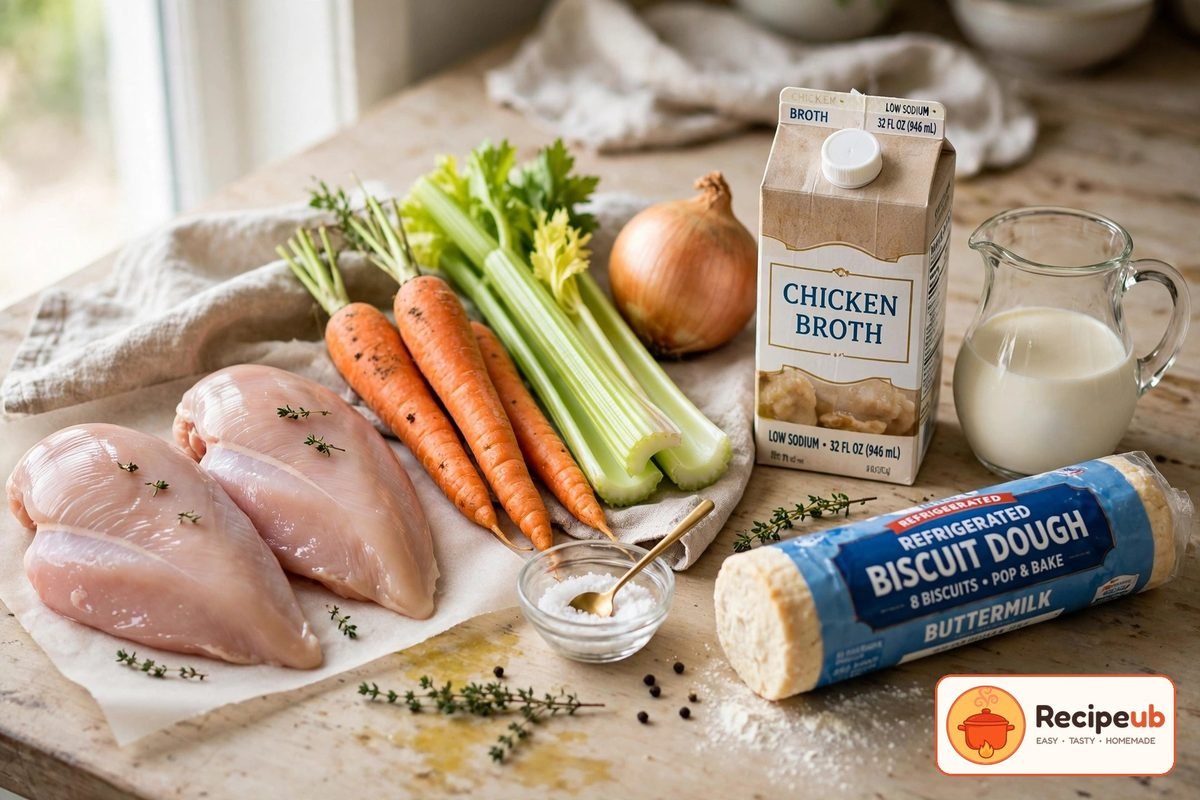
- 1½ lb boneless, skinless chicken breasts
- 1 medium yellow onion, diced
- 3 carrots, peeled and sliced into ½-inch rounds
- 3 celery stalks, sliced
- 2 cloves garlic, minced
- 2 Tbsp butter
- 2 cans (10.5 oz each) condensed cream of chicken soup
- 3 cups low-sodium chicken broth
- 1 tsp poultry seasoning
- ½ tsp dried thyme
- 1 tsp kosher salt
- ½ tsp black pepper
- 1 cup frozen peas
- 1 can (16.3 oz) refrigerated buttermilk biscuits (8 count), cut into quarters
- Fresh parsley, chopped, for serving
Ingredient notes: The biscuits are the recipe — a standard 16.3 oz can of refrigerated buttermilk biscuits (Pillsbury Grands is the one most of us grab), cut in quarters so every piece is small enough to cook through in the hour. Flaky-layer biscuits separate into layers as they cook; the homestyle buttermilk style holds together better as a dumpling, so reach for that can if both are on the shelf. Cream of chicken soup is the base every page-one version of this dish is built on, and it brings salt with it — that is why the broth is low-sodium and why the final seasoning happens at the end, after shredding, when you can actually judge it. Poultry seasoning is the flavor shortcut that makes the pot taste like it simmered all day; if your jar is older than the slow cooker, replace it. Kosher salt note: if you use fine table salt, cut it to ¾ teaspoon. Thighs swap in one-for-one — richer, darker, and they forgive an extra hour in the pot in a way breasts do not.
How to Make Slow Cooker Chicken and Dumplings
- Load the vegetables. Put the onion, carrots, celery and garlic in the bottom of a 6-quart slow cooker and dot the butter over the top.
- Add the chicken and the base. Lay the chicken breasts on the vegetables in a single layer. Whisk the cream of chicken soup and broth together in a bowl (it pours more evenly than straight from the can), pour it over the chicken, and sprinkle on the poultry seasoning, thyme, salt and pepper.
- Cook the stew. Cover and cook on LOW for 4 hours (or HIGH for 2 hours), until the chicken reaches 165°F and shreds at the touch of a fork. Leave the lid alone — the cooker needs its heat.
- Shred and finish the base. Lift the chicken onto a cutting board, shred it with two forks into bite-size pieces, and stir it back into the pot. Stir in the frozen peas. Taste the base now and add salt if it needs it — this is your last easy chance to season before the dumplings go on.
- Bring it to a simmer and switch to HIGH. Turn the cooker to HIGH and give the stew 15 to 20 minutes, lid on, until you can see it bubbling at the edges. Do not skip this: dumplings dropped on lukewarm stew absorb broth before they set, and that is exactly how they turn gummy.
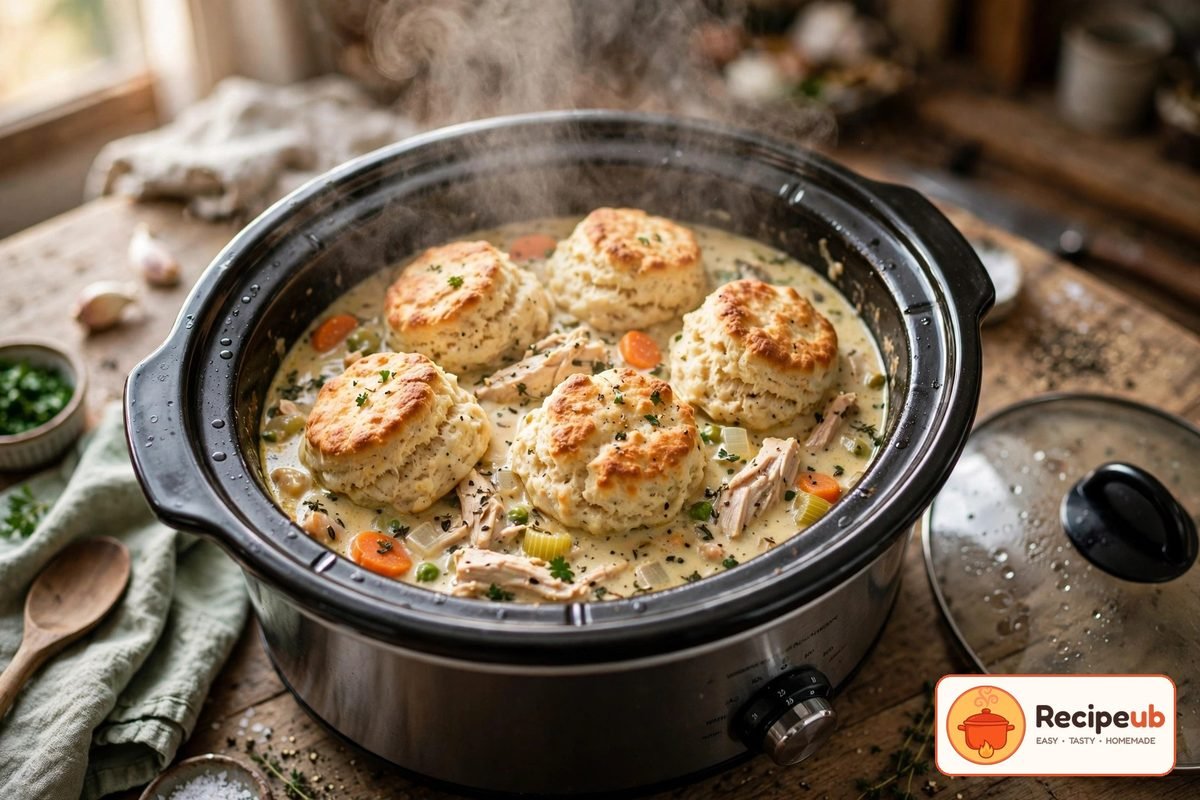
- Add the dumplings. Cut each biscuit into quarters. Lay the pieces over the top of the stew in a single layer, close together but not stacked — a little overlap is fine, a pile is not. Do not stir them in; they sit on top and steam.
- Cook with the lid shut. Cover and cook on HIGH for 1 hour without lifting the lid. Then test the biggest dumpling: a toothpick in its center should come out clean, and split open, the middle should look like cooked bread. If it is still doughy, lid back on, 15 to 20 minutes more.
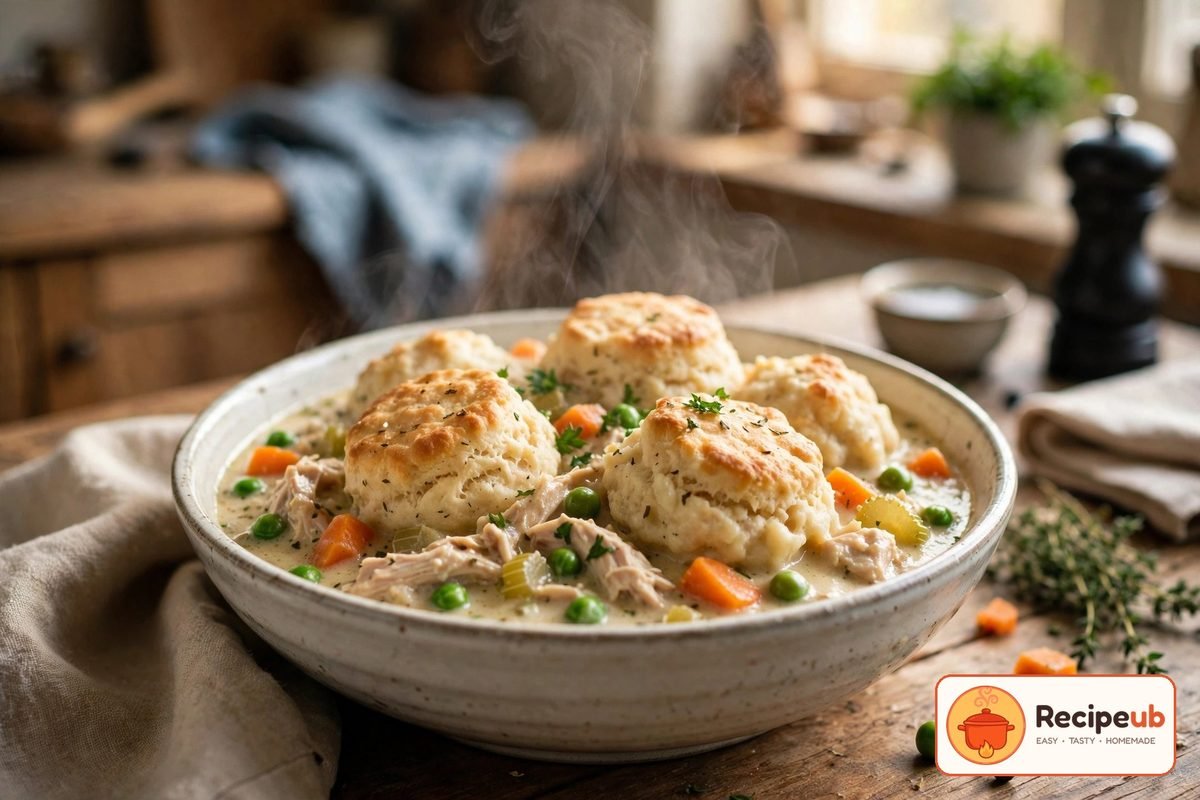
- Rest and serve. Let the pot rest 10 minutes with the lid cracked — the sauce thickens as it stands and the dumplings finish setting. Scatter with parsley and ladle into deep bowls, making sure every bowl gets stew, chicken and dumplings together.
Slow Cooker Chicken and Dumplings with Biscuits (Fluffy, Never Gummy)
Ingredients
Equipment
Method
- Add the onion, carrots, celery and garlic to a 6-quart slow cooker and dot with the butter. Lay the chicken breasts on top in a single layer.
- Whisk the cream of chicken soup and broth together, pour over the chicken, and sprinkle on the poultry seasoning, thyme, salt and pepper.
- Cover and cook on LOW for 4 hours (HIGH: 2 hours), until the chicken reaches 165°F and shreds easily.
- Shred the chicken with two forks and stir it back in. Stir in the frozen peas and taste for salt.
- Switch the cooker to HIGH and let the stew come up to a simmer at the edges, 15 to 20 minutes, lid on.
- Cut each biscuit into quarters and lay the pieces over the top of the stew in a single layer. Do not stir.
- Cover and cook on HIGH for 1 hour, without lifting the lid, until a toothpick in the center of the largest dumpling comes out clean.
- Rest 10 minutes, scatter with parsley, and serve in deep bowls.
Notes
- Dumpling timing by dough: biscuit quarters = HIGH 1–1¼ hours; biscuit eighths or strips = HIGH 1–1½ hours; Bisquick drops = HIGH 30–45 minutes; from-scratch drops (heaping tablespoon) = HIGH 1–1½ hours; frozen flat dumplings = HIGH 1–2 hours. Always on a simmering stew, pot on HIGH, lid shut. Done = toothpick clean, center bready.
- From-scratch dumplings: whisk 2 cups flour, 1 Tbsp baking powder, 1 tsp salt; stir in 2 Tbsp melted butter and ¾–1 cup milk just until combined. Drop by the heaping tablespoon and cook as above.
- Leftover chicken fast lane: cook the vegetable base alone 3 hours on LOW, stir in 3–4 cups cooked shredded chicken, bring to a simmer on HIGH, then add dumplings as written.
- Freeze the stew before adding dumplings for up to 3 months; thaw, reheat to a simmer and cook a fresh batch of dumplings on top.
Emma’s Tips for the Best Slow Cooker Chicken and Dumplings
Do not peek. I mean it. The dumplings cook in the steam trapped under the lid, and every lift of that lid dumps the steam and drops the pot’s temperature — one peek can cost you ten minutes and a layer of gumminess. Set a timer for the full hour and trust it. If you have a glass lid, look through it; that is what it is for.
Cut the pieces small and even. The single most common reason for a raw middle is a dumpling that was simply too big. Quarters of a standard biscuit are the biggest piece that cooks through reliably in an hour; if your biscuits are the jumbo kind, cut them in sixths. Even matters as much as small — a pot of mixed sizes is a pot where half are done and half are dough.
A light flour toss keeps dumplings separate. If your biscuit pieces tend to fuse into one big raft, toss the cut pieces in a tablespoon of flour (or a pinch of cornmeal) before they go on the stew. It keeps them individual, and the little bit of starch that washes off helps the base thicken. Not required — just the fix if rafting is your problem.
Season at the end, not the beginning. Condensed soup is salty and gets saltier as the pot reduces, so a stew seasoned perfectly at hour zero can be over-salted by hour five. The recipe’s measured salt goes in at the start; your final judgment happens after the chicken is shredded and back in, when the base tastes like what you will actually serve.
The toothpick tests the biggest dumpling, always. The small ones at the edge finish first and will lie to you. Find the largest piece in the center of the pot, push a toothpick into its middle, and read that one. Clean toothpick, bready center — dinner. Wet dough on the pick — lid back on, 15 more minutes, no debate.
Storage and Reheating
Fridge: Refrigerate leftovers in airtight containers for up to 3 days. Be honest with yourself about what changes: the dumplings keep drinking broth as they sit, so day-two dumplings are softer and the stew around them is thicker. Plenty of us think it is better that way; just know it will not be the same texture as the first night.
Reheating: Warm it gently on the stove over medium-low heat, stirring now and then, until steaming throughout — about 12 to 15 minutes for a family-size portion. Add a splash of broth or milk if it has thickened more than you like. The microwave works for single bowls; stir halfway and let it stand a minute so the dumplings heat through to the center.
Freezing: Freeze the stew before the dumplings go on — that is the move. Cooked dumplings freeze into sponges; the plain stew freezes beautifully for up to 3 months. Freeze the base in portion-size containers, thaw overnight in the fridge, bring it back to a simmer in the slow cooker on HIGH, and cook a fresh batch of dumplings on top exactly as the recipe directs. It comes back tasting like the day you made it — the same freezer logic as my Slow Cooker Chicken Noodle Soup, where the pot does the waiting and dinner is ready whenever the month gets busy.
FAQs
How long do dumplings take in the slow cooker?
It depends on the dough, which is why the answers online disagree. On HIGH, over a simmering stew with the lid shut: biscuit quarters take 1 to 1¼ hours, eighths or strips 1 to 1½ hours, Bisquick drops 30 to 45 minutes, from-scratch drops 1 to 1½ hours, and frozen flat dumplings 1 to 2 hours. The full chart, with LOW times and the doneness test, is in the timing section above — and when the clock and the toothpick disagree, believe the toothpick.
Why are my dumplings gummy or raw in the middle?
Almost always one of three causes. The stew was not simmering when the dough went on, so the dumplings absorbed broth before they could set — always bring the base up to a bubble on HIGH first. The lid came off during the cook, dumping the steam they cook in. Or the pieces were too big or unevenly cut, so the outside finished while the center stayed raw. Small, even pieces on a hot base under a closed lid fixes all three.
How can I tell when the dumplings are done?
Two tests, both aimed at the biggest dumpling in the center of the pot. Push a toothpick into its center: it should come out clean, with no wet dough clinging to it. Or split that dumpling open with a spoon: the middle should look like cooked bread — set, matte and steamy — not shiny, sticky or translucent. The tops should look dry, not wet and glossy.
Can you overcook dumplings in a slow cooker?
Yes. Cooked dumplings hold well for about 2 to 3 hours on LOW or Warm after they finish, but keep pushing past that and they keep absorbing broth until they start to dissolve into it — the pot thickens and the dumplings disappear. On HIGH the window is shorter: much past 90 minutes, even good dumplings begin to break down. Serve within the hold window, or let the pot sit on Warm rather than stretching the cook.
Why did my dumplings fall apart?
Usually because they were stirred too soon, or cut too small. New dumplings are fragile for the first half of their cook — stirring in that window breaks them into the broth. Lay them on top, close the lid, and leave them completely alone until the timer ends. Pieces cut tiny — smaller than an eighth of a biscuit — can also dissolve rather than set; quarters and eighths are the sizes that hold.
Why is my chicken and dumplings watery, and how do I thicken it?
Give it the rest first: the sauce thickens noticeably in the 10-minute stand after cooking, and the dumplings’ surface starch does part of the job during their hour. If it is still thinner than you like, whisk 1 tablespoon of cornstarch into 2 tablespoons of cold water, stir it in, and cook uncovered on HIGH for 10 to 15 minutes. Start with one slurry — condensed-soup bases thicken fast once they simmer, and you can always add more but you cannot take it back.
Can I start with frozen chicken breasts?
You can, and the chicken chart has the row: frozen breasts take 5 to 6 hours on LOW for the stew phase, in a single layer, and they must reach 165°F in the thickest part before you shred them — check with a thermometer, not the clock. My honest preference is still to thaw overnight in the fridge, because a slow cooker warms frozen chicken slowly and thawed chicken cooks more evenly. Either way, the dumpling finish is exactly the same.
Can I use rotisserie or leftover cooked chicken instead?
Yes — that is the fast lane, and it is one of the best uses of a Sunday bird. Cook the vegetable and soup base on its own for 3 hours on LOW, until the carrots are tender. Stir in 3 to 4 cups of shredded cooked chicken — rotisserie, or the meat from my whole chicken post — switch to HIGH, let the pot come back to a simmer, then add the dumplings exactly as written. Because the chicken is already cooked, it only heats through instead of cooking for hours in the base.
Can you freeze chicken and dumplings?
Yes, with one rule: freeze the stew before the dumplings, not after. Cooked dumplings turn spongy and fall apart in the freezer, but the chicken stew base freezes for up to 3 months without complaint. Thaw it overnight in the fridge, bring it back to a simmer on HIGH, and cook a fresh batch of dumplings on top — dumplings that taste freshly made, because they are.
Biscuits or homemade dumplings — which is better?
Neither — they are different dumplings. Biscuits are the 2-minute, pillowy, bready option this recipe is timed for, and what I make on weeknights. Homemade drop dumplings are tender and cakey, cost about 60 cents of pantry staples, and take 5 minutes to stir together — the recipe is in the comparison section above. The only wrong answer is expecting them to behave like each other.
Final Thoughts
Chicken and dumplings never needed a new idea — it needed somebody to say plainly that the dumpling time depends on the dumpling, and to print the chart. Five doughs, five honest times, one rule underneath all of them: simmering stew, pot on HIGH, lid shut, toothpick decides. Do that and the pot that has disappointed a generation of slow cooker owners comes out the way it was always supposed to — creamy chicken underneath, fluffy dumplings on top, and a January-priced bowl at about $2.50 that tastes like somebody’s grandmother is still supervising. Cut the biscuits in quarters, set the timer, and keep your hands off the lid.
More Easy Slow Cooker Dinners
If this pot earns a place in your winter rotation, the rest of the slow cooker shelf is built the same honest way. My Slow Cooker White Chicken Chili is the other creamy chicken pot — built creamy from the start, with the same set-it-and-forget-it ease for the nights that want a little Southwest heat. When soup season is at full strength, the Slow Cooker Chicken Tortilla Soup brings the bright, brothy opposite: no cream at all, a toppings bar, and a timing chart for every cut of chicken. And the full collection lives in my 13 Slow Cooker Dinners for Busy Weeknights, where the dump-and-go dinners, cozy soups and comfort classics are all gathered with their exact cook times in one place — including the whole chicken that makes this recipe’s fastest version possible.




Never Run Out of Dinner Ideas
One easy air fryer or slow cooker dinner in your inbox every week. No spam, ever.
You’re on the list — welcome to Recipeub!