
Slow Cooker Beef Stew (No Wine, Fork-Tender in 8 Hours on Low)
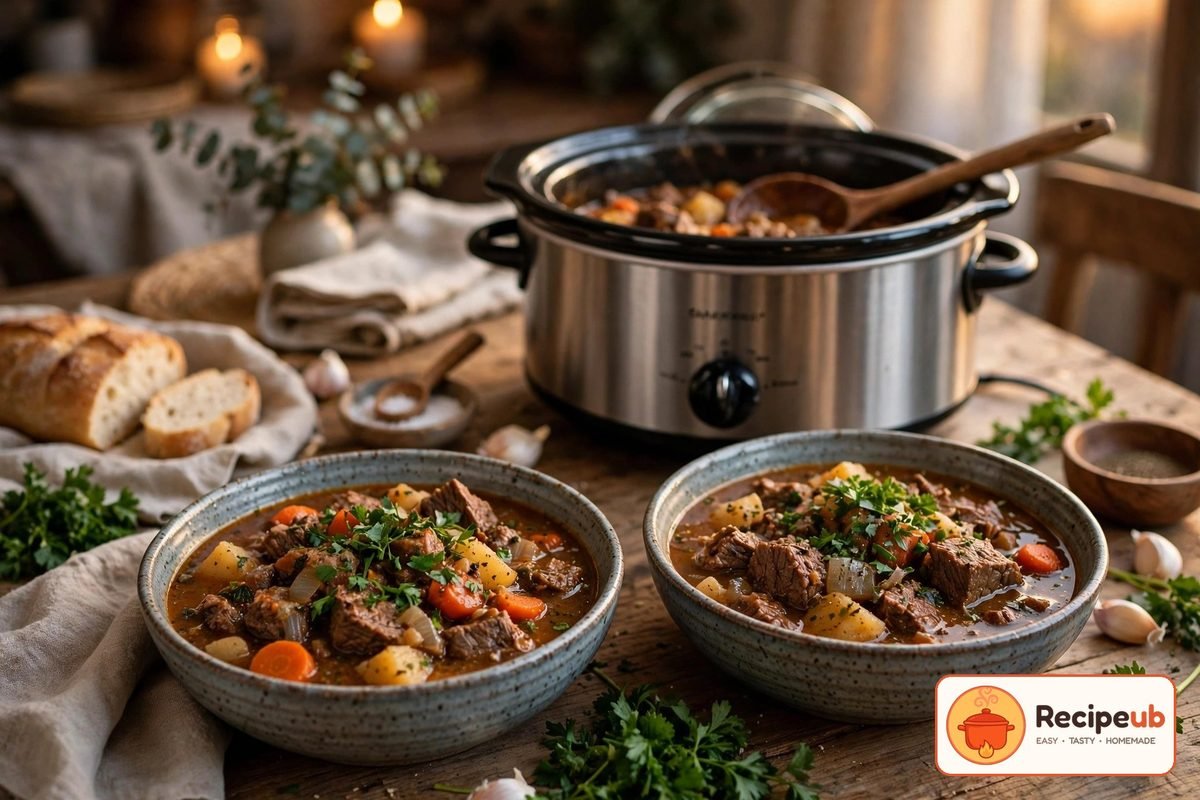
There is a specific heartbreak every slow cooker owner knows: you lift the lid after eight patient hours, the beef is perfect — and the vegetables have dissolved into baby food. The potatoes are paste, the carrots are threads, the peas are gray. Most recipes pretend this is just how crockpot beef stew goes. It is not. It is a timing problem, and timing problems have charts. This is the beef stew I make all winter: chuck cut into honest 1½-inch cubes, seared hard, and cooked 8 hours on LOW in a rich, completely no-wine gravy — with a second chart that tells you exactly when every vegetable goes in, so the potatoes hold, the mushrooms stay meaty and the peas stay green.
It is the classic, from-scratch version of the comfort my Slow Cooker Beef and Potatoes delivers on a weeknight — but where that one is a simple two-ingredient-hearted dinner, this is the full stew: a flour-coated sear, a tomato paste and Worcestershire gravy, and vegetables that still taste like themselves at hour eight. No wine, not because wine is bad, but because a Tuesday family stew should not require an open bottle, and because the depth everyone thinks comes from wine actually comes from the browned pan. I will show you.
The short answer: Beef stew takes 8 to 9 hours on LOW or 4½ to 5 hours on HIGH in a slow cooker for 1½-inch chuck cubes — this recipe cooks 8 hours on LOW. The beef is done when a cube twists apart with a fork. Potatoes and carrots go in at the start, mushrooms in the last hour, peas in the last 10 minutes — the vegetable chart below has every timing.
In This Recipe
The Plan at a Glance
- Cut: one whole chuck roast, cut at home into 1½-inch cubes
- Setting and time: LOW for 8 hours (HIGH option: 4½ to 5 hours)
- Thickening: seasoned flour on the beef from the start + a cornstarch slurry in the last 15 to 20 minutes
- Wine: none — beef broth, tomato paste, Worcestershire and the seared pan fond do the work
- Vegetable rule: hard vegetables at the start, mushrooms at the last hour, peas at the last 10 minutes
- Serves: 8 generous bowls (about 2 cups each) in a 6-quart slow cooker
Why This Recipe Works
The sear is the flavor, not a suggestion. Every stew recipe that holds a top spot on Google browns the beef, and there is a reason: flour-coated chuck, seared in batches until it has a deep brown crust, builds the fond — the caramelized layer stuck to the pan — that becomes the entire backbone of the gravy. Deglaze that pan with broth and every bit of it melts into the stew. Skip the sear and you get a pale, boiled-tasting pot no amount of seasoning rescues. Twelve minutes of browning is the whole difference, and this recipe treats it as non-negotiable.
No wine, and nothing missing. The famous wine-based stews get their depth from three things: acid, fruit sugars and the reduced pan sauce. This recipe replaces all three honestly — tomato paste cooked in the fond for a minute brings the concentrated, slightly sweet depth; Worcestershire brings the savory tang; and the fond itself, scraped up with plain beef broth, brings the roasted flavor wine is usually credited for. What you get is a dark, glossy, beefy gravy a kid, a pregnant mom and a Tuesday night can all say yes to — and one less thing to buy.
Cube size is the timing. Recipes argue about whether stew takes 7 hours or 10 because they never tell you their cube size — a 1-inch cube and a 2-inch cube are different recipes wearing the same name. This one is built on 1½-inch cubes and 8 hours on LOW, and the next section gives you the honest time for the other sizes too.
Vegetables are added in waves, not dumped. Potatoes and carrots are dense enough to need all 8 hours — cut at a full inch, they finish tender but intact. Mushrooms give up their texture after about an hour of stewing, so they go in late. Peas need almost nothing — 10 minutes in the hot stew — and the cornstarch slurry goes in at the very end, when you can finally see how much liquid you actually have to thicken. Nothing in this pot cooks longer than it should, which is exactly why nothing turns to mush.
How Long Does Beef Stew Take in the Slow Cooker?
Here is the question behind almost every search for this recipe, answered with the size logic the other recipes leave out. All times are for chuck, cooked until a cube twists apart with a fork — stew beef is done by tenderness, not by the clock alone, and fork-tender happens well past the 145°F safety minimum, in the range where the collagen has fully melted into gelatin.
| Cube Size | LOW | HIGH |
|---|---|---|
| 1-inch cubes | 7–8 hours | 4–4½ hours |
| 1½-inch cubes (this recipe) | 8–9 hours | 4½–5 hours |
| 2-inch cubes | 9–10 hours | 5–6 hours |
How to read the chart: this recipe uses the middle row — 1½-inch cubes, 8 hours on LOW — because that size gives you a substantial, steak-like bite that still finishes inside a workday-plus-prep window. Check at the early end of your row’s range: if a cube resists the fork, give it 45 minutes more and test again, because slightly undercooked stew is the tough stew everyone complains about (more on that in the FAQs). A very full cooker — a double batch, or a pot filled past three-quarters — needs an extra 30 to 60 minutes. And a warning from experience: past about 10 hours on LOW, even perfect stew starts to go stringy and the vegetables surrender, so set a timer rather than letting it ride all day and evening.
Slow Cooker Beef Stew with Potatoes and Carrots: When to Add Each Vegetable
This is the chart I wish every stew recipe printed. It assumes the recipe’s 8-hour LOW cook; if you are cooking on HIGH, add each item at the same distance from the end — mushrooms 1 hour before serving, and so on.
| Ingredient | When to Add | Why |
|---|---|---|
| Potatoes (1-inch chunks), carrots (1-inch pieces), celery, onion | At the start, under and around the beef | They need the full cook; big pieces hold their shape for all 8 hours |
| Mushrooms | Last 1 hour | They go rubbery and spongy over a full cook; 1 hour keeps them meaty |
| Cornstarch slurry (2 Tbsp cornstarch + 2 Tbsp cold water) | Last 15–20 minutes, cooker switched to HIGH | Thickens at the end, once you can see the final liquid level |
| Frozen peas | Last 10 minutes | They stay bright green; any longer and they dull and split |
| Fresh parsley | At serving | Fresh herbs die in a long cook; add them to the bowl, not the pot |
The two rules underneath the chart: cut the start vegetables big — a 1-inch chunk of potato survives 8 hours, a ½-inch dice does not — and keep the late additions genuinely late. If you will be out until serving time, the stew still works with everything in at the start except the peas and slurry; just cut the mushrooms in thick quarters and accept them softer. But on a day when you are home for the last hour, this chart is the difference between a stew and a good stew.
What This Stew Costs in 2026 — and How to Keep It Under Control
I am not going to call this a cheap stew, because in 2026 that would not be true: beef for stew averaged $8.53 a pound in the Bureau of Labor Statistics’ September 2026 retail data, and chuck roast sat at $9.19. What this recipe does is put you in control of the cost, three ways. First, buy the whole chuck roast and cut it yourself: pre-cut “stew meat” is priced at or above the roast it came from, and it is a mixed bag of cuts that finish at different times — some tender, some still chewing at hour eight. One roast, one cut, one finish time, and usually the better price per pound, especially on sale. Second, the pot stretches 2½ pounds of beef across 8 servings — the potatoes and carrots are not filler, they are half the bowl, which is how stew has always fed a crowd. Third, nothing is wasted and everything freezes: the same thrift logic behind my Slow Cooker Pulled Pork, where one affordable cut becomes dinner twice. A bowl of this stew costs less than almost any other beef dinner you can put on the table right now — that is the honest claim, and it is enough.
Ingredients
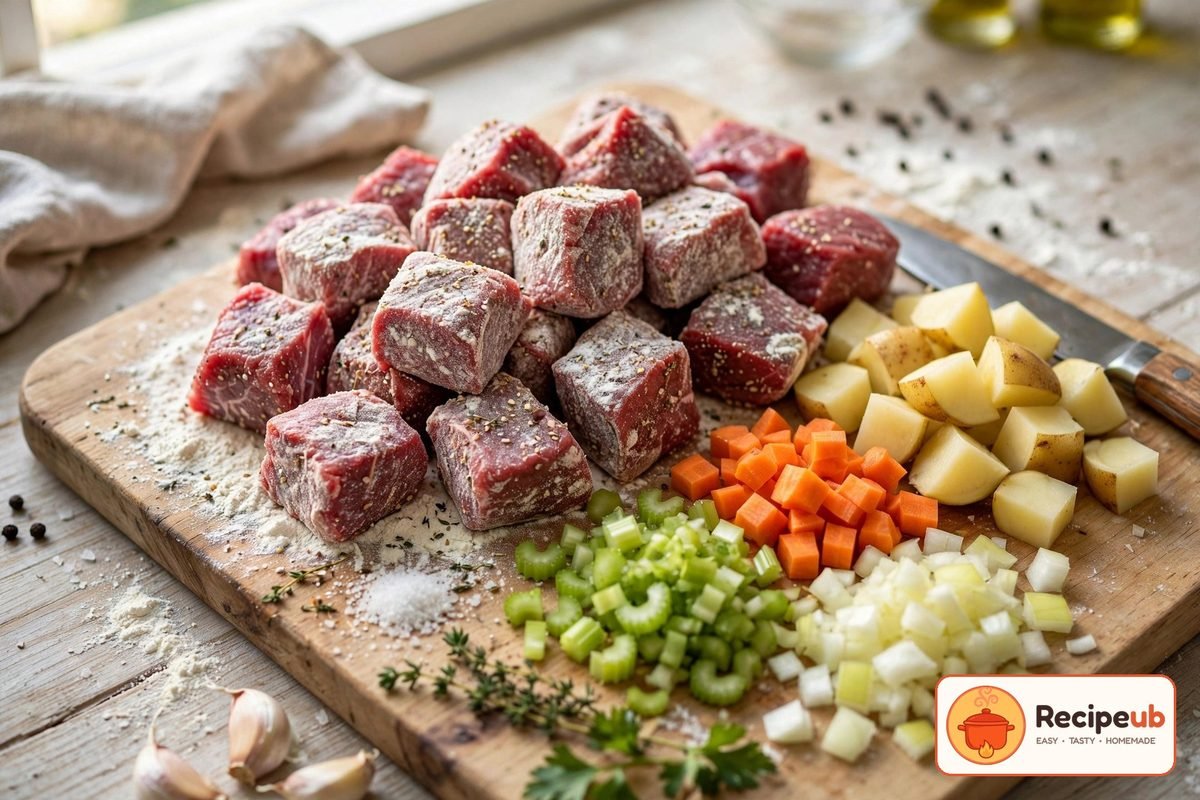
- 2½ lb chuck roast, cut into 1½-inch cubes
- ¼ cup all-purpose flour
- 1½ tsp kosher salt
- 1 tsp garlic powder
- ½ tsp black pepper
- 2 Tbsp olive oil
- 1 large yellow onion, diced
- 4 cloves garlic, minced
- 2 Tbsp tomato paste
- 3 cups beef broth
- 1 Tbsp Worcestershire sauce
- 1 tsp dried thyme
- 2 bay leaves
- 1½ lb Yukon Gold potatoes, cut into 1-inch chunks
- 1 lb carrots, cut into 1-inch pieces
- 3 celery stalks, cut into 1-inch pieces
- 8 oz mushrooms, halved (quartered if large)
- 2 Tbsp cornstarch + 2 Tbsp cold water, for the slurry
- 1 cup frozen peas
- Fresh parsley, chopped, for serving
Ingredient notes: Chuck is the cut — well-marbled, full of the collagen that melts into body over 8 hours; leaner cuts like round come out dry and stringy no matter how carefully you time them. Cut the cubes yourself and keep them at 1½ inches, because the timing chart is built on that size. Yukon Golds hold their shape better than russets in a long cook and their skins are thin enough to leave on. The flour does double duty: it helps the beef crust in the pan and it pre-thickens the gravy from the first hour. Kosher salt note: if you use fine table salt, cut it to 1 teaspoon. And the Worcestershire is not optional decoration — in a no-wine stew it is carrying real weight, so do not skip it.
How to Make Slow Cooker Beef Stew
- Cube and coat the beef. Pat the chuck cubes dry with paper towels — dry beef browns, wet beef steams. Toss them in a big bowl with the flour, salt, garlic powder and black pepper until every piece is coated.
- Sear in batches. Heat the olive oil in a large skillet over medium-high heat until it shimmers. Brown the beef in two or three batches, 2 to 3 minutes per side, until each batch has a deep brown crust. Do not crowd the pan. Move the browned beef to the slow cooker as you go, and add a splash more oil between batches if the pan looks dry.
- Build the gravy base. In the same skillet, over medium heat, cook the diced onion in the beef drippings for 3 to 4 minutes, scraping up the browned bits. Stir in the garlic and tomato paste and cook 1 minute more, until the paste darkens a shade.
- Deglaze. Pour in the beef broth and scrape the pan thoroughly — every browned speck is flavor. Stir in the Worcestershire and thyme, then take the pan off the heat.
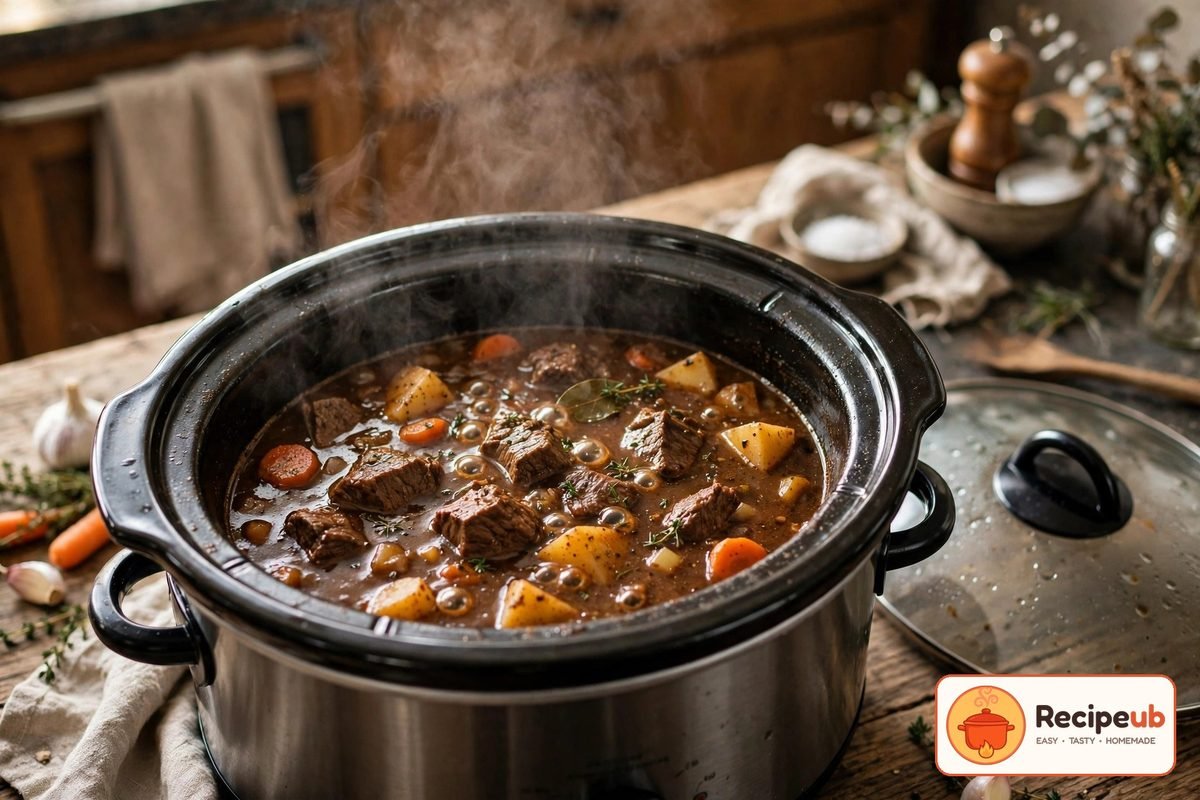
- Load the cooker in order. Put the potatoes, carrots and celery in the bottom of a 6-quart slow cooker, then the seared beef and any juices on top. Pour the hot broth mixture over everything and tuck in the bay leaves.
- Cook low and slow. Cover and cook on LOW for 8 hours. Resist lifting the lid — the cooker needs its heat. At the 7-hour mark, stir in the mushrooms.
- Thicken at the end. About 20 minutes before serving, whisk the cornstarch and cold water into a slurry, stir it into the stew, switch the cooker to HIGH and cover for 15 to 20 minutes, until the gravy turns glossy and coats a spoon.
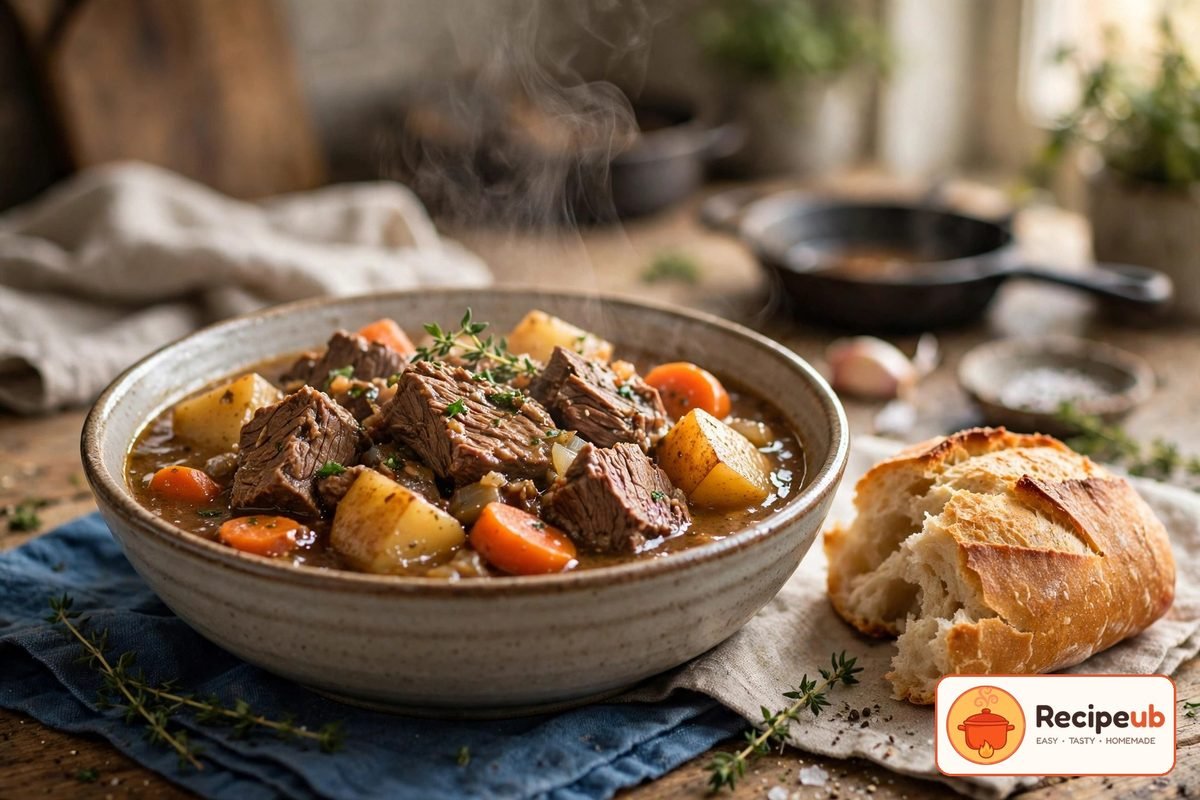
- Peas, then serve. Stir in the frozen peas for the last 10 minutes — they will be bright and just tender. Fish out the bay leaves, taste for salt, rest the stew 10 minutes off the heat, and serve in deep bowls with the parsley scattered over.
Slow Cooker Beef Stew (No Wine, Fork-Tender in 8 Hours on Low)
Ingredients
Equipment
Method
- Pat the chuck cubes dry and toss with the flour, salt, garlic powder and pepper until coated.
- Sear the beef in the olive oil in batches over medium-high heat, 2 to 3 minutes per side, until deeply browned. Transfer to a 6-quart slow cooker.
- In the same skillet, cook the onion in the drippings 3 to 4 minutes. Add the garlic and tomato paste; cook 1 minute.
- Pour in the broth, scraping up all the browned bits. Stir in the Worcestershire and thyme.
- Add the potatoes, carrots and celery to the cooker under and around the beef. Pour the broth mixture over, add the bay leaves, cover and cook on LOW for 8 hours (HIGH: 4½ to 5 hours).
- Stir in the mushrooms at the 7-hour mark (the last hour of cooking).
- Whisk the cornstarch and cold water into a slurry. Stir it in, switch to HIGH and cook 15 to 20 minutes, until the gravy is glossy and thick.
- Stir in the frozen peas for the last 10 minutes. Remove the bay leaves, rest 10 minutes, and serve with fresh parsley.
Notes
- Timing by cube size: 1-inch cubes = LOW 7–8 hours / HIGH 4–4½ hours; 1½-inch cubes (this recipe) = LOW 8–9 hours / HIGH 4½–5 hours; 2-inch cubes = LOW 9–10 hours / HIGH 5–6 hours. Done means a cube twists apart with a fork.
- Vegetable timing: potatoes, carrots, celery and onion at the start, cut at 1 inch; mushrooms in the last hour; slurry in the last 15–20 minutes; peas in the last 10 minutes; parsley at serving.
- No wine needed: the seared fond, tomato paste and Worcestershire carry the depth. Never cook past about 10 hours on LOW — the beef turns stringy and the vegetables dissolve.
Emma’s Tips for the Best Slow Cooker Beef Stew
Dry beef browns; wet beef steams. This is the whole sear secret. Pat every batch dry, give the pieces room in the pan, and do not move them until the crust lets go on its own. If the pan is crowded, the beef boils in its own juice and the fond — the flavor this entire stew is built on — never forms.
Cut the roast yourself, and cut it evenly. A package of pre-cut stew meat can hold three different cuts that finish an hour apart. One chuck roast, cut by your own knife into even 1½-inch cubes, finishes all at once — and it is usually the cheaper buy per pound besides.
If the stew is tough, it is not done. This feels backwards the first time: chewy stew beef at hour seven is almost never overcooked, it is undercooked — the collagen is still holding. Give it 45 minutes more and test again before you change anything else. It is the same patience that makes a great gravy, the way the creamy sauce in my Swedish Meatballs needs its simmer time to come together.
Thicken at the end, not the beginning. A stew thickened at hour zero can scorch at the edges and still end up thin, because you cannot know the final liquid level until the beef and vegetables have given up their juices. The flour coat gives the gravy a head start; the slurry at the end gives you control. Always whisk cornstarch into cold water first — straight into the hot stew, it seizes into lumps.
Stew is better on day two. The flavors marry overnight in a way no same-day stew matches. If you are cooking for guests, make it the day before, chill it whole, and reheat it gently — you will look like a genius for doing less work on the day.
Storage and Reheating
Fridge: Cool the stew, then refrigerate in airtight containers for up to 4 days. It will thicken as it chills — that is the gelatin doing its job, and it loosens again as it warms.
Reheating: Warm it gently on the stove over medium-low heat, stirring now and then, until it is steaming throughout — about 15 minutes for a family-size portion. Add a splash of broth or water if it has thickened more than you like. The microwave works for single bowls; stir halfway so it heats evenly.
Freezing: Beef stew freezes beautifully for up to 3 months, in portion-size containers with a little headspace. One honest note: potatoes soften a touch after freezing — still good, just softer. If you are cooking a batch for the freezer, you can leave the potatoes slightly firm at the end of the cook. Thaw overnight in the fridge and reheat as above. Like my Slow Cooker Ham and Potato Soup, this is one of those winter pots that makes a busy February night feel handled weeks in advance.
FAQs
How long does beef stew take in the slow cooker?
For this recipe — 1½-inch chuck cubes — it is 8 to 9 hours on LOW or 4½ to 5 hours on HIGH, and the card time is 8 hours on LOW. Smaller 1-inch cubes take 7 to 8 hours on LOW; big 2-inch cubes take 9 to 10. The clock is a guide, not the finish line: the beef is done when a cube twists apart with a fork. The full cube-size chart is in the timing section above.
Do you have to brown the beef before slow cooking?
No — the stew will cook safely and taste fine without it. But “fine” is doing a lot of work in that sentence. Browning the flour-coated beef builds the fond that flavors the entire gravy, and in a no-wine stew there is nothing else to hide behind. Twelve minutes at the stove is the difference between a good stew and the one people ask you to make again, so in this kitchen the sear is not optional.
Can you put raw beef in the slow cooker?
Yes, safely — a slow cooker brings thawed raw beef up to a full cook without any food-safety issue. What you give up is flavor and color: unseared beef releases more liquid, stays gray at the edges and makes a flatter gravy. If a day truly has no 12 minutes in it, coat the raw cubes in the seasoned flour anyway and add 30 minutes to the cook — just know the seared version is the one this page is proud of.
Why is my slow cooker beef stew tough?
Almost always because it is undercooked, not overcooked. Chuck is full of collagen, and collagen melts slowly: at the point where the meat first becomes safe and sliceable, it is still tough. It needs the full cook — for 1½-inch cubes, the full 8 hours on LOW — before the collagen gives way and the meat turns fork-tender. If your stew is chewy, close the lid, give it 45 to 60 minutes more, and test again before you judge it.
What is the best cut of beef for slow cooker stew?
A whole chuck roast that you cube yourself. Chuck has the marbling and collagen a long cook rewards, it is one consistent cut so every cube finishes at the same time, and the whole roast is usually a better price per pound than pre-cut stew meat — in the Bureau of Labor Statistics’ September 2026 data, stew beef averaged $8.53 a pound while the roast it comes from regularly sells for less on sale. Avoid lean cuts like round; without collagen, they dry out and turn stringy over 8 hours.
How do you thicken beef stew in the slow cooker?
Two stages. The seasoned flour coating the beef thickens the gravy gently from the start, and a cornstarch slurry — 2 tablespoons of cornstarch whisked into 2 tablespoons of cold water — stirred in for the last 15 to 20 minutes on HIGH finishes it glossy and spoon-coating. If your stew is ever still thinner than you like at serving time, simmer it with the lid off for the last stretch, or mash a few of the potato chunks against the side of the pot and stir them in.
Can you overcook beef stew in a slow cooker?
Yes. A slow cooker is forgiving, but it is not magic: past about 10 hours on LOW, the beef that was fork-tender at hour eight starts to shred into dry strings, and the potatoes and carrots dissolve into the gravy. If your schedule runs long, use the HIGH setting for 4½ to 5 hours instead, or let the cooker switch to Warm after the cook finishes rather than stretching the LOW cook itself.
Can I make beef stew without wine?
Yes — this recipe is built that way on purpose. Wine’s job in a stew is depth and a little acidity, and both are covered here: the seared pan fond and tomato paste bring the deep, roasted flavor, and Worcestershire sauce brings the tang. Use a good beef broth, do not skip the sear, and you will not miss the wine — nobody at my table ever has, including the people who order the wine version in restaurants.
How long does leftover beef stew keep?
Up to 4 days in the fridge in an airtight container, and up to 3 months in the freezer in portion-size containers. Leftover stew genuinely improves on day two, as the flavors settle into each other — plan for leftovers when you make it. Reheat gently on the stove with a splash of broth if it has thickened in the chill.
Final Thoughts
Beef stew is the oldest winter recipe there is, and it does not need reinventing — it needs its two real problems solved. This version solves them plainly: no wine, because the sear was doing the heavy lifting all along, and a chart for the vegetables, because mush was never a flavor anyone chose. Cut the chuck at 1½ inches, give it its 8 quiet hours, and add things when the chart says to add them. What comes out is the stew that tastes like somebody’s grandmother is still supervising — dark, thick, tender, and with every vegetable still itself.
More Easy Slow Cooker Dinners
If this pot earns a place in your winter rotation, the rest of the slow cooker shelf is built the same honest way. My Slow Cooker Beef Chili takes the same chuck-and-patience logic in a spicier direction, thick and three-bean hearty. On the nights when only a bowl of soup will do, the Slow Cooker Chicken Noodle Soup is the from-scratch classic my family asks for the moment anyone sniffles. And when beef prices bite hardest, the Slow Cooker Beef and Potatoes stretches the same flavors into the simplest dump-and-go dinner on the site — proof that the cooker, a good cut and a little patience can carry a whole season.





Never Run Out of Dinner Ideas
One easy air fryer or slow cooker dinner in your inbox every week. No spam, ever.
You’re on the list — welcome to Recipeub!