Behind the French Menu: Dining in Normandy.

from
Behind the French Menu
by
Bryan G. Newman
behindthefrenchmenu@gmail.com

Normandy in France.
Map courtesy of OnTheWorldM

Enjoying French cuisine on its home ground is a
significant reason for visiting France; another reason is to see places of
unique interest or great art and architecture that cannot be found elsewhere.
Normandy can satisfy both pursuits and many others.
Apart from great food, castles, art, and
architecture, Normandy is blessed with 640 km (398 miles) of coastline,
providing wonderful sandy beaches. There are also many inland rivers, canals,
and lakes, including the River Seine that flows through Paris and into the
Atlantic near Honfleur in Normandy.
Normandy also has a great deal of European
history, most importantly connecting Normandy to the English throne. In 1066
Guillaume, a Norman-French Duke, William in English, a descendant of a Viking
King, conquered England. William was crowned King of England and is a direct
relative to the present Queen Elizabeth II. William, better known as William the
conqueror, was crowned in Westminster Abbey like all his descendants through to the reigning queen. William the conqueror’s granting land to his Norman Barons had
a significant effect on the English kitchen, with many French food names becoming part
of the English language. Below are just a few examples:
French – English
Bacon – Bacon
Bœuf – Beef
Jambon – Ham
Mouton – Mutton
Porc – Pork
Poulet – Pullet or chicken
Saucisse- Sausage
Documents, mostly
in Latin, called the Vikings ‘Nortmanni,’ which means “men of the
North”. Nor-man-di means the Northman’s land and so that part of France became Normandie, in English Normandy.
Traditional dishes on the menu in Normandy:
Pommeau
de Normandie AOP – This traditional Norman apéritif is a light 16 -18% alcohol made
with apple juice and a young Calvados, apple brandy. Pommeaus are drunk cold
and made in much the same way as Pineaux
de Charente in Cognac
country and
Floc de Gascogne in Armagnac
country.
L’Andouillette d’Alençon Grillée à
la Crème de Camembert – Andouillette
Alençon sausages grilled
and served with a cream of Camembert
cheese sauce.
Andouillettes are mostly made with the intestines and tripe of pigs but the
Alençon Andouillette Alençon comes from calves’ intestines and tripe. The
sausage casing used is entirely natural, so the final sausage has no fixed
diameter. Along with all the tubing comes salt, pepper, spices, and a strong
smell. Andouillettes are on many menus, but visitors should know that they are
an acquired taste.

An andouillette served in a Camembert sauce.
Photograph
courtesy of Kent Wang
https://www.flickr.com/photos/kentwang/20545992021/

Gigot de Pré-salé du Mont-Saint-Michel Rôti
au Romarin – Roasted leg
of lamb with rosemary from the lambs
raised on the salt meadows close to the island of Mont-Saint-Michel on the Atlantic
coast and the border between Normandy and Brittany. These lambs are raised on
the salt meadows; some are salt marshes on France’s Atlantic coast. Pré-salé
lambs go to market when they are 5-9 months old, and before then, they will
have been raised by their mothers for at least 60-90 days, and when weaned,
they will spend at least another 75 days grazing in the salt meadows on
France’s Atlantic shores. The sea air and the sea salt flavor the grasses on
which the lambs feed; that creates a uniquely tasting lamb without even the
slightest trace of salt. Remember that the French prefer their lamb pink, rosé
and unlike steaks, you will not usually be asked
how you like your lamb. So advise your waiter if you prefer your lamb well done.

The Pré-salé lambs near
Mont-Saint-Michel
Photograph
courtesy of Côte à l’Os

Filet
Mignon au Camembert
de Normandie au Lait Cru – A
pork filet mignon prepared
with Normandy’s famous cheese, the Camembert
de Normandie AOP
is made with unpasteurized cow’s milk. This menu offering is a perfect example
of what a Filet Mignon really means. While in the USA, a Filet Mignon indicates
a thick cut from a beef filet, the tenderloin, In France, a beef filet mignon
is the thin end part of the tenderloin. However, on a French menu, when beef is
not noted, Filet Mignon is whole pork tenderloin, the pork filet as it is on
this menu listing. The Camembert will have been prepared and melted with crème
fraiche,
and Normandy’s
Pommeau with
the slices of the pork filet mignon will be served on top of the melted
cheese.
Escalope
de Veau IGP
à la Normande –
A Label Rouge IGP veal
scallop prepared
with button
mushrooms, dry
cider,
and créme
fraîche.
Some variations may use Calvados, Normandy’s famous apple
brandy, instead of Cider. France produces some of the country’s best veal, and
this is its signature dish made with the best veal that Normandy offers. It’s
not surprising that Normandy has excellent veal. With so much milk, butter, and
cream coming from Normandy’s cows, there is a surfeit of young males who will
not grow up to provide milk.
Crème fraiche has a creamy texture, and
while it is not like sour cream or yogurt, neither is it a sweet cream. Crème fraîche
is a pasteurized and naturally thickened cow’s milk, with most offerings having
30% or more fat. The unique taste of crème fraiche comes from the added milk
bacteria. There is no English translation for crème fraîche; it is a uniquely
French creation, so crème fraiche it remains in English. Button mushrooms were
the first mushrooms to be successfully farmed in any quantity, and that
happened in Paris; hence the French name: Champignons
de Paris. (A veal escalope is lean veal that has been to
flattened both to increase the surface size and to tenderize the meat).

A veal escalope
Photograph
courtesy of Images Alight
https://www.flickr.com/photos/alan-light/5765780914/

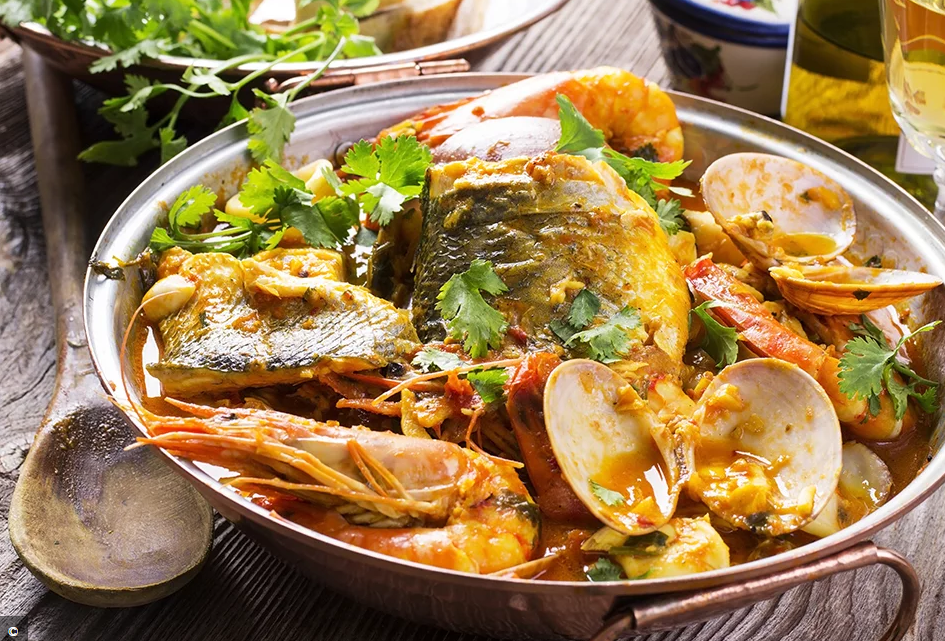
Marmite Dieppoise – Marmite in the manner of
the port and fishing center of Dieppe on the Atlantic coast of Normandy. The
name marmite is a traditional name for
saltwater and seafood soups and stews and has nothing to do with the much-loved
British vegetarian paste called Marmite. The Marmite Dieppoise is a stew, and
since this is a saltwater fish stew and Dieppe is also an open sea fishing
port, the fish available may change daily. The fish may include turbot, sole, mackerel, and red
mullet,
with the seafood including some of Normandy’s plentiful shrimps and mussels. Essential to the
flavor is Norman cider, with vegetables, onions, celery, leeks, parsley, thyme, chervil, bay
leaves,
and garlic. Petit marmites are
smaller cooking pots and are often used for serving the soups or stews they
contain.

Marmite Dieppoise
Photograph courtesy of Marie Claire
Poulet de la Vallée d’Auge – Chicken in the manner of the Auge
Valley is one of Normandy’s most popular chicken dishes and includes
apples, button
mushrooms,
fresh cream, dry
cider, and Calvados. While not noted on this menu
listing Normany has its own Label Rouge, red label, chickens the Poulet Fermier
Normand, IGP, which is farmed in the Vallée d’Auge. The whole of the Vallée
d’Auge is famed for its agriculture, its dairy produce, and it’s also the home
of Camembert cheese as well as its apples, and of course, its Cidre de Pays
d’Auge AOP and Calvados. The Vallée d’Auge includes most of the departments of
Calvados and Orne and a corner of the department of Eure.
Moules
Frites à
la Normande – Mussels
and French fries in
the Norman manner. The broth for this dish will include créme
fraîche, dry
cider,
apples and shallots.

Moules Frites à la Normande
Photograph
courtesy of Yummy foods by Nancy.

Trou
Normand – The
custom of the Trou Normand Calvados offered during the meal.
Calvados is usually served as a digestif replacing Cognac or Armagnac. However, the Trou Normand is
taken as a shot of Calvados, particularly following seafood dishes, to prevent
indigestion. The True Normand is now seen on menus when served as a
Calvados sorbet; the sorbet version is supposed
to awaken the digestive juices.
Sole à la Normande – Filets of lemon
sole in
the manner of Normandy, with pink
shrimps (the common prawn), button
mushrooms,
fresh cream, white wine, shallots, and dill; a few locally farmed mussels may be added. You may be
surprised to see wine in this Norman dish, and while Normandy is not famous for
its wine, there are some excellent white Norman wines, and I have seen a local
pinot noir red on a wine list.
Fish and seafood will overflow from the
tables in Normandy with Dover
Sole,
often on the menu as Sole Français, lemon
sole, sea
bream, European
sea bass, mackerel, sea
trout,
and more. On local menus, the shellfish include the langouste, the clawless spiny lobster
or rock lobster, the owner of the lobster tail, shrimp, king
scallops, homard, the European two-clawed
lobster, and more. Local sea farms produce oysters and mussels, and freshwater farms
rainbow trout. Normandy contains a vast
network of streams, ponds, canals, lakes, and marshlands that are home to pike, zander
or pike-perch, freshwater
perch, European
eels,
and much more.
Boudin
Noir à
la Normande – Black
pudding in
the manner of Normandy served with Normandy’s apples. French boudins noir are
usually smaller than the black pudding sausages in the UK, with the most
popular just large enough for an individual serving. In France, a boudin noir
will often be served with a variety of apple preparations which are the
traditional French accompaniment. If you like black puddings, then visit the
town of Mortagne-au-Perche, in Normandy. You will begin to realize that the
boudin noir is not a sausage for the French, British, and the Irish alone; this
is a sausage of importance to all humanity. In the spring, usually on the third
Friday, Saturday, and Sunday in March, sausage lovers come to the
Mortagne-au-Perche sausage fair from all over the world. The fair is for
all sausage
lovers though
the competition is only open to those who produce the black pudding sausages.
The Tourist
Information Office for Mortagne-au-Perche will supply information on
the following year’s fair a few months before.

Boudin Noir à la Normande
Photograph
courtesy of La Radio du Goût

Tarte
Normande –
A Norman apple tart with a Pâte Sablée, a sweet crust pastry Pâte Sablée has
the same ingredients as pâte sucrée, but the butter is creamed with the sugar
and the eggs before the flour is folded in. This method mixes the butter more
evenly, making the dough less puffy and creating a less crumbly texture.
Normandy has tens of different apples for its ciders. Every different cider and
every Calvados has its favorite combination of apples. One of those apples may
in this apple tart, but the
Granny Smith apple is
one of France’s favorites where apple tarts or pies are concerned.

Tarte Normande
Photograph
courtesy of Merle ja Joonas
https://www.flickr.com/photos/merlejajoonas/7463109160/

Cheese from Normandy
While France’s most famous cheese
is Camembert, only a tiny part of the Camembert produced in Normandy can be
labeled Camembert de Normandie AOP. However, most locally produced Camemberts
are better than the copies made in other countries. Also from Normandy comes
three other famous AOP cheeses, Livarot
AOP,
Pont-l’Évêque AOP, and Neufchâtel
AOP.
These cheeses and many others come from milk provided by the descendants of the
cows that William’s Viking ancestors brought with them.

Maturing
Livarot cheese
Photograph courtesy of Debbi
Baron
https://www.flickr.com/photos/131579145@N07/16445271767/

Butter and Crème Fraîche In Normandy
One of France’s top three butters
comes from Normandy, the Beurre
d’Isigny AOP.
Also France’s only Crème Fraîche with an AOP also comes from Normandy,
the Crème
Fraîche d’Isigny AOP.
Even without an AOP, butter, cream, or Crème Fraîche from Normandy always
carries a premium. The consumers know that the Norman cows, the descendants of
those brought by the original Viking settlers, and the fabulous grasses produce
many of the best milk products in France. With Norman milk so highly rated,
it’s not surprising that 15% of the milk bears the AB sign for
Agriculture-Biologique, Organic Farming.

Beurre
d’Isigny AOP
Photograph
courtesy of Carrefour

Cider and Perry
Cidre de Pays d’Auge – One of France’s two apple
ciders that hold an AOP. In Normandy and Brittany, the local sparkling ciders
are served in bottles similar to those used for champagne. While Normandy does
have a small number of vineyards sparkling cider often replaces Champagne, Crémant, or another sparkling wine at
celebrations. Drive through the Norman Route du Cidre, their cider road, a
drive of approximately 40 km (25 miles); that will take you through many
beautiful villages, with plenty of restaurants along the way. Cambremer in the department of
Calvados is the largest village on the route and has a Fête
des AOP de Normandie usually
at the end of April and beginning of May. The fete celebrates all of Normandy’s
ciders, Calvados, and Pommeau and its wonderful butter, cheeses, and crème
fraiche.
Cidre de Poiré and Poiré Domfront
AOP –
Pear ciders or perries. The best of these is the Poiré Domfront AOP that comes
from the area around the small and attractive town of Domfront, in the
department of Orne is very close to Brittany. Domfront is in the western part
of the Park
Naturel Normandie-Maine, the Normandie-Maine Regional Nature Park.

Cidre
de Pays d’Auge
Photograph
courtesy of Pierre Huit

Calvados
Calvados AOP – The most famous apple
brandy in the world, and it comes from Normandy in three varieties. Calvados AOP – Holds 70% of the market and
comes from apples grown all over Normandy.
Calvados Pays d’Auge AOP – This is made in the old
Normandy region of Pays d’Auge that includes parts of the departments of
Calvados, Orne, and Eure. Calvados Pays d’Auge is the only Calvados that must
be double-distilled.
Calvados Domfrontais AOP – This is the third Calvados and
is the last one to be awarded an AOP. This Calvados has a unique and
distinctive taste being an apple brandy made with at least 30% pear cider, a
perry. The pear eau-de-vie provides a very different taste. Calvados
Domfrontais is mainly produced in Orne, Manche, and Mayenne. Even the youngest
Domfrontais is aged for a minimum of three years in oak barrels.

Calvados
Pays d’Auge AOP
Photograph
courtesy of Famille Dupont

The
age on the bottle indicates the age when the apples were picked. The brandy
would not have been in the barrel for much more than twenty years at the most,
usually less. After maturing in the barrel the Calvados will be bottled and
like Cognac and Armagnac does not mature in the bottle
The ages of Calvados on the labels.
Fine – Fine Calvados, Trois
Étoiles – Three Stars ***, and Trois Pommes, the pictures of three apples – These indicate the
youngest Calvados in a blend. They will have been matured for at least two
years in oak barrels.
Vieux, Old, or Réserve, Reserved – These names on the label
indicate brandies that have been barrel-aged for at least three years.
V.O. Very Old,
Vieille Réserve, Old Réserve, V.S.O.P. Very Superior Old Pale – These
brandies will have been barrel aged for at least four years.
Extra, Napoléon, XO, Extra Old,
Hors d’Age, To old to determine or Age Inconnu, Age unknown – These Calvadoses are at
least six years old but are often sold with descriptions that indicate they are
older. There is no official standard for Calvados over six years old. Markings
that suggest they are 20 years old etc. have no legal meaning. The producer’s
interest in protecting their reputation is considered enough of a guarantee.
Four of the many many places to visit in Normandy.
Monet’s Garden in Giverny – Giverny is famous for the home
and garden of Monet, the painter. Claude Monet was one of the founders of the
impressionist movement. Monet was born in Normandy in the town of Le Havre on
the Atlantic coast in the department of Seine-Maritime. Giverny is just 50
minutes from Paris, but for the visitor, it is a world away; it is in
Normandie, in the department of Eure.

A path in Monet’s garden
Photograph courtesy of Tom
Hilton
https://www.flickr.com/photos/tomhilton/19269996201

The Bayeux Tapestry – Preserved and displayed
in the museum in the town of Bayeux, a medieval town in the
department of Calvados, The tapestry, really an embroidery 70 meters (230′)
long, represents figures and pictures showing William the Conqueror’s conquest
of England .’The Bayeux Tapestry was probably commissioned in the 1070s by
Bishop Odo of Bayeux, half-brother of William the Conqueror.
Every year, on the first weekend
in July, the Bayeux Medieval Festival is a landmark event in the town. Bayeux
was miraculously spared by bombing in June 1944. It was the first city in
mainland France to be liberated and home to the largest British war cemetery
from WWII in Normandy.
Le
Palais Bénédictine, the Benedictine Palace – Le Palais Bénédictine is not
the home of royalty, it is the factory that produces the Bénédictine D.O.M.
liqueur, a sweet, orange, and honey flavored, 40% proof liqueur. It is named
after the Bénédictine monks who purportedly created it. This liqueur is only
made in the pretty Atlantic coastal town of Fecamp in the department of
Seine-Maritime in Normandy, France. That palace looks more like a freaked-out
French version of Hogwarts School of Witchcraft and Wizardry than a palace.
Nevertheless, here Bénédictine D.O.M is made and it makes an interesting place to visit.
Rouen and its Cathédrale Notre-Dame – Rouen, the Norman-French city,
dates back to the Gauls. Rouen is set on the River Seine and is the capital of
Normandy. Rouen would become important to the Romans as an inland port from the
Atlantic connecting to Paris, originally a village called Lutetia. After
the Romans came the Vikings, and it was that group of Vikings who metamorphosed
into the Norman-French over hundreds of years. Ever since Rouen became the
Norman French capital in the 11th Century, Rouen has always been the
Prefecture, the regional capital.
The inhabitants of Rouen call themselves Rouennais,
and your menu will offer dishes á la Rouennais; in the manner of Rouen. Dishes
á la Rouennais are not a unified cooking style but rather the local version of
a particular dish; Rouen is the capital of Normandie, so it is Norman cuisine
that most restaurants will be serving. During the 100 years of war between
England and France, Rouen was claimed for England by King Henry V, and later it
was here that Joan of Arc was burned at the stake in 1431. Rouen once again
became part of France in 1449 when the English were expelled.
Rouen is famous for its Gothic Cathedral; the main structure
was built in the 13th century, but the building was not completed until the
18th century. It is considered one of France’s most significant examples of
Gothic architecture. Now wholly reconstructed from WWII’s damage and renowned
for Claude Monet’s impressionist paintings of the cathedral. Monet, over two
years from 1892, made over 30 paintings that show the cathedral at the very
time of day and in every season. When I visited Rouen, there was only one of
those paintings on show in the City’s museum, though there were at least a
number of reproductions of the others.
Rouen is not just a Cathedral and a place to enjoy
Norman cuisine. Rouen is the cultural center of Haute Normandie and had its own
opera house in the 18th century; that opera house was destroyed in WWII, and a
new Théâtre des Arts opened in 1962, the permanent home of L’Opéra de Rouen,
Haute Normandie.
Rouen is also an industrial city with a very active
inland seaport set on the River Seine; it is set nearly midway between Paris
and the sea. The port is called Rotomagus, the name the Romans gave to the
city.
A Famous Recipe that may not be on your menu today.
Canard de Rouen – The Rouen duckling will be
part of many menus though its most famous recipe Canard à la Pressé or Canard à
la Rouennaise is too expensive to be on many modern menus. The Canard de Rouen
is a farm-raised cross with the mallard duck that, together with the recipe,
originated in the capital of Normandy, the city of Rouen. To read more about
Canard à la Pressé click
here.
A famous chefs from Normandy’s history
Guillaume Tirel, best known as
Taillevent (1310-1395) – The first cook to be officially appointed Chef to a King
of France. Taillevent served the French King Charles V
and later his son King Charles VI. Taillevent was born in the town of
Pont-Audemer, now part of the department of Eure in Normandy. He is accepted as
the author of the first published French cookbook, Le Viander. The book was
published about 100 years after his death in various versions, and some of the
contributions are disputed. From time to time, reprints, including English
translations, are still being printed; the last English reprint I saw was
published in 2002. A copy of the original book may also be downloaded free of
charge via Project
Gutenberg.
—————————–
Searching for the meaning of words, names or phrases
on
a French menu?
Just add the word, words, or phrase that you are searching for to
the words “Behind the French Menu” (best when including the inverted
commas), and search with Google. Behind the French Menu’s links, include
hundreds of words, names, and phrases that are seen on French menus. There are nearly
50 posts that include over 4,000 French dishes with English translations
and explanations.
————-
Behind the French Menu
by
Bryan G. Newman
behindthefrenchmenu@gmail.com
Copyright 2010, 2022, 2023.
——————–
Connected
Posts:
Agneau
de Pré- Salé -The unique lambs raised on the salt meadows along France’s
Atlantic coast. Ordering Lamb in FranceAil
– Garlic. Garlic in French Cuisine.Aneth
– Dill. The spice with a very light aniseed flavor and a favorite in the French
kitchen.Anguille,
Anguille d’Europe – the European Freshwater Eel in French Cuisine.Andouillettes.
The Sausages of France IArmagnac
one of France’s two fabulous AOP grape brandies.Bar
or Loup – European Sea Bass. Bar on French Menus. European Sea Bass in French
Cuisine.Beurre
– Butter. Butter in French Cuisine.Boudin
– A Sausage. The Boudin Blanc and the Boudin Noir; Pork Sausages and Black
Puddings. The Sausages of France II.Brochet
– Pike, the Fish. Pike in French CuisineCalvados
– The Most Famous Apple Brandy in the World. Calvados on French Menus.Camembert
Cheese; France’s most Famous Cow’s Milk Cheese.Canard
– Duck. Duck on French Menus.Céleri
– Celery. The Joys of Celery in French Cuisine.Cerfeuil
– Chervil, the Herb, in French Cuisine.Champagne
the Most Famous Sparkling Wine in the World. Reading the Label and Choosing
Your Sweetness Preferences.Champignons
on French Menus. The Champignon de Paris, the Button Mushroom in French
Cuisine. The Mushrooms of France I.Cidre
– Cider in France. France’s Fabulous Ciders, Sparkling Ciders and Basque Cider.Cognac
the Town, and Visiting Cognac and Tasting the Product. Cognac IV.Coquilles
Saint-Jacques and the Vanneaux or Pétoncle. The King Scallop and the Queen
Scallop in French Cuisine.Cremants
Are the Best Value in French Sparkling Wines.Crème
Fraîche – Creme Fraiche. What is Crème Fraîche? Crème Fraîche on French Menus.Crevettes
and Gambas – Shrimps and Prawns. SM., the Liqueur, and its Amazing Factory Benedictine in Fecamp, Normandy.Escalope
de Veau or Paillard de Veau. Veal in France II – A Veal Cutlet, Escalope,
Escallop or Scallop.Échalotes
– Shallots. Shallots on French Menus. Shallots are One of the Most Important
Herbs in the French KitchenFeuille
de Laurier – The Bay Leaf, the Laurel Leaf and the Bay Leaf in French Cuisine.Filet
Mignon on French Menus and Filet de Bœuf in French Cuisine.Gigot,
Gibelotte, Gigolette, Gigotin and Gigue on French Menus and in French Cuisine.Homard
– Lobster. The Two-Clawed European Lobster. Lobster in French Cuisine.Huitres.
Oysters in France 1. Ordering, Eating, and Enjoying Oysters. Huitres on French
Menus.Livarot
AOC/AOP – Livarot Cheese. Livarot is One of France’s Tastiest
“Aromatic” Cheeses. Livarot in French French Cuisine.Langouste.
Lobster Tails and the Tails’ Owner, the Rock Lobster, Spiny Lobster or
Crawfish. Langouste on French menus.Marmite
– Marmite on French menus. In France, a Marmite is Usually, but not Always, a
French Fish Soup or Stew.Maquereau
– Mackerel. Mackerel in French Cuisine.Moules
– Mussels. Moules Frites and Much More. Mussels on French Menus.Neufchâtel
(Neufchatel) Fromage AOP. The Coeur de Neufchâtel, the heart-shaped Neufchâtel
cheese.Oignon
or Ognon – An Onion. Onions on French menus. France’s most famous onions and
their history.Ordering
a Steak in France, Cooked the Way you Like it.Pageot
or Pagre, the fish. Sea Bream on French Menus.Perche,
Perche Commune. Perch: Fresh Water Perch. Freshwater Perch in French Cuisine.Persil
– Parsley. Parsley in French Cuisine.Pineau
des Charentes; the Aperitif of France’s Cognac Region. Cognac III.Poireaux
– Leeks. The Leek in French Cuisine.Pommes
Granny Smith – Granny Smith apples. Granny Smith Apples on French Menus.Poulet,
Poularde, Poule, Pousin – Chicken. Chicken in French Cuisine.Romarin
– Rosemary. Rosemary the Herb in French cuisine.Rouget
Barbet and Rougets de Roche, Red Mullet and Striped Red Mullet, the Fish on
French Menus.Sandre
– Zander in the USA and Pike Perch in the UK. Sandre in French CuisineSausages,
an Important Part of French Cuisine.. A Short Introduction to France’s World of
Sausages. The Sausages of France III.Sole
Française – Dover Sole in French Cuisine.Sole
Limande – Lemon Sole on French Menus .Sorbet
– Sorbet. Sorbets on French Menus.The
French Connection and The English Kitchen .Thyme
in France. Thym, Serpolet, Farigoule and Thym Citron, Lemon Thyme in France.Truite
– Trout, the Fish. Trout in French Cuisine.Turbot
– Turbot. Turbot, the fish on French Menus.




Post Comment